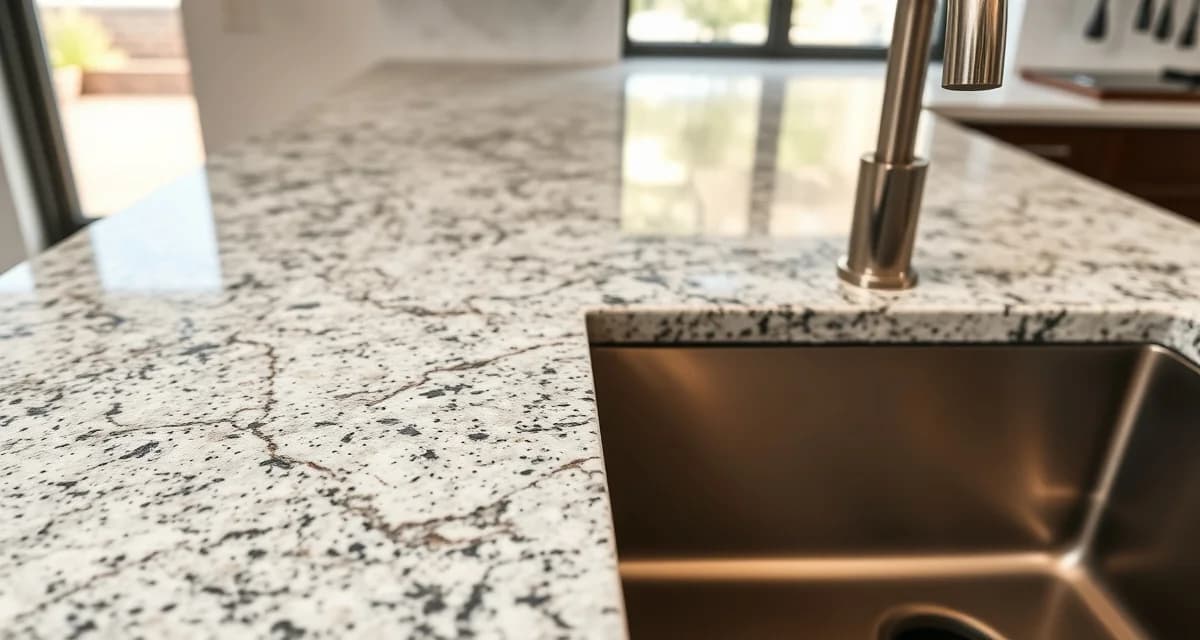
How to Hide a Countertop Seam
Hiding a countertop seam depends on three factors: placement (where the seam falls), fabrication quality (how precisely the edges meet), and material choice (some stones hide seams better than others). The best seams are placed at natural transition points (behind the sink, at inside corners, or where the countertop changes direction), cut with CNC precision to within 1/32", and bonded with color-matched epoxy. A well-executed seam is nearly invisible from standing height (3-4 feet away).
TL;DR
- Strategic placement at natural break points (behind faucets, at corners) makes seams least visible
- CNC-cut seam edges match to within 1/32" for the tightest possible joint
- Color-matched epoxy fills the seam line and blends with the stone color
- Busy, veined stones hide seams better than solid-color materials
- Seam width should be 1/16" or less for a professional result
- Seam location should be agreed upon with your fabricator before cutting begins
- L-shaped countertops always need at least one seam (at the corner or along a run)
Why Countertops Need Seams
Most kitchens require at least one seam because:
Calculate your material waste savings
See exactly how much slab material and money you could save with optimized cutting layouts.
Try the free Waste CalculatorSlab size limitations: A standard slab measures about 55" x 120" (roughly 4.5' x 10'). Any countertop run longer than 10 feet needs a seam. L-shaped and U-shaped kitchens always need seams where the countertop changes direction.
Transport limitations: Even if a slab is large enough, the fabricated piece must fit through doorways, up staircases, and around corners. Most installers cap single-piece dimensions at roughly 8-10 feet.
Weight considerations: A 10-foot granite countertop piece at 25.5" depth weighs approximately 300-350 pounds. Longer pieces become difficult to maneuver without risking breakage.
Structural requirements: Very long unsupported spans can flex and crack. Seams allow structural breaks at supported points.
Best Seam Placement Strategies
| Placement Location | Visibility | Why It Works |
|---|---|---|
| Behind the faucet/sink centerline | Very low | Faucet and sink accessories cover the seam visually |
| At an inside corner (L-shape) | Low | The eye expects a break at direction changes |
| At a cooktop or range cutout edge | Low | The appliance draws attention away from the seam |
| Along a dark vein or color transition | Low | The natural pattern disguises the seam line |
| Center of a long straight run | Medium-high | Nothing distracts from the visible seam |
| On the island centerline | Medium | Works if vein pattern is matched well |
| Near the front edge of the counter | High | Most visible location; avoid if possible |
Rule of thumb: Place seams where the eye naturally expects a break or where fixtures create visual distraction. Avoid seams in the middle of open, visible stretches.
L-Shaped Kitchen Seams
An L-shaped kitchen requires a seam at or near the corner. Two approaches:
Diagonal seam at the corner (45-degree miter): The seam runs at a 45-degree angle through the inside corner. This creates a clean, symmetrical joint but wastes more material and is harder to execute precisely.
Straight seam along one leg: The seam runs perpendicular to the countertop on one side of the corner, typically 2-3 inches from the corner. This is easier to fabricate and produces a strong joint. Most fabricators prefer this approach.
Island Seams
Islands under 8 feet typically don't need seams. Islands over 8 feet usually require one seam, ideally placed:
- Behind the sink (if the island has one)
- At the centerline, aligned with a vein pattern
- At a transition between two different edge treatments
What Makes a Good Seam
Tight Joint (1/16" or Less)
A professional seam should be barely perceptible by touch. The gap between the two pieces should be 1/16" or less, filled with color-matched epoxy. CNC-cut edges produce the tightest joints because the cutting accuracy is within 1/32".
Level Surfaces
The two pieces must be perfectly flush. Any height difference (even 1/32") creates a lip that catches fingertips and draws the eye. Proper installation includes shimming and leveling each piece to ensure a flush transition.
Color-Matched Epoxy
Fabricators use colored epoxy to fill the seam gap. The epoxy should match the stone's dominant color. For granite with multiple colors, the fabricator matches to the color at the specific seam location, not the stone's overall average color.
Pattern Continuity
When possible, the vein pattern or grain direction should flow across the seam. This requires careful planning during slab layout, aligning the cut pieces so their patterns match at the seam.
Material and Seam Visibility
| Material | Seam Visibility | Why |
|---|---|---|
| Busy granite (speckled) | Low | The varied pattern distracts from the seam line |
| Veined marble/quartzite | Low to medium | Veins can be aligned across seams; if misaligned, very visible |
| Solid-color quartz (white, gray) | High | No pattern to disguise the joint; any imperfection stands out |
| Quartz with veining | Medium | Veining helps but manufactured patterns are harder to match at seams |
| Butcher block | Low | Wood grain is naturally varied; seams blend into the pattern |
| Concrete | Low | The mottled texture hides seam lines well |
Key insight: Solid-color materials (especially pure white or pure black quartz) show seams most obviously because there's no pattern variation to break up the seam line. If you're choosing a solid countertop and seams concern you, discuss placement carefully with your fabricator.
What to Ask Your Fabricator
Before fabrication begins, discuss these seam-related questions:
- How many seams will my kitchen need? Get the exact count and proposed locations.
- Can you show me the seam locations on a layout drawing? A digital layout should clearly mark each seam.
- Can the seam be moved to a less visible location? Sometimes a slight adjustment in cut placement can move a seam behind a faucet or to a corner.
- What epoxy color will you use? Ask to see the epoxy color options for your specific stone.
- How wide will the seam be? The answer should be 1/16" or less.
- Will you match the vein pattern at seams? For veined stone, this is critical and should be part of the layout planning.
When Seams Go Wrong
Common seam problems and their causes:
Wide gap (>1/8"): Poor cutting precision or edges that weren't finished properly. This indicates substandard fabrication quality.
Height difference (lip): Uneven substrate (cabinets not level) or poor shimming during installation. The installer should level both pieces to match.
Color mismatch at seam: Epoxy color doesn't match the stone, or the two pieces came from different areas of the slab where the color shifts. This is a planning failure.
Vein mismatch: Pattern doesn't flow across the seam. This happens when slab layout wasn't planned carefully or when the pieces shifted during installation.
Visible epoxy line: The epoxy has discolored over time (yellowing is common with some epoxies) or was applied too thickly. Quality fabricators use UV-stable epoxy that resists yellowing.
Can Seams Be Fixed After Installation?
Limited fixes are possible:
- Re-coloring: A stone restoration professional can remove old epoxy and reapply with a better color match. Cost: $150-$300.
- Re-leveling: If there's a height difference, the high side can sometimes be ground down slightly. This is risky and may damage the finish.
- Re-polishing the seam area: Helps if the seam is rough or the epoxy is uneven. Cost: $100-$200.
Major seam issues (wide gaps, severe misalignment) usually require removing and re-fabricating the affected section.
FAQ
Can I have a kitchen with no seams? Only if your kitchen is small enough that all countertop pieces fit within a single slab and can be transported through your home. Single-wall kitchens under 10 feet and small galleys can sometimes be done seamlessly.
How visible are seams on white quartz? Solid white quartz shows seams most clearly of any countertop material. Even the best fabrication will leave a faintly visible line. If this concerns you, choose a white quartz with veining or movement that helps disguise seams.
Do seams weaken the countertop? Properly fabricated and installed seams are structurally sound. The epoxy bond is strong, and the seam is supported by the cabinet beneath. Seams at unsupported overhangs are the exception and should be avoided.
How thick is a countertop seam? A professional seam should be 1/16" (1.5mm) or less. Some high-end fabricators achieve 1/32" seams. Anything wider than 1/8" indicates a quality issue.
Can I choose where my seams go? Yes. Discuss seam placement with your fabricator during the planning phase. They'll recommend locations based on structural and aesthetic considerations, but you can request changes within practical limits.
Do seams show more with dark or light countertops? Solid dark countertops (Absolute Black) and solid light countertops (pure white quartz) both show seams prominently. Patterned or speckled surfaces in any color range hide seams best.
Will my seam discolor over time? Quality UV-stable epoxy maintains its color for years. Lower-grade epoxy can yellow over time, especially with sun exposure. Ask your fabricator what epoxy brand they use.
Can seams be placed on the island diagonal? Yes, diagonal seams are possible but uncommon. They create a unique look that can highlight bookmatched veining patterns.
Get Your Countertop Quote
Planning a kitchen project? Use our cost calculator to estimate material and fabrication pricing for your specific layout, including seam considerations.
[Try the SlabWise Cost Calculator →]
Try These Free Tools
- Cost Calculator -- Get instant countertop cost estimates by material, edge profile, and square footage.
- Compare Materials -- Side-by-side material comparison with pricing, durability, and maintenance ratings.
- Edge Profile Selector -- Browse edge profiles with cost impact and visual previews.