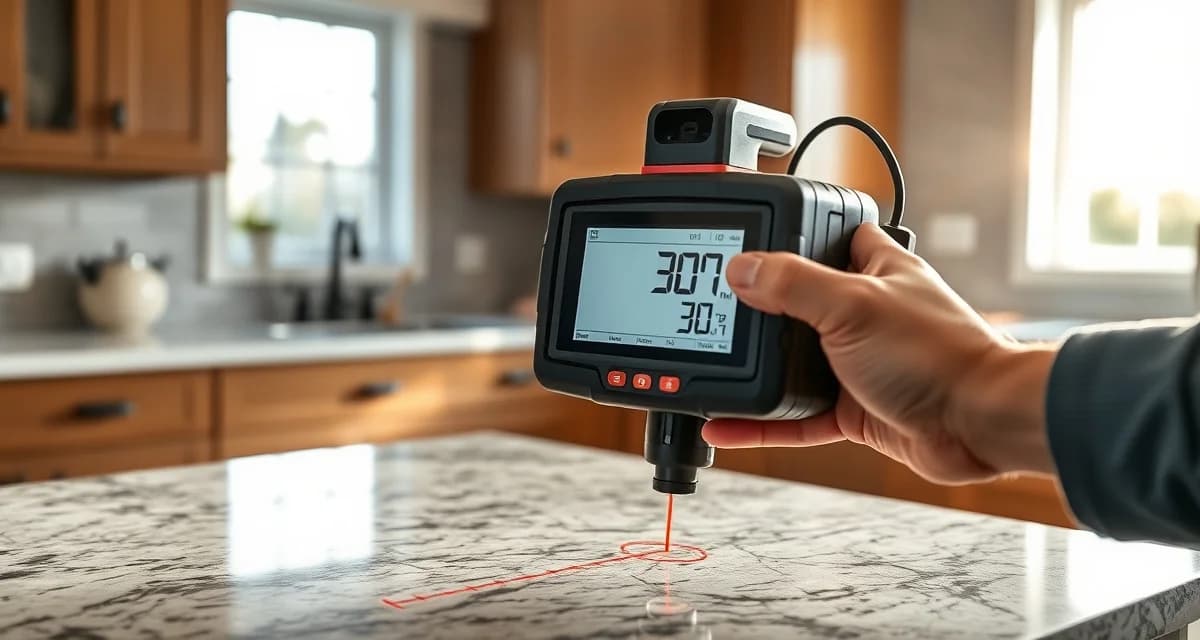
What Is Digital Templating?
Digital templating is the process of using electronic measuring devices - such as laser templaters, digital probes, or 3D scanners - to capture exact countertop dimensions at a job site. Instead of creating physical strip templates from wood or plastic, the technician builds a precise digital file that can be sent directly to CNC cutting machines. Digital templating is accurate to within ±1/64 inch and has become the industry standard for quality-focused fabrication shops.
TL;DR
- Digital templating replaces physical strip templates with electronic measurements
- Accuracy reaches ±1/64 inch (0.4mm), compared to ±1/8 inch for manual methods
- A typical kitchen takes 20-40 minutes to template digitally vs. 60-90 minutes manually
- The digital file goes directly to CAD/CAM software and CNC machines
- Equipment costs range from $8,000 to $35,000 depending on the system
- Digital templates can't warp, shift, or break during transport - they're just files
- Roughly 30-40% of US fabrication shops have adopted digital templating
How Digital Templating Differs from Traditional Methods
For decades, countertop fabricators used physical strip templates - thin pieces of wood, luan plywood, or composite material hot-glued together on top of the cabinets to create a full-size pattern. The fabricator would then transport this physical template back to the shop and lay it on the stone slab to mark cutting lines.
Calculate your material waste savings
See exactly how much slab material and money you could save with optimized cutting layouts.
Try the free Waste CalculatorThis method works, but it has significant drawbacks:
| Aspect | Physical Templates | Digital Templates |
|---|---|---|
| Accuracy | ±1/8 to ±1/4 inch | ±1/64 inch |
| Template time | 60-90 minutes | 20-40 minutes |
| Transport risk | Can warp, break, or shift | Digital file - no physical transport |
| Storage | Takes up shop space | Stored on computer |
| CNC integration | Requires manual tracing | Direct file import |
| Reusability | One-time use | Archived indefinitely |
| Cost per template | $5-15 in materials | No consumable cost |
| Skill floor | Moderate | Higher initial training |
The Digital Templating Process: Step by Step
1. Setup (5-10 minutes)
The technician places the digital measuring device in the room. Most systems mount on a tripod or portable stand. The device needs a clear line of sight to all measurement areas.
2. Reference Calibration (2-3 minutes)
The system establishes its reference coordinate system. Some devices use built-in calibration targets; others reference known distances in the room.
3. Point Capture (10-25 minutes)
The operator moves around the countertop layout, capturing measurement points. Each point the laser or probe touches gets recorded as an X-Y (or X-Y-Z for 3D) coordinate. The operator captures:
- Every straight edge along cabinet fronts
- All corners and angles
- Curves and radius features
- Wall contours where backsplash meets
- Sink and cooktop cutout outlines
- Faucet hole positions
- Overhang distances
4. Detail Annotation (5-10 minutes)
The technician adds notes to the digital file:
- Edge profile selections
- Seam locations and preferences
- Material specifications
- Special instructions (e.g., "match vein pattern at seam")
5. Review and Export (3-5 minutes)
The software displays a completed digital layout for review. The technician checks for missing measurements or errors, then exports the file as a DXF, DWG, or system-specific format.
6. Transmission to Shop
The file gets sent to the fabrication shop - typically via cloud upload, email, or USB drive. Some systems sync automatically over cellular or Wi-Fi connections.
Types of Digital Templating Devices
Laser Templating Systems
These use a laser beam to measure distances and angles to target points. The operator aims the laser at a specific point, records it, and moves to the next.
Examples: LT-2D3D, Laser Products LT-55 Best for: Standard residential and commercial countertop work Price range: $8,000-$25,000
Digital Probe Systems
A mechanical arm or flexible probe touches each measurement point. The device tracks the probe's position with internal encoders, building the template from contact points.
Examples: Proliner Best for: Complex shapes, tight spaces where laser line-of-sight is limited Price range: $20,000-$35,000
3D Scanning Systems
These capture thousands of data points rapidly, creating a complete 3D model of the space. While powerful, they generate far more data than most fabrication workflows require.
Examples: Various commercial 3D scanners Best for: Complex commercial projects, multi-surface installations Price range: $15,000-$50,000+
Photogrammetry
Uses photographs taken from multiple angles to reconstruct 3D geometry. Still emerging in the countertop space but gaining attention for its low hardware cost (a calibrated camera).
Examples: Various software-based solutions Best for: Shops exploring digital methods at lower cost Price range: $2,000-$8,000
What Digital Templating Means for Homeowners
If you're getting new countertops, here's what changes when your fabricator uses digital templating:
Faster Appointments
The template visit takes 20-40 minutes instead of an hour or more. Less time in your home means less disruption.
Better Fit
The tighter accuracy (±1/64 inch vs. ±1/8 inch) means your countertops fit better - tighter seams, more accurate cutouts, and backsplash that follows your wall contour precisely.
Fewer Problems
Digital templates can't warp during transport or get damaged at the shop. The measurements that were taken in your kitchen are exactly what the CNC machine uses to cut your stone.
You Might Not Notice the Difference
Honestly, from a homeowner's perspective, the template visit looks similar whether the technician is using strips or a laser. The difference shows up in the final product quality and the reduced chance of something going wrong.
What Digital Templating Means for Fabricators
For fabrication shops, the shift to digital templating is a bigger deal:
Reduced Remakes
The most direct financial benefit. Shops switching from manual to digital templating typically see remake rates drop from 3-5% to 1-2%. At an average remake cost of $2,500, a shop doing 60 jobs per month saves roughly $45,000 per year.
Higher Throughput
A digital templater can complete 5-7 jobs per day vs. 3-4 with strip templates. This means either handling more work with the same staff or reassigning labor to other tasks.
Better CNC Integration
Digital files import directly into CAD/CAM software, eliminating the manual tracing step that's required with physical templates. This removes another potential source of error.
Data Archiving
Every template is stored digitally. If a customer needs a replacement piece three years later, the original template is on file - no need for a return visit.
Integration with Modern Fabrication Software
Digital template data feeds into the broader fabrication workflow. Platforms like SlabWise use this data for AI-powered slab nesting (achieving 10-15% better yield than manual layout) and template verification (a 3-layer AI check that catches dimensional errors before fabrication begins).
The combination of accurate digital templates and smart nesting software means less waste, fewer mistakes, and faster turnaround times.
Common Concerns About Digital Templating
"What if the technology fails on-site?"
All reputable systems save data continuously, so a battery failure or crash doesn't lose your work. Many templaters also carry a tape measure as a basic backup for simple confirmations.
"Is the learning curve too steep?"
Most technicians become proficient in 1-2 weeks. The basics can be learned in a day, but building speed and handling complex layouts takes practice.
"Can it handle complex shapes?"
This is actually where digital templating shines. Curves, radius corners, and irregular shapes are captured with far more accuracy than manual methods.
"What about small shops that can't afford it?"
Entry-level systems start around $8,000. For a shop doing even 15-20 jobs per month, the remake savings alone pay for the equipment within the first year.
FAQ
What is digital templating in countertop fabrication?
Digital templating uses electronic measuring devices to capture exact countertop dimensions. Instead of physical patterns, it creates a digital file that goes directly to CNC cutting equipment.
How accurate is digital templating?
Most systems achieve ±1/64 inch (approximately 0.4mm) accuracy, which is 4-8 times more precise than traditional strip templating.
How long does digital templating take?
A standard kitchen takes 20-40 minutes with digital templating, compared to 60-90 minutes for traditional methods.
Do I need to do anything different as a homeowner?
No. Your preparation is the same - cabinets installed, sink on-site, faucet selected. The template visit just goes faster.
Can digital templates be used if my kitchen has unusual shapes?
Yes. Curves, angles, and irregular layouts are easier to capture digitally than with rigid strip templates.
What happens to the digital template file after my countertops are installed?
Most shops archive it. This is useful if you ever need a replacement piece - the fabricator can pull up the exact measurements without returning to your home.
Does digital templating cost more?
Not usually. The fabricator's cost is absorbed into their operations. You shouldn't see a price difference as a consumer.
What's the difference between digital templating and laser templating?
Laser templating is a type of digital templating. "Digital templating" is the broader category that includes laser systems, digital probes, and 3D scanners.
Can a fabricator use digital templating for bathrooms too?
Absolutely. Bathroom vanity tops, tub surrounds, and shower seats are all commonly templated digitally.
Do all fabricators offer digital templating?
No. As of 2024, roughly 30-40% of US fabrication shops have adopted digital templating. The rest still use manual methods. If accuracy matters to you, ask your fabricator what they use.
Is the digital template file compatible with all CNC machines?
Most systems export in standard formats (DXF, DWG) that work with nearly all CNC equipment. Verify compatibility with your specific setup before purchasing.
Can digital templating measure vertical surfaces?
Yes. Systems with 3D capability can measure backsplashes, shower walls, fireplace surrounds, and other vertical surfaces.
Better Templates, Better Results
For fabrication shops ready to get more value from their digital template data, SlabWise connects templating to AI-powered nesting and verification. Catch measurement errors before fabrication and reduce slab waste by 10-15%. Start your 14-day free trial at slabwise.com.
Try These Free Tools
- Nesting Optimizer -- AI-powered slab layout that maximizes yield considering vein direction and defects.
- Defect Mapping -- Upload a slab photo and AI maps every fissure, pit, and color issue.
- Value Engineering -- Find dollar-quantified suggestions to save material without cutting margin.