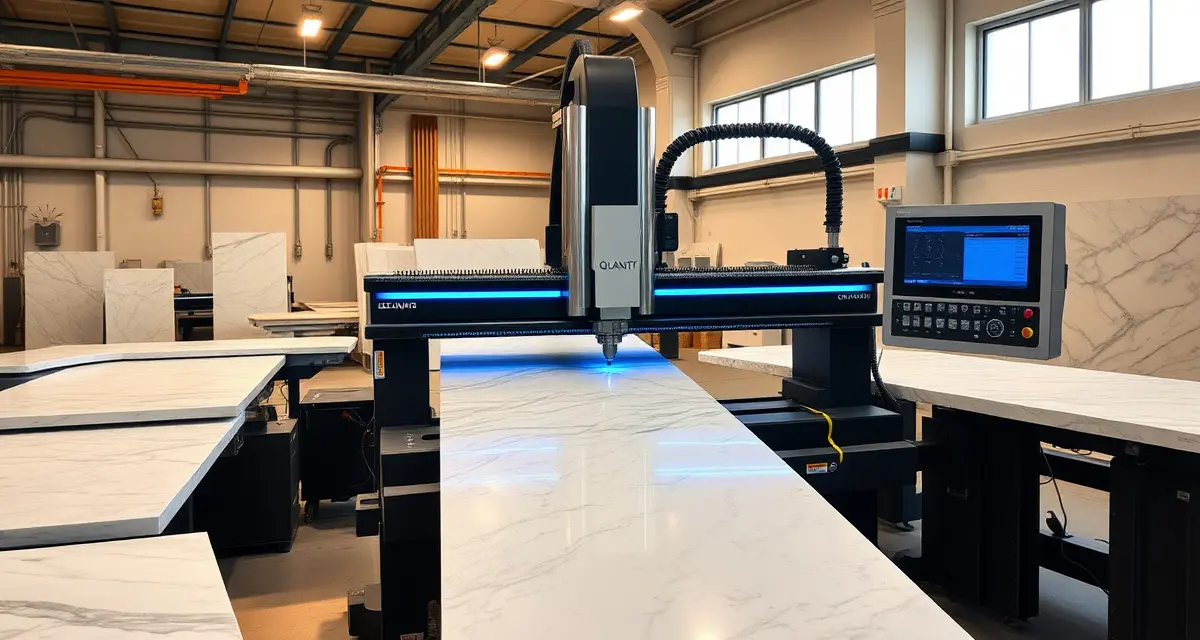
What Is Breton? Definition & Guide
Quick Definition
Breton S.p.A. is an Italian engineering company that invented the Bretonstone process for manufacturing engineered quartz slabs and also produces high-end stone fabrication machinery (CNC saws, routers, and processing centers). Founded in 1963 and headquartered in Castello di Godego, Italy, Breton is responsible for the technology behind virtually every major quartz brand - including Caesarstone, Silestone, Cambria, and others.
TL;DR
- Breton invented the technology used to manufacture engineered quartz countertops (Bretonstone process, patented 1974)
- Nearly every quartz countertop brand uses Breton manufacturing technology under license
- They also make premium CNC fabrication equipment for stone processing shops
- Breton equipment is considered the top tier for high-volume fabrication
- Pricing for Breton fabrication machines ranges from $150,000 to $800,000+
- Understanding Breton helps fabricators understand quartz quality and manufacturing consistency
- The company has over 60 years of stone technology experience
Breton: The Company Behind Every Quartz Countertop
The Bretonstone Process - How Quartz Countertops Are Made
In 1974, Breton patented the Bretonstone process, which remains the dominant method for manufacturing engineered quartz slabs. Here's what happens:
Calculate your material waste savings
See exactly how much slab material and money you could save with optimized cutting layouts.
Try the free Waste Calculator- Raw material mixing: 90-94% ground natural quartz crystals are combined with 6-10% polymer resins and pigments
- Compaction: The mixture is poured into a mold and compacted under vacuum vibro-compression (eliminating air pockets)
- Curing: The compacted slab is hardened in a kiln at approximately 100°C (212°F)
- Calibrating and polishing: The cured slab is ground to precise thickness and polished to final finish
This process produces a slab that's harder than granite (7 on the Mohs scale), non-porous, and consistent in color and pattern from slab to slab. For fabricators, this consistency means fewer material surprises compared to natural stone.
Why Breton Matters to Every Fabricator
Even if you never buy a Breton machine, Breton affects your business because their manufacturing technology determines the quality characteristics of the quartz you cut every day.
| Quartz Brand | Uses Breton Technology? |
|---|---|
| Caesarstone | Yes - licensed Bretonstone process |
| Silestone (Cosentino) | Yes - licensed process |
| Cambria | Yes - licensed process |
| MSI Q Premium | Yes - manufactured on Breton lines |
| Daltile ONE Quartz | Yes - manufactured on Breton lines |
| LG Viatera | Yes - licensed process |
When a quartz manufacturer invests in newer Breton production lines, fabricators benefit from:
- More consistent thickness - fewer calibration issues during fabrication
- Better pattern distribution - veining and color are more uniform across the slab
- Improved structural integrity - fewer weak spots, micro-cracks, or voids
Breton Fabrication Equipment
Beyond manufacturing technology, Breton also makes premium CNC equipment for countertop fabrication shops.
Key Breton Machine Categories
| Machine Type | Model Examples | Price Range |
|---|---|---|
| CNC Machining Centers | Breton Contourbreton, ShapeOne | $250K-$800K+ |
| Bridge Saws | Breton Smart Cut | $150K-$350K |
| Edge Polishers | Breton Levibreton | $80K-$200K |
| Waterjet Systems | Breton Primus | $200K-$500K |
Breton fabrication equipment sits at the top of the market in both price and capability. These machines are designed for high-volume shops processing 50+ kitchens per month or specialty shops handling ultra-premium materials where precision matters most.
Who Should Consider Breton Equipment?
Breton machines make financial sense for:
- Large fabrication operations processing 50-100+ kitchens per month
- Multi-location fabricators who need consistent output quality across shops
- Shops specializing in premium materials (exotic stones, bookmatch projects)
- Commercial fabricators with high-volume, repetitive production needs
For the typical US fabrication shop doing 15-30 kitchens per month, Park Industries or Intermac equipment provides excellent capability at 30-50% lower cost. Breton enters the picture when production volume justifies the premium.
Breton vs. Other Equipment Manufacturers
| Factor | Breton | Park Industries | Intermac |
|---|---|---|---|
| Country | Italy | USA | Italy |
| Price Range | $150K-$800K+ | $80K-$400K+ | $100K-$500K+ |
| Best For | High-volume, premium work | Mid-volume US shops | Mid to high-volume |
| Service in US | Through distributors | Direct (domestic) | Through Biesse US |
| Technology Level | Top tier | Professional grade | Professional to premium |
Understanding Quartz Quality Through the Breton Lens
When your customer asks "Is this quartz good quality?" the answer often traces back to the Breton manufacturing line where it was made.
Newer Breton production lines produce slabs with:
- Tighter thickness tolerances (3cm +/- 0.5mm vs +/- 1.5mm on older lines)
- More realistic marble-look veining (modern lines can create through-body veining)
- Higher structural consistency (fewer internal stress points that cause cracking during fabrication)
Older Breton production lines (or lower-quality copies of the Breton process) produce slabs that may have:
- More variation in thickness across the slab
- Surface patterns that don't match edge patterns well
- Slightly higher rates of fabrication breakage
As a fabricator, you can't always know which production line made your slab. But understanding this context helps you evaluate different quartz brands and explain quality differences to customers.
What is the Bretonstone process?
The Bretonstone process is Breton's patented method for manufacturing engineered quartz slabs. It combines ground quartz crystals with polymer resins under vacuum vibro-compression, then cures and polishes the result into finished slabs.
Did Breton invent quartz countertops?
Yes. Breton S.p.A. invented the process for manufacturing engineered quartz surfaces in 1974. Virtually all quartz countertop manufacturers use Breton technology or derivatives of it.
Where is Breton located?
Breton is headquartered in Castello di Godego, in the Veneto region of Italy. They have service and sales operations worldwide.
How much does Breton fabrication equipment cost?
Breton fabrication equipment ranges from approximately $150,000 for bridge saws to $800,000+ for advanced CNC machining centers. Pricing depends on configuration and capabilities.
Is Breton equipment worth the premium?
For high-volume fabrication shops (50+ kitchens/month), Breton equipment can justify its premium through higher output, tighter tolerances, and lower per-unit production costs. For smaller shops, mid-range equipment from Park Industries or Intermac offers better value.
Do all quartz brands use Breton technology?
Nearly all major quartz brands use the Bretonstone process or licensed derivatives. A small number of manufacturers use alternative processes, but Breton's technology dominates the global market.
Does Breton have service in the United States?
Breton provides US service and support through authorized distributors and service partners. Response times can be longer than domestic manufacturers like Park Industries, which is a consideration for shops evaluating equipment options.
What is the difference between Breton manufacturing and Breton fabrication equipment?
Breton's manufacturing technology (Bretonstone process) is used by quartz brands to produce slabs in factories. Breton's fabrication equipment is used by countertop shops to cut, shape, and finish those slabs into finished countertops. They are separate but related product lines.
Can Breton equipment cut all countertop materials?
Yes. Breton fabrication equipment can process quartz, granite, marble, quartzite, porcelain, and other slab materials with appropriate tooling and settings.
How long do Breton machines last?
With proper maintenance, Breton fabrication equipment commonly operates for 15-25+ years. The machines are built for industrial-grade durability, which partially justifies their higher price point.
Maximize Your Breton Investment with SlabWise
Whether you run Breton, Park Industries, or Intermac equipment, your machines need optimized cut layouts and verified templates to deliver maximum yield. SlabWise's AI-powered slab nesting improves material yield by 10-15%, and template verification catches errors before they reach your CNC - preventing remakes that cost $1,500-$4,000 each.
Start your 14-day free trial at SlabWise.com
Try These Free Tools
- Nesting Optimizer -- AI-powered slab layout that maximizes yield considering vein direction and defects.
- Defect Mapping -- Upload a slab photo and AI maps every fissure, pit, and color issue.
- Value Engineering -- Find dollar-quantified suggestions to save material without cutting margin.
Sources & Further Reading
- Natural Stone Institute - Fabrication Guidelines and Best Practices
- International Surface Fabricators Association - Waterjet Cutting Technology Standards
- ASTM International - Standard Guide for Abrasive Waterjet Machining
- OSHA - Safety Guidelines for Waterjet Operations