How to Match Countertops with Backsplash
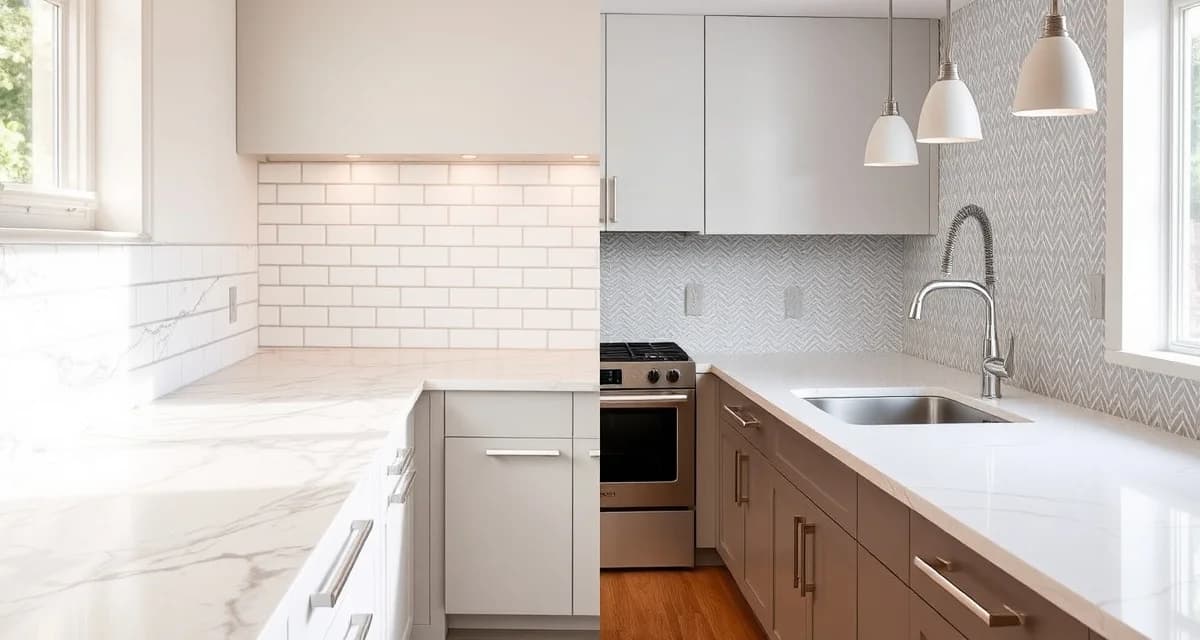
Matching your countertop with a backsplash follows one core principle: one surface should be the visual star, and the other should play a supporting role. If your countertop has dramatic veining or bold movement, choose a simple, solid-color backsplash. If your countertop is a plain solid color, the backsplash is your opportunity to add pattern and texture. Trying to make both surfaces equally attention-grabbing creates a kitchen that feels busy and disjointed.
TL;DR
- Follow the "one star, one support" rule: pair a busy countertop with a simple backsplash, or vice versa
- Pull one color from your countertop's veining or flecks and use it as the backsplash color
- White subway tile remains the safest backsplash choice and works with almost any countertop
- Full-slab backsplashes using the same material as the countertop create a high-end, continuous look
- Avoid matching the backsplash and countertop in the exact same color and pattern, which looks flat
- Tile size matters: large format tiles (12"+) look modern; small mosaics look traditional
- Budget $10-$50 per square foot for backsplash materials, plus $8-$15/sq ft for installation
The One Star, One Support Rule
This is the simplest and most reliable design guideline for countertop-backsplash coordination:
Calculate your material waste savings
See exactly how much slab material and money you could save with optimized cutting layouts.
Try the free Waste Calculator| Countertop Style | Backsplash Approach | Example Pairing |
|---|---|---|
| Bold veining (Calacatta, Super White) | Simple, solid color | Calacatta quartz + white matte subway tile |
| Heavy speckle/movement (granite) | Subtle, single tone | Baltic Brown granite + cream subway tile |
| Solid color (pure white quartz) | Bold pattern or texture | White Caesarstone + blue herringbone tile |
| Waterfall edge countertop | Minimal or no backsplash | Waterfall quartz island + painted wall |
| Butcher block | Patterned tile for visual interest | Walnut butcher block + zellige tile |
When both surfaces compete for attention, the eye doesn't know where to rest. The result is a kitchen that photographs poorly and feels overwhelming in person. Let one surface carry the design weight.
How to Pull Colors from Your Countertop
The most reliable matching technique is pulling a secondary color from your countertop and using it as your backsplash color. Here's how:
- Examine your slab in natural light. Look for secondary colors in the veining, flecks, or background.
- Identify 2-3 accent colors. A Calacatta quartz, for example, might have a white background, gray primary veining, and gold secondary veining.
- Choose one accent for the backsplash. In the Calacatta example, you could pull the gray for a gray backsplash or the gold for a warm brass-toned tile.
- Get physical samples. Hold the tile sample directly against the slab at the yard or in your kitchen.
This color-pulling technique creates a cohesive look because the backsplash and countertop share a common color thread without being matchy-matchy.
Popular Backsplash Options by Countertop Material
Backsplash for White or Gray Quartz
White and gray quartz countertops are by far the most popular choice in 2026 kitchens, and they pair well with a wide range of backsplash options:
- White subway tile (3"x6" or 4"x12"): The go-to safe choice. Works with every countertop and never goes out of style. Cost: $2-$8/sq ft for materials.
- White or gray herringbone: Adds geometric interest without competing with veined quartz. Cost: $8-$15/sq ft.
- Zellige or handmade tile: The irregular surface adds texture and warmth that contrasts nicely with quartz's smooth finish. Cost: $15-$30/sq ft.
- Large-format porcelain: 24"x48" or larger tiles with minimal grout lines create a modern, sleek look. Cost: $10-$25/sq ft.
- Full-slab backsplash: Using the same quartz material from the countertop up the wall creates a dramatic, seamless look. Cost: $50-$100/sq ft installed.
Backsplash for Granite
Granite's natural variation makes backsplash matching both easier (more colors to pull from) and harder (more potential for clashing):
- Solid-color ceramic or porcelain: Pick one color from the granite and match it. Simple and effective.
- Glass tile: The reflective surface brightens the kitchen and contrasts with granite's matte or polished surface.
- Natural stone mosaic: Small pieces of marble or travertine complement granite without competing.
- Painted drywall with chair rail: Budget-friendly and clean. Works well with busy granite patterns.
Backsplash for Marble
Marble countertops are already a statement. Keep the backsplash understated:
- Same marble as a full-slab backsplash: The ultimate luxury look, but expensive ($60-$120/sq ft installed)
- White or off-white matte tile: Lets the marble countertop be the focus
- Marble mosaic in a complementary pattern: Herringbone or basketweave in similar tones
Backsplash for Butcher Block
Wood countertops benefit from a backsplash that adds visual texture:
- Subway tile in white, cream, or sage green: Classic farmhouse pairing
- Zellige tile in earthy tones: Handmade quality complements natural wood
- Brick veneer: Creates a warm, rustic look with strong farmhouse appeal
- Patterned cement tile: Geometric patterns in muted colors add personality
Full-Slab Backsplash: When and Why
A full-slab backsplash uses the same countertop material running from the countertop surface up the wall, typically to the bottom of the upper cabinets (18" standard height). This creates a continuous, uninterrupted stone surface.
Advantages:
- No grout lines to clean or maintain
- Dramatic, high-end appearance
- Veining can flow from countertop to wall
- Simple and modern aesthetic
Considerations:
- Material cost is significant (adds 12-18 sq ft of stone per typical kitchen)
- Requires additional slab material (may push you from 1 slab to 2)
- Electrical outlets need to be carefully planned
- Installation is more complex than tile
Cost: A full-slab backsplash adds $1,200-$3,600 to your countertop project for a typical kitchen (12-18 sq ft at $50-$100/sq ft installed), depending on the material.
Tile Size and Pattern Guide
The size and pattern of your backsplash tile affects the overall kitchen feel:
| Tile Size | Pattern Options | Style Vibe | Best With |
|---|---|---|---|
| 2"x2" mosaic | Straight set, offset | Traditional, detailed | Solid countertops needing interest |
| 3"x6" subway | Stacked, offset, herringbone | Classic, versatile | Any countertop style |
| 4"x12" elongated subway | Stacked, offset | Modern classic | Clean-line kitchens |
| 6"x6" square | Straight set | Retro or Scandi | Mid-century and minimalist designs |
| 12"x24" large format | Stacked, offset | Modern, minimal | Busy countertops needing simplicity |
| 24"x48" extra-large | Full coverage | Ultra-modern | Dramatic or commercial kitchens |
Grout color matters too. Matching grout to tile color creates a seamless look. Contrasting grout (like dark grout with white tile) emphasizes the tile pattern but makes the backsplash busier.
Budget Planning for Backsplash
Backsplash costs vary widely by material and installation complexity:
| Material | Material Cost ($/sq ft) | Install Cost ($/sq ft) | Total for 30 sq ft |
|---|---|---|---|
| Ceramic subway | $2-$8 | $8-$12 | $300-$600 |
| Porcelain | $5-$15 | $8-$12 | $390-$810 |
| Glass tile | $10-$30 | $10-$15 | $600-$1,350 |
| Natural stone mosaic | $15-$35 | $12-$18 | $810-$1,590 |
| Zellige/handmade | $15-$30 | $12-$18 | $810-$1,440 |
| Full stone slab | $50-$100 | Included | $1,500-$3,000 |
| Peel-and-stick | $5-$15 | $0 (DIY) | $150-$450 |
A standard kitchen backsplash covers 25-35 square feet (the area between the countertop and upper cabinets, excluding windows and range hoods).
FAQ
Should the backsplash match the countertop exactly? No. An exact match looks flat and one-dimensional. The most effective approach is coordination, not matching. Pull a secondary color from your countertop or choose a complementary tone that creates subtle contrast.
What's the most popular backsplash for quartz countertops? White subway tile in a 3"x6" or 4"x12" format is the most common pairing with quartz countertops. It's affordable, timeless, and doesn't compete with quartz patterns. Herringbone layouts are increasingly popular for added visual interest.
Can I skip the backsplash entirely? Technically yes, but it's not recommended in kitchen areas behind the sink and stove. Without a backsplash, water and cooking splatter will damage the drywall over time. At minimum, install a backsplash behind the sink and stove, even if you leave other walls bare.
Does a backsplash go behind the stove? Yes. The area behind the stove is the most critical backsplash zone due to grease splatter and heat. Many homeowners install a taller backsplash (24-36") behind the range, even if the rest of the kitchen has a standard 18" backsplash.
Should the backsplash go all the way to the ceiling? Full-height backsplashes (counter to ceiling) are trending in modern kitchens, especially with slab material or large-format tile. However, standard 18" backsplashes (counter to upper cabinet) are still the norm and cost significantly less.
How do I handle the backsplash where there are no upper cabinets? Where upper cabinets are absent (like above a window or open shelving), extend the backsplash to match the height of neighboring cabinet sections, or run it all the way to the ceiling for a finished look.
Can I do a peel-and-stick backsplash with stone countertops? You can, but the quality difference will be obvious. Peel-and-stick backsplashes cost $5-$15 per square foot and look budget-friendly next to $50-$100/sq ft stone countertops. If the countertop is high-end, the backsplash should match that quality level.
What backsplash works with busy granite? When granite has heavy movement or many colors, choose a simple, solid-color backsplash that matches one of the granite's background tones. White, cream, or light gray in a large-format tile with minimal grout lines is almost always the right call.
Do I install backsplash before or after countertops? Countertops are installed first, then the backsplash. This ensures the backsplash sits cleanly on top of the countertop edge. If the backsplash is installed first, the joint between the countertop and backsplash will be visible and harder to seal.
How much does a full-slab backsplash cost? A full-slab backsplash adds $1,200-$3,600 to a typical kitchen project (12-18 sq ft of additional material at $50-$100/sq ft installed). It may also increase the number of slabs needed for your project from 1 to 2.
Estimate Your Full Kitchen Project
Planning countertops and backsplash together? Use our cost calculator to get pricing for your countertop material, and factor in the additional square footage if you're considering a full-slab backsplash.
[Try the SlabWise Cost Calculator →]
Try These Free Tools
- Cost Calculator -- Get instant countertop cost estimates by material, edge profile, and square footage.
- Compare Materials -- Side-by-side material comparison with pricing, durability, and maintenance ratings.
- Edge Profile Selector -- Browse edge profiles with cost impact and visual previews.