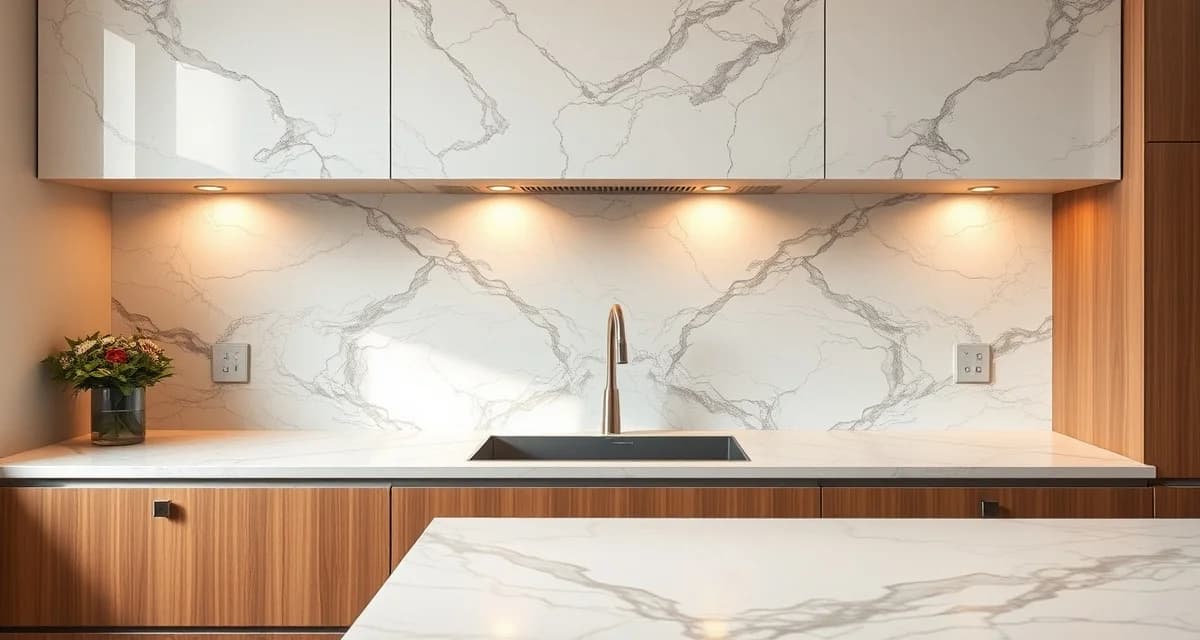
What Is a Full Slab Backsplash?
A full slab backsplash uses the same countertop material (granite, quartz, marble, or quartzite) as a continuous surface running from the countertop up the wall, typically to the bottom of the upper cabinets (18" standard) or all the way to the ceiling. Unlike tile backsplashes, a slab backsplash has no grout lines, creating a clean, uninterrupted surface. When the veining flows from the countertop into the backsplash, the effect is dramatic and high-end, which is why this feature appears in an increasing number of premium kitchen designs.
TL;DR
- A slab backsplash uses the same material as the countertop, running up the wall
- Standard height is 18" (counter to upper cabinet); full height runs to the ceiling
- Adds $1,200-$5,000+ to a typical kitchen project (12-20 sq ft of additional material)
- No grout lines means easier cleaning and a more modern aesthetic
- Veining can flow continuously from countertop to backsplash for visual drama
- May require purchasing an additional slab depending on total material needs
- Requires careful planning for outlets, switches, and window openings
How Much Does a Full Slab Backsplash Cost?
| Material | Material $/sq ft | 18" Backsplash (15 sq ft) | Full Height (25 sq ft) |
|---|---|---|---|
| Quartz (standard) | $50-$75 | $750-$1,125 | $1,250-$1,875 |
| Quartz (premium) | $75-$120 | $1,125-$1,800 | $1,875-$3,000 |
| Granite | $40-$100 | $600-$1,500 | $1,000-$2,500 |
| Marble (Carrara) | $60-$100 | $900-$1,500 | $1,500-$2,500 |
| Marble (Calacatta) | $100-$200 | $1,500-$3,000 | $2,500-$5,000 |
| Quartzite | $80-$150 | $1,200-$2,250 | $2,000-$3,750 |
Prices include material only. Add $15-$30/sq ft for fabrication and installation.
Calculate your material waste savings
See exactly how much slab material and money you could save with optimized cutting layouts.
Try the free Waste CalculatorTotal installed cost for a standard kitchen slab backsplash: $1,200-$5,000 for 18" height, $2,000-$8,000 for full ceiling height.
For comparison, a tile backsplash for the same area typically costs $300-$1,500 for standard ceramic or porcelain tile, and $800-$2,500 for premium tile options.
Slab vs. Tile Backsplash Comparison
| Feature | Full Slab Backsplash | Tile Backsplash |
|---|---|---|
| Grout lines | None | Yes (requires maintenance) |
| Cleaning | Wipe with cloth | Scrub grout periodically |
| Visual continuity | Matches countertop perfectly | Different material/look |
| Installation time | 1-2 hours (done with countertop) | 1-3 days (separate trade) |
| Cost | $1,200-$5,000+ | $300-$2,500 |
| Outlets/switches | Cut into stone | Tile works around them |
| Material consistency | Same lot/slab as countertop | Different material |
| Replacement | Difficult; must match stone | Individual tiles replaceable |
| Design impact | High-end, modern | Range from basic to high-end |
| Maintenance | Same as countertop | Grout cleaning and sealing |
Installation Process
Planning Phase
- Measure backsplash areas: Calculate total square footage including behind the range, sink, and any open wall areas
- Account for obstacles: Mark outlet locations, switch plates, window positions, and under-cabinet lighting
- Plan vein direction: If the stone is veined, decide how the vein pattern should flow from countertop to backsplash
Fabrication
The backsplash pieces are cut from the same slab as the countertop (or from the same lot for color consistency). The fabricator:
- Cuts backsplash strips to exact dimensions including outlet cutouts
- Polishes all visible edges
- Ensures the bottom edge of the backsplash matches the countertop's back edge for a flush transition
- Creates inside corner pieces if the backsplash wraps around corners
Installation
Slab backsplash is typically installed at the same time as the countertop:
- Countertop is set and leveled first
- Backsplash pieces are dry-fitted against the wall
- Silicone adhesive is applied to the back of the slab pieces
- Pieces are pressed against the wall and held until adhesive sets
- A thin bead of color-matched caulk seals the joint between countertop and backsplash
Installation time: 1-2 hours for an average kitchen, included in the countertop installation crew's visit.
Design Considerations
Outlet and Switch Cutouts
Electrical outlets and switches behind the countertop need cutouts in the slab backsplash. This involves:
- Precise measurement of each outlet and switch location
- CNC cutting of rectangular openings in the stone
- Installing outlet box extensions (slab thickness pushes the outlet further from the wall)
- Replacing outlet covers with ones rated for the additional depth
Code consideration: Outlets must be accessible and functional. Some municipalities require GFCI outlets near sinks regardless of backsplash material. Discuss outlet placement with your electrician before fabrication.
Veining Continuity
The most impactful slab backsplashes show veining flowing upward from the countertop. Achieving this requires:
- Cutting the backsplash from the same section of the slab as the adjacent countertop
- Maintaining the same vein orientation (no flipping or rotating)
- Planning during slab layout so vein-rich areas land where the backsplash will be visible
This works beautifully with strongly veined materials (Calacatta marble, dramatic quartzite) and is less impactful with subtle or speckled materials.
Height Options
Standard (18"): Counter to bottom of upper cabinets. This is the most common height and matches standard kitchen layout. Least expensive option.
Full height to ceiling: Creates a dramatic, floor-to-ceiling stone wall effect. Requires more material and is most impactful behind ranges or open shelving.
Partial (4-6"): A short slab strip that protects the wall without the cost of a full backsplash. Least expensive but less visually dramatic.
Mixed: Full slab behind the range (full height) with shorter slab or no backsplash elsewhere. Creates a focused focal point.
When a Slab Backsplash Makes Sense
Best scenarios:
- You've chosen a heavily veined material and want the veining to flow upward
- You prefer a modern, grout-free aesthetic
- You want minimal maintenance (no grout to clean or seal)
- The kitchen has limited backsplash area (small kitchen = lower cost)
- You're already buying 2+ slabs and have leftover material
Less ideal scenarios:
- Budget is tight (tile is significantly cheaper)
- The countertop material is solid-colored (less visual payoff from continuous slab)
- The kitchen has extensive backsplash area (large cost for many square feet)
- You want to change the backsplash independently of the countertop later
FAQ
Does a slab backsplash cost more than tile? Yes, typically 2-4 times more. A slab backsplash costs $1,200-$5,000+ for a standard kitchen, while tile costs $300-$2,500. The premium buys a grout-free, maintenance-free, visually continuous surface.
Can the slab backsplash be a different material than the countertop? It can, but the primary appeal of a slab backsplash is matching the countertop for a continuous look. Mixing materials is uncommon and may look mismatched. If you want a different backsplash material, tile is usually a better choice.
How thick is a slab backsplash? Typically 2cm (3/4"), thinner than the 3cm countertop. The thinner profile reduces weight on the wall adhesive and uses less material. Some fabricators use 1cm material for backsplashes.
Does a slab backsplash need sealing? If the material is natural stone (granite, marble, quartzite), yes. Seal at the same frequency as the countertop. Quartz backsplashes don't need sealing.
Will a slab backsplash crack if the house settles? Minor settling is usually absorbed by the silicone adhesive behind the slab. Major settling could crack the backsplash at stress points, particularly around outlet cutouts. This risk is low in modern construction.
Can I install a slab backsplash over existing tile? Not recommended. The existing tile should be removed to ensure a flat surface for proper adhesion. Installing over tile adds unnecessary thickness and creates future removal challenges.
Does a slab backsplash increase home value? It's perceived as a premium feature and can contribute to a higher kitchen valuation. However, the return on investment depends on the material cost and local market expectations.
How does the backsplash attach to the wall? Silicone adhesive (construction grade) bonds the slab to the wall. No mechanical fasteners are needed for standard 2cm backsplash pieces. Heavier 3cm pieces may use hidden metal clips for extra support.
Can I get a slab backsplash with my existing countertop? Yes, if you can source matching material. Your original fabricator may have remnants from your slab, or you can find a matching lot at the slab yard. Exact color matching is harder the longer you wait.
Do I need to move outlets for a slab backsplash? Outlets stay in the same location but need box extenders to account for the slab thickness. Your electrician should install these during or after the backsplash installation. Cost: $10-$25 per outlet for extenders.
Estimate Your Backsplash Cost
Considering a full slab backsplash for your kitchen? Use our cost calculator to see the additional material cost based on your specific layout and material choice.
[Try the SlabWise Cost Calculator →]
Try These Free Tools
- Cost Calculator -- Get instant countertop cost estimates by material and square footage.
- Kitchen Visualizer -- Upload a kitchen photo and preview different materials in place.
- Template Compare -- Upload two templates and see every dimension change highlighted.
Sources & Further Reading
-
Natural Stone Institute - Countertop Installation Best Practices Guide
-
National Kitchen & Bath Association - Kitchen Renovation Sequencing Guidelines
-
International Surface Fabricators Association - Professional Installation Standards
-
Remodeling Magazine - Kitchen Remodel Installation Order Best Practices