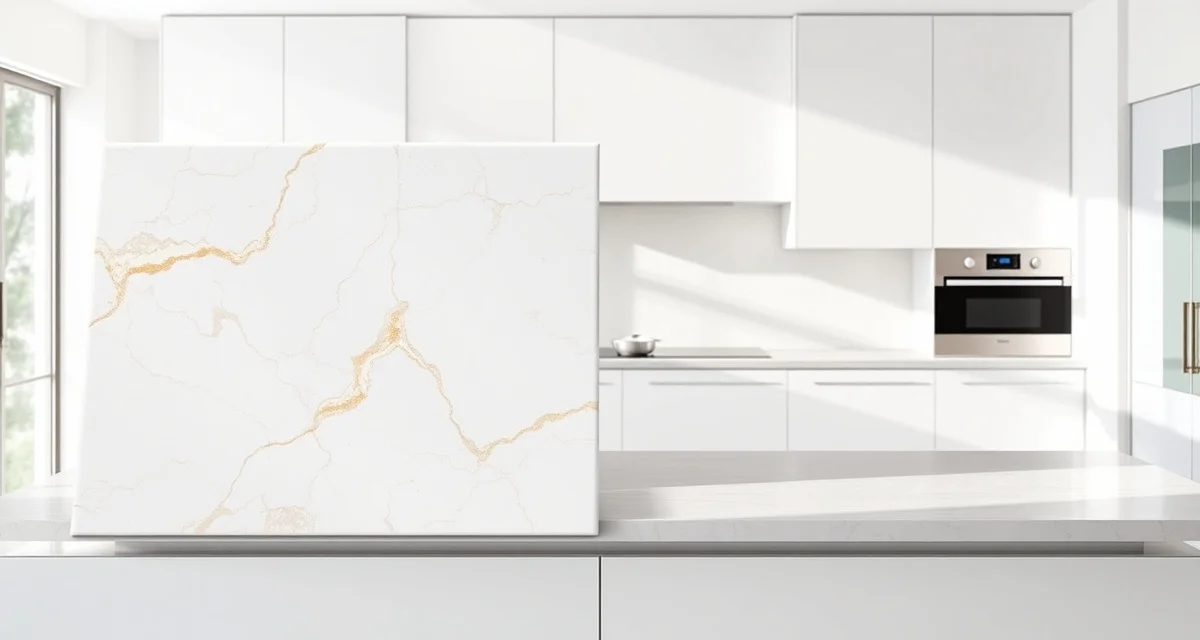
Quartzite vs Porcelain Countertops: 2026 Comparison
Quartzite and porcelain both target the premium countertop market, and both are gaining popularity in 2026. Quartzite offers genuine natural stone beauty with excellent hardness. Porcelain offers zero-maintenance convenience with modern manufacturing versatility. Here is how they stack up.
TL;DR
- Quartzite is a natural stone with unique, one-of-a-kind patterns; porcelain patterns are digitally printed
- Porcelain needs zero maintenance - no sealing ever; quartzite needs sealing every 6-24 months
- Both handle heat well, but porcelain is rated for 500F+ while quartzite also performs excellently
- Quartzite is harder (7 Mohs) and more chip-resistant on edges than porcelain
- Porcelain works outdoors (UV-stable); quartzite also works outdoors
- Quartzite costs more: $80-$200/sq ft vs. $55-$120/sq ft for porcelain
- Porcelain has limited edge profiles due to thinner slabs; quartzite supports all standard profiles
Side-by-Side Comparison
| Feature | Quartzite | Porcelain Slab |
|---|---|---|
| Type | Natural metamorphic stone | Manufactured (fired clay) |
| Installed Cost (per sq ft) | $80-$200 | $55-$120 |
| Sealing Required | Every 6-24 months | Never |
| Heat Resistance | Excellent | Excellent |
| Scratch Resistance | Very High (7 Mohs) | High |
| Stain Resistance | Moderate (sealed) | Very High |
| UV Resistance | Yes | Yes |
| Outdoor Use | Yes | Yes |
| Edge Chip Resistance | High | Moderate |
| Pattern Uniqueness | Every slab is unique | Printed (can repeat) |
| Edge Profile Options | Full range | Limited |
| Thickness | 2cm, 3cm | 12mm, 20mm, 30mm |
| Maintenance Level | Low-Medium | Very Low |
Cost Comparison
Quartzite is the pricier option:
Calculate your material waste savings
See exactly how much slab material and money you could save with optimized cutting layouts.
Try the free Waste Calculator- Quartzite: $80-$200/sq ft installed (standard to exotic)
- Porcelain: $55-$120/sq ft installed (standard to premium)
A 40-square-foot kitchen costs $3,200-$8,000 in quartzite vs. $2,200-$4,800 in porcelain. The savings from choosing porcelain can be significant, especially with premium quartzite varieties.
Natural vs. Manufactured Beauty
This is the fundamental trade-off.
Quartzite is quarried from the earth. Each slab is millions of years old and genuinely unique. The veining, crystalline sparkle, and depth of color are natural phenomena that cannot be precisely replicated. When light hits quartzite, it enters the stone slightly and creates a glow that is distinctive.
Porcelain is manufactured in a factory using digital printing on fired clay. Modern porcelain does an impressive job of mimicking natural stone, concrete, wood, and other materials. But it is a reproduction, not the original. On large installations, pattern repeats may become visible.
If natural uniqueness is a core value, quartzite wins. If you care more about performance and lower cost, porcelain is compelling.
Maintenance Advantage: Porcelain
Porcelain requires nothing beyond basic cleaning. No sealing, no special cleaners, no worry about spills. This zero-maintenance profile is one of porcelain's strongest selling points.
Quartzite needs sealing every 6-24 months to prevent stain absorption. While this is much less demanding than marble (every 3-6 months), it is still a periodic task that porcelain eliminates entirely.
Edge Profiles and Chip Resistance
Quartzite, at standard 3cm thickness, supports every common edge profile: bullnose, ogee, waterfall, beveled, eased, and more. Its hardness makes these edges durable and chip-resistant.
Porcelain, typically 12mm or 20mm thick, has limited edge options. Mitered edges create the illusion of thickness. But complex profiles are not practical, and porcelain edges are more vulnerable to chipping from heavy impacts.
Cost Breakdown by Project Size
Quartzite sits at the premium end of countertop pricing, while porcelain offers more budget flexibility:
| Kitchen Size | Quartzite Installed | Porcelain Installed | Savings with Porcelain |
|---|---|---|---|
| Small (25 sq ft) | $1,875-$4,375 | $875-$2,500 | $1,000-$1,875 |
| Medium (40 sq ft) | $3,000-$7,000 | $1,400-$4,000 | $1,600-$3,000 |
| Large (60 sq ft) | $4,500-$10,500 | $2,100-$6,000 | $2,400-$4,500 |
Quartzite's wide price range reflects the huge variation between common varieties (White Macaubas, Taj Mahal) and rare exotics (Blue Louise, Azul Cielo) that can hit $200+ per square foot for the slab alone.
Ongoing Maintenance Costs
Quartzite needs sealing every 1-2 years ($50-$150 if professional, $20-$40 DIY). Some lighter quartzites are more porous than others and may need more frequent attention. Porcelain never needs sealing, period. Over 20 years, this adds $400-$3,000 in extra costs for quartzite.
Living With Each Material
Quartzite in Daily Use
Quartzite is genuinely tough. It's harder than granite (7 on the Mohs scale), resists scratching from normal kitchen use, and handles heat better than any engineered surface. You can set a hot pan directly on quartzite without concern.
The catch: quartzite is a natural stone and every slab is different. Some quartzites are nearly bulletproof while others are softer and more porous. Always ask your fabricator about the specific quartzite you're considering, because the name alone doesn't tell you everything.
Porcelain in Daily Use
Porcelain countertops are essentially maintenance-free. Stain-proof, UV-resistant, heat-resistant, and never need sealing. They perform well indoors and outdoors.
The downside is edge vulnerability. Porcelain is thinner than natural stone (typically 12-20mm vs. 30mm for quartzite) and the edges can chip if hit with heavy objects. Mitered edge treatments help create a thicker look, but the material itself remains thin.
Fabrication Considerations
These two materials require very different shop capabilities:
- Quartzite fabricates like granite. Standard CNC and bridge saw equipment works fine. Wet cutting is mandatory for silica dust control. Most stone shops handle quartzite routinely, though some exotic varieties are harder on tooling.
- Porcelain slabs are brittle and require careful handling. CNC routing can cause chipping if speeds and feeds aren't adjusted. Many shops charge a premium for porcelain fabrication because of the higher breakage risk and specialized techniques needed.
- Seam visibility differs. Quartzite seams look like natural stone seams (visible but expected). Porcelain seams are more noticeable because the manufactured pattern doesn't flow naturally across the joint.
- Cutouts are higher-risk in porcelain. Sink and faucet cutouts need reinforcement and careful technique to avoid cracking the slab.
Resale Value
Quartzite is recognized as a premium natural stone by homebuyers and appraisers. Exotic quartzites can be genuine selling points in luxury homes.
Porcelain countertops are newer to the US market, and buyer awareness is still growing. Some buyers may not recognize porcelain as a premium material. In modern and contemporary homes, porcelain's clean aesthetic fits the design language well. In traditional kitchens, quartzite's natural character resonates more with buyers.
Best Uses
Choose Quartzite When:
- Natural stone authenticity matters
- You want the full range of edge profiles
- Scratch and heat resistance are priorities
- The kitchen is a showcase space deserving genuine stone
- Budget allows for the premium investment and ongoing sealing
Choose Porcelain When:
- Zero maintenance is the top priority
- Budget is a significant factor
- Outdoor installation is needed (fully UV and weather resistant)
- A modern, thin-profile design is desired
- Large-format, seamless-look applications
FAQ
Is quartzite better than porcelain?
Quartzite is a harder, more natural material with unique patterns. Porcelain is easier to maintain and less expensive. Neither is universally better - the right choice depends on whether you prioritize natural beauty or practical convenience.
Does quartzite need more maintenance than porcelain?
Yes. Quartzite requires periodic sealing (every 6-24 months) and careful cleaning to avoid sealant degradation. Porcelain needs only basic cleaning with any household product.
Can porcelain mimic quartzite?
Porcelain can produce quartzite-inspired patterns that are convincing from a normal distance. However, the crystalline sparkle and natural depth of real quartzite are difficult to replicate in a printed surface.
Which is better for outdoor kitchens?
Both work outdoors. Porcelain has a slight edge because it never needs sealing - important for surfaces exposed to rain and weather. Quartzite works well outdoors but needs more frequent sealing in exterior applications.
Does porcelain chip more than quartzite?
Porcelain edges are more susceptible to chipping from heavy impacts, especially at thinner profiles. Quartzite's natural hardness provides better edge chip resistance.
Which lasts longer?
Quartzite has a proven 50+ year lifespan as a building material. Porcelain is expected to last 25-50+ years but has a shorter track record in countertop applications specifically.
Can you put hot pans on quartzite?
Yes. Quartzite handles hot cookware without issue. As a natural stone that formed under extreme heat and pressure, it is highly resistant to thermal damage.
Which has better resale value?
Both are premium materials that add value. Quartzite's natural stone status may carry slightly more prestige with luxury home buyers. Porcelain is well-received by buyers who value low-maintenance living.
Compare Your Options
Both quartzite and porcelain are excellent premium countertop choices. The decision rests on whether natural authenticity or zero-maintenance convenience matters more.
Get a project estimate with our countertop cost calculator. Fabricators can try SlabWise free for 14 days to optimize nesting on both natural stone and porcelain slabs.
Try These Free Tools
- Cost Calculator -- Compare material costs instantly across different countertop options.
- Compare Materials -- Side-by-side material comparison with pricing, durability, and maintenance.
- Kitchen Visualizer -- Let customers preview countertop materials in their actual kitchen.
Sources & Further Reading
-
Natural Stone Institute - Technology and Software Solutions for Stone Fabricators
-
International Surface Fabricators Association - Fabrication Software and Digital Tools
-
National Kitchen & Bath Association - Technology Integration in Countertop Design
-
Marble Institute of America - Digital Fabrication and Software Standards