Waterfall vs Mitered Edge: Which to Choose?
Quick Definition
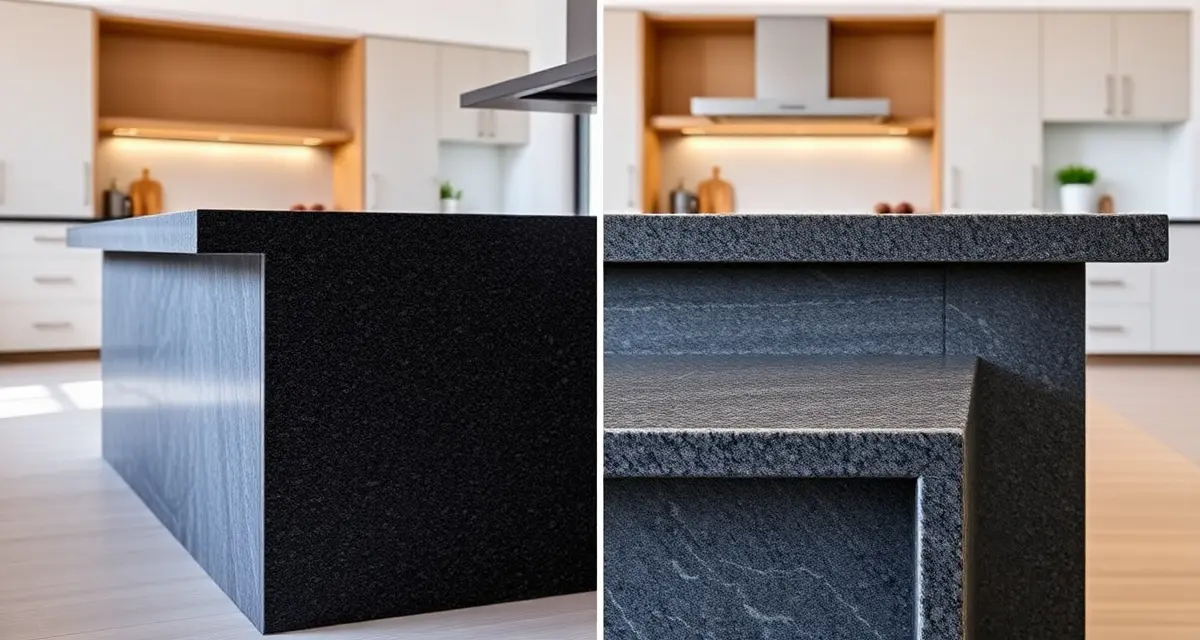
Waterfall and mitered edges are two distinct treatments that create a thick, modern countertop appearance. A waterfall edge continues the countertop material down the side of a cabinet or island, flowing vertically to the floor like a waterfall. A mitered edge joins two pieces of stone at a 45-degree angle along the front edge to create the illusion of a thicker slab -- typically doubling the apparent thickness from 3cm to 6cm. These are different techniques that serve different design goals.
TL;DR
- Waterfall extends the countertop surface vertically down cabinet sides; mitered thickens the front edge by joining two pieces at 45 degrees
- Waterfall costs $800-$2,500+ per side panel depending on height and material
- Mitered edge costs $25-$50/linear foot, roughly $1,000-$2,000 for a typical island
- Both are modern, high-end treatments popular on kitchen islands
- Waterfall uses significantly more material (full side panel) while mitered uses narrower strips
- Fabrication complexity is high for both -- seam quality is critical
- Waterfall requires vein matching at the 90-degree turn for a polished result
- Both treatments work best on quartz, marble, and quartzite where consistent patterns aid seam matching
Visual Comparison
| Feature | Waterfall | Mitered |
|---|---|---|
| Coverage | Full side panel(s) to floor | Front edge only (doubled thickness) |
| Apparent thickness | Same as countertop (3cm) | Double (6cm from two 3cm pieces) |
| Signature look | Stone flowing floor to counter | Thick, substantial front edge |
| Material visible | Top surface + side surface | Front edge and top surface |
| Design statement | Strong, architectural | Refined, substantial |
| Best on | Islands and peninsulas | Islands, peninsulas, perimeter counters |
Cost Comparison
| Cost Factor | Waterfall (per side) | Mitered (per linear foot) |
|---|---|---|
| Material cost | $300-$1,200+ (full panel) | $15-$40 (edge strip) |
| Fabrication labor | $200-$500 | $15-$25/LF |
| Total per side/run | $800-$2,500+ | $25-$50/LF |
| Typical island total | $1,600-$5,000 (two sides) | $1,000-$2,000 (front edge) |
| Material waste | High (large offcuts) | Moderate (strip offcuts) |
Waterfall edges are among the most expensive countertop treatments because they require full panels of material. A kitchen island with waterfall panels on both ends may require an additional full slab, which on materials like Calacatta marble could mean $3,000-$6,000+ in material alone.
Calculate your material waste savings
See exactly how much slab material and money you could save with optimized cutting layouts.
Try the free Waste CalculatorMitered edges use significantly less material -- just a strip of stone approximately 2-3 inches wide that gets mitered and joined to the front edge. The labor per foot is comparable to waterfall seaming, but the total cost is usually lower because the material requirements are smaller.
Durability and Practical Considerations
Structural Strength
Waterfall joints occur at a 90-degree turn where the horizontal countertop meets the vertical panel. This joint is structural -- it must support the weight of the countertop overhang and resist lateral stress. Proper reinforcement includes:
- Steel rodding through the miter joint
- Two-part epoxy adhesive rated for stone fabrication
- Some fabricators add a concealed steel bracket inside the cabinet for additional support
Mitered joints are primarily aesthetic. The laminated edge strip is bonded to the front of the countertop with epoxy. The joint does not bear structural load, but it must resist separation from daily contact (leaning on the edge, bumping with chairs).
Vulnerability Points
| Risk | Waterfall | Mitered |
|---|---|---|
| Seam visibility | High if poorly matched | Moderate (thin line at join) |
| Impact damage at joint | Possible on exposed corners | Low (protected by countertop top) |
| Separation over time | Rare with proper reinforcement | Possible if adhesive fails |
| Floor contact damage | Bottom edge exposed to mopping, impacts | N/A (no floor contact) |
Maintenance
Waterfall panels require the same sealing as the countertop surface since they are exposed stone. Vertical surfaces collect less spill residue than horizontal ones, but they do accumulate fingerprints, cooking splatter, and dust.
Mitered edges need occasional inspection of the seam line. Over time, the thin epoxy line at the miter joint can collect residue, making it more visible. A quick wipe with the right cleaner keeps it clean.
Design and Style Fit
When to Choose Waterfall
- Statement islands: Waterfall edges turn a kitchen island into an architectural feature, not just a work surface
- Dramatic stone patterns: Materials with bold veining (Calacatta marble, dramatic quartzite) create striking visual continuity when the pattern wraps from top to side
- Modern and contemporary kitchens: Waterfall edges are the signature look of high-end modern kitchen design
- Open-concept spaces: In kitchens visible from living or dining areas, waterfall panels create a finished, furniture-like presence
- Hiding island structure: Waterfall panels conceal the cabinet base, creating a floating appearance
When to Choose Mitered
- Thick-slab aesthetic: When the design calls for a substantial edge but full waterfall panels are not in the budget
- Perimeter counters: Mitered edges work on any countertop run, not just islands -- waterfall only makes sense on exposed ends
- Matched cabinetry: When island cabinetry has decorative panels or painted finishes that should remain visible
- Budget-conscious modern: Mitered gives a contemporary, substantial feel at lower cost than waterfall
- Multiple edge treatments: Some designs use mitered on the perimeter and waterfall on the island for a layered look
Fabrication Perspective
Waterfall Fabrication
Waterfall edges are among the most demanding fabrication tasks:
- Slab selection: The slab must yield both the countertop and the side panel(s) with enough material for vein matching at the turn. This often requires a larger slab than the countertop alone would need
- Vein matching: The veining pattern must flow continuously around the 90-degree corner. This requires cutting the panel piece adjacent to the countertop piece on the same slab, with careful planning of which edge becomes the miter
- Miter cutting: Both pieces need precise 45-degree miter cuts along the joining edge. CNC saws handle this accurately; manual saws introduce risk
- Dry fit: Always dry-fit the joint before applying adhesive. Check vein alignment, gap width, and squareness
- Assembly: Apply two-part epoxy, join the pieces, and clamp. Insert steel rods for reinforcement. Cure time is typically 24 hours before handling
- Seam finishing: The external seam line at the 90-degree corner must be polished flush. Any step or gap is immediately visible on a waterfall joint
Common mistakes:
- Cutting the waterfall panel from a different slab than the countertop (veins will not match)
- Insufficient reinforcement at the miter (joint fails under stress)
- Visible epoxy squeeze-out not cleaned before curing
- Vein mismatch at the corner due to poor layout planning
Mitered Edge Fabrication
Mitered edges are technically demanding but more routine:
- Strip cutting: Cut 2-3" wide strips from the same slab (or matching material) for the edge lamination
- Miter both pieces: Cut 45-degree miters on both the countertop front edge and the strip's top edge
- Adhesive application: Apply stone epoxy to both miter faces
- Clamping: Use edge clamps or vacuum clamps to hold the strip in position during cure
- Seam filling: Fill the hairline seam with color-matched epoxy
- Finish polishing: Polish the front face and bottom return of the laminated edge
Production rate: An experienced fabricator can miter and laminate 20-30 linear feet per day, while waterfall assembly (including slab layout, cutting, and joining) takes most of a day for a single island.
Nesting and Material Usage
Waterfall projects complicate nesting because the side panels must come from specific areas of the slab to maintain vein continuity. This constraint reduces the nesting algorithm's flexibility and typically increases waste:
| Project Type | Standard Island (no waterfall) | Waterfall Island (two sides) |
|---|---|---|
| Countertop area | 25-35 sq ft | 25-35 sq ft |
| Side panels | 0 sq ft | 12-20 sq ft |
| Total material needed | 25-35 sq ft | 37-55 sq ft |
| Typical waste | 30-35% | 35-45% |
The higher waste percentage on waterfall jobs comes from the vein-matching constraint. You cannot always use the most spatially efficient nesting arrangement because the panel pieces must be adjacent to the countertop pieces for pattern continuity.
SlabWise's nesting engine accounts for waterfall panel requirements when laying out cuts, optimizing placement while respecting vein-direction constraints that manual layout often misses.
How much does a waterfall edge island cost?
A waterfall kitchen island with panels on both ends typically adds $1,600-$5,000+ to the countertop cost, depending on material. On premium marble or quartzite, the added cost can exceed $5,000 because of the additional material requirements.
Can you do a waterfall edge on granite?
Yes, though it is less common. Granite's speckled patterns are harder to vein-match at the 90-degree waterfall turn than marble or quartz, which have more directional patterns. Linear or directional granites (like Viscount White) work better for waterfall than speckled granites (like Giallo Ornamental).
Is a mitered edge the same as a laminated edge?
A mitered edge is one type of laminated edge. The term "laminated" refers to any technique that bonds additional stone to the edge to increase apparent thickness. Mitered lamination uses 45-degree cuts; other lamination methods stack flat pieces or use an L-shaped strip.
Do waterfall edges increase home value?
Waterfall edges are considered a premium kitchen feature in real estate. In luxury markets, they can contribute to higher perceived kitchen value during a sale. However, the return on investment varies -- the $3,000-$5,000 spent on waterfall panels does not necessarily add $3,000-$5,000 to the home value.
Can waterfall edges be done on quartz?
Yes, and quartz is actually one of the easier materials for waterfall execution. Quartz patterns are manufactured to be consistent across the slab, making vein matching at the waterfall corner more predictable than with natural stone.
How thick does a mitered edge look?
Standard mitered edge on 3cm material creates an apparent 6cm (roughly 2-3/8") edge thickness. Some clients request double-mitered profiles that create 9cm apparent thickness, though this is less common and more expensive.
Will the waterfall seam be visible?
On well-executed waterfall joints, the seam is a hairline that is visible upon close inspection but not noticeable at conversational distance. On poorly executed joints, the seam is the first thing people notice. Quality of the miter cut, vein matching, and seam finishing determine visibility.
Which is harder for fabricators -- waterfall or mitered?
Waterfall is harder because of the vein-matching requirement, the structural loading at the joint, and the larger pieces involved. Mitered edges are technically precise but more routine and lower-risk.
Can I have both waterfall and mitered on the same island?
Yes. Some designs use waterfall panels on the island ends with a mitered thick edge along the front seating overhang. This combines both treatments for maximum visual impact, though the cost reflects both additions.
How long does a waterfall fabrication take?
A two-sided waterfall island typically requires 6-10 hours of total fabrication time, including slab layout, cutting, miter work, assembly, curing, and finish polishing. This is spread over at least two days to allow for epoxy cure time.
Quote Waterfall and Mitered Edge Jobs Accurately
Waterfall and mitered edge projects carry significant material and labor costs that are easy to underestimate. SlabWise's Quick Quote tool calculates material requirements for waterfall panels, mitered edge strips, and waste factors automatically -- ensuring your quotes protect your margins on these high-value jobs.
Try These Free Tools
- Cost Calculator -- Compare material costs instantly across different countertop options.
- Compare Materials -- Side-by-side material comparison with pricing, durability, and maintenance.
- Kitchen Visualizer -- Let customers preview countertop materials in their actual kitchen.
Sources & Further Reading
-
Natural Stone Institute - Technology and Software Solutions for Stone Fabricators
-
International Surface Fabricators Association - Fabrication Software and Digital Tools
-
National Kitchen & Bath Association - Technology Integration in Countertop Design
-
Marble Institute of America - Digital Fabrication and Software Standards
Internal Links
- Bullnose vs Eased Edge -- Compare simpler edge profile options
- Countertop Pricing Calculator -- Build complete quotes including edge treatments
- Slab Waste Calculator -- Factor in the higher waste from waterfall projects
- Nesting Yield Calculator -- See how vein matching constraints affect material usage