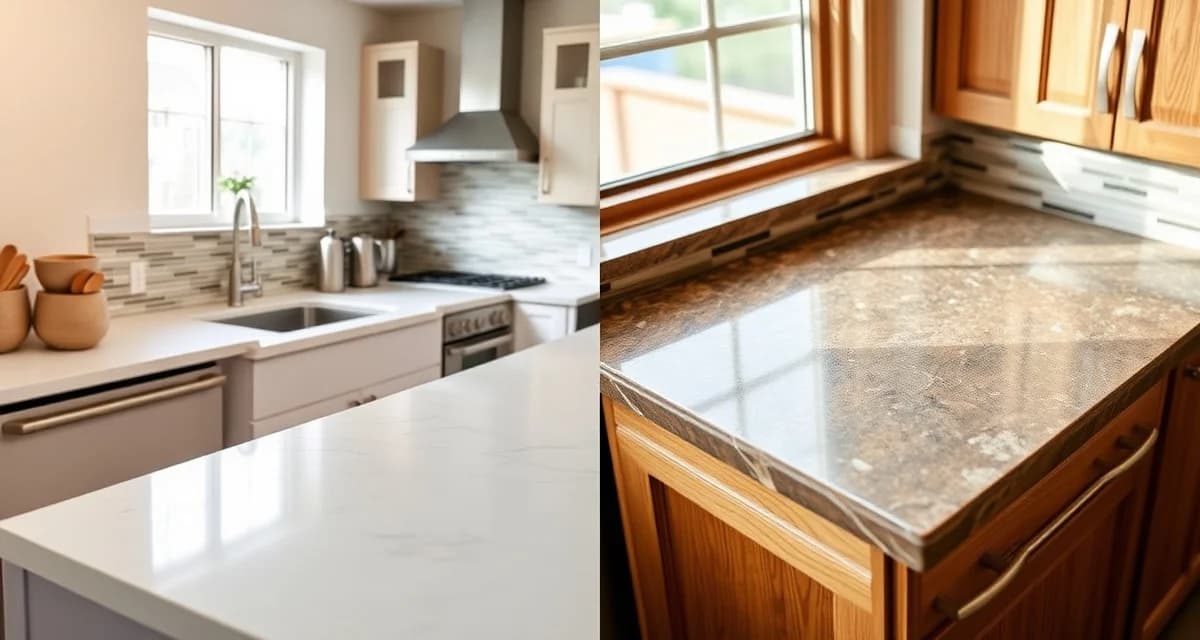
Quartz vs Soapstone Countertops: 2026 Comparison
Quartz and soapstone sit at opposite ends of the countertop personality spectrum. Quartz is modern, uniform, and low-maintenance. Soapstone is rustic, characterful, and develops a living patina over time. Both are excellent kitchen materials, but they appeal to very different homeowners.
TL;DR
- Soapstone never needs sealing and is naturally non-porous; quartz also never needs sealing
- Soapstone handles heat better than any countertop material - it is literally used in wood stoves; quartz scorches above 300F
- Soapstone scratches easily but scratches can be sanded out with fine sandpaper; quartz rarely scratches
- Soapstone develops a dark patina over time; quartz maintains its original appearance
- Pricing is similar: quartz $50-$150/sq ft, soapstone $70-$120/sq ft installed
- Soapstone comes in limited colors - mostly gray to dark charcoal; quartz offers hundreds of options
- Soapstone is chemically inert - acids, bases, and chemicals cause zero damage
Side-by-Side Comparison
| Feature | Quartz | Soapstone |
|---|---|---|
| Type | Engineered (quartz + resin) | Natural metamorphic stone (talc-based) |
| Installed Cost (per sq ft) | $50-$150 | $70-$120 |
| Sealing | Never | Not required (oiling is optional) |
| Heat Resistance | Low (scorches above 300F) | Excellent (fireproof) |
| Scratch Resistance | High | Low (soft, 1-2 Mohs) |
| Stain Resistance | Very High | High (naturally non-porous) |
| Acid/Chemical Resistance | Moderate (harsh chemicals damage resin) | Excellent (chemically inert) |
| Color Range | Hundreds of options | Very limited (grays, greens, blacks) |
| Repairability | Difficult | Excellent (sand and re-oil) |
| Patina | None (maintains appearance) | Darkens over time |
| Lifespan | 25-30+ years | 100+ years |
Heat Resistance: Soapstone's Superpower
Soapstone's heat resistance is genuinely remarkable. The material has been used to line wood-burning stoves and fireplaces for centuries. You can place a 500F pan, a hot baking sheet, or even a flaming dish directly on soapstone without any concern. The stone absorbs and radiates heat without any surface damage.
Calculate your material waste savings
See exactly how much slab material and money you could save with optimized cutting layouts.
Try the free Waste CalculatorQuartz, by contrast, scorches above 300F because of its resin content. This is probably the starkest practical difference between the two materials. If heat resistance matters to you, soapstone is in a class of its own.
Hardness and Scratch Resistance
Here is where soapstone's personality becomes polarizing.
Soapstone is soft - 1-2 on the Mohs hardness scale. A fingernail (2.5 Mohs) can scratch it. Knives, pots, and daily kitchen use will mark the surface. Over time, soapstone develops a network of fine scratches and wear marks.
But soapstone owners generally love this. The scratches become part of the stone's character, blending into the patina. And unlike most materials, soapstone scratches are easy to repair: sand with fine-grit sandpaper (220-grit), then apply mineral oil. The scratch disappears.
Quartz is extremely hard and resists scratching from normal kitchen activity. If you want a surface that looks the same on day 1,000 as day 1, quartz delivers that consistency.
The Patina Factor
Soapstone changes over time. New soapstone is typically light to medium gray. Over months and years, it darkens to a deep charcoal. This darkening happens naturally through oxidation, and it can be accelerated by applying mineral oil.
Many homeowners apply mineral oil when the countertop is new to immediately achieve the darker, richer appearance. Others let the stone age naturally, creating an uneven patina that lightens in less-touched areas and darkens where contact is frequent.
This evolving appearance is either soapstone's greatest charm or its most annoying trait, depending on your personality. If you want a surface that changes and tells a story, soapstone is beautiful. If you want predictable, consistent appearance, quartz is the safer bet.
Chemical Resistance
Soapstone is chemically inert - meaning it does not react with acids, bases, or any common household chemicals. Lemon juice, vinegar, wine, bleach, and even harsh laboratory chemicals cause zero surface damage. This is why soapstone has been used for laboratory countertops for over a century.
Quartz resists most household chemicals but can be damaged by oven cleaners, paint strippers, and other harsh solvents that attack the resin binder.
Color Limitations
This is soapstone's biggest competitive weakness. Natural soapstone comes in a very narrow color range: grays, dark grays, charcoal, and occasionally greenish-gray tones. There is no white soapstone, no patterned soapstone, and no way to significantly alter the color.
Quartz comes in hundreds of colors and patterns: whites, marbles, concretes, solids, and everything in between. If specific color matching matters for your kitchen design, quartz has an overwhelming advantage.
Maintenance
Both materials are surprisingly low-maintenance:
Quartz: Clean with soap and water. Never seal. Avoid harsh chemicals and hot pans. Done.
Soapstone: Clean with soap and water. Oiling is optional (purely cosmetic to enhance color). Sand out scratches as desired. Place hot items directly on the surface without worry. No sealing needed.
The maintenance approaches are different but equally simple. Soapstone asks you to occasionally sand a scratch and maybe apply oil. Quartz asks you to always use a trivet for hot items.
Best Uses
Choose Quartz When:
- Wide color and pattern selection is important
- You want a surface that stays the same over time
- Scratch-free appearance matters
- Modern or transitional kitchen design
Choose Soapstone When:
- Heat resistance is a top priority
- You love the idea of a living, aging surface
- Farmhouse, rustic, or historical kitchen aesthetic
- Chemical resistance matters (lab-quality inertness)
Does soapstone crack?
Soapstone is flexible for a stone and resists cracking better than granite or marble. It bends slightly under stress rather than snapping. Cracking is rare under normal kitchen conditions.
Is soapstone expensive?
Soapstone typically costs $70-$120 per square foot installed, putting it in the mid-to-premium range. This is comparable to mid-range quartz pricing. The limited color range means you are paying for performance and character, not variety.
How often do you oil soapstone?
Oiling is optional. Some homeowners oil weekly for the first month, then monthly, to accelerate patina development. Others never oil and let the stone age naturally. There is no wrong approach.
Will soapstone darken over time?
Yes. All soapstone gradually darkens from light/medium gray to deep charcoal through natural oxidation. This process takes months to years and can be accelerated with mineral oil application.
Can you cut on soapstone?
You can, but knives will mark the surface. Most soapstone owners use cutting boards out of habit, though scratches sand out easily.
Is soapstone good for baking?
Soapstone is excellent for bakers. Its ability to handle any temperature without trivets and its smooth surface for rolling dough make it a favorite in baking-focused kitchens.
Does soapstone harbor bacteria?
Soapstone is naturally non-porous and does not harbor bacteria. Its use in laboratory settings for over a century testifies to its sanitary properties.
Can you use soapstone outdoors?
Yes. Soapstone is naturally UV-stable and weather-resistant. It works well for outdoor kitchens, though the limited color range means it pairs best with rustic or natural outdoor designs.
Find Your Kitchen Personality
Quartz and soapstone attract different kinds of kitchen owners. Quartz is for those who want modern reliability. Soapstone is for those who want timeless character. Both are excellent materials that will serve your kitchen well.
Get a project estimate with our countertop cost calculator. Fabricators can try SlabWise free for 14 days to optimize quoting across all material types.
Try These Free Tools
- Cost Calculator -- Compare material costs instantly across different countertop options.
- Compare Materials -- Side-by-side material comparison with pricing, durability, and maintenance.
- Kitchen Visualizer -- Let customers preview countertop materials in their actual kitchen.
Sources & Further Reading
-
Natural Stone Institute - Technology and Software Solutions for Stone Fabricators
-
International Surface Fabricators Association - Fabrication Software and Digital Tools
-
National Kitchen & Bath Association - Technology Integration in Countertop Design
-
Marble Institute of America - Digital Fabrication and Software Standards