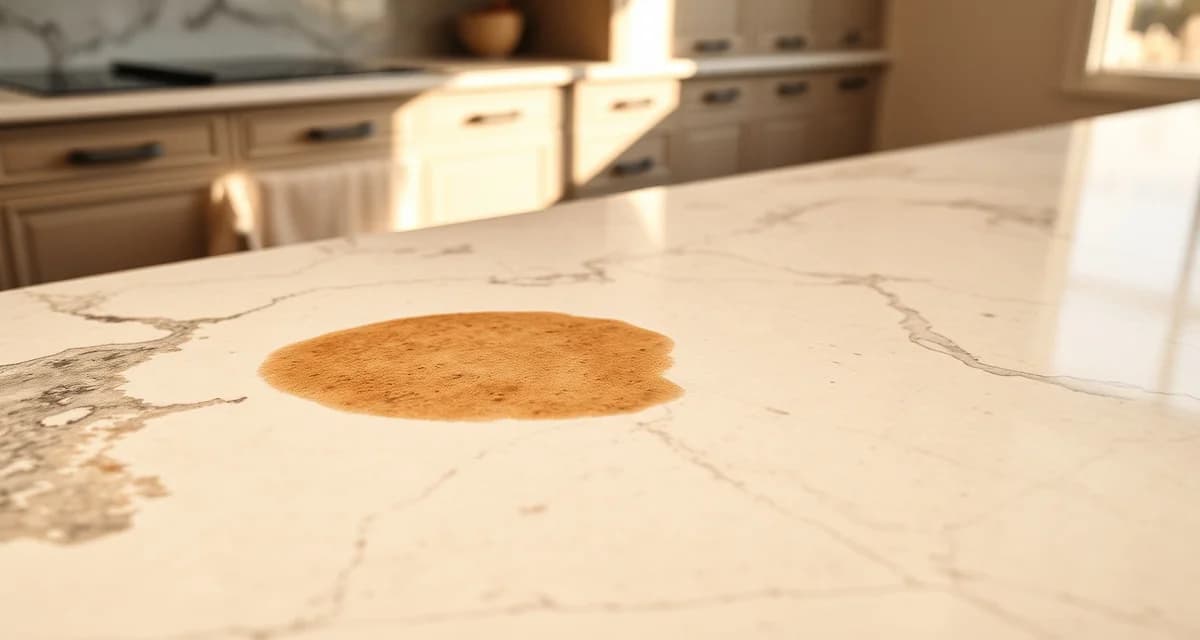
Marble Countertop Stained: How to Fix
Quick Definition
A stained marble countertop can usually be restored with the right approach and materials.
Marble countertop stains fall into two categories: actual stains (where a substance has absorbed into the stone's pores) and etching (where an acid has chemically reacted with the marble surface, creating a dull spot). The fix depends entirely on which problem you have. Stains require a poultice to draw the substance out. Etching requires polishing to restore the surface. Knowing the difference saves time, money, and frustration.
TL;DR
- Stains are dark spots where something soaked into the marble; etching is a dull/light spot caused by acid
- The poultice method removes most organic and oil-based stains in 24-48 hours
- Etch marks on polished marble require honing and repolishing by a professional ($200-$500)
- Honed marble hides etch marks better than polished marble
- Prevention (sealing every 6-12 months + prompt spill cleanup) is far easier than repair
- Different stain types need different treatment -- identify the stain source before choosing a method
- Professional marble restoration costs $3-$8/sq ft for full surface refinishing
Stain vs. Etch: Identify Your Problem First
| Characteristic | Stain | Etch |
|---|---|---|
| Appearance | Dark spot or discoloration | Light/dull spot or ring |
| Cause | Liquid absorbed into pores | Acid dissolved surface calcite |
| Feel | Same texture as surrounding marble | Rough or matte compared to surrounding |
| Common sources | Coffee, wine, oil, rust | Lemon, vinegar, tomato sauce, wine (acid) |
| Fix method | Poultice to draw out | Polish to restore surface |
| DIY difficulty | Moderate | Difficult (for polished marble) |
Note: Wine is a double offender -- it both stains (color absorption) and etches (acid reaction). You may need to treat both issues.
Calculate your material waste savings
See exactly how much slab material and money you could save with optimized cutting layouts.
Try the free Waste CalculatorRemoving Stains by Type
Organic Stains (Coffee, Tea, Wine, Food)
Appearance: Pink, brown, or dark discoloration Treatment: Hydrogen peroxide poultice
Poultice method:
- Mix 12% hydrogen peroxide with enough baking soda or diatomaceous earth to form a thick paste (peanut butter consistency)
- Apply the paste over the stain, extending 1 inch beyond the stain edges
- Cover with plastic wrap and tape the edges to seal
- Allow to sit 24-48 hours (the poultice draws the stain upward as it dries)
- Remove the dried poultice, rinse with water, and dry
- Repeat if the stain has lightened but not fully disappeared (up to 3 applications)
Oil-Based Stains (Cooking Oil, Grease, Butter)
Appearance: Darkened area that may feel slightly greasy Treatment: Acetone or mineral spirits poultice
Poultice method:
- Mix acetone (or mineral spirits) with baking soda or diatomaceous earth to form a paste
- Apply over the stain area, cover with plastic wrap
- Allow to sit 24-48 hours
- Remove, rinse, and assess. Oil stains often require 2-3 applications
Important: Acetone is flammable. Use in a ventilated area, away from heat sources.
Rust Stains
Appearance: Orange, brown, or reddish discoloration, often circular (from a can or metal object) Treatment: Rust-specific poultice or commercial rust remover rated for marble
Process:
- Apply a commercial marble rust remover (follow product directions -- these are typically acidic, so test on an inconspicuous area first)
- For stubborn rust: iron-out powder mixed with water to a poultice consistency
- Apply, cover, and wait 24 hours
- Rust stains are among the most stubborn; professional treatment may be needed
Warning: Rust stains from embedded iron within the marble itself (not surface contamination) cannot be permanently removed because the iron source remains in the stone.
Water Stains and Hard Water Deposits
Appearance: White haze, rings, or cloudy areas Treatment: These are usually mineral deposits sitting on the surface, not true stains
Process:
- Apply a marble-safe hard water remover (do NOT use vinegar or acidic cleaners)
- Gently scrub with a soft cloth
- Rinse thoroughly and dry
- For stubborn deposits, a fine (0000 grade) steel wool pad can be used carefully on polished marble
Fixing Etch Marks
Etch marks are surface damage, not stains. The acid has dissolved a thin layer of the marble's calcite surface, creating a dull spot on polished marble (or a lighter spot on honed marble).
Minor Etch Marks on Polished Marble
DIY approach: Marble polishing powder
- Wet the etched area with water
- Sprinkle marble polishing powder (tin oxide or commercial marble polish) onto the wet surface
- Buff with a soft cloth or felt pad using circular motions for 3-5 minutes
- Rinse and dry
- Repeat until the etch mark blends with the surrounding polish
This works for light etch marks. Deep etching requires professional honing and repolishing.
Severe Etch Marks on Polished Marble
Professional cost: $200-$500 for spot repair; $3-$8/sq ft for full surface refinishing
Professional marble restoration involves:
- Honing the affected area with diamond pads (starting at 200-400 grit)
- Progressively polishing through finer grits (800, 1500, 3000)
- Finishing with marble polishing compound
- Feathering the polished area into the surrounding surface so the repair is invisible
Etch Marks on Honed Marble
Honed marble shows etch marks less because the surface is already matte. Minor etching on honed marble often blends naturally over time as the surrounding surface develops similar wear. For visible etch marks on honed marble:
- Sand lightly with 400-grit wet sandpaper
- Follow with 800-grit
- The etch mark should blend into the honed surface
Prevention Strategy
Preventing stains and etching is dramatically easier than fixing them:
Sealing
- Apply penetrating impregnating sealer every 6-12 months on kitchen countertops
- Test if resealing is needed: place a few drops of water on the surface. If it absorbs within 5 minutes (darkening the stone), resealing is due
- Sealer does NOT prevent etching -- it only slows liquid absorption. Acidic liquids will still etch sealed marble
Daily Care
| Do | Do Not |
|---|---|
| Wipe spills immediately | Let liquids sit on marble |
| Use pH-neutral stone cleaner | Use vinegar, lemon, or acidic cleaners |
| Use coasters under glasses | Place citrus fruits directly on surface |
| Use cutting boards | Cut acidic foods directly on marble |
| Use trivets under hot items | Place hot pots on marble |
Client Education for Fabricators
If you fabricate and install marble countertops, providing clients with written care instructions reduces callbacks and complaints. Many stain and etch complaints come from clients who were not informed about marble's maintenance requirements at the time of installation.
A simple care card included at installation prevents most common issues. This protects both the client's investment and your shop's reputation.
Can you get stains out of marble?
Most stains can be removed from marble using the poultice method. Organic stains (coffee, wine, food) respond well to hydrogen peroxide poultice. Oil-based stains respond to acetone poultice. Rust stains are the most difficult and may require professional treatment.
Why does my marble have dull spots?
Dull spots on polished marble are almost always etch marks caused by acidic contact. Lemon juice, vinegar, tomato sauce, wine, and many cleaning products contain acids that react with marble's calcium carbonate surface. These are not stains -- they are chemical damage to the polish.
How much does professional marble stain removal cost?
Spot treatment for a single stain runs $100-$200. Etch mark repair costs $200-$500 for spot work. Full surface refinishing (honing and repolishing the entire countertop) costs $3-$8/sq ft, or $200-$600 for a typical bathroom vanity and $500-$1,500 for a kitchen countertop.
Does sealing marble prevent stains?
Sealing significantly reduces stain risk by slowing liquid absorption. A well-sealed marble surface gives you time to clean spills before they penetrate. However, sealer does not prevent etching from acidic liquids -- it only addresses absorption-based stains.
Is honed marble easier to maintain than polished?
In practice, yes. Honed marble hides etch marks and minor wear better than polished marble because the surface is already matte. Water spots, fingerprints, and light etching blend naturally into a honed surface. The trade-off is that honed marble is more porous and needs more frequent sealing.
Can I use baking soda on marble?
Baking soda is safe on marble. It is mildly alkaline and non-scratching, making it a good base for poultice mixes. Do NOT confuse baking soda with baking powder or cream of tartar, which contain acidic components.
Why does my marble turn yellow?
Yellowing in marble typically results from iron oxidation within the stone. Moisture trapped behind or beneath the marble can trigger iron minerals in the stone to oxidize, creating a yellowish discoloration. This is an internal process and is different from surface staining.
How often should marble countertops be sealed?
Kitchen countertops: every 6-12 months. Bathroom vanities: every 12-18 months. Frequency depends on use intensity and the specific sealer product. Perform the water drop test periodically to assess sealer condition.
Can bleach be used on marble?
Diluted bleach can remove organic stains from light-colored marble, but it should be used sparingly and briefly. Full-strength bleach can damage the stone surface. Always test in an inconspicuous area first.
Will marble stains get worse over time?
Untreated stains typically darken and set deeper over time as the staining substance continues to migrate into the stone's pore structure. Early treatment produces better results than delayed treatment.
Help Clients Maintain Their Marble Countertops
Educated clients are satisfied clients. When you install marble countertops, the sale does not end at installation. SlabWise helps fabrication shops manage client relationships from quote to long-term care, including automated follow-up reminders for resealing and maintenance.
Try These Free Tools
- Cost Calculator -- Get instant countertop cost estimates by material, edge profile, and square footage.
- Compare Materials -- Side-by-side material comparison with pricing, durability, and maintenance ratings.
- Edge Profile Selector -- Browse edge profiles with cost impact and visual previews.
Sources & Further Reading
-
Natural Stone Institute - Stone Installation Guidelines and Best Practices
-
National Kitchen & Bath Association - Countertop Installation Standards
-
International Surface Fabricators Association - Fabrication and Installation Technical Guide
-
Marble Institute of America - Stone Care and Installation Manual
Internal Links
- Italian Marble Guide -- Understand Carrara, Calacatta, and Statuario
- Quartz Discoloration Guide -- Compare marble maintenance to quartz issues
- Granite Sealer Failing Guide -- Sealing best practices for all natural stone
- Bathroom Countertop Trends 2026 -- Marble in bathroom design