The Problem in 60 Seconds
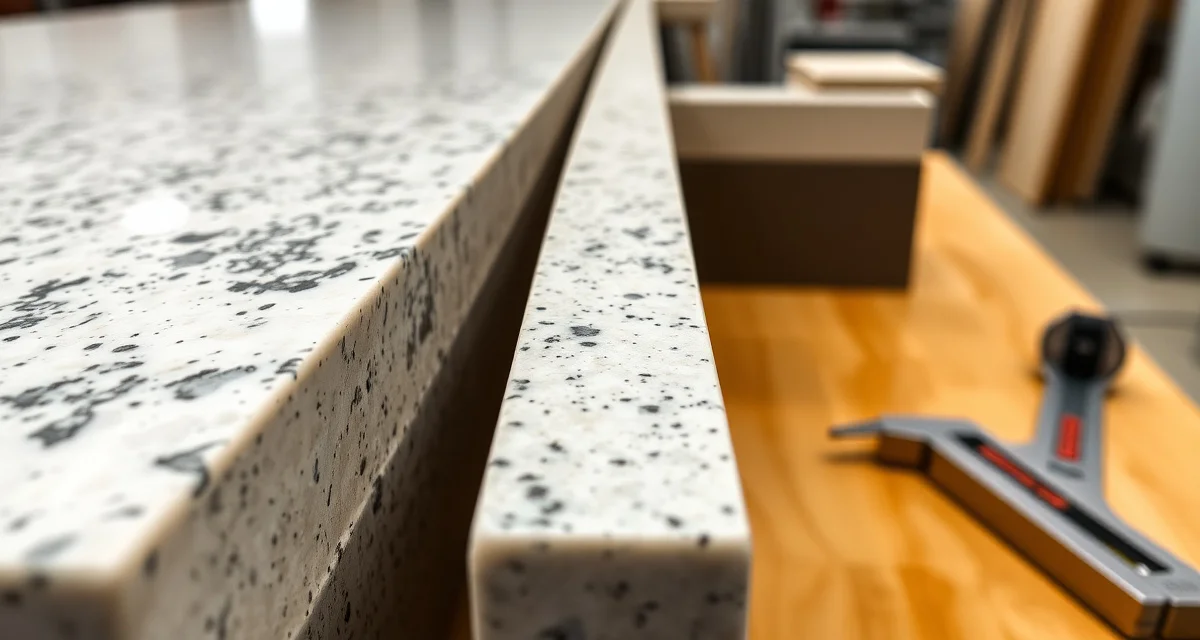
Inconsistent edge profiles are one of the most visible fabrication defects - and one of the hardest to fix after installation. When edge shapes vary along a countertop run, between pieces in the same kitchen, or from the shop sample to the installed product, the result is a job that looks wrong even to untrained eyes. This leads to customer complaints, callbacks, and costly remakes.
TL;DR - Fixing Inconsistent Edge Profiles
- Edge inconsistencies are the #2 customer complaint behind seam quality issues
- Root causes: worn tooling, manual profiling variations, template errors, and operator-to-operator differences
- Each edge-related callback costs $400-$1,200 in labor; full remakes run $1,500-$4,000
- CNC routers produce edge profiles within 0.5mm tolerance vs. 2-3mm for hand profiling
- Template verification software catches edge profile mismatches before fabrication starts
- Standardized tool change schedules reduce edge quality drift by 60-80%
- Digital work orders eliminate the "telephone game" between sales, template, and fabrication
Why Edge Profiles Come Out Wrong
The Five Root Causes
Edge inconsistency isn't random. It traces back to five specific failure points:
Calculate your material waste savings
See exactly how much slab material and money you could save with optimized cutting layouts.
Try the free Waste Calculator1. Worn or Damaged Tooling
Edge profile bits and polishing pads degrade with use. A bullnose bit that cuts a perfect radius at hour 1 produces a slightly flatter profile at hour 200. Most shops don't track tooling hours - they replace bits when someone notices the edges look off. By then, they've already shipped inconsistent work.
| Tooling Type | Recommended Replacement Interval | Common Practice |
|---|---|---|
| Diamond profile bits | Every 150-200 linear feet | "When it looks bad" |
| Polishing pads (resin) | Every 100-150 linear feet | "When the shine drops" |
| Polishing pads (diamond) | Every 200-300 linear feet | "When someone complains" |
2. Operator-to-Operator Variation
In shops using hand-held routers or semi-manual profiling, each operator develops slightly different technique. Operator A applies more pressure, producing a deeper ogee curve. Operator B moves faster, leaving a slightly shallower profile. The difference is subtle on any single piece but visible when pieces are installed side by side.
3. Template-to-Fabrication Miscommunication
The customer approved an eased edge with a 1/16" radius. The template notes say "eased." The fabricator interprets "eased" as a slightly rounded square edge - which is technically correct but can range from a barely-broken corner to a visible quarter-round depending on who's running the router.
4. Mixed CNC and Hand Processing
Some shops CNC-cut the straight runs but hand-profile the curves, inside corners, or sink cutout edges. The CNC-profiled sections are consistent; the hand-profiled sections are not. The customer sees the mismatch where machine work meets hand work.
5. Material-Specific Challenges
Different stones respond differently to profiling tools. A profile that comes out clean on quartz may chip on granite or feather on marble. Shops that don't adjust speeds, feed rates, and tooling for each material type produce inconsistent edges across their mix of jobs.
The Real Cost of Edge Inconsistency
Direct Costs
| Consequence | Cost Per Occurrence |
|---|---|
| On-site edge re-polishing | $400-$800 (technician time + travel) |
| Partial re-fabrication (one piece) | $800-$2,000 (material + labor) |
| Full re-fabrication | $1,500-$4,000 (material + labor + second install) |
| Average monthly edge-related callbacks (2-4 shops) | $1,600-$8,000 |
Indirect Costs
- Reputation damage. One visible edge inconsistency photographed and posted to a Google review affects dozens of future prospects.
- Contractor relationship strain. General contractors who send clients to your shop and get callbacks will stop referring work.
- Crew demoralization. Fabricators who take pride in their work hate doing remakes. Repeated callbacks erode job satisfaction and contribute to turnover.
Solution 1: Standardize Through CNC Processing
The single biggest improvement a shop can make is moving all edge profiling to CNC equipment.
CNC vs. Hand Profiling
| Factor | CNC Router | Hand Router |
|---|---|---|
| Profile tolerance | ±0.5mm | ±2-3mm |
| Repeatability across pieces | 99%+ consistent | Varies by operator |
| Speed (linear foot/min) | Consistent, programmable | Operator-dependent |
| Inside corners and curves | Programmed, consistent | Skill-dependent |
| Operator skill requirement | CNC programming | Manual profiling skill |
If you already have a CNC router, the fix might be as simple as programming all standard edge profiles into the machine and routing 100% of edge work through the CNC - including curves, inside corners, and sink cutout edges that many shops still hand-finish.
Solution 2: Implement Template Verification
Edge profile errors often start at the template stage. The customer says "ogee." The template notes say "OG." The fabricator interprets "OG" as either a standard ogee or a Roman ogee depending on their training. The finished product doesn't match what the customer expected.
Template verification software eliminates this by:
- Requiring specific edge profile selection from a standardized dropdown - not free-text notes
- Attaching a visual profile image to each edge specification in the digital work order
- Running a 3-layer check that compares the specified edge against the CNC profile library to confirm the machine can produce it
- Flagging mismatches between the quoted edge profile and the template specification before fabrication starts
This catches the "telephone game" errors that cause 30-40% of edge-related callbacks. The fix takes seconds at the verification stage; at the installation stage, it costs $400-$4,000.
Solution 3: Establish Tooling Maintenance Schedules
Replace the "when it looks bad" approach with data-driven tool replacement:
Tooling Replacement Protocol
- Track linear feet per tool. Log the running footage on each profile bit and polishing pad. Many CNC machines track this automatically; for manual tools, use a simple spreadsheet.
- Set replacement thresholds. Based on the manufacturer's recommendations and your quality observations, set maximum footage before mandatory replacement.
- Inspect before each shift. Visual inspection of profile bits takes 2 minutes and catches chips or wear that would degrade the next run.
- Keep replacement inventory on hand. The most common reason shops push worn tooling is that the replacement isn't in stock. Maintain a 2-week buffer of consumable tooling.
Shops that implement scheduled tool replacement report 60-80% fewer edge-quality complaints. The tooling cost increase is typically $200-$500/month - far less than a single callback.
Solution 4: Create Edge Profile Standards
Build a shop-specific edge profile reference guide:
- Photograph each standard profile from the side, at 45 degrees, and from above
- Document the CNC program number for each profile
- Specify the tooling (bit type, grit sequence) for each profile
- Include material-specific notes (e.g., "reduce feed rate 15% on White Macaubas marble")
- Post the guide at every workstation - templating station, CNC console, hand-finishing bench, and QC inspection point
When the template tech, the CNC operator, and the hand-finisher are all looking at the same reference photo, interpretation errors drop dramatically.
Solution 5: Quality Check Before Packaging
Add a 3-minute edge inspection to your end-of-fabrication workflow:
- Run a straightedge along each profiled edge to check for humps or dips
- Compare the profile against the work order's specified edge (using your reference photos)
- Check polish consistency - inconsistent shine is often the first sign of edge problems
- Verify that curved sections match straight sections in profile depth and radius
- Document with a photo attached to the job file
This final check catches issues that slipped through earlier stages. Three minutes of inspection prevents hours of callback and remake labor.
How Software Ties It All Together
Individual solutions help, but they work best as a system. Fabrication management software connects the entire chain:
- Sales quotes specify the exact edge profile with a visual reference
- Digital templates carry the edge specification through to fabrication without re-entry
- Template verification confirms the edge profile matches the quote and the CNC library
- Nesting software includes the edge profile in the CNC program file
- Job tracking documents which tools, programs, and operators were involved - creating traceability if an issue surfaces later
Platforms like SlabWise integrate these steps into a single workflow, eliminating the handoff gaps where edge profile errors enter the process.
What are the most common edge profile complaints?
The top three: (1) profile shape doesn't match the sample or quote, (2) profile varies between adjacent pieces in the same kitchen, and (3) uneven polish or rough spots along the profiled edge.
Which edge profiles are hardest to keep consistent?
Ogee and dupont edges - profiles with multiple curves - have the most room for variation. Eased edges and simple bevels are the easiest to keep consistent across pieces.
How much does a CNC router cost?
Entry-level CNC routers suitable for edge profiling start around $25,000-$40,000. Mid-range machines with automatic tool changers run $50,000-$120,000. The investment typically pays for itself in 12-18 months through reduced callbacks and improved throughput.
Can you fix an inconsistent edge after installation?
Minor inconsistencies can be corrected on-site with a hand polisher ($400-$800 per visit). Significant profile differences require re-fabrication of the affected piece ($800-$4,000 including reinstallation).
How often should I replace profiling tooling?
Follow manufacturer recommendations as a baseline. For diamond profile bits, 150-200 linear feet is typical. Track actual footage and correlate with quality inspections to calibrate replacement intervals for your specific material mix.
Does material type affect edge consistency?
Yes, significantly. Quartz and engineered stone profile very consistently. Natural granites vary by hardness and crystal structure. Marble and quartzite are more prone to chipping during profiling. Porcelain slabs require specialized tooling and reduced feed rates.
What's the fastest way to reduce edge complaints?
Move all edge profiling to CNC processing (if you have the equipment) and implement template verification software to catch specification errors before fabrication. Together, these two changes address 70-80% of edge inconsistency root causes.
How does template verification prevent edge problems?
Verification software checks the specified edge profile against the CNC's profile library, flags free-text edge descriptions that could be misinterpreted, and attaches visual references to the digital work order. This eliminates the communication gaps between sales, templating, and fabrication.
Stop Fixing Edges After the Fact
Edge consistency problems are process problems - and process problems are solvable. SlabWise connects your quoting, templating, verification, and fabrication workflow so edge profiles are specified once, verified automatically, and produced consistently.
Start Your 14-Day Free Trial →
Try These Free Tools
- Nesting Optimizer -- AI-powered slab layout that maximizes yield considering vein direction and defects.
- Defect Mapping -- Upload a slab photo and AI maps every fissure, pit, and color issue.
- Value Engineering -- Find dollar-quantified suggestions to save material without cutting margin.
Sources & Further Reading
-
Natural Stone Institute - Customer Service Best Practices for Stone Fabricators
-
International Surface Fabricators Association - Effective Client Communication Strategies
-
National Kitchen & Bath Association - Managing Client Expectations in Kitchen Projects
-
Remodeling Magazine - Preventing Customer Complaints Through Better Communication