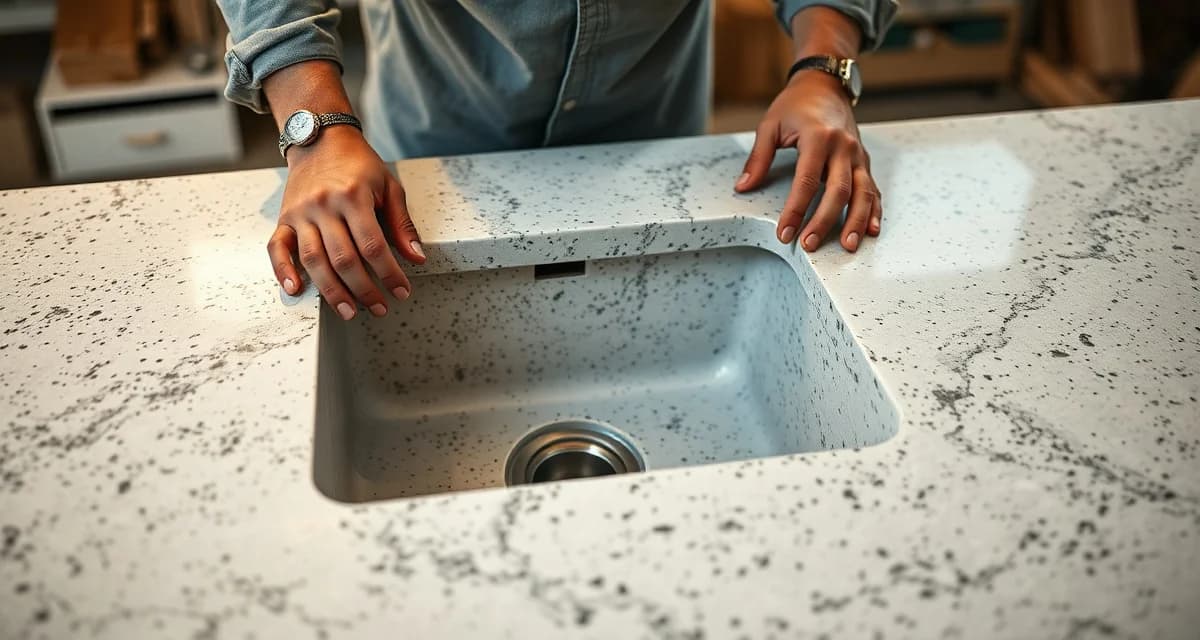
Do You Install Sink Before Countertops?
Quick Definition: The sink is not permanently installed before the countertop, but you need to have the sink on-site before templating so the fabricator can make the correct cutout. For undermount sinks, the sink is attached to the underside of the countertop either at the fabrication shop or during installation. For drop-in sinks, the sink is placed into the cutout after the countertop is installed.
TL;DR
- The sink must be purchased before templating -- the fabricator needs exact dimensions for the cutout
- Undermount sinks are attached to the countertop before or during installation (not before fabrication)
- Drop-in (top-mount) sinks are placed into the cutout after the countertop is installed
- Farmhouse/apron sinks are installed before countertops -- the countertop is templated around the sink
- The plumber typically disconnects before and reconnects after countertop installation
- Wrong sink dimensions are a leading cause of fabrication errors -- always have the actual sink on-site for template day
- Sink model changes after templating require re-fabrication (expensive)
The Correct Order of Operations
For Undermount Sinks (Most Common with Stone Countertops)
- Purchase the sink (before template day)
- Template day: Fabricator measures the countertop area and confirms sink model/dimensions
- Fabrication: Cutout is made in the slab based on the sink's template drawing
- Pre-installation: Some fabricators mount the sink to the countertop at the shop; others do it on-site
- Installation day: Countertop with sink attached is placed on cabinets
- Plumber reconnects faucet, drain, garbage disposal, and water supply lines
For Drop-In (Top-Mount) Sinks
- Purchase the sink (before template day)
- Template day: Fabricator records cutout dimensions
- Fabrication: Cutout is made slightly larger than undermount (the sink rim covers the edge)
- Installation day: Countertop is installed
- Sink is dropped in from the top and sealed with plumber's putty or silicone
- Plumber connects everything below
For Farmhouse (Apron-Front) Sinks
This is the one exception where the sink goes in first:
Calculate your material waste savings
See exactly how much slab material and money you could save with optimized cutting layouts.
Try the free Waste Calculator- Purchase the sink
- Cabinet modification: The sink base cabinet is modified or a special cabinet is installed to support the farmhouse sink
- Sink is set into the cabinet and leveled
- Template day: The fabricator templates around the already-installed sink, capturing its exact position and dimensions
- Fabrication: The countertop is cut to fit precisely around the sink
- Installation: Countertop is set in place, fitting tightly around the farmhouse sink
- Plumber reconnects
Why farmhouse sinks go first: An apron-front sink is visible from the front. The countertop must fit precisely around its top edge. If you template without the sink in place, you're guessing -- and guessing leads to gaps or tight spots.
Why You Need the Actual Sink Before Templating
This is one of the most common sources of fabrication problems. Here's why the fabricator needs your actual sink (or at minimum, the exact model number and manufacturer template):
Sink Dimensions Vary
Two "33-inch single-bowl undermount sinks" from different manufacturers can have different actual cutout dimensions, corner radii, and clip positions. The fabricator needs the manufacturer's cutout template -- not generic dimensions.
Cutout Tolerances Are Tight
For undermount sinks, the cutout must be:
- Large enough for the sink to fit through from below
- Small enough for the sink rim to have adequate overlap (usually 1/4" to 3/8" on each side)
- Positioned correctly front-to-back and side-to-side within the countertop
A cutout that's 1/4" too large in any direction means the sink rim may not fully support the countertop edge, potentially leading to failure under load.
What Happens if You Change the Sink After Templating
| Scenario | Consequence |
|---|---|
| New sink is same size | Usually OK -- verify with fabricator |
| New sink is slightly smaller | Cutout may be too large -- visible gaps |
| New sink is larger | Cutout is too small -- requires re-cut or new slab |
| New sink has different corner radius | Undermount alignment won't match |
| New sink type (e.g., drop-in to undermount) | Complete re-fabrication needed |
Cost of re-fabrication due to sink change: $500-$2,000+ depending on material and whether a new slab is needed.
Undermount vs. Drop-In: Installation Differences
| Factor | Undermount | Drop-In (Top-Mount) |
|---|---|---|
| Sink visibility | Hidden under counter | Rim visible on top |
| Cutout precision | Must be very precise | More forgiving (rim covers edge) |
| Attachment method | Epoxy + clips from below | Gravity + sealant from above |
| Water cleanup | Easy -- wipe crumbs directly into sink | Rim catches crumbs |
| Sink replacement | Harder (requires detaching from stone) | Easier (lift out, reseal) |
| Cost difference | $50-$150 more for undermount installation | Standard |
| Best with | Stone, quartz, solid surface | Laminate, tile, stone |
The Plumber's Role in Countertop Installation
The plumber's work bookends the countertop installation:
Before Countertop Installation
- Disconnect water supply lines
- Disconnect drain and garbage disposal
- Remove the faucet (or it can stay if the countertop is being replaced with the same faucet hole position)
- Cap water lines to prevent leaks during construction
After Countertop Installation
- Mount the faucet through the countertop hole(s)
- Connect water supply lines
- Connect the drain assembly
- Reconnect garbage disposal
- Reconnect dishwasher drain line
- Test for leaks
Important timing note: Schedule the plumber for the same day as or the day after countertop installation. Every day without a functioning kitchen sink is a day of frustration for the homeowner.
For fabricators, coordinating plumber timing with installation day is a frequent source of customer complaints. SlabWise's Customer Portal gives homeowners clear scheduling milestones, including when to have their plumber available -- reducing the back-and-forth calls that slow down your day.
Common Sink-Related Mistakes
Mistake 1: Not Having the Sink on Template Day
The fabricator either has to come back (delaying the project) or use manufacturer specs (riskier than measuring the actual sink).
Mistake 2: Buying a Sink That Doesn't Fit the Cabinet
Standard sink base cabinets are 30" or 36" wide. The sink must fit within the cabinet interior with room for clips and plumbing. A 33" sink in a 30" cabinet doesn't work.
Mistake 3: Changing the Sink After the Countertop Is Fabricated
Even if the new sink is "about the same size," the cutout may not align. Always verify with the fabricator before making changes.
Mistake 4: Forgetting About the Garbage Disposal
If you're adding a garbage disposal, the plumber may need extra clearance below the sink. Also, the countertop may need an air switch hole for the disposal activation button.
Mistake 5: Not Specifying Faucet Hole Count
The fabricator needs to know how many faucet holes to drill, their spacing, and their position. A single-hole faucet, a 3-hole widespread faucet, and a bridge faucet all require different setups.
FAQ
Do you install the sink before or after the countertop? After, in most cases. Undermount sinks are attached to the countertop during or just before installation. Drop-in sinks go in after the countertop is set. Farmhouse sinks are the exception -- they're installed before the countertop.
Do I need my sink before the countertop is templated? Yes. The fabricator needs the sink's exact dimensions (or manufacturer cutout template) to make an accurate cutout. Having the actual sink on-site is strongly recommended.
Who installs the undermount sink -- the fabricator or the plumber? The fabricator or countertop installer typically mounts the undermount sink to the countertop (using epoxy and clips). The plumber handles the faucet, drain, and water connections.
Can I change my sink after the countertop is templated? Only if the new sink has the same or very similar cutout dimensions. Even small differences can cause fit problems. Always check with your fabricator before making changes.
What kind of sink is best with granite or quartz countertops? Undermount sinks are the most popular choice with stone and quartz countertops. They provide a clean look and make cleanup easier since there's no rim to catch debris.
Do I need a plumber for countertop installation? You need a plumber to disconnect and reconnect the sink, faucet, garbage disposal, and water lines. The countertop installer handles the stone work but not the plumbing.
How long after countertop installation can I use the sink? The plumber can typically reconnect the same day. If the undermount sink is attached with epoxy, allow 24 hours for the adhesive to cure before putting heavy loads in the sink.
Can I reuse my old sink with new countertops? Yes, if it's in good condition and you want the same size and style. Provide the sink to the fabricator for template day so the new cutout matches exactly.
What if the sink cutout is too big? If the cutout is slightly too large, the undermount clips may still hold, but the margin is thinner and less stable. Significantly oversized cutouts require a new countertop section -- there's no way to add stone back.
How much does a sink cutout cost? Most fabricators charge $150-$400 for a sink cutout, which includes the cutting, polishing the interior edges, and (for undermount) mounting the sink.
simplify Sink and Countertop Coordination
For fabricators, sink-related errors are among the most expensive callbacks. SlabWise's Template Verification system cross-checks cutout dimensions against the specified sink model, catching mismatches before the slab is cut.
Try These Free Tools
- Photo to Template -- Snap a photo of an existing countertop and get an AI-generated DXF template.
- Template Compare -- Upload two templates and see every dimension change highlighted instantly.
- AI Template Verification -- Cross-check your template against manufacturer specs before cutting.
Sources & Further Reading
- Natural Stone Institute - Countertop Support Guidelines
- International Surface Fabricators Association - Structural Support Requirements
- National Kitchen & Bath Association - Countertop Installation Standards
- ASTM International - C1526 Standard Specification for Serpentine Dimension Stone