Who Drills Faucet Holes in Countertops?
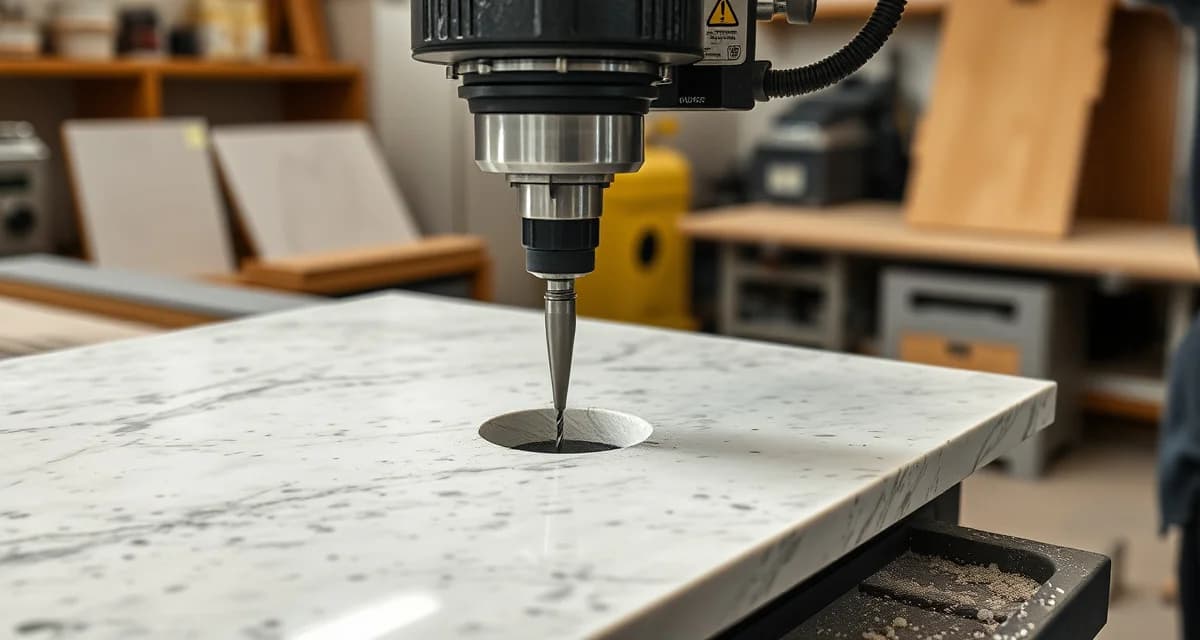
Quick Definition: The countertop fabricator drills faucet holes during the fabrication process, before the countertop is installed. Holes are typically 1-3/8" in diameter, drilled with diamond-tipped core drill bits on a CNC machine or drill press. The number, size, and placement of holes depend on your faucet type. Never drill stone countertops yourself -- incorrect drilling can crack the slab.
TL;DR
- The fabricator drills faucet holes -- not the plumber, not the installer, and not you
- Holes are drilled during fabrication at the shop, before installation
- Standard faucet hole diameter: 1-3/8" (35mm)
- Number of holes depends on faucet type: 1 hole (single-handle), 3 holes (widespread), or 4 holes (with sprayer)
- You must select your faucet before templating so the fabricator knows hole count, size, and spacing
- Drilling after installation is possible but risky and expensive ($75-$200 per hole on-site)
- Additional holes may be needed for soap dispensers, air gaps, instant hot water taps, or water filtration
- Wrong hole placement is irreversible in stone -- there's no way to fill and re-drill
Why the Fabricator Drills the Holes
Drilling holes in stone countertops requires:
Calculate your material waste savings
See exactly how much slab material and money you could save with optimized cutting layouts.
Try the free Waste Calculator- Diamond-tipped core drill bits -- standard drill bits won't cut through granite, quartz, or marble
- Water cooling -- dry drilling can overheat and crack the stone
- Precise positioning -- holes must match the faucet's mounting specs exactly
- Controlled pressure -- too much pressure cracks the stone; too little causes the bit to wander
- Proper support -- the slab must be fully supported underneath the drill point
Fabrication shops have CNC machines that drill holes with sub-millimeter accuracy, or they use bench-mounted drill presses with diamond core bits. Either way, drilling happens in a controlled environment where the slab is fully supported and water is flowing.
Faucet Hole Requirements by Type
| Faucet Type | Number of Holes | Standard Hole Size | Hole Spacing |
|---|---|---|---|
| Single-handle (1-hole) | 1 | 1-3/8" | N/A |
| Single-handle with side sprayer | 2 | 1-3/8" each | 8" apart (varies) |
| Centerset (4" spread) | 3 | 1-3/8" each | 4" center-to-center |
| Widespread (8" spread) | 3 | 1-3/8" each | 8" center-to-center |
| Bridge faucet | 2 | 1-3/8" each | 8" apart (varies) |
| Wall-mounted | 0 (holes in wall) | N/A | N/A |
| Soap dispenser | 1 | 1-1/4" to 1-3/8" | Separate location |
| Air gap (for RO system) | 1 | 1-1/4" | Near sink |
| Instant hot water tap | 1 | 1-3/8" | Near sink |
Why You Need to Choose Your Faucet First
A single-handle faucet needs one hole. A widespread faucet needs three holes spaced 8 inches apart. If you haven't chosen your faucet by template day, the fabricator either has to guess (bad) or delay fabrication until you decide (costly).
Even worse: if the fabricator drills for a single-hole faucet and you later decide on a widespread model, you're stuck with three options:
- Choose a single-hole faucet (change your mind)
- Have two additional holes drilled on-site (risky and expensive)
- Replace the countertop section (very expensive)
Where Faucet Holes Are Positioned
Standard Placement
For kitchen sinks, faucet holes are typically centered behind the sink cutout, about 2-3 inches back from the sink edge. The exact position depends on:
- The faucet's reach (how far the spout extends over the sink)
- Cabinet and backsplash obstructions
- The homeowner's preference for faucet position
Off-Center Placement
Some homeowners prefer the faucet to one side of the sink (common with large single-bowl sinks where the faucet is positioned to the right or left). This must be specified before fabrication.
Corner Sinks
Corner sink configurations require careful hole placement since the faucet may need to be angled or positioned on a diagonal. This is a good reason to have the actual faucet on-site during templating.
Can Holes Be Drilled After the Countertop Is Installed?
Yes, but it's not ideal. On-site drilling is:
- Riskier -- the slab isn't as well supported as it is in the shop
- Messier -- water and stone dust in your kitchen
- More expensive -- $75-$200 per hole for on-site drilling
- Less precise -- hand-held drilling is harder to control than CNC
When On-Site Drilling Happens
- The homeowner forgot to select a faucet before fabrication
- A soap dispenser or hot water tap is being added after the fact
- The original faucet is being replaced with one that needs different hole configuration
- A hole was accidentally positioned incorrectly and needs correction nearby
On-Site Drilling Process
- Fabricator brings a diamond core drill bit and water supply
- A jig or template is positioned to mark exact hole location
- Wet drilling with steady, moderate pressure
- The plug of stone is carefully removed
- Edges are smoothed
Materials and On-Site Drilling Risk
| Material | On-Site Drilling Risk |
|---|---|
| Granite | Low-moderate (granite drills well if done carefully) |
| Quartz | Moderate (resin can overheat; silica dust concern) |
| Marble | Low-moderate (softer stone, drills easily but can chip) |
| Quartzite | Moderate-high (very hard stone, more drilling time) |
| Porcelain slab | High (prone to cracking if not properly supported) |
Common Faucet Hole Mistakes
Mistake 1: Not Having the Faucet Selected
Results in either wrong hole count or fabrication delays.
Mistake 2: Too Close to the Backsplash
If faucet holes are drilled too far back, the faucet body may not have clearance to mount properly. The faucet handle may also hit the backsplash when turned.
Mistake 3: Too Close to the Sink Edge
Drilling too close to the sink cutout weakens the stone between the hole and the cutout. This thin strip can crack during installation or use.
Mistake 4: Wrong Spacing for Widespread Faucets
Widespread faucets come in different spreads (8", 10", 12", or adjustable). The holes must match the faucet's specific spacing, not a generic template.
Mistake 5: Forgetting Additional Holes
Homeowners often remember the faucet but forget about the soap dispenser, air gap, instant hot water tap, or sprayer. Communicate all hole needs to the fabricator before fabrication begins.
For fabricators, faucet hole errors are among the most common and most frustrating fabrication mistakes. SlabWise's Template Verification includes a fixture checklist that cross-references the specified faucet model with the hole count and spacing on the template -- catching "forgot the soap dispenser hole" before it becomes a callback.
Covering Unused Holes
If you have a countertop with extra holes (common when replacing a 3-hole faucet with a single-hole model), you can:
- Sink hole cover plates -- decorative metal or plastic caps that snap into the unused holes (most popular solution, $5-$20 each)
- Soap dispenser -- fill one hole with a functional soap pump
- Instant hot water dispenser -- fill a hole with a useful accessory
- Stone plug -- a fabricator can make a matching stone plug (expensive, $50-$150)
FAQ
Who is responsible for drilling faucet holes in countertops? The countertop fabricator drills faucet holes during the fabrication process at their shop, before the countertop is delivered for installation.
Can you drill a hole in a granite countertop yourself? It's possible with the right diamond core bit and water cooling, but not recommended. The risk of cracking the stone or misplacing the hole is high. Hire a professional.
How much does it cost to drill a hole in granite? In the shop during fabrication, it's usually included in the fabrication price or costs $30-$50 per hole. On-site drilling after installation runs $75-$200 per hole.
What size hole does a faucet need in a countertop? The standard faucet hole size is 1-3/8" (35mm) in diameter. Some faucets require larger holes -- check your faucet's installation manual.
Can you fill a hole in a granite countertop? There's no invisible way to fill a drilled hole in stone. You can use a sink hole cover plate, a stone plug, or install a soap dispenser or accessory in the unused hole.
Do I need to have my faucet before the countertop template? Ideally yes. At minimum, you need to have selected the exact faucet model so the fabricator knows the hole count, size, and spacing.
Where should faucet holes be placed on a countertop? Typically centered behind the sink, 2-3 inches from the sink edge. Exact placement depends on the faucet's reach, cabinet/backsplash clearance, and personal preference.
Can a plumber drill faucet holes in stone? Most plumbers don't carry diamond core bits for stone. This is fabricator work. If your plumber offers to drill stone, confirm they have the right equipment and experience.
How many holes do I need for a kitchen faucet? It depends on the faucet: single-handle = 1 hole, centerset = 3 holes (4" spread), widespread = 3 holes (8" spread). Add extra holes for soap dispensers, sprayers, or accessories.
Can you move a faucet hole on an existing countertop? You can drill a new hole in a different position, but the old hole can't be removed. You'd need to cover the old hole with a cover plate or accessory.
Get Faucet Holes Right Every Time
For fabricators, faucet hole mistakes are irreversible and expensive. SlabWise's Template Verification includes a fixture checklist that flags missing or mismatched hole specifications before the slab is cut.
Try These Free Tools
- Photo to Template -- Snap a photo of an existing countertop and get an AI-generated DXF template.
- Template Compare -- Upload two templates and see every dimension change highlighted instantly.
- AI Template Verification -- Cross-check your template against manufacturer specs before cutting.
Sources & Further Reading
- Natural Stone Institute - Countertop Support Guidelines
- International Surface Fabricators Association - Structural Support Requirements
- National Kitchen & Bath Association - Countertop Installation Standards
- ASTM International - C1526 Standard Specification for Serpentine Dimension Stone