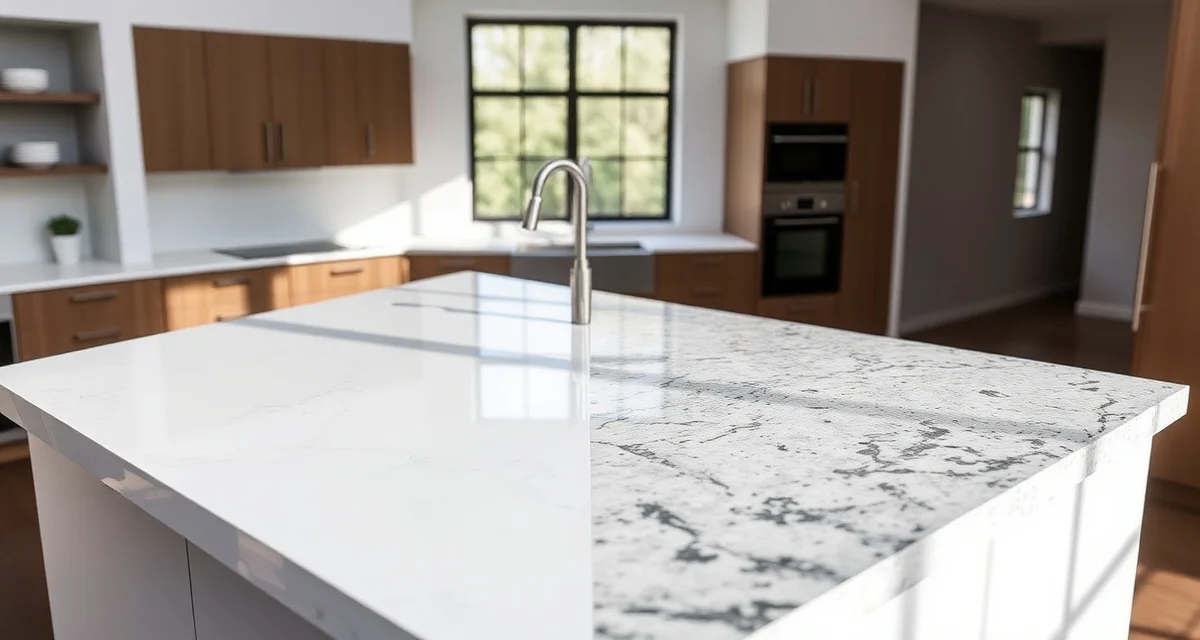
Is Quartz Better Than Granite?
Quick Answer
Neither is universally "better" - they're different materials that excel in different areas. Quartz wins on low maintenance (no sealing needed), consistency (predictable patterns), and stain resistance. Granite wins on heat resistance, natural uniqueness (no two slabs alike), and the depth of a natural stone aesthetic. Both are durable, long-lasting, and will serve a kitchen well for 15-25+ years. Your choice depends on what you value most.
TL;DR
- Quartz requires zero sealing; granite needs sealing every 1-2 years
- Granite handles heat better; quartz can be damaged by hot pans
- Quartz offers more consistent patterns; granite is unique slab to slab
- Both cost roughly $50-$100 per square foot installed for mid-range options
- Quartz is slightly more stain-resistant; granite is more scratch and heat resistant
- Neither material has a clear resale value advantage - both are desirable
- Quartz is manufactured; granite is quarried from the earth
The Full Comparison
| Feature | Quartz | Granite |
|---|---|---|
| Composition | 90-95% ground quartz + 5-10% polymer resin | 100% natural stone (quarried) |
| Hardness (Mohs) | 7 | 6-7 |
| Stain resistance | Excellent (non-porous) | Very good (when sealed) |
| Heat resistance | Moderate - resin can scorch above 300°F | Excellent - natural stone handles heat well |
| Scratch resistance | Very good | Very good |
| Sealing required | No | Yes, every 1-2 years |
| UV resistance | Poor - can fade/yellow in direct sunlight | Excellent - no UV degradation |
| Pattern consistency | High - same pattern across slabs | Low - every slab is unique |
| Color options | Very wide (manufactured) | Limited to natural variations |
| Installed cost | $50-$120/sq ft | $45-$120/sq ft |
| Lifespan | 15-25+ years | 20-30+ years (natural stone lasts longer) |
| Repairability | Moderate - chips repairable, cracks more difficult | Good - chips, cracks, and stains repairable |
| Eco-friendliness | Lower - manufacturing involves resin and energy | Higher - natural material, less processing |
| Weight | Similar (~20-25 lbs/sq ft for 3cm) | Similar (~18-22 lbs/sq ft for 3cm) |
Where Quartz Wins
Zero Maintenance
This is the biggest practical difference. Quartz never needs sealing. You clean it with soap and water. That's the entire maintenance routine. For busy homeowners who don't want to think about countertop upkeep, quartz is the easier choice.
Calculate your material waste savings
See exactly how much slab material and money you could save with optimized cutting layouts.
Try the free Waste CalculatorConsistency
When you pick a quartz color from a sample, you know what you're getting. The countertop will match the sample closely. With granite, every slab has unique variation - which is beautiful but means the installed countertop may not look exactly like the small sample in the showroom. If predictability matters to you, quartz delivers.
Stain Resistance
Quartz's non-porous surface doesn't absorb liquids under normal conditions. Granite, even when properly sealed, can absorb dark liquids if they sit long enough. For kitchens that see heavy use with coffee, wine, and cooking liquids, quartz offers a slight edge.
Color Variety
Because quartz is manufactured, it's available in colors and patterns that don't exist in nature - including convincing marble lookalikes, concrete styles, and bold solid colors. Granite is limited to what the earth produces.
Where Granite Wins
Heat Tolerance
You can set a hot pot directly on granite without worry. Granite handles temperatures far above normal cooking heat without any damage. Quartz's resin component is vulnerable to heat above 300°F, which makes trivets mandatory. For cooks who move fast and don't want to think about trivets, granite is more forgiving.
Natural Beauty
There's a depth and complexity to natural granite that engineered quartz hasn't fully replicated. The mineral crystals in granite catch light differently depending on the angle. Each slab is genuinely one of a kind - your countertop is unlike anyone else's in the world. For homeowners who value natural materials, this matters.
UV Resistance
Granite doesn't fade in sunlight. Quartz can yellow or discolor when exposed to direct UV light over time. This makes granite the clear winner for outdoor kitchens, sunrooms, or countertops next to large, sun-facing windows.
Longevity
Granite is natural stone that has existed for millions of years. It doesn't degrade, the color doesn't fade (indoors), and it can be re-polished indefinitely. Quartz's resin binder will eventually break down - though "eventually" means 20+ years under normal use. Granite has a longer theoretical lifespan.
Repairability
Granite can be repaired, re-polished, and even re-profiled. Chips fill with epoxy, cracks bond with resin, stains pull out with poultices, and dull surfaces polish back to new. Quartz repair is possible but more limited - heat damage and deep cracks are harder to fix because the resin doesn't respond to traditional stone restoration techniques.
Where They're Roughly Equal
Durability for Daily Use
Both materials handle the demands of a busy kitchen just fine. Dropping normal kitchen items, chopping on cutting boards nearby, cleaning with standard products - both perform well for decades.
Cost
For mid-range options, quartz and granite cost roughly the same. Budget options in both materials start around $40-$50/sq ft installed. Premium options in both materials reach $100-$150+/sq ft. The pricing overlap is significant enough that cost shouldn't be the deciding factor for most projects.
Resale Value
Real estate agents consistently report that both quartz and granite countertops are highly desirable to home buyers. Neither material has a measurable advantage in resale value. What matters more is the condition of the countertops - well-maintained granite and clean quartz both impress buyers.
Hygiene
Both surfaces are hygienic when properly maintained. Quartz's non-porous surface doesn't harbor bacteria. Sealed granite achieves a similarly hygienic surface. The NSF (National Sanitation Foundation) has certified both materials as safe for food preparation.
Decision Framework: Which Should You Choose?
Choose Quartz If:
- You want zero maintenance (no sealing, ever)
- You prefer a consistent, predictable appearance
- You want a marble look without marble's fragility
- You don't want to worry about stains from daily kitchen use
- You're looking for bold or unusual colors (white, solid colors, patterns)
- Your countertop won't be in direct sunlight
Choose Granite If:
- You cook frequently and want to set hot pans down without thinking
- You value the uniqueness of natural stone
- You're comfortable with simple annual maintenance (sealing)
- Your countertop will be near windows or used outdoors
- You want a material that can be repaired and re-polished indefinitely
- You prefer natural, earth-sourced materials over manufactured products
Common Misconceptions
"Quartz is more durable than granite." - Not exactly. Quartz is more stain-resistant; granite is more heat-resistant. Overall durability is comparable.
"Granite is outdated." - Granite remains one of the most popular countertop materials. Quartz has gained market share, but granite is nowhere near "out of style."
"Quartz is more expensive." - Price ranges overlap significantly. Premium granite (Blue Bahia, Van Gogh) costs as much as premium quartz (Cambria, high-end Caesarstone).
"Granite harbors bacteria." - Sealed granite is as hygienic as quartz for household use. Studies show no meaningful difference in bacterial growth on sealed natural stone vs. engineered stone.
"Quartz looks fake." - Modern quartz manufacturing has advanced dramatically. Many quartz products are difficult to distinguish from natural stone without close inspection.
Which is better for a busy family kitchen?
Quartz, slightly, because of its lower maintenance requirements and better stain resistance. But granite is a perfectly fine choice for family kitchens too - just commit to sealing it annually and wiping up spills.
Can I mix quartz and granite in the same kitchen?
Yes. Some homeowners use granite on the main countertops (where cooking and heat exposure happen) and quartz on the island (where it's mostly a prep and eating surface). This gives you the best properties of each material where they matter most.
Which is more eco-friendly?
Granite has a smaller manufacturing carbon footprint - it's quarried and cut, not manufactured with resins and polymers. However, quartz manufacturing has become more efficient, and the transportation of heavy granite slabs from quarries (often overseas) has its own environmental cost.
Does either material crack more easily?
Quartz is more prone to thermal cracking (from hot pots). Granite is more prone to cracking from impact at weak points (near cutouts, at natural fissures). Neither cracks easily under normal use.
Which holds up better to scratches?
Both are very scratch-resistant. Quartz is slightly harder (Mohs 7 vs. 6-7), but the practical difference is negligible. Neither should be used as a cutting surface - use cutting boards.
Which has better resale value?
Equal. Both are in the top tier of desirable countertop materials. A well-maintained countertop of either material adds value to a home.
Can fabrication shops work with both materials equally?
Yes. Any shop equipped with CNC routers and bridge saws fabricates both quartz and granite daily. The cutting and profiling processes are similar, with minor adjustments for material hardness.
Which lasts longer?
Granite, marginally. The resin in quartz will eventually degrade (over 20-25+ years), while granite as a natural stone is essentially permanent. Both will outlast most kitchen renovations.
Get the Right Material for Your Kitchen
The quartz vs. granite decision comes down to your priorities: maintenance convenience (quartz) or natural beauty and heat tolerance (granite). Both are excellent choices that will serve your kitchen well for decades.
SlabWise-powered fabrication shops can quote both materials for your specific kitchen in 3 minutes, making it easy to compare costs side by side.
Free to use. See pricing for quartz, granite, and other materials instantly.
Try These Free Tools
- Cost Calculator -- Get instant countertop cost estimates by material, edge profile, and square footage.
- Compare Materials -- Side-by-side material comparison with pricing, durability, and maintenance ratings.
- Edge Profile Selector -- Browse edge profiles with cost impact and visual previews.
Sources & Further Reading
- Natural Stone Institute - Stone Thickness Guidelines
- International Surface Fabricators Association - Countertop Specifications
- National Kitchen & Bath Association - Countertop Installation Standards
- ASTM International - Standard Test Methods for Stone Thickness