Can Quartz Countertops Crack?
Quick Answer
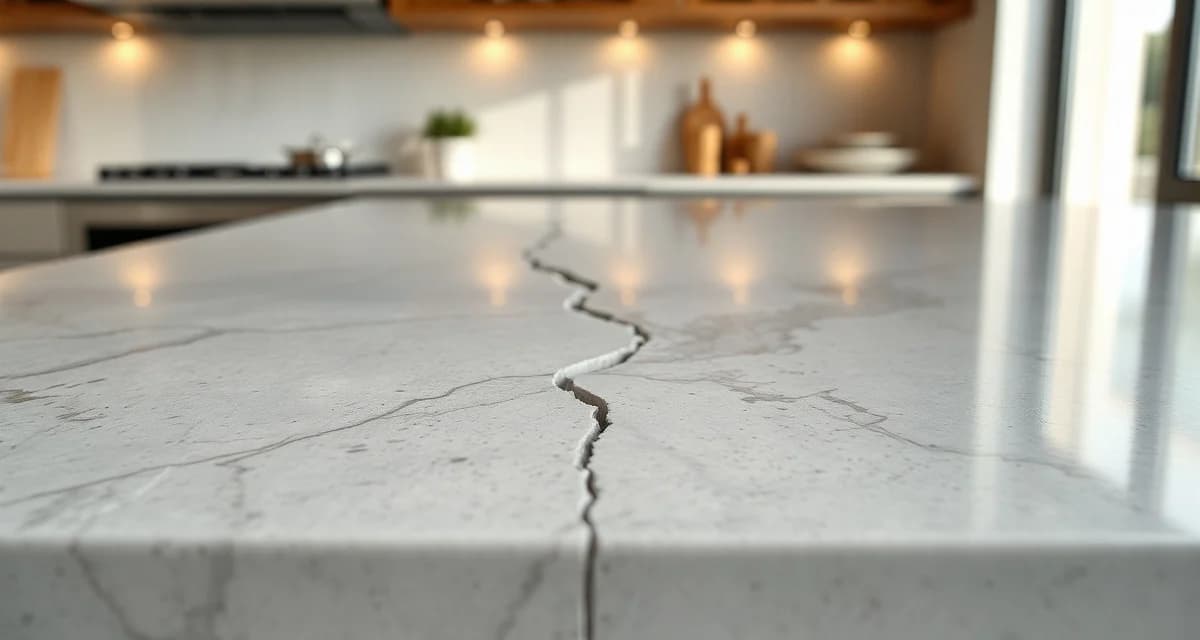
Yes, quartz countertops can crack, though it's relatively uncommon with proper fabrication and installation. The most frequent causes are thermal shock (placing a hot pan directly on the surface), inadequate support (unsupported overhangs or unlevel cabinets), and impact damage (dropping heavy objects on edges or near cutouts). Quartz is engineered to be strong, but it's not indestructible.
TL;DR
- Quartz is strong (Mohs hardness 7) but can crack under specific conditions
- Thermal shock is the number one cause - hot pots and pans directly on quartz cause stress cracks
- Unsupported overhangs and unlevel cabinets create stress points that lead to cracking over time
- Cracks near sink and cooktop cutouts are the most common location
- Most quartz cracks are preventable with proper installation and daily use habits
- Small cracks can often be repaired with color-matched epoxy ($200-$500)
- Large cracks or cracks near structural stress points usually require section replacement
- Manufacturer warranties typically cover defects but not thermal damage or impact
Why Quartz Cracks (The Common Causes)
Thermal Shock
Quartz countertops are made of roughly 90-95% ground quartz crystals bound with 5-10% polymer resins. Those resins are the weak link when it comes to heat. When a 400-degree pan sits directly on the surface, the rapid temperature change causes the resin to expand faster than the quartz particles around it. This differential expansion creates stress that can produce a crack.
Calculate your material waste savings
See exactly how much slab material and money you could save with optimized cutting layouts.
Try the free Waste CalculatorTemperature thresholds:
- Below 300 degrees F: Generally safe for brief contact
- 300-400 degrees F: Risk zone - hairline cracks possible with prolonged contact
- Above 400 degrees F: High risk of thermal cracking
The crack doesn't always appear immediately. Sometimes the damage is internal, and the crack surfaces days or weeks later, leading homeowners to think it happened spontaneously.
Inadequate Cabinet Support
Quartz is heavy - a 3cm slab weighs about 20-25 pounds per square foot. A standard kitchen countertop weighs 300-500+ pounds total. If the cabinets underneath aren't level, properly secured, or if there are gaps in support, the stone bears weight unevenly. Over time, this stress concentrates at weak points (usually near cutouts) and produces cracks.
Common support problems:
| Issue | What Happens |
|---|---|
| Unlevel cabinets | Stone flexes slightly; stress builds at cutouts |
| Missing support under seams | Seam area bears too much load |
| Overhangs greater than 12" without support | Cantilever force exceeds stone strength |
| Settling cabinets or floor | Gradual shift creates new stress points |
| Dishwasher or oven heat rising from below | Repeated thermal cycling weakens resin |
Impact Damage
Dropping a heavy cast-iron pan, a marble rolling pin, or a full crockpot on the edge of a countertop can chip or crack the stone. The edges and areas around cutouts are the most vulnerable because they have the least structural support.
Fabrication Stress
Less commonly, cracks can originate from the fabrication process:
- Aggressive CNC cutting speeds that create micro-fractures
- Overly tight inside corners on sink cutouts (should have a minimum 1/2" radius)
- Cutouts placed too close to the edge of the slab
- Insufficient support during transport from shop to install site
Good fabrication shops round inside corners, maintain proper cutout margins, and handle pieces carefully during transport. These practices prevent stress-induced cracking.
Where Cracks Happen Most Often
| Location | Frequency | Why |
|---|---|---|
| Around sink cutout | Most common | Cutout weakens the surrounding stone; weight of sink pulls downward |
| Around cooktop cutout | Common | Large opening + heat exposure from cooking |
| At seams | Occasional | Improper seam support or adhesive failure |
| Along unsupported overhangs | Occasional | Cantilever stress exceeds stone strength |
| Random surface crack | Rare | Usually internal defect or extreme thermal shock |
How to Prevent Quartz Cracks
Daily Habits
- Always use trivets or hot pads - Never put hot cookware directly on quartz. This is the single most important habit.
- Don't slide heavy appliances - Lift stand mixers, crockpots, and cast-iron cookware instead of dragging them.
- Avoid concentrated impacts - Don't use the countertop edge as a cutting surface or lean on overhangs.
- Use cutting boards - While quartz resists scratches, impact from heavy chopping can stress the surface.
Installation Requirements
- Level cabinets within 1/8 inch - The countertop should sit flat without rocking.
- Full perimeter support - No unsupported spans greater than 6 inches between support points.
- Support overhangs - Any overhang exceeding 10-12 inches needs brackets, corbels, or a support structure.
- Rounded inside corners - All cutout corners should have a minimum 1/2" radius to distribute stress.
- Proper cutout margins - Maintain at least 3 inches of material between any cutout edge and the countertop edge.
- Seam support - Every seam should have cabinet or substrate support directly underneath.
Protecting the Vulnerable Areas
- Under the sink: Make sure the undermount sink clips are properly installed and the sink isn't pulling the countertop downward.
- Around the cooktop: Use a cooktop with a proper gasket to prevent direct heat transfer to the stone edge.
- At the dishwasher: The steam vent from a dishwasher blows hot, moist air directly onto the underside of the countertop above it. This repeated thermal cycling can weaken the resin over years. A deflector strip (most dishwashers include one) helps redirect this heat.
Can Cracked Quartz Be Repaired?
Small Cracks and Chips
| Damage Type | Repair Method | Cost | Success Rate |
|---|---|---|---|
| Hairline surface crack | Color-matched epoxy fill | $150-$300 | Good - crack becomes nearly invisible |
| Small chip (under 1") | Epoxy fill and polish | $100-$250 | Good |
| Moderate crack (2-6") | Epoxy injection and reinforcement | $250-$500 | Moderate - may remain slightly visible |
| Large crack or structural failure | Section replacement | $500-$2,000+ | New section needed |
DIY Repair vs. Professional
For chips smaller than a dime, a quartz repair kit ($15-$30) can produce acceptable results. For anything larger, call a professional stone restoration company. They have color-matching expertise, proper adhesives, and the ability to polish repaired areas to match the surrounding surface.
When Replacement Is Necessary
If the crack runs from one side of a cutout to the edge of the countertop, or if the crack extends more than 6 inches, repair is usually not sufficient. The structural integrity of the stone is compromised, and the crack will likely propagate further over time. In these cases, the affected section needs to be replaced - which means re-fabricating and re-installing that piece.
Does the Warranty Cover Cracks?
Most quartz manufacturer warranties (Caesarstone, Cambria, Silestone, MSI) cover:
- Manufacturing defects
- Material defects (internal flaws that cause cracking under normal use)
- Color or pattern inconsistencies
Most warranties do NOT cover:
- Thermal damage (hot pans, heat sources)
- Impact damage
- Cracks caused by improper installation (unlevel cabinets, unsupported overhangs)
- Cracks resulting from structural movement in the home
- Normal wear and tear
The installation warranty from your fabrication shop typically covers workmanship-related cracks (poor seaming, inadequate support, improper cutout technique) for 1-2 years. This is separate from the manufacturer's material warranty.
How common is it for quartz to crack?
Relatively uncommon. Industry estimates suggest fewer than 1-2% of properly installed quartz countertops develop cracks within the first 5 years. Poor installation and thermal abuse increase this rate significantly.
Can quartz crack on its own without any cause?
Rarely. What appears to be a spontaneous crack is almost always caused by an unseen factor - heat exposure, settling cabinets, or an internal defect from manufacturing. True spontaneous cracking from a manufacturing defect is covered under warranty.
Is quartz more likely to crack than granite?
Quartz is more susceptible to thermal cracking because of its resin content. Granite handles heat better (no resin binders) but is more prone to cracking from impact because it has natural fissures and grain structure. Both materials are durable when properly installed and maintained.
Will a small crack get bigger over time?
It can, especially if the underlying cause (unlevel cabinets, unsupported overhang) isn't addressed. A hairline crack near a sink cutout that's caused by inadequate support will continue to grow as long as the stress exists. Fix the cause, then repair the crack.
Can I put a crockpot on my quartz countertop?
The bottom of a crockpot during cooking can reach 200-300 degrees F. While this is within the lower risk range, prolonged contact (hours of slow cooking) can stress the surface. Use a trivet or heat-resistant mat under crockpots and Instant Pots.
Does the color of quartz affect crack resistance?
No. Crack resistance is determined by the resin formulation and quartz content, not the pigments. All colors within a manufacturer's line have the same structural properties.
Can you repair a quartz countertop without replacing the whole section?
Yes, for most minor damage. Color-matched epoxy fills for chips and hairline cracks are effective and common repairs. Only structural cracks (those affecting the integrity of the stone around cutouts or along stress lines) require section replacement.
Will homeowner's insurance cover a cracked quartz countertop?
Typically only if the crack was caused by a covered event (structural damage, fallen object, plumbing failure). Normal cracking from heat exposure or poor installation is not covered by standard homeowner's policies. Check your specific policy.
How long do quartz countertops typically last?
With proper installation and care, quartz countertops last 15-25+ years. The resin binders are the limiting factor - over decades, UV exposure (outdoor use) and repeated thermal stress can degrade them. Indoor quartz countertops in a well-maintained kitchen have an extremely long lifespan.
Are thicker quartz slabs less likely to crack?
Thicker slabs (3cm vs. 2cm) are more resistant to cracking because they distribute stress over more material. The industry standard for kitchen countertops is 3cm for this reason. Bathroom vanities sometimes use 2cm, but these have smaller spans and fewer stress points.
Protect Your Investment
Quartz is one of the most durable countertop materials available, but it's not immune to damage. The combination of proper installation, reasonable daily habits (trivets for hot items), and choosing a fabricator who follows best practices will keep your quartz looking flawless for decades.
Looking for a fabrication shop that gets installation right the first time? SlabWise-powered shops use template verification and quality checks designed to prevent the stress points that cause cracking.
Free to use. Find the right material and fabricator for your project.
Try These Free Tools
- Photo to Template -- Snap a photo of an existing countertop and get an AI-generated DXF template.
- Template Compare -- Upload two templates and see every dimension change highlighted instantly.
- AI Template Verification -- Cross-check your template against manufacturer specs before cutting.
Sources & Further Reading
- Natural Stone Institute - Countertop Support Guidelines
- International Surface Fabricators Association - Structural Support Requirements
- National Kitchen & Bath Association - Countertop Installation Standards
- ASTM International - C1526 Standard Specification for Serpentine Dimension Stone