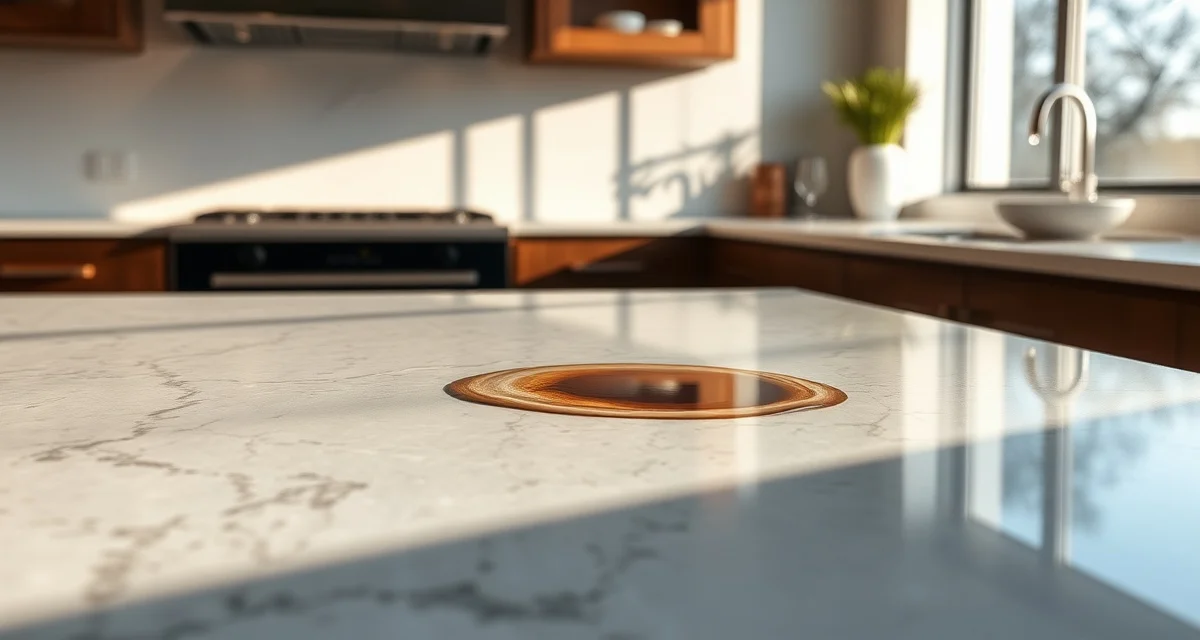
Do Quartz Countertops Stain?
Quick Answer
Quartz countertops are highly stain-resistant but not stainproof. The engineered surface is non-porous, which means most liquids (coffee, wine, juice) won't penetrate if wiped up within a reasonable time. However, certain substances - permanent markers, strong dyes, some chemicals, and prolonged contact with dark liquids - can cause discoloration that's difficult to remove. Quartz is significantly more stain-resistant than granite or marble but not as impervious as many marketing claims suggest.
TL;DR
- Quartz is non-porous and resists most household stains
- It does NOT need sealing (unlike granite and marble)
- Permanent marker, turmeric, hair dye, and strong chemicals can stain quartz
- Prolonged contact (hours) with coffee, wine, or tea can leave marks on lighter colors
- Most stains can be removed with a non-abrasive cleaner or baking soda paste
- Lighter-colored quartz shows staining more easily than darker colors
- Heat damage causes permanent discoloration (yellowing/browning) that looks like a stain
- Cleaning with harsh chemicals (bleach, oven cleaner) can damage the resin and cause discoloration
What Makes Quartz Stain-Resistant
Quartz countertops are engineered from approximately 90-95% ground quartz crystals bonded with 5-10% polymer resins and pigments. The resin fills the gaps between quartz particles, creating a non-porous surface that doesn't absorb liquids the way natural stone does.
Calculate your material waste savings
See exactly how much slab material and money you could save with optimized cutting layouts.
Try the free Waste CalculatorWith granite or marble, a spill soaks into microscopic pores in the stone. With quartz, the liquid sits on top of the surface. This is why quartz doesn't require sealing - there are no pores to seal.
But "non-porous" doesn't mean "nothing sticks." The resin component of quartz can react with certain chemicals and dyes, and prolonged exposure to staining agents can bond colorants to the surface.
What Can Stain Quartz (and What Can't)
Low Risk - Wipe and Forget
| Substance | Stain Risk | Notes |
|---|---|---|
| Water | None | No water rings or marks |
| Coffee (spilled briefly) | Very low | Wipe within an hour, no issue |
| Wine (spilled briefly) | Very low | Wipe within an hour, no issue |
| Juice | Very low | Citrus juice won't etch quartz like it does marble |
| Cooking oil | Very low | Wipe up, clean with dish soap |
| Ketchup/mustard | Low | Clean within a few hours |
| Soy sauce | Low | Clean within a few hours |
Moderate Risk - Clean Promptly
| Substance | Stain Risk | Notes |
|---|---|---|
| Coffee (sitting for hours) | Moderate | Can leave marks on white/light quartz |
| Red wine (sitting overnight) | Moderate | Prolonged contact on light colors causes discoloration |
| Tea bags (sitting directly) | Moderate | Tannins can discolor if left for hours |
| Berry juice | Moderate | Natural dyes can bond to resin over time |
| Tomato sauce (dried on) | Moderate | Pigments can set if left overnight |
High Risk - Avoid or Clean Immediately
| Substance | Stain Risk | Notes |
|---|---|---|
| Permanent marker | High | Ink penetrates resin; often requires acetone |
| Turmeric/curry | High | Strong yellow pigment bonds to resin quickly |
| Hair dye | High | Formulated to bond to surfaces permanently |
| Nail polish | High | Solvents can damage resin while pigments stain |
| Bleach (undiluted) | High | Damages resin, causing permanent discoloration |
| Oven cleaner | High | Harsh chemicals attack the resin binder |
| Paint stripper | High | Dissolves resin component |
| Rust | Moderate-High | Metal objects left on wet quartz leave rust rings |
Heat Damage vs. Staining
One of the most common "stains" on quartz is actually heat damage. When a hot pan (above 300 degrees F) sits directly on quartz, the polymer resin can scorch, causing a yellow or brown discoloration mark. This isn't a surface stain - it's chemical damage to the resin that can't be cleaned off.
Signs of heat damage vs. a stain:
- Heat damage: Yellow/brown/white mark directly where a hot object sat, won't respond to cleaning
- Stain: Colored mark corresponding to a specific substance, may respond to cleaning
Heat damage is permanent and usually requires professional repair or section replacement. Always use trivets or hot pads with quartz countertops.
How to Remove Stains from Quartz
General Cleaning
For daily cleaning, use a soft cloth with warm water and a small amount of dish soap. This handles 95% of messes.
For Stubborn Stains
Baking soda paste method:
- Mix baking soda with water to create a thick paste
- Apply to the stained area
- Cover with plastic wrap
- Let sit for several hours or overnight
- Wipe off and rinse
- Repeat if needed
Isopropyl alcohol (for ink, marker, dried-on residue):
- Apply rubbing alcohol (70% or higher) to a soft cloth
- Gently rub the stained area
- Rinse with water and dry
Bar Keeper's Friend (for tough stains):
- Make a paste with a small amount of water
- Apply gently - don't scrub aggressively
- Rinse thoroughly
- This product contains oxalic acid, which is effective but should not be used frequently
What NOT to Use on Quartz
- Bleach - Damages resin, causes discoloration
- Abrasive scrub pads (Scotch-Brite, steel wool) - Scratch the surface
- Oven cleaner - Too harsh; dissolves resin
- Paint thinner or acetone - Use sparingly and only on stubborn spots; prolonged exposure damages resin
- Alkaline cleaners (pH above 10) - Break down resin over time
- Acidic cleaners (pH below 3) - Can dull the surface finish
Does Color Affect Staining?
Yes, significantly. The stain itself is the same, but visibility varies dramatically:
| Quartz Color | Stain Visibility | Practical Impact |
|---|---|---|
| White/cream | Highest | Shows coffee, wine, and turmeric marks readily |
| Light gray | High | Shows dark-colored stains |
| Medium tones | Moderate | Balanced - some stains visible, others hidden |
| Dark colors (black, espresso) | Low | Hides most stains; water spots may show |
| Patterned/veined | Lowest | Pattern helps camouflage minor discoloration |
If you're choosing quartz for a busy kitchen with kids, darker colors and patterned designs are more forgiving for daily life.
Quartz Stain Resistance vs. Other Materials
| Material | Stain Resistance | Sealing Required | Daily Care Level |
|---|---|---|---|
| Quartz | Very high | No | Low |
| Granite | High (when sealed) | Yes (annually) | Low-moderate |
| Marble | Moderate (when sealed) | Yes (every 6-12 months) | High |
| Quartzite | High (when sealed) | Yes (annually) | Moderate |
| Solid surface (Corian) | High | No | Low |
| Laminate | Moderate | No | Low |
| Butcher block | Low | Yes (frequent oiling) | High |
Quartz is the most stain-resistant option that doesn't require ongoing sealing maintenance. It's the closest thing to a "maintenance-free" countertop on the market - though not completely free from risk.
Can I use Clorox wipes on quartz?
Occasional use is fine, but daily use is not recommended. Clorox wipes contain bleach, which can dull the surface and damage the resin with repeated exposure. Use a damp cloth with mild dish soap for daily cleaning.
Will a coffee mug leave a ring on quartz?
A clean, dry mug won't leave a mark. A wet mug bottom sitting in a coffee puddle for hours on light-colored quartz might leave a faint ring. Wipe up puddles and you'll never see a ring.
Is white quartz a bad idea for a kitchen?
Not bad - just more demanding. White quartz shows stains more easily, which means you need to be more diligent about cleaning up spills promptly. If you love the look and are willing to maintain it, white quartz performs beautifully.
Can turmeric permanently stain quartz?
Turmeric is one of the few household substances that can cause lasting discoloration on quartz, especially lighter colors. The curcumin pigment bonds to the resin surface. Clean turmeric spills immediately. If a stain sets, a baking soda poultice or Bar Keeper's Friend may help, but deep turmeric stains can be permanent.
Does quartz stain from water?
No. Water doesn't stain quartz. What looks like a "water stain" is usually mineral deposits from hard water that have dried on the surface. These wipe off with vinegar (used sparingly) or a glass cleaner.
Will food coloring stain quartz?
Concentrated food coloring (the kind used for baking) can stain quartz if left in contact for an extended period. Wipe up spills promptly. If a stain occurs, try isopropyl alcohol followed by a baking soda paste.
How do I prevent staining on quartz?
Three simple habits: (1) wipe up spills within a reasonable time frame, (2) use trivets for hot cookware (prevents heat damage that mimics staining), and (3) clean with mild soap and water daily. That's it. No sealing, no special products, no complicated routine.
Can professional cleaning remove quartz stains?
Professional stone restoration companies can polish out surface stains and discoloration on quartz. For deep resin damage (from heat or chemicals), the damaged section may need to be replaced. Professional cleaning runs $200-$500 for a kitchen.
Does quartz discolor over time?
Quartz can yellow slightly with prolonged UV exposure (outdoor installations or counters next to large windows). Indoor quartz in normal kitchen use maintains its color for 15-25+ years without noticeable change.
Is quartz really non-porous?
The surface is functionally non-porous - liquid doesn't soak in like it does with granite or marble. However, the resin binder can absorb certain chemical dyes at a molecular level, which is why permanent marker and hair dye can stain. For practical purposes, quartz behaves as a non-porous surface for all normal kitchen use.
Choose the Right Countertop for Your Kitchen
Quartz offers the best combination of stain resistance and low maintenance of any countertop material - and it does it without needing annual sealing. For most homeowners, quartz is the most practical choice for a kitchen that looks great with minimal effort.
Want to compare quartz options for your kitchen? SlabWise-powered fabrication shops generate detailed quotes in 3 minutes with material comparisons built in.
Free to use. Compare quartz, granite, and marble pricing for your kitchen.
Try These Free Tools
- Cost Calculator -- Get instant countertop cost estimates by material, edge profile, and square footage.
- Compare Materials -- Side-by-side material comparison with pricing, durability, and maintenance ratings.
- Edge Profile Selector -- Browse edge profiles with cost impact and visual previews.
Sources & Further Reading
- Natural Stone Institute - Stone Thickness Guidelines
- International Surface Fabricators Association - Countertop Specifications
- National Kitchen & Bath Association - Countertop Installation Standards
- ASTM International - Standard Test Methods for Stone Thickness