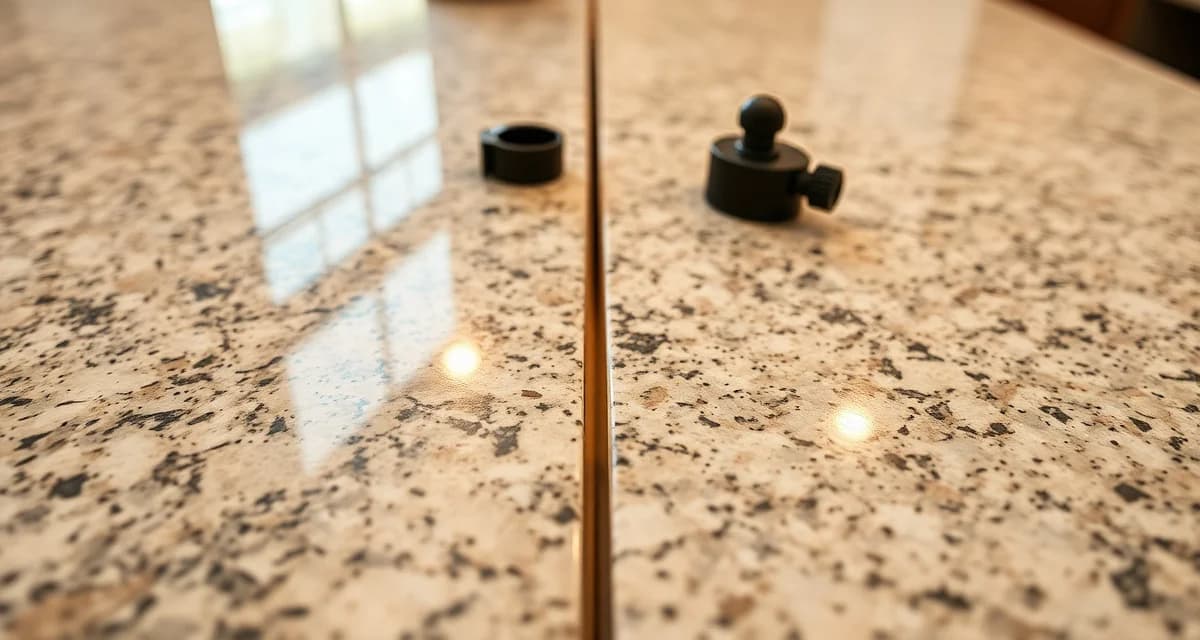
How Are Two Countertop Pieces Joined?
Quick Answer
Two countertop pieces are joined using color-matched epoxy adhesive applied to precisely cut edges that are clamped tightly together. The fabricator cuts both edges with a CNC machine or bridge saw for a perfect fit, applies a two-part epoxy tinted to match the stone color, pulls the pieces together with seam clamps or vacuum suction cups, and lets it cure. A skilled fabricator can make the seam nearly invisible - typically 1/16 inch or less.
TL;DR
- Countertop seams use color-matched two-part epoxy adhesive, not grout or caulk
- CNC-cut edges create tight, precise joints (1/16 inch or thinner)
- Seam placement is planned during templating to minimize visibility
- Quartz seams tend to be less visible than granite seams due to pattern consistency
- L-shaped and U-shaped kitchens almost always require at least one seam
- Seam quality depends heavily on fabricator skill and equipment
- A good seam should be felt with a fingertip but barely seen from a few feet away
Why Countertops Need Seams
Most kitchens can't be covered by a single slab. Here's why:
Calculate your material waste savings
See exactly how much slab material and money you could save with optimized cutting layouts.
Try the free Waste CalculatorSlab size limits. Standard stone slabs measure roughly 55 x 120 inches (about 4.5 x 10 feet). Any countertop run longer than about 9.5 feet - accounting for edge finishing - needs a seam. L-shaped and U-shaped layouts always need at least one joint.
Transport and handling. Even if a slab is large enough, an extremely long single piece is difficult to move through doorways, hallways, and up staircases. A piece longer than 8-9 feet becomes very fragile during transport.
Weight. A 10-foot run of 3cm granite weighs roughly 300-350 pounds. Cutting it into two manageable pieces reduces the risk of breakage during installation.
When You Can Avoid Seams
- Straight runs under 9 feet
- Small bathroom vanities (typically 24-72 inches)
- Some island configurations (depending on slab size)
- Smaller peninsula countertops
The Seam-Making Process: Step by Step
Step 1: Planning During Templating
Seam placement starts before any stone is cut. During the template visit, the fabricator identifies where seams will fall. Good seam placement follows these rules:
- Away from the sink area - moisture exposure weakens adhesive over time
- Not over a dishwasher - heat and steam stress the joint
- At natural break points - inside corners, behind faucets, or along a natural color transition
- 18 inches or more from inside corners - prevents stress cracking
Step 2: Precision Cutting
Both edges that will meet at the seam are cut using a CNC bridge saw or waterjet. These machines achieve tolerances of 1/32 inch or better. The edges are usually cut straight (butt joint) or occasionally mitered for waterfall edges.
| Cut Type | Use Case | Difficulty |
|---|---|---|
| Butt joint | Standard horizontal seams | Standard |
| Mitered joint | Waterfall edges, thick-look laminations | High |
| Angled joint | L-shaped counters at inside corners | Moderate |
Step 3: Dry Fit
Before any adhesive is applied, the fabricator does a dry fit on-site. Both pieces are set on the cabinets and checked for:
- Gap consistency along the entire seam length
- Level alignment (no lippage between pieces)
- Pattern and color alignment
- Proper overhang and positioning
Step 4: Adhesive Application
The standard adhesive for stone countertop seams is two-part epoxy (sometimes polyester resin for lighter-duty applications). Here's what matters:
Color matching. The fabricator mixes pigment into the epoxy to match the stone. A good fabricator keeps a library of tints and can blend custom colors on-site. The goal is an epoxy line that disappears into the stone's color.
Application. Epoxy is applied to both edges. The pieces are pushed together and clamped using:
- Seam setters (suction-cup clamps that pull the pieces together)
- Spring clamps along the underside for support
- Shims to maintain level alignment
Cure time. Most countertop epoxies cure in 20-45 minutes. Full strength develops over 24 hours.
Step 5: Finishing
After the epoxy cures, the fabricator:
- Scrapes excess epoxy flush with the surface using a razor blade
- Lightly polishes the seam area if needed
- Checks for any gaps or low spots
Seam Visibility by Material
Not all materials hide seams equally well.
| Material | Seam Visibility | Why |
|---|---|---|
| Quartz (solid colors) | Very low | Consistent color makes color-matching easy |
| Quartz (veined patterns) | Low to moderate | Veins need alignment, which is more difficult |
| Granite (uniform) | Low | Speckled patterns camouflage the seam line |
| Granite (veined/movement) | Moderate | Busy patterns can distract, but veins are hard to align perfectly |
| Marble | Moderate to high | Strong veining makes alignment tricky; lighter colors show epoxy lines |
| Quartzite | Moderate | Natural variation makes matching harder |
| Porcelain | Low to moderate | Thin material is easier to align; digital patterns are consistent |
What Makes a Good Seam vs. a Bad Seam
Signs of Quality Work
- Gap is 1/16 inch or narrower
- Epoxy color matches the stone when viewed from 3 feet away
- No lippage (both pieces are flush - you can't feel a height difference)
- Seam is placed in a logical location (not in the middle of a visible run)
- Pattern alignment is reasonable (especially for veined materials)
Red Flags
- Visible gap wider than 1/8 inch
- Epoxy color doesn't match (bright white line on dark stone, for example)
- Noticeable height difference between the two pieces
- Seam placed directly over the dishwasher or in front of the sink
- Rough or bumpy texture along the seam line
- Adhesive squeeze-out left unfinished along the seam
Common Seam Placement Mistakes
Seam at the front edge of the sink cutout. Water constantly hits this area. A seam here will weaken over time, even with good epoxy.
Seam centered on a visible run. If you have a 14-foot run, putting the seam at 7 feet - dead center - draws the eye. Placing it off-center (at a natural break point or behind an appliance) is smarter.
Seam over the dishwasher. The heat and moisture from dishwasher cycles stress the adhesive bond. Fabricators should position seams at least 3-4 inches away from the dishwasher opening.
Ignoring vein direction. On veined materials like marble or quartzite, the fabricator should cut both seam pieces from the same slab and align the veining as closely as possible. This takes extra time during layout and nesting but makes a significant difference in the final appearance.
Can You Repair a Bad Seam?
Yes, but it depends on what's wrong:
- Discolored epoxy: A fabricator can grind out the old epoxy, re-tint, and refill. This is a common repair.
- Gap too wide: The existing epoxy can sometimes be removed and the pieces re-set closer. More often, the gap is filled with a thicker epoxy application and carefully color-matched.
- Lippage: This usually requires removing one piece, adjusting the substrate or cabinet, and reinstalling. It's a bigger job.
- Separation: If the seam has opened up, the area is cleaned, fresh epoxy is applied, and the pieces are re-clamped.
Repair costs typically run $150-$400 depending on the scope.
How Fabricators Plan Seams Using Software
Modern fabrication shops use software to plan seam placement during the layout process. Tools like SlabWise allow fabricators to:
- Map slab dimensions against the countertop template
- Test different seam positions before cutting
- Optimize nesting to reduce waste while maintaining good seam placement
- Generate digital job packets that clearly mark seam locations for the install crew
This pre-planning catches problems before they reach the job site. A seam that looks fine on paper but falls in a bad spot on the actual countertop can be moved during the digital layout stage - saving the cost of a potential remake.
For fabricators processing multiple jobs daily, digital seam planning through tools like SlabWise's nesting software reduces errors and speeds up production. The result: fewer callbacks from homeowners unhappy with visible seams.
How wide should a countertop seam be?
A well-made seam should be 1/16 inch or narrower. Some high-quality fabricators achieve seams as tight as 1/32 inch. Anything wider than 1/8 inch is generally considered poor workmanship.
What adhesive is used to join countertop pieces?
Two-part epoxy is the industry standard for stone countertops. It's color-matched to the stone using pigment tints. Polyester resin is sometimes used for lighter-duty applications, but epoxy offers superior bond strength and longevity.
Can you see the seam on a quartz countertop?
On solid-color quartz, seams can be nearly invisible when done well. Veined quartz patterns make seams slightly more noticeable because the veins need to align across the joint. Overall, quartz seams tend to be less visible than natural stone seams.
Where should seams be placed on a countertop?
Away from sinks, dishwashers, and high-moisture areas. Good locations include behind the faucet, at inside corners (18+ inches from the corner), or in areas where appliances or accessories will partially conceal the joint.
How long does it take for countertop seam epoxy to cure?
Most two-part epoxies reach handling strength in 20-45 minutes. Full cure takes 24 hours. During this time, avoid placing heavy objects on or near the seam.
Do all countertops have seams?
No. Small vanities, short runs under 9 feet, and some island configurations can be fabricated from a single slab with no seams. Most full-kitchen installations require at least one seam.
Can a bad countertop seam be fixed?
Yes. Discolored epoxy can be ground out and replaced with properly matched epoxy. Gaps can be refilled. Lippage is harder to fix and may require partial reinstallation. Typical repair cost: $150-$400.
Is a seam a sign of cheap work?
No. Seams are a physical necessity for most kitchen layouts. Even the most expensive fabricators use seams. The quality of the seam - not its presence - indicates the fabricator's skill level.
Do mitered seams cost more?
Yes. Mitered joints (used for waterfall edges and thick-look laminations) require more labor, more precise cuts, and more careful alignment. Expect to pay $200-$500 more for mitered seam work.
How do fabricators match epoxy color to the stone?
Fabricators use pigment tinting systems - small bottles of color that are mixed into clear epoxy. Experienced fabricators can blend 2-4 pigments to closely match any stone color. Some use the stone's own dust mixed into the epoxy for an even closer match.
Get Better Seam Outcomes With Smarter Planning
Poor seam placement is one of the top reasons for countertop remakes - and remakes cost fabricators $1,500-$4,000 each. SlabWise's template verification and slab nesting tools help fabricators plan seam locations digitally before a single cut is made.
Start your 14-day free trial and see how digital seam planning reduces remakes and material waste.
Try These Free Tools
- Nesting Optimizer -- AI-powered slab layout that maximizes yield considering vein direction and defects.
- Defect Mapping -- Upload a slab photo and AI maps every fissure, pit, and color issue.
- Value Engineering -- Find dollar-quantified suggestions to save material without cutting margin.
Sources & Further Reading
-
Natural Stone Institute - Stone Selection and Specification Guide
-
International Surface Fabricators Association - Slab Selection Best Practices
-
National Kitchen & Bath Association - Countertop Material Selection Guidelines
-
Marble Institute of America - Natural Stone Inspection and Grading Standards