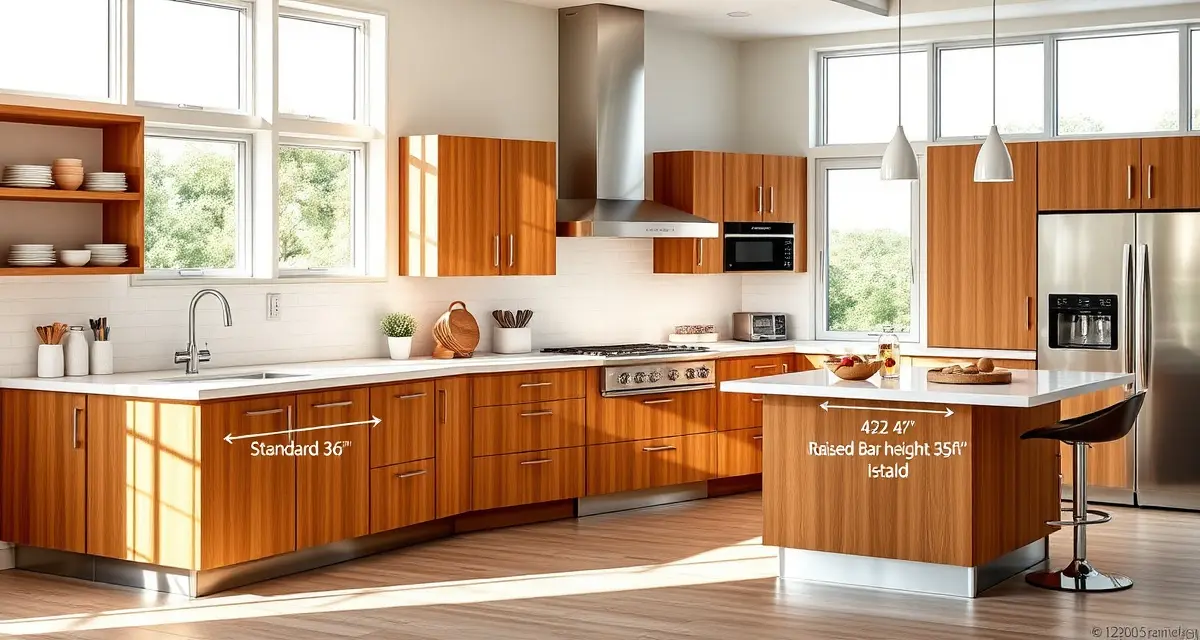
Can Countertops Be Different Heights?
Quick Definition: Yes, countertops can absolutely be different heights within the same kitchen or bathroom. Standard counter height is 36 inches, but multi-level designs, bar-height islands, ADA-accessible workstations, and baking stations at 30-34 inches are all common. Different heights serve different functions and users.
TL;DR
- Standard kitchen counter height is 36" from the floor (established in the 1950s for a 5'7" average user)
- Bar-height countertops are 42" and require bar stools (28-30" seat height)
- Counter-height raised sections sit at 36-38" and use counter stools (24-26" seat height)
- ADA-compliant countertops must include a section at 34" max with knee clearance underneath
- Baking/prep stations are sometimes lowered to 30-34" for easier dough rolling
- Multi-level countertops require careful fabrication planning for the transition point
- Different heights add $200-$800+ to fabrication costs depending on material and design
The Standard Counter Height -- And Why It Doesn't Fit Everyone
The 36-inch kitchen counter height became standard in the mid-20th century. It was designed for an average female height of about 5'4" to 5'7". The problem? Not everyone is 5'4" to 5'7".
Calculate your material waste savings
See exactly how much slab material and money you could save with optimized cutting layouts.
Try the free Waste CalculatorIf you're 6'2", spending an hour chopping vegetables at a 36-inch counter means hunching over and straining your lower back. If you're 5'0", that same counter has you working with your elbows raised uncomfortably high.
That's exactly why multi-height countertops exist.
Common Countertop Heights and Their Uses
| Height | Name | Primary Use | Seating |
|---|---|---|---|
| 28-30" | Table height | Seated work, ADA, baking | Standard dining chairs |
| 30-34" | Lowered prep | Baking, dough rolling, accessibility | Low stools or chairs |
| 36" | Standard counter | General cooking, prep, most tasks | Counter stools (24-26") |
| 38-39" | Raised counter | Taller users, standing work | Counter stools (26-28") |
| 42" | Bar height | Eating bar, socializing | Bar stools (28-30") |
| 44-48" | Standing desk | Standing workstation, commercial | No seating |
Multi-Level Kitchen Island Designs
The most popular place for mixed heights is the kitchen island. Here are the common configurations:
Two-Tier Island
The classic multi-level island has a lower prep area (36") and a raised eating bar (42"). The raised section faces the living/dining area and hides the cooking mess from guests.
Pros:
- Hides dirty dishes and prep clutter
- Creates a defined eating area
- Provides a natural separation between cook and guests
Cons:
- The transition ledge collects crumbs
- More expensive to fabricate (requires two slab sections and a support structure)
- Reduces continuous prep surface
Waterfall-to-Bar Transition
A waterfall island (where the countertop material continues down the side) can transition to a raised bar section. This is a dramatic design element but requires precise fabrication.
Flush Island with Step-Down
Some modern kitchens keep the island at 36" but include a step-down section at 30" for a seated workspace or accessible prep area.
ADA Accessibility Requirements
If you're building a kitchen that needs ADA (Americans with Disabilities Act) compliance -- such as in a rental unit, commercial space, or for a household member who uses a wheelchair -- specific height requirements apply:
- At least one section of countertop must be 34 inches or lower
- That section needs knee clearance underneath (27" high, 30" wide, 19" deep minimum)
- The accessible section should have a smooth approach with no raised thresholds
- Controls (outlets, switches) near the accessible countertop must be reachable from a seated position
ADA-compliant countertop sections are not just for wheelchairs. They're also useful for seated food prep, children's workstations, and anyone with back or joint issues that make standing uncomfortable.
How Multi-Level Countertops Are Fabricated
From a fabrication standpoint, different heights create specific challenges:
The Transition Point
Where two heights meet, the fabricator has options:
-
Butt joint with support bracket: Two separate slab pieces at different heights, meeting at a vertical transition. A steel bracket or wood support structure holds the raised section.
-
Stepped single slab: Rarely done because stone can't be bent, but some thin formats (12mm porcelain panels) can accommodate gentle curves.
-
Separate slabs with a waterfall drop: The higher section has a short waterfall edge that drops down to meet the lower section.
Fabrication Cost Impact
| Design Element | Additional Cost |
|---|---|
| Simple two-level island | $200-$500 |
| Waterfall transition | $400-$800 |
| ADA step-down section | $200-$400 |
| Curved transition (porcelain) | $600-$1,200 |
| Three or more levels | $500-$1,000+ |
The extra cost comes from additional cutting, polishing exposed edges, and the structural support needed for raised sections.
What Fabricators Need to Know
Multi-level countertops require precise templating. The transition point must align with the cabinet support structure, and any height difference needs to be accounted for in the template. A 1/4" error at the transition is much more visible than a 1/4" error along a straight wall run.
For shops using SlabWise, the Template Verification system catches height discrepancies by cross-referencing cabinet specs with template measurements -- flagging conflicts before the slab is cut.
Choosing the Right Height for Your Kitchen
For Cooking and Prep
The ideal prep height puts your elbows at a 90-degree angle when your hands rest on the counter surface. A quick formula:
Ideal counter height = Your elbow height - 3 to 4 inches
For most people between 5'4" and 5'10", that lands at 34-38 inches.
For an Eating Bar
Bar height (42") works best when you want a casual, social eating space. Counter height (36") eating areas feel more like a table and work better for kids and elderly family members.
For Baking
Serious bakers often prefer a lowered section at 30-33". Rolling dough requires downward pressure, and a lower surface gives you better body mechanics. Pastry chefs in commercial kitchens typically work at surfaces around 30-32".
For Universal Design
If you're building for long-term use (aging in place, multi-generational households), consider including at least one section at 30-34" with open knee space below. This doesn't have to look clinical -- many designers integrate accessible sections as natural design elements like a desk area or lowered island end.
Real-World Examples
Example 1: Family Kitchen
- Main perimeter counters: 36" (standard)
- Island prep area: 36" (standard)
- Island eating bar (facing family room): 42" with waterfall end
- Kids' baking corner: 30" with open base
Example 2: Aging-in-Place Remodel
- Main cooking counters: 34" (slightly lower for seated access)
- Pull-out cutting board: 30" (wheelchair accessible)
- Small standing section near range: 36"
Example 3: Entertainer's Kitchen
- Perimeter counters: 36"
- Massive island: 38" (owners are both over 6')
- Separate wet bar: 42" with under-counter refrigerator
FAQ
What is the standard kitchen countertop height? 36 inches from the finished floor to the top of the countertop surface. This has been the US standard since the 1950s and is what most base cabinets (34.5" tall) plus a standard countertop thickness (1.5") produce.
Can I make my kitchen counter taller than 36 inches? Yes. If you're tall, you can raise counter height to 38-39" using taller base cabinets, thicker countertop material, or a platform under the cabinets. Custom cabinetry makes any height possible.
What is bar height for a kitchen island? 42 inches is standard bar height. This requires bar stools with a seat height of 28-30 inches. Some designs go to 44-45" for a more dramatic visual.
How much does a multi-level countertop cost? A two-tier island typically adds $200-$800 to fabrication costs compared to a single-level design. The exact amount depends on material, transition style, and structural support needed.
Is 42-inch counter height too tall for eating? For adults, 42" with appropriate bar stools is comfortable. For children under 10 or elderly family members, it can be awkward. Consider a 36" counter-height eating area instead.
Do different height countertops need different cabinets? Usually yes. Standard base cabinets are 34.5" tall (producing a 36" counter with a standard slab). Taller or shorter sections need custom cabinet heights or platform/recessed installations.
What height should an ADA-compliant countertop be? 34 inches maximum, with knee clearance underneath (27" high, 30" wide, 19" deep). At least one work surface must be at this height in an ADA-compliant kitchen.
Can I change my countertop height after installation? It's possible but expensive. It usually requires removing the countertop, modifying or replacing the cabinets, and reinstalling. Plan heights carefully before fabrication.
What's the best height for a kitchen desk or homework station? 30 inches (standard desk height) works well. This matches standard office chair height and is comfortable for seated adults and older children.
Should my bathroom countertop be a different height than my kitchen? Standard bathroom vanity height is 30-32" (old standard) or 36" (newer "comfort height"). The right choice depends on who uses the bathroom and whether children need to reach the sink.
Get Multi-Level Quotes Right the First Time
For fabricators, multi-level countertops mean more complex templates, more edge polishing, and higher callback risk. SlabWise's Quick Quote tool handles multi-height pricing automatically -- generating accurate quotes in 3 minutes instead of 20.
Try These Free Tools
- Photo to Template -- Snap a photo of an existing countertop and get an AI-generated DXF template.
- Template Compare -- Upload two templates and see every dimension change highlighted instantly.
- AI Template Verification -- Cross-check your template against manufacturer specs before cutting.
Sources & Further Reading
- Natural Stone Institute - Countertop Support Guidelines
- International Surface Fabricators Association - Structural Support Requirements
- National Kitchen & Bath Association - Countertop Installation Standards
- ASTM International - C1526 Standard Specification for Serpentine Dimension Stone