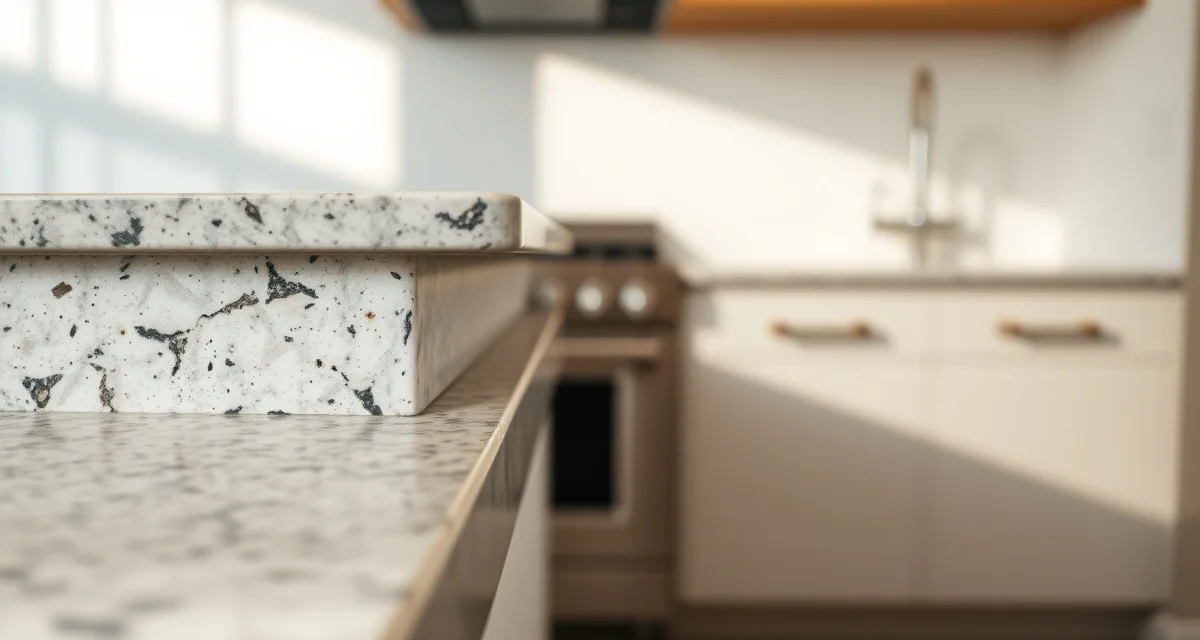
Gap Between Countertop and Wall: Causes, Fixes, and Prevention
Quick Definition: A gap between a countertop and wall is a visible space where the countertop's back edge doesn't sit flush against the wall surface. Gaps range from hairline cracks to 1/4" or more, and they're caused by uneven walls, imprecise templating, settling, or installation errors. Most gaps are fixable with caulk, backsplash, or shimming.
TL;DR
- Small gaps (1/16" or less) are normal and typically filled with color-matched caulk
- Medium gaps (1/16" to 1/4") can be fixed with caulk, a backsplash, or a scribe strip
- Large gaps (over 1/4") usually indicate a templating or installation error
- Most walls are not perfectly flat -- expect some variation
- Caulk (not grout) should fill the countertop-to-wall joint because the materials expand differently
- A 4" backsplash or full-height backsplash hides wall gaps completely
- Fabricators who use digital templating (laser or photogrammetry) get tighter wall fits
- This is the #1 cosmetic complaint in countertop installation callbacks
Why Gaps Happen Between Countertops and Walls
Before blaming your fabricator, understand this: almost no wall in a residential home is perfectly straight or plumb. Drywall bows, studs warp, corners aren't true 90 degrees, and old plaster is wavy. A countertop slab, by contrast, is cut to precise dimensions with straight edges.
Calculate your material waste savings
See exactly how much slab material and money you could save with optimized cutting layouts.
Try the free Waste CalculatorWhen you push a straight edge against a curved surface, gaps are inevitable.
Common Causes
| Cause | How Common | Gap Size |
|---|---|---|
| Wall not flat/straight | Very common | 1/16" - 1/4" |
| Wall not plumb (leaning) | Common | Varies by section |
| Imprecise templating | Occasional | 1/8" - 1/2"+ |
| Countertop shifted during installation | Occasional | Uneven gaps |
| House settling after install | Less common | Gradual widening |
| Drywall or tile added after template | Less common | Uniform gap |
| Incorrect scribe | Occasional | 1/8" - 3/8" |
The Templating Connection
Most gaps trace back to what happened during templating. When a fabricator measures your kitchen, they're recording the exact wall contours to cut a countertop that matches. Three methods exist:
- Physical templates (wood/foam strips): Traditional method. The template sits against the wall and captures its shape. Accuracy depends entirely on the templater's skill.
- Laser templating (LT-2D3D, Proliner, etc.): Digital measurement captures wall contours to within 1mm. More precise but still depends on proper technique.
- Manual measurements (tape measure): Least accurate. Used mainly for simple layouts. Higher chance of wall gaps.
The templater typically leaves a small gap allowance (1/16" to 1/8") between the countertop and wall. This is intentional -- it prevents the slab from binding against the wall and allows for caulking.
How to Fix a Countertop Wall Gap
Fix 1: Caulk (For Gaps Up to 1/4")
The most common fix. Use 100% silicone caulk color-matched to either the countertop or the wall.
Steps:
- Clean both surfaces with isopropyl alcohol
- Apply painter's tape on both sides of the gap for clean lines
- Apply a smooth bead of silicone caulk
- Tool the caulk with a wet finger or caulk finishing tool
- Remove tape immediately before caulk skins over
- Allow 24 hours to cure
Important: Use silicone caulk, not grout. The countertop and wall expand and contract at different rates. Grout is rigid and will crack. Silicone stays flexible.
Cost: $5-$15 DIY, $75-$200 if hiring someone
Fix 2: Backsplash (Hides Gaps Completely)
A backsplash -- whether 4" stone, full-height tile, or slab -- covers the countertop-to-wall joint entirely. This is why many designers recommend installing a backsplash: it eliminates the gap problem.
Options:
| Backsplash Type | Covers Gap? | Cost per Linear Foot |
|---|---|---|
| 4" stone splash (same material) | Yes | $15-$35 |
| Full-height tile | Yes | $20-$50 |
| Full-height slab | Yes | $40-$100 |
| Peel-and-stick tile | Partially | $5-$15 |
Fix 3: Scribe Strip or Trim Molding
A scribe strip is a thin piece of matching stone or wood molding that covers the gap. Fabricators can make scribe strips from the same slab material. This is common in situations where the wall curve is too dramatic for caulk but you're not installing a backsplash.
Cost: $10-$25 per linear foot for stone; $3-$8 for wood trim
Fix 4: Re-Fabrication or Re-Cutting
For large gaps (over 1/4") caused by measurement errors, the fabricator may need to re-cut the countertop. This should be covered under the fabricator's warranty if the error was on their end.
A note for fabricators: Callbacks for wall gaps are expensive and time-consuming. Each one costs you $150-$400 in labor, travel, and materials -- not counting the customer frustration. Accurate digital templating and a proper scribe allowance prevent most of these issues. Tools like SlabWise's Template Verification system add a 3-layer check that catches measurement discrepancies before the slab is cut.
What's an Acceptable Gap?
Industry standards from the Natural Stone Institute suggest:
- 0 to 1/16": Ideal. Barely visible, easily caulked.
- 1/16" to 1/8": Acceptable. Standard caulk joint.
- 1/8" to 1/4": Marginal. Fixable but may look noticeable without a backsplash.
- Over 1/4": Below standard. The fabricator should address this.
Keep in mind that "acceptable" can vary by material. A granite countertop with a rougher natural edge has more visual forgiveness than a bright white quartz with a polished eased edge.
Preventing Gaps: What to Tell Your Fabricator
If you're a homeowner about to get new countertops, make these requests:
- Ask about their templating method. Digital/laser is more accurate than manual.
- Request a scribe. A scribed edge is custom-cut to follow the wall's exact contour. It costs more but eliminates gaps.
- Discuss backsplash plans. If you're adding a backsplash, the fabricator can leave a larger allowance since the splash covers it.
- Check the wall before template day. If your wall is visibly bowed, mention it. Some fabricators adjust their approach for problem walls.
- Don't change the wall after templating. Adding tile, removing wallpaper, or skimming the wall after the template is taken will change the fit.
Special Situations
Corner Gaps
Inside corners (where two walls meet) are the worst spot for gaps. Walls are rarely a true 90-degree angle. Even a 1-degree deviation creates a noticeable gap at the ends of a long run. Fabricators handle this by:
- Scribing the corner section
- Cutting a slightly oversized template and trimming to fit
- Using a flexible caulk in the corner
Floating Walls
In some homes, especially those with post-tension foundations or pier-and-beam construction, walls can shift seasonally. If your gap appears and disappears with the seasons, you're dealing with structural movement. Silicone caulk (which flexes) is the right fix here. Rigid fillers will crack.
After-the-Fact Tile Backsplash
If you add a tile backsplash after countertop installation, the new tile thickness can actually push the visual gap closer. But if the tile doesn't extend all the way down to the countertop surface, you'll need to caulk between the bottom tile edge and the countertop.
FAQ
Is a gap between the countertop and wall normal? Yes. Small gaps (1/16" or less) are expected because residential walls are rarely perfectly flat. These gaps are filled with caulk during installation.
Should I use grout or caulk between the countertop and wall? Always caulk. The joint between a countertop and wall is a movement joint -- the two materials expand at different rates. Grout is rigid and will crack. Silicone caulk stays flexible.
What color caulk should I use for a countertop wall gap? Match the caulk to either the countertop or the wall color, whichever provides the least visible joint. For white or light countertops against white walls, white silicone works well.
How big of a gap is too big? Anything over 1/4" warrants a conversation with your fabricator. Gaps under 1/8" are standard. Between 1/8" and 1/4" is marginal but fixable.
Will a backsplash cover the gap between my countertop and wall? Yes. A 4" stone backsplash or any height tile backsplash will cover the countertop-to-wall joint completely.
Can I fix a countertop wall gap myself? For gaps under 1/4", yes. Apply color-matched silicone caulk with painter's tape for clean lines. For larger gaps, consult a professional.
Why is there a gap on one end but not the other? This usually means the wall is bowed -- straight in one section and curved or angled in another. It can also mean the countertop shifted slightly during installation.
My gap is getting bigger over time. Is that normal? No. A growing gap suggests house settling, foundation movement, or cabinet shifting. Have a contractor evaluate the structural cause before fixing the cosmetic issue.
Should the fabricator fix a large gap for free? If the gap is due to a templating or fabrication error, yes. If the gap is due to wall irregularities that were noted during templating, it may not be covered. Check your installation contract.
Does the gap between the countertop and wall cause water damage? It can. An unsealed gap behind a kitchen sink allows water to seep behind the countertop, potentially causing mold or cabinet damage. Always seal this joint with caulk.
Stop Wall-Gap Callbacks Before They Start
For fabricators: wall gaps are the number-one cosmetic callback in countertop installation. SlabWise's Template Verification system runs a 3-layer check on every measurement, catching wall-contour discrepancies before you cut the slab -- not after you've installed it.
Try These Free Tools
- Photo to Template -- Snap a photo of an existing countertop and get an AI-generated DXF template.
- Template Compare -- Upload two templates and see every dimension change highlighted instantly.
- AI Template Verification -- Cross-check your template against manufacturer specs before cutting.
Sources & Further Reading
- Natural Stone Institute - Countertop Support Guidelines
- International Surface Fabricators Association - Structural Support Requirements
- National Kitchen & Bath Association - Countertop Installation Standards
- ASTM International - C1526 Standard Specification for Serpentine Dimension Stone