Undermount vs Drop-in Sinks: What Every Countertop Fabricator Needs to Know
Choosing between undermount and drop-in sinks isn't just a homeowner decision - it directly affects your fabrication workflow, material costs, and callback rate. The wrong cutout spec or edge finish can turn a profitable job into a $2,000 remake.
TL;DR
- Undermount sinks require polished cutout edges and tighter tolerances (typically +/- 1/8")
- Drop-in sinks are faster to fabricate - about 30-45 minutes less per cutout
- Undermount installations account for roughly 70% of granite and quartz kitchen jobs in 2026
- Fabrication cost difference: $150-$300 more per undermount cutout vs drop-in
- Template accuracy matters more with undermount - digital templating reduces errors by 40-60%
- Drop-in sinks hide minor edge imperfections; undermount sinks expose every flaw
- Material thickness affects mounting: 2cm slabs need extra support clips for undermount
Understanding the Two Sink Types
Drop-in (Self-Rimming) Sinks
A drop-in sink sits on top of the countertop surface with a visible rim or lip that overlaps the cutout edge. The rim covers the raw cut, which means your edge finish doesn't need to be perfect. For fabricators, this translates to faster production and fewer quality concerns at the cutout.
Calculate your material waste savings
See exactly how much slab material and money you could save with optimized cutting layouts.
Try the free Waste CalculatorDrop-in sinks have been the standard since the laminate countertop era. The rim acts as its own seal and support system. You cut the hole, set the sink, apply sealant under the rim, and tighten the clips from below. Total installation time: 15-25 minutes.
Undermount Sinks
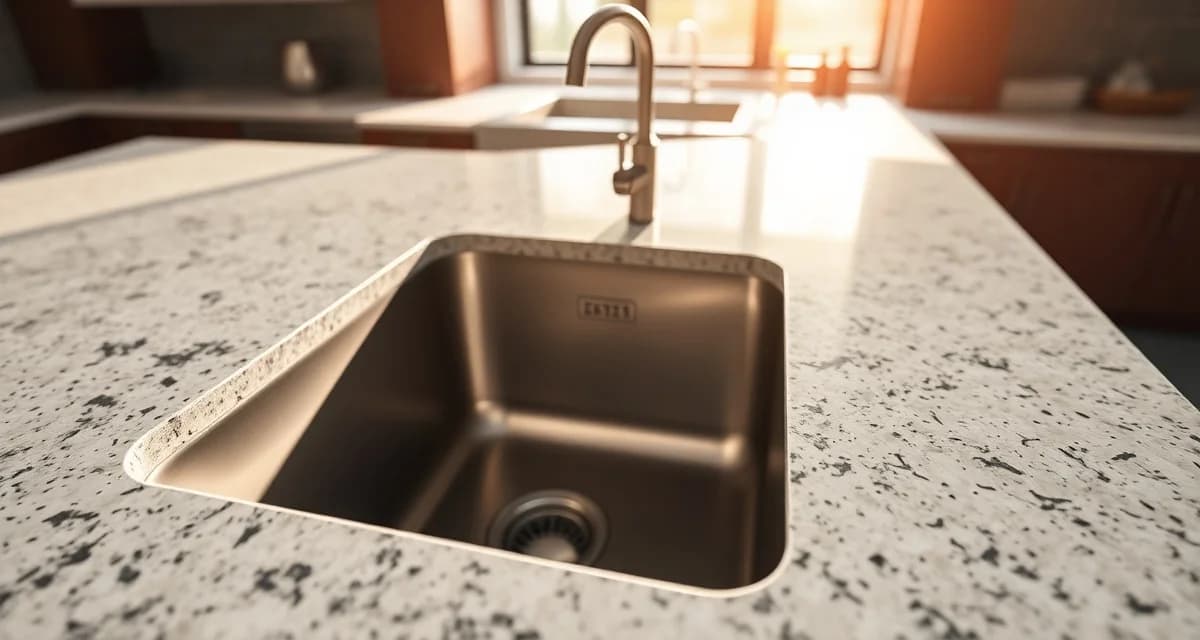
An undermount sink mounts beneath the countertop surface, attached with clips and adhesive to the stone's underside. The cutout edge is fully visible to the homeowner, which means it must be polished to the same standard as the front edge profile.
This is where fabrication skill and precision matter most. The cutout needs to be smooth, consistent, and properly shaped - usually with a slight radius on the inside corners to prevent stress cracks. Most shops use a 1/2" to 3/4" reveal (the amount of stone that extends past the sink rim).
Fabrication Requirements Compared
| Factor | Drop-in Sink | Undermount Sink |
|---|---|---|
| Cutout tolerance | +/- 1/4" | +/- 1/8" |
| Edge finishing | Rough cut acceptable | Full polish required |
| Inside corner radius | Not critical | Min 1/2" radius recommended |
| Avg. fabrication time | 45-60 min per cutout | 75-120 min per cutout |
| Template precision needed | Moderate | High |
| Risk of stress cracks | Low | Moderate (at sharp corners) |
| Support hardware | Rim supports itself | Clips + epoxy required |
| Seam visibility | Hidden by rim | Fully exposed |
Cutout Specifications
For drop-in sinks, most manufacturers provide a paper template. You trace it, cut slightly inside the line, and the rim covers any minor variance. The typical tolerance is +/- 1/4", giving you room for adjustment.
Undermount cutouts demand more precision. You're working with +/- 1/8" tolerance, and the edge must be polished - typically to 200-grit or higher for natural stone, and sometimes buffed to 400-grit for engineered quartz. Inside corners need a minimum 1/2" radius to distribute stress and prevent cracking during thermal expansion.
Edge Finishing Process
Drop-in sink cutouts need minimal finishing. A quick knock-down of sharp edges with a hand pad is usually sufficient since the rim hides everything.
Undermount cutouts require a multi-step finishing process:
- Initial cut with CNC or bridge saw
- Rough grind with 50-grit pad
- Progressive polishing through 100, 200, 400 grit
- Final buff (optional for premium jobs)
- Radius check on all inside corners
This process adds 30-45 minutes per cutout and requires dedicated tooling. Most shops allocate 2-3 diamond polishing pads specifically for sink cutout work.
Cost Analysis for Fabricators
Direct Fabrication Costs
The cost difference between undermount and drop-in fabrication breaks down like this:
| Cost Factor | Drop-in | Undermount | Difference |
|---|---|---|---|
| Labor (per cutout) | $45-$75 | $90-$150 | +$45-$75 |
| Polishing supplies | $5-$10 | $25-$40 | +$20-$30 |
| Support hardware | $0 (included with sink) | $15-$35 | +$15-$35 |
| Adhesive/epoxy | $3-$5 | $10-$20 | +$7-$15 |
| Total per cutout | $53-$90 | $140-$245 | +$87-$155 |
Most shops charge $150-$300 more for undermount installation, which covers material and labor costs while maintaining a 30-40% margin on the cutout work.
Pricing Strategies
Smart fabricators price undermount cutouts as a separate line item rather than burying the cost in the per-square-foot rate. This approach:
- Makes your quote transparent to homeowners
- Justifies the higher price with a clear explanation of the extra work
- Protects your margins when customers request last-minute sink changes
- Allows you to price different sink sizes and configurations independently
A typical pricing structure: base cutout fee ($150-$200) plus per-linear-inch charges for cutouts over 33" in any dimension.
Template Accuracy and Its Impact
Template errors cause more undermount sink remakes than any other factor. A 2024 industry survey found that 34% of all countertop remakes involved sink cutout issues, and undermount configurations accounted for 78% of those.
Digital vs Manual Templating
Digital laser templating systems (like Laser Products LT-2D3D or Prodim Proliner) measure sink cutout locations to within 1/16" accuracy. Manual templating with sticks and hot glue introduces human error - typically 1/8" to 1/4" variance at the sink location.
For undermount sinks, that variance is the difference between a perfect fit and a visible gap. Shops that switched from manual to digital templating report a 40-60% reduction in sink-related callbacks.
Common Template Errors
The most frequent undermount sink template mistakes:
- Incorrect reveal measurement - Not accounting for the sink rim width when setting the cutout offset
- Missing inside corner radius - Specifying square corners that cause stress cracks
- Wrong sink model - The customer changed sinks after templating but didn't tell you
- Clip clearance issues - Not verifying that mounting hardware clears the cabinet framing
- Off-center placement - Misaligning the cutout relative to the base cabinet
SlabWise's Template Verification system uses a 3-layer check that catches these errors before the stone is cut. The system cross-references the sink model specs against the cutout dimensions and flags discrepancies - saving shops an average of 2-3 remakes per month.
Installation Considerations
Undermount Support Methods
Undermount sinks in stone countertops use three main attachment methods:
Clip-and-adhesive (most common): Metal clips bolt to the sink rim and press against the stone underside, supplemented by silicone adhesive. Works for sinks up to 35 lbs when empty.
Epoxy-only (for lightweight sinks): Two-part epoxy bonds the sink rim directly to the stone. Suitable for bar sinks and small prep sinks under 15 lbs. Not recommended for large kitchen sinks.
Support rail system: Metal rails span the cabinet opening and carry the sink weight independently of the stone. Required for cast iron undermount sinks (60+ lbs) and recommended for sinks in 2cm material.
Material Thickness Matters
A 3cm (1-1/4") slab provides enough material for standard undermount clips to grip securely. With 2cm (3/4") material, you need:
- Wider clip faces to distribute pressure
- Additional support rails in most cases
- More adhesive coverage (at least 80% of the rim perimeter)
- Careful torque control on clips to avoid cracking thinner stone
Some fabricators laminate a strip of matching material around the cutout perimeter to create a thicker mounting surface. This adds $50-$100 in material and 20-30 minutes of labor but provides much more secure undermount attachment in 2cm slabs.
Market Trends and Customer Preferences
Undermount sinks now dominate the natural stone and engineered quartz market. Industry data from the Natural Stone Institute shows approximately 70% of residential kitchen countertop jobs specify undermount sinks, up from about 55% a decade ago.
The trend is driven by:
- Easier cleanup - No rim lip for crumbs and water to collect around
- Cleaner aesthetic - Continuous countertop surface look
- Higher perceived value - Associated with premium kitchen design
- Designer influence - Most kitchen designers default to undermount specs
Drop-in sinks remain popular for:
- Budget-friendly renovations
- Laminate and tile countertop installations
- Commercial/rental properties
- Laundry room and utility applications
- Bathroom vanities (about 40% still use drop-in)
Reducing Callbacks and Remakes
Sink-related callbacks cost fabricators an average of $1,500-$2,500 per incident when you factor in material, labor, and scheduling disruption. Here's how to minimize them:
For Undermount Installations
- Always verify the exact sink model and dimensions before cutting
- Use digital templates when possible
- Maintain consistent reveal measurements (document your shop standard)
- Round all inside corners to at least 1/2" radius
- Test-fit clips before applying adhesive
- Apply plumber's putty or silicone in a continuous bead (no gaps)
- Photograph every completed installation for your records
For Drop-in Installations
- Confirm countertop thickness matches the sink's clip range
- Verify that the cutout allows the sink rim to sit flat (no high spots)
- Apply sealant to the full rim perimeter before setting
- Tighten clips in an alternating pattern (like lug nuts) for even pressure
Choosing the Right Approach for Your Shop
If your shop processes more than 20 jobs per month, you likely handle both types regularly. The key decisions:
Invest in undermount tooling if:
- More than 50% of your jobs specify undermount
- You work primarily with granite, quartz, or quartzite
- Your average job value exceeds $3,000
- You want to target higher-end residential work
Keep drop-in as your standard if:
- You focus on commercial or multi-family projects
- Budget renovations make up your core business
- Your team is still building fabrication skills
- You work mostly with 2cm material without lamination capabilities
Can you convert a drop-in sink cutout to undermount?
Generally no. Drop-in cutouts are larger since the rim overlaps the stone. An undermount cutout needs to be smaller than the sink's outer rim. You'd need to re-fabricate the countertop section.
What's the minimum countertop thickness for undermount sinks?
Most undermount sinks require at least 3/4" (2cm) of material. However, 1-1/4" (3cm) is strongly recommended for standard kitchen sinks. For 2cm material, always use additional support rails.
Do undermount sinks void any stone warranties?
Not typically, but some engineered quartz manufacturers require specific installation methods. Caesarstone and Cambria, for example, have published guidelines for undermount attachment that must be followed to maintain warranty coverage.
How much extra should I charge for undermount vs drop-in?
Most shops charge $150-$300 more per undermount cutout. This covers the additional polishing, hardware, and labor. Price it as a line item so customers see the value.
What adhesive works best for undermount stone countertops?
Two-part epoxy (like Akemi Platinum or Tenax Glaxs) provides the strongest bond. Supplement with silicone for flexibility. Never rely on silicone alone for undermount applications in natural stone.
Can you undermount a sink in marble?
Yes, but marble requires extra care. The softer material is more prone to chipping during cutout finishing. Use slower RPMs when polishing, and always radius the inside corners to prevent cracking along natural veining.
What's the standard reveal for undermount sinks?
Most fabricators use a 1/4" to 3/4" reveal (stone extending past the sink rim). A 1/2" reveal is the most common standard. Negative reveals (where the stone is cut smaller than the sink opening) are used for specific design looks but reduce structural support.
How do I handle undermount sinks in island installations?
Islands with undermount sinks need extra support since there's no backsplash wall for additional bracing. Use longer clips, increase adhesive coverage, and consider support rails even in 3cm material for large sinks.
Do farmhouse/apron sinks count as undermount?
Farmhouse sinks are a separate category. The front panel extends below the counter surface, requiring a custom cutout with a finished front edge. Fabrication is more complex than standard undermount - budget 2-3x the labor time.
What causes undermount sinks to separate from the stone?
The top three causes: using silicone instead of epoxy as the primary adhesive, insufficient clip tension, and not degreasing the stone surface before bonding. Proper surface prep is critical - wipe with acetone or denatured alcohol before applying any adhesive.
simplify Your Sink Cutout Workflow
Whether you're fabricating undermount or drop-in cutouts, accuracy at the template stage prevents expensive mistakes at the saw. SlabWise's Template Verification catches sink specification errors before they reach your CNC, reducing remakes and protecting your margins.
Start Your 14-Day Free Trial →
Try These Free Tools
- Cost Calculator -- Compare material costs instantly across different countertop options.
- Compare Materials -- Side-by-side material comparison with pricing, durability, and maintenance.
- Kitchen Visualizer -- Let customers preview countertop materials in their actual kitchen.
Sources & Further Reading
- Natural Stone Institute - Stone Selection and Specification Guide
- National Kitchen & Bath Association - Countertop Material Selection Guidelines
- ASTM International - Standard Test Methods for Natural Building Stone
- International Surface Fabricators Association - Material Sampling Best Practices