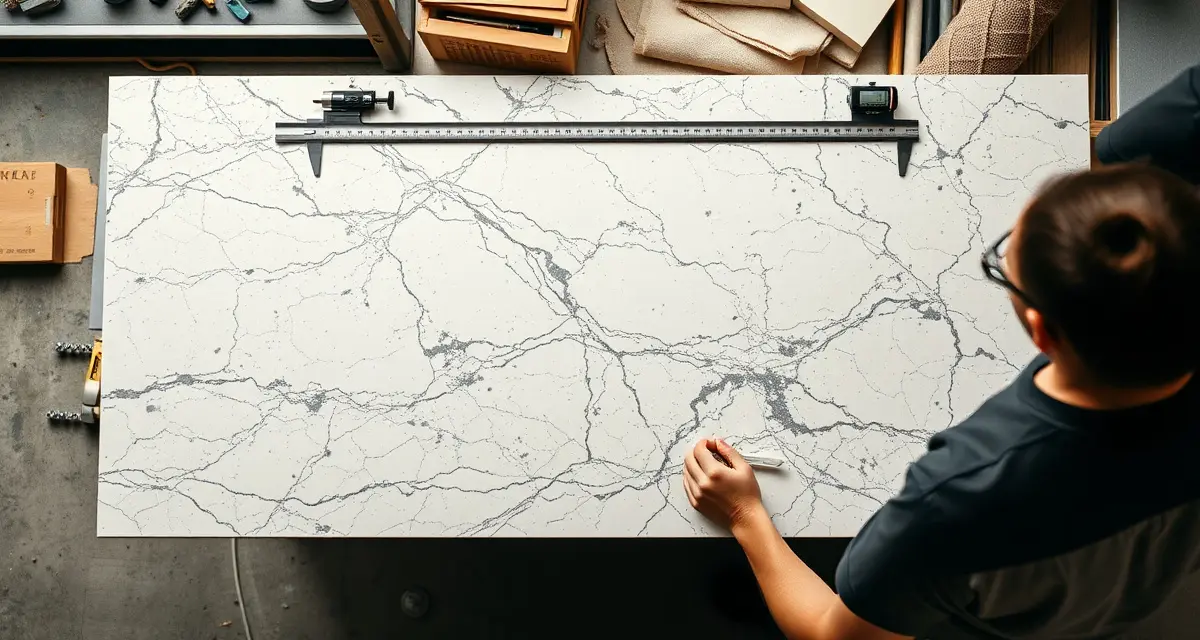
Calculate and Improve Slab Yield
Slab yield is the percentage of a stone slab that becomes installed countertop material versus what ends up as waste. Measured as a simple formula - (square feet of usable pieces / total slab square feet) x 100 - yield is the single most important number for controlling material costs in a fabrication shop. Every percentage point of improvement saves real money: on a $3,000 slab, a 1% yield improvement saves $30.
TL;DR
- Slab yield = (usable piece area / total slab area) x 100
- Industry average yield is 72-78%; top performers hit 88-93%
- Every 1% yield improvement saves $25-40 per slab (depending on material cost)
- The five biggest yield killers: poor nesting, single-job cutting, unused remnants, remakes, and slab defects
- AI nesting improves yield by 10-15 percentage points over manual methods
- Track yield per slab, per material, and per operator to identify improvement opportunities
- SlabWise tracks yield automatically and identifies optimization opportunities
How to Calculate Slab Yield
Basic Yield Calculation
Formula: Yield % = (Total area of cut pieces / Total slab area) x 100
Calculate your material waste savings
See exactly how much slab material and money you could save with optimized cutting layouts.
Try the free Waste CalculatorExample:
- Slab dimensions: 120" x 63" = 7,560 sq in = 52.5 sq ft
- Pieces cut: Kitchen L-counter (36.2 sq ft) + backsplash strips (4.8 sq ft) = 41.0 sq ft
- Yield: 41.0 / 52.5 = 78.1%
Adjusted Yield (Including Usable Remnants)
A better metric includes remnants large enough for future jobs:
Formula: Adjusted Yield % = (Pieces + Usable Remnants) / Total Slab Area x 100
Example (continuing above):
- Remnant: One piece measuring 24" x 48" = 8 sq ft (suitable for a bathroom vanity)
- Adjusted yield: (41.0 + 8.0) / 52.5 = 93.3%
The difference between 78% basic yield and 93% adjusted yield shows the value of creating usable remnants instead of irregular waste.
True Waste Calculation
True waste = Total slab area - Pieces - Usable remnants
From our example: 52.5 - 41.0 - 8.0 = 3.5 sq ft of true waste (6.7% of the slab)
That 3.5 sq ft represents blade kerf, between-piece clearances, and scraps too small to use. This is the irreducible minimum for this particular slab layout.
Yield Benchmarks by Material
Different materials have different achievable yields due to rotation and matching constraints:
| Material Category | Poor | Average | Good | Excellent |
|---|---|---|---|---|
| Solid-color quartz | Below 78% | 78-84% | 84-90% | 90%+ |
| Patterned quartz | Below 76% | 76-82% | 82-88% | 88%+ |
| Granite (granular) | Below 74% | 74-80% | 80-86% | 86%+ |
| Granite (directional) | Below 72% | 72-78% | 78-84% | 84%+ |
| Marble/quartzite | Below 70% | 70-77% | 77-84% | 84%+ |
| Bookmatched pairs | Below 68% | 68-75% | 75-82% | 82%+ |
Why Materials Differ
- Solid-color quartz: No pattern constraints, pieces can be rotated freely, maximum nesting flexibility
- Patterned quartz: Slight directional preference, most rotations acceptable
- Granular granite: General pattern direction matters, 0/90/180/270 rotation ok
- Directional granite/marble: Strong vein direction, limited to 0/180 rotation
- Bookmatched: Fixed positions for mirror effect, most constrained
Five Ways to Improve Yield
1. Use AI Nesting
The single biggest lever. AI nesting evaluates millions of piece arrangements to find the optimal layout.
| Nesting Method | Typical Yield | Time Per Slab |
|---|---|---|
| No planning | 65-72% | 0 min |
| Manual eyeball | 72-78% | 10-15 min |
| Software optimization | 80-86% | 2-5 min |
| AI optimization | 86-93% | 10-30 sec |
Switching from manual to AI nesting typically improves yield by 10-15 percentage points.
2. Cross-Job Batching
Cut pieces from multiple jobs on a single slab. A kitchen (38 sq ft) plus a bathroom vanity (8 sq ft) on a 54 sq ft slab yields 85% instead of the 70% you'd get cutting the kitchen alone.
3. Remnant-First Approach
Before opening a new slab, check your remnant inventory. A bathroom vanity that needs 8 sq ft might fit on an existing remnant, saving an entire new slab.
4. Reduce Remakes
Every remake wastes the original piece (complete loss) and requires a new piece (additional material). Preventing 2 remakes per month can improve your effective yield by 3-5 percentage points across all slabs.
5. Right-Size Your Slabs
Match slab size to job requirements. Don't use a jumbo slab for a job that only needs 35 sq ft. Check if a half slab, remnant, or smaller slab fits the job with acceptable yield.
Tracking Yield: What to Measure
Per-Slab Tracking
For every slab you cut, record:
| Data Point | Example | Purpose |
|---|---|---|
| Slab ID | #2024-0847 | Unique identifier |
| Material | Calacatta Laza | Yield comparison by material |
| Slab dimensions | 120" x 63" | Total area calculation |
| Total slab area | 52.5 sq ft | Denominator for yield |
| Pieces cut | Kitchen L-counter, backsplash | What was produced |
| Total piece area | 41.0 sq ft | Numerator for yield |
| Usable remnant area | 8.0 sq ft | Adjusted yield calculation |
| True waste area | 3.5 sq ft | Irreducible waste |
| Basic yield | 78.1% | Primary KPI |
| Adjusted yield | 93.3% | Includes remnant value |
| Operator | Mike S. | Performance tracking |
| Nesting method | AI | Compare methods |
| Jobs batched | 1 (or 2+) | Batching impact |
Monthly Dashboard
Aggregate your per-slab data into a monthly dashboard:
| Metric | Jan | Feb | Mar | Target |
|---|---|---|---|---|
| Average basic yield | ___% | ___% | ___% | 85%+ |
| Average adjusted yield | ___% | ___% | ___% | 90%+ |
| Total slabs used | ___ | ___ | ___ | Trend down |
| Total sq ft delivered | ___ | ___ | ___ | Trend up |
| Cost per sq ft delivered | $___ | $___ | $___ | Trend down |
| Remakes | ___ | ___ | ___ | Under 1 |
| Remnants created | ___ | ___ | ___ | Track |
| Remnants consumed | ___ | ___ | ___ | Track |
Identifying Improvement Areas
Your tracking data reveals patterns:
- Yield varies by operator: Training opportunity for lower-performing operators
- Yield varies by material: Expected, but large gaps suggest nesting issues for specific materials
- Yield varies by day of week: Friday afternoon yield drops may indicate rushing
- Remnant creation exceeds consumption: Your remnant pile is growing - need better remnant matching
- Yield is good but cost per sq ft is high: You might be using premium slabs where standard would work
The Dollar Value of Yield Improvement
Annual Savings Calculator
Use this table to estimate your savings from yield improvement:
| Monthly Slabs | Avg Slab Cost | 5% Improvement | 10% Improvement | 15% Improvement |
|---|---|---|---|---|
| 10 | $2,500 | $1,250/mo ($15K/yr) | $2,500/mo ($30K/yr) | $3,750/mo ($45K/yr) |
| 20 | $3,000 | $3,000/mo ($36K/yr) | $6,000/mo ($72K/yr) | $9,000/mo ($108K/yr) |
| 30 | $3,000 | $4,500/mo ($54K/yr) | $9,000/mo ($108K/yr) | $13,500/mo ($162K/yr) |
| 50 | $3,500 | $8,750/mo ($105K/yr) | $17,500/mo ($210K/yr) | $26,250/mo ($315K/yr) |
How to read this table: A shop using 30 slabs/month at $3,000 average, improving yield by 10%, saves $9,000/month or $108,000/year. Against a SlabWise subscription of $199-349/month, that's a 25-45x return on investment.
Common Yield Mistakes
Mistake 1: Not Measuring Yield at All
You can't improve what you don't measure. Many shops have no idea what their average yield is. Start tracking today - even rough estimates are better than nothing.
Mistake 2: Measuring Only Basic Yield
Basic yield ignores usable remnants. A slab that produces 75% product and a 15% usable remnant is performing much better than one that produces 80% product and 20% waste. Track adjusted yield alongside basic yield.
Mistake 3: Blaming the Material
Yes, veined materials yield less than solid colors. But that doesn't mean you can't improve. The gap between average and excellent is 8-12 percentage points for every material type. There's room to improve regardless of what you're cutting.
Mistake 4: Ignoring Small Jobs
Bathroom vanities and bar tops seem too small to worry about. But cutting a 6 sq ft vanity from a 25 sq ft half slab (24% yield) is terrible. These small jobs are perfect remnant candidates.
Mistake 5: Accepting "That's Just How It Is"
Every percentage point matters. A 25-slab-per-month shop that improves from 75% to 85% yield saves $75,000 per year. That's not rounding error - that's a real employee's salary.
What slab yield should I be targeting?
For a mixed material shop: 85% basic yield or 90% adjusted yield (including usable remnants). If you're below 78%, you have immediate improvement opportunities. Above 90%, you're performing among the best in the industry.
How do I improve yield without buying software?
Start with the free improvements: always draw layouts before cutting, check remnants before ordering new slabs, batch jobs when possible, and track yield per slab to identify patterns. These alone can improve yield 5-8%.
Does higher yield mean lower quality?
Not if done correctly. Good nesting maintains proper clearances between pieces, accounts for blade kerf, and respects vein direction constraints. Yield only hurts quality when pieces are packed too tightly or vein matching is sacrificed.
How long does it take to see yield improvement?
Nesting changes show results on the first slab. Cross-job batching takes 1-2 weeks to establish workflow. Remnant management takes 30-60 days to build up inventory. Overall, most shops see measurable improvement within 30 days.
Should I track yield by operator?
Yes. Yield differences between operators highlight training opportunities. Some variation is normal (complex jobs vs. simple ones), but consistent gaps suggest one operator could learn from another's techniques.
What's the maximum possible yield?
For solid-color materials with perfect batching, theoretical maximum is around 96-97% (limited by blade kerf and minimum clearances). In practice, 92-95% is excellent for solid colors. For veined materials, 87-90% is excellent.
How does slab size affect yield?
Larger slabs generally produce higher yield because there's more flexibility for piece arrangement. But only if you have enough pieces to fill the slab. A jumbo slab for a small job produces terrible yield - match slab size to job requirements.
Can I compare my yield to industry benchmarks?
The industry average is 72-78% basic yield. Shops using nesting software typically achieve 82-88%. Shops using AI nesting with cross-job batching achieve 88-93%. Your material mix affects where you fall within these ranges.
How often should I review yield data?
Weekly reviews catch problems early. Monthly summaries reveal trends. Quarterly reviews should compare to goals and adjust strategy. Annual reviews inform equipment and software investment decisions.
Does yield tracking help with pricing?
Absolutely. If you know your actual yield, you can price more accurately. A shop achieving 85% yield can price material lower than a shop at 72% yield - because they're wasting less. Accurate yield data prevents both overcharging and undercharging.
Start Tracking and Improving Your Yield
SlabWise tracks yield per slab, per material, and per operator automatically. AI nesting optimizes every layout for maximum yield, and the system identifies cross-job batching opportunities to push yield even higher.
Start Your 14-Day Free Trial - yield tracking and AI nesting included with every plan.
Try These Free Tools
- Nesting Optimizer -- AI-powered slab layout that maximizes yield considering vein direction and defects.
- Defect Mapping -- Upload a slab photo and AI maps every fissure, pit, and color issue.
- Value Engineering -- Find dollar-quantified suggestions to save material without cutting margin.
Sources & Further Reading
-
International Surface Fabricators Association - Digital Fabrication and CAD/CAM Best Practices
-
Natural Stone Institute - Stone Fabrication Technology and Optimization
-
Marble Institute of America - Template and Layout Efficiency Guidelines
-
National Kitchen & Bath Association - Countertop Installation and Fabrication Standards