What Is Rodding? Definition & Guide
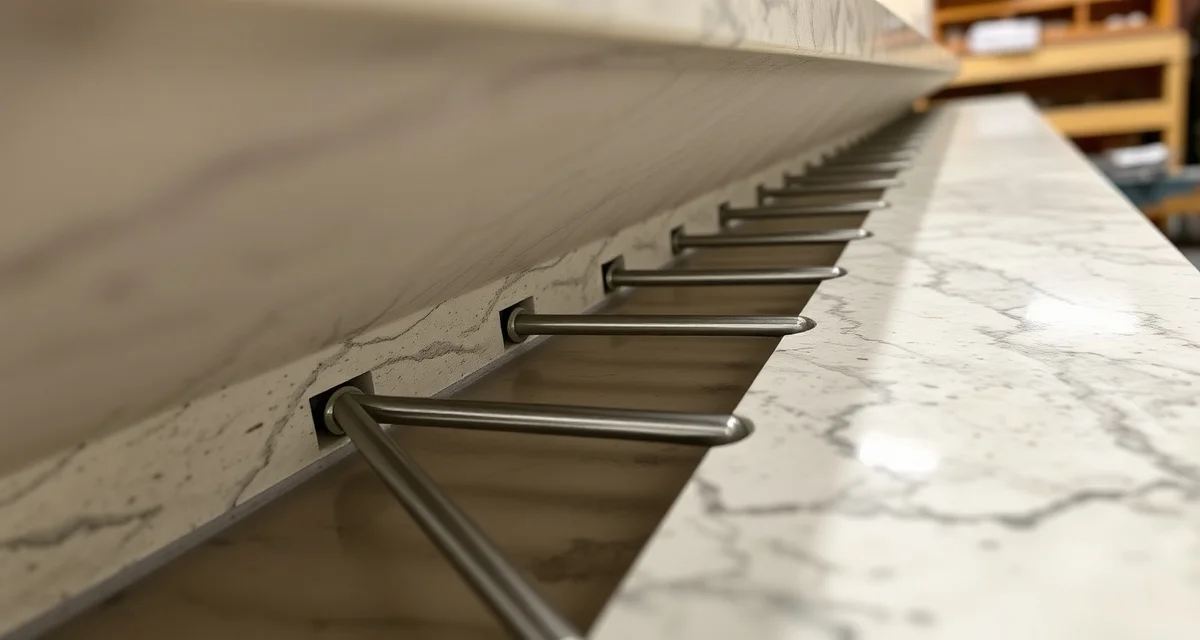
Rodding is a structural reinforcement technique where steel or fiberglass rods are embedded in channels routed into the underside of a stone countertop, then secured with epoxy. The rods span across weak points - like sink cutouts, cooktop openings, and narrow sections - to prevent cracking during transport and installation. Industry standards recommend rodding on any natural stone countertop piece with a cutout that leaves less than 4 inches of material on any side, and it's used on an estimated 75-85% of all residential kitchen countertop installations.
TL;DR
- Steel or fiberglass rods are set in routed channels on the underside of stone countertops
- Required whenever a cutout leaves less than 4 inches of material on any side
- Used on 75-85% of residential kitchen countertop installations
- Prevents cracking during transport, installation, and long-term use
- Rod materials: steel ($0.50-$1.50/ft) or fiberglass ($1-$3/ft)
- Standard rod diameter is 3/8" to 1/2" for most countertop applications
- Adds 15-30 minutes of fabrication time per piece requiring rodding
Why Rodding Is Necessary
Natural stone is strong in compression (bearing weight from above) but weak in tension (resisting bending forces). When you cut a sink or cooktop opening into a countertop, the remaining material around the cutout becomes vulnerable to:
Calculate your material waste savings
See exactly how much slab material and money you could save with optimized cutting layouts.
Try the free Waste CalculatorCommon Failure Points
- Behind sink cutouts - The narrow strip of stone between the sink opening and the back edge (often just 2-3 inches) is the #1 crack location
- Cooktop openings - A 30" x 21" cooktop cutout in a 25.5" deep countertop leaves very little material at the back
- Narrow peninsulas - Long, narrow countertop sections flex under their own weight
- Inside corners - L-shaped countertops experience stress concentration at the inside corner
- Faucet holes near edges - Core-drilled holes close to the sink cutout weaken an already stressed area
The Cost of Not Rodding
A cracked countertop during installation is one of the most expensive mistakes in fabrication:
- Material replacement: $1,500-$6,000+ for the slab
- Re-fabrication labor: 4-8 hours
- Customer delay: 3-10 days for material sourcing and re-fabrication
- Reputation damage: Bad reviews, lost referrals
By contrast, rodding a piece takes 15-30 minutes and costs $5-$15 in materials. The ROI on rodding is astronomical.
Rod Types and Materials
Steel Rods
- Material: Mild steel or stainless steel
- Diameter: 3/8" most common; 1/2" for heavy-duty applications
- Cost: $0.50-$1.50 per linear foot
- Pros: Inexpensive, strong, readily available
- Cons: Can rust if exposed to moisture; thermal expansion differs from stone
Fiberglass Rods
- Material: Pultruded fiberglass composite
- Diameter: 3/8" or 1/2"
- Cost: $1-$3 per linear foot
- Pros: No rust, thermal expansion closer to stone, lighter weight
- Cons: More expensive, harder to bend for curved applications
Carbon Fiber Rods (Premium)
- Material: Carbon fiber composite
- Diameter: 1/4" or 3/8"
- Cost: $3-$8 per linear foot
- Pros: Strongest option pound-for-pound, zero corrosion, minimal weight
- Cons: Expensive, brittle if impacted, limited availability
| Property | Steel | Fiberglass | Carbon Fiber |
|---|---|---|---|
| Tensile strength | 58,000 PSI | 100,000 PSI | 300,000+ PSI |
| Corrosion resistance | Low (rusts) | High | High |
| Cost per foot | $0.50-$1.50 | $1-$3 | $3-$8 |
| Weight | Heavy | Light | Very light |
| Ease of use | Easy | Easy | Moderate |
| Best for | Standard work | Wet areas, outdoor | Premium installs |
How to Rod a Countertop: Step by Step
Tools Needed
- Router with 1/2" or 5/8" straight bit (or CNC with routing program)
- Rods (steel or fiberglass, cut to length)
- Knife-grade or flowing epoxy
- Mixing supplies and applicator
- Clamps or weights for curing
Process
Step 1: Plan rod placement. Rods should span across the weakest point, extending at least 6 inches past each side of the cutout. For a sink cutout, place 2 rods behind the opening, running parallel to the back edge.
Step 2: Route channels. Cut channels 3/8"-1/2" deep and 1/16" wider than the rod diameter into the underside of the stone. Channels should be at least 1" from any edge.
Step 3: Dry-fit rods. Place rods in channels to confirm they fit and span the full intended distance. Rods should not protrude above the channel.
Step 4: Apply epoxy. Fill the channel halfway with epoxy, press the rod into place, then cover with more epoxy to fill the channel flush.
Step 5: Cure. Allow full cure time (2-24 hours depending on epoxy type) before moving the piece. Don't rush this step.
Step 6: Document. Note the rodding pattern in your job packet so installers know what to expect on the underside.
Rodding Standards and Best Practices
When Rodding Is Required
According to the Natural Stone Institute and industry best practices:
- Any cutout leaving less than 4" of material on any side
- Countertop sections longer than 60" without intermediate support
- All undermount sink cutouts in 2cm (3/4") material
- Narrow sections less than 6" wide and longer than 24"
- Any piece in 2cm material with a cooktop cutout
Rod Placement Guidelines
- Minimum 2 rods behind every sink cutout
- Minimum 2 rods on each side of cooktop cutouts
- Rods should extend 6-8 inches past each side of the cutout
- Space multiple rods 2-3 inches apart
- Keep rods at least 1 inch from any edge
- For pieces over 80" long, add midspan rodding even without cutouts
Common Rodding Patterns
Standard sink cutout (undermount): Two parallel rods behind the sink, running the full width of the piece. This addresses the thin strip between the cutout and the back edge - the highest-stress area.
Cooktop cutout: Two rods on each side (left and right), perpendicular to the front edge. These prevent the narrow material alongside the cooktop from snapping during handling.
L-shaped piece with inside corner: Diagonal rod across the inside corner, plus rods along any adjacent cutouts. The inside corner is a natural stress concentrator.
Is rodding necessary for granite countertops?
Rodding is strongly recommended for any granite countertop with sink or cooktop cutouts. While dense granites like Absolute Black may be less prone to cracking, the industry standard is to rod behind all undermount sink cutouts and beside all cooktop openings regardless of stone density.
What size rod should I use for countertops?
For most residential countertop applications, 3/8" diameter rods are standard. Use 1/2" rods for heavier-duty applications like commercial work, 3cm (1-1/4") thick slabs, or large cooktop cutouts. The rod should be slightly smaller than the routed channel to allow epoxy to fully surround it.
How many rods do I need behind a sink cutout?
The standard is 2 rods behind every undermount sink cutout, placed 2-3 inches apart and running the full width of the countertop piece. For farm/apron sinks or very large undermount sinks (33"+), some fabricators add a third rod for extra security.
Can I use rebar instead of purpose-made rods?
Technically yes, but it's not ideal. Standard rebar has a rough, ridged surface that doesn't sit cleanly in narrow channels and requires wider routing. Smooth steel rod or fiberglass rod is preferred because it fits precisely in routed channels and allows better epoxy bonding.
How long does rodding take?
Rodding a standard kitchen countertop piece with one sink cutout takes 15-30 minutes, including routing, rod placement, and epoxy application. Pieces with multiple cutouts or complex geometries may take 30-45 minutes. Cure time is additional - 2 to 24 hours depending on the epoxy type.
Does rodding show on the top surface?
No. Rodding is applied to the underside of the countertop and is completely invisible from the top surface. The only time rodding might be visible is if you're looking at the underside of an overhanging section, and even then it's covered by epoxy flush with the stone's bottom surface.
Should I rod 3cm (1-1/4") thick countertops?
Yes, even though 3cm stone is thicker and stronger than 2cm, it should still be rodded behind sink cutouts and beside cooktop openings. The thicker material means you can route deeper channels (1/2" instead of 3/8"), and you should use 1/2" rods for maximum reinforcement.
Is fiberglass better than steel for rodding?
Fiberglass rods are better in wet environments (near sinks, outdoor kitchens) because they don't rust. They also have a thermal expansion rate closer to stone, reducing stress from temperature changes. Steel rods are cheaper and work fine for standard indoor applications. For premium work, fiberglass is the safer choice.
What epoxy should I use for rodding?
Use a knife-grade or flowing epoxy specifically designed for stone fabrication. It should have a tensile strength of at least 3,500 PSI and a cure time compatible with your production schedule. Polyester resin is acceptable for quick jobs but offers less structural strength than true epoxy.
Can rodding fix an already-cracked countertop?
Rodding can reinforce a cracked countertop after the crack is repaired with epoxy, but it's a salvage operation - not a standard practice. The crack is glued with flowing epoxy, then rods are installed on the underside spanning the repair area. This is a field repair technique that costs $200-$500 and is best used when replacement isn't practical.
Never Miss a Rodding Step
When your job packets list every reinforcement requirement upfront, your CNC team routes the channels and your fabricators install the rods - without guessing or forgetting. SlabWise's digital job packets include rodding specs for every piece, reducing crack-related remakes.
Start Your 14-Day Free Trial → No credit card required.
Try These Free Tools
- Cost Calculator -- Get instant countertop cost estimates by material and square footage.
- Kitchen Visualizer -- Upload a kitchen photo and preview different materials in place.
- Template Compare -- Upload two templates and see every dimension change highlighted.