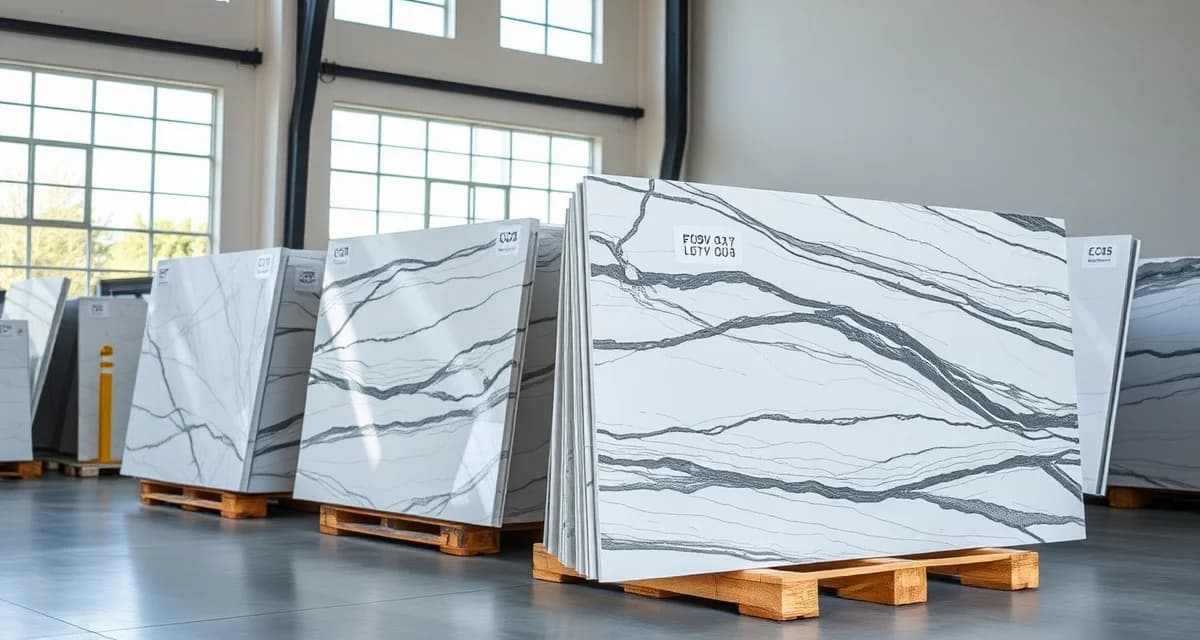
What Is FOB Pricing? Definition & Guide
FOB pricing (Free On Board) is a shipping and trade term used in countertop fabrication that determines when ownership and liability for a stone slab transfer from seller to buyer. In the U.S. stone industry, roughly 80% of slab distributors quote prices on an FOB basis, meaning the buyer assumes freight costs and damage risk once the material leaves the seller's warehouse or loading dock.
TL;DR
- FOB stands for "Free On Board" and defines who pays for shipping and bears transit risk
- FOB Origin means the buyer owns the slab as soon as it's loaded onto the truck
- FOB Destination means the seller retains responsibility until it arrives at your shop
- Freight costs for a standard granite slab bundle (8-10 slabs) typically run $800-$2,500 depending on distance
- Understanding FOB terms can save fabricators $3,000-$8,000 annually on material procurement
- Most U.S. slab distributors like MSI, Arizona Tile, and Daltile use FOB Origin pricing
- Always confirm FOB terms in writing before placing any slab order over $5,000
How FOB Pricing Works in the Stone Industry
When you see a slab listed at "$45/sq ft FOB Houston," that price covers the material cost at the distributor's Houston warehouse. You're responsible for arranging and paying for transport from Houston to your fabrication shop.
Calculate your material waste savings
See exactly how much slab material and money you could save with optimized cutting layouts.
Try the free Waste CalculatorThere are two primary FOB arrangements fabricators encounter:
FOB Origin (FOB Shipping Point)
This is the most common arrangement in stone distribution. The moment the slab bundle is loaded onto a carrier at the seller's dock, three things happen:
- Ownership transfers to you, the buyer
- Risk of damage becomes your responsibility
- Freight costs are on your account
If a slab cracks during transit under FOB Origin terms, you - not the distributor - file the insurance claim.
FOB Destination
Less common but sometimes available from larger distributors, FOB Destination means the seller owns the material and bears the risk until it arrives at your shop. The seller typically includes freight in the quoted price, so the per-square-foot cost appears higher.
FOB Pricing vs. Delivered Pricing: Key Differences
| Factor | FOB Origin | FOB Destination | Delivered Price |
|---|---|---|---|
| Ownership transfer | At seller's dock | At your shop | At your shop |
| Who pays freight | Buyer | Seller (built in) | Seller (built in) |
| Transit damage risk | Buyer | Seller | Seller |
| Price transparency | High | Medium | Low |
| Typical price/sq ft (granite) | $35-$65 | $40-$75 | $45-$80 |
| Negotiation flexibility | High | Medium | Low |
| Common with | Most distributors | Large orders | Direct importers |
Why FOB Pricing Matters to Fabricators
1. It Affects Your True Material Cost
A slab quoted at $42/sq ft FOB Origin might actually cost you $48-$55/sq ft once you factor in freight, unloading, and insurance. If you're running 50 jobs per month with an average of 45 sq ft per job, a $6/sq ft freight miscalculation costs you $13,500 monthly.
2. It Determines Insurance Responsibility
Under FOB Origin, you need transit insurance on every incoming shipment. A single broken Calacatta Gold slab at $95/sq ft represents a $4,750 loss on a standard 50 sq ft slab if you don't have proper coverage.
3. It Impacts Your Quoting Accuracy
When you quote a customer, your material cost must include the true landed cost - not just the FOB price. Fabricators who forget to account for freight in their quotes lose 3-7% on margin per job.
How to Calculate Your True Landed Cost
Here's the formula every fabricator should use:
Landed Cost = FOB Price + Freight + Insurance + Unloading Labor
Example Calculation
- Slab: White Fantasy granite, 120" x 78" (65 sq ft)
- FOB Price: $38/sq ft = $2,470
- Freight (Dallas to Atlanta, 790 miles): $385
- Transit Insurance (1.5% of value): $37
- Unloading Labor (30 min crane time): $75
- Total Landed Cost: $2,967
- True Cost Per Sq Ft: $45.65/sq ft
That's a 20% increase over the quoted FOB price. Missing this in your quotes means you're giving away $497 per slab.
Common FOB Pricing Mistakes Fabricators Make
Mistake 1: Not reading the fine print. Some distributors quote "FOB warehouse" without specifying which warehouse. If they ship from a distant location, your freight costs can double.
Mistake 2: Skipping transit insurance. A $3,000 slab bundle with no insurance is a gamble. One bad pothole or forklift incident and you're eating the full replacement cost.
Mistake 3: Forgetting accessorial charges. Liftgate service ($75-$150), residential delivery surcharges ($100-$200), and detention fees ($50-$75/hour after the first 2 hours) all add up.
Mistake 4: Not comparing total landed costs. A slab at $40/sq ft FOB from 500 miles away may cost more than a $44/sq ft slab from a distributor 50 miles down the road.
How to Negotiate Better FOB Terms
- Consolidate orders - Buying 10+ slabs? Ask for FOB Destination or a freight discount
- Use the distributor's carrier - They often have negotiated rates 20-30% below retail freight
- Ask about free freight thresholds - Many distributors offer free shipping on orders over $10,000-$15,000
- Get multiple freight quotes - Use freight brokers to compare LTL and full truckload rates
- Negotiate damage inspection windows - Push for 48-hour inspection rights instead of the standard 24 hours
Tracking FOB Costs in Your Shop
Keeping accurate records of landed costs is essential for profitable quoting. Many fabricators still track material costs on spreadsheets, which makes it easy to miss freight line items.
Fabrication management software like SlabWise lets you log the FOB price, freight charges, and all accessorial costs against each slab in your inventory. When you pull a slab for a job, the system automatically calculates your true material cost - so your quotes reflect real numbers, not estimates.
What does FOB stand for in stone pricing?
FOB stands for "Free On Board." It's a shipping term that indicates the point where ownership and risk transfer from seller to buyer. In countertop fabrication, it typically refers to the distributor's warehouse or loading dock where slabs are picked up or shipped from.
Is FOB Origin or FOB Destination better for fabricators?
FOB Destination is generally better for fabricators because the seller retains risk during transit. However, FOB Origin prices are typically 5-15% lower since freight isn't included. For large orders over $10,000, FOB Origin with your own carrier can save you money if you negotiate good freight rates.
How much does freight add to FOB slab pricing?
Freight typically adds $5-$12 per square foot to the FOB price, depending on distance and slab quantity. A single slab shipped 500 miles might cost $300-$500 in freight, while a full bundle of 8-10 slabs over the same distance runs $800-$1,500. Local pickups within 50 miles usually cost $150-$250.
Do I need insurance on FOB Origin shipments?
Yes. Under FOB Origin terms, you own the slabs from the moment they're loaded. Transit insurance typically costs 1-2% of the material value. On a $5,000 order, that's $50-$100 - far cheaper than replacing a cracked slab worth $2,500+.
What happens if a slab arrives damaged under FOB Origin?
Under FOB Origin, the buyer (you) must file a damage claim with the freight carrier, not the seller. Document the damage immediately with photos and notes on the Bill of Lading. Most carriers require claims within 9 months, but filing within 48 hours significantly improves your chances of approval.
Can I negotiate FOB terms with distributors?
Absolutely. Distributors regularly adjust terms for volume buyers. If you're purchasing $20,000+ monthly, ask for FOB Destination or freight allowances. Some distributors offer free freight on orders exceeding $10,000 or $15,000, especially when they're trying to move excess inventory.
How does FOB pricing differ from CIF pricing?
FOB pricing covers the material cost at the origin point, and the buyer pays freight. CIF (Cost, Insurance, and Freight) includes material, insurance, and freight in one price. CIF is more common in international stone imports from countries like Brazil, Italy, and India, while FOB dominates domestic U.S. transactions.
Should I factor FOB costs into my customer quotes?
Always. Your customer quote should reflect your true landed cost - not just the FOB price. Failing to include freight, insurance, and handling means you're absorbing $5-$12 per square foot in hidden costs. On a 45 sq ft kitchen, that's $225-$540 in lost margin per job.
What's the difference between FOB and Ex Works?
Ex Works (EXW) places even more responsibility on the buyer than FOB Origin. Under EXW, the buyer handles everything - including loading at the seller's facility. FOB at least means the seller is responsible for loading the slabs onto the carrier. EXW is more common in international stone purchasing.
How do I track FOB costs across multiple distributors?
Use a centralized inventory management system that records the FOB price, freight, insurance, and handling for each slab. This lets you compare true landed costs across distributors and identify which suppliers actually offer the best value. Spreadsheets work for small shops, but they become error-prone beyond 20-30 slabs in inventory.
Start Tracking Your True Material Costs
Knowing your FOB terms is step one. Tracking your actual landed costs on every slab is what separates profitable fabricators from the rest. SlabWise automatically calculates true material costs including freight, insurance, and handling - so every quote you send reflects real margins.
Start Your 14-Day Free Trial → No credit card required.
Try These Free Tools
- Cost Calculator -- Get instant countertop cost estimates by material, edge profile, and square footage.
- Compare Materials -- Side-by-side material comparison with pricing, durability, and maintenance ratings.
- Edge Profile Selector -- Browse edge profiles with cost impact and visual previews.
Sources & Further Reading
- National Kitchen & Bath Association - Cabinet Frame Construction Standards
- International Surface Fabricators Association - Support Frame Requirements for Stone Installation
- Natural Stone Institute - Structural Framing Guidelines for Natural Stone Applications
- ASTM International - ASTM C1242 Standard Guide for Selection, Design, and Installation of Dimension Stone Attachment Systems