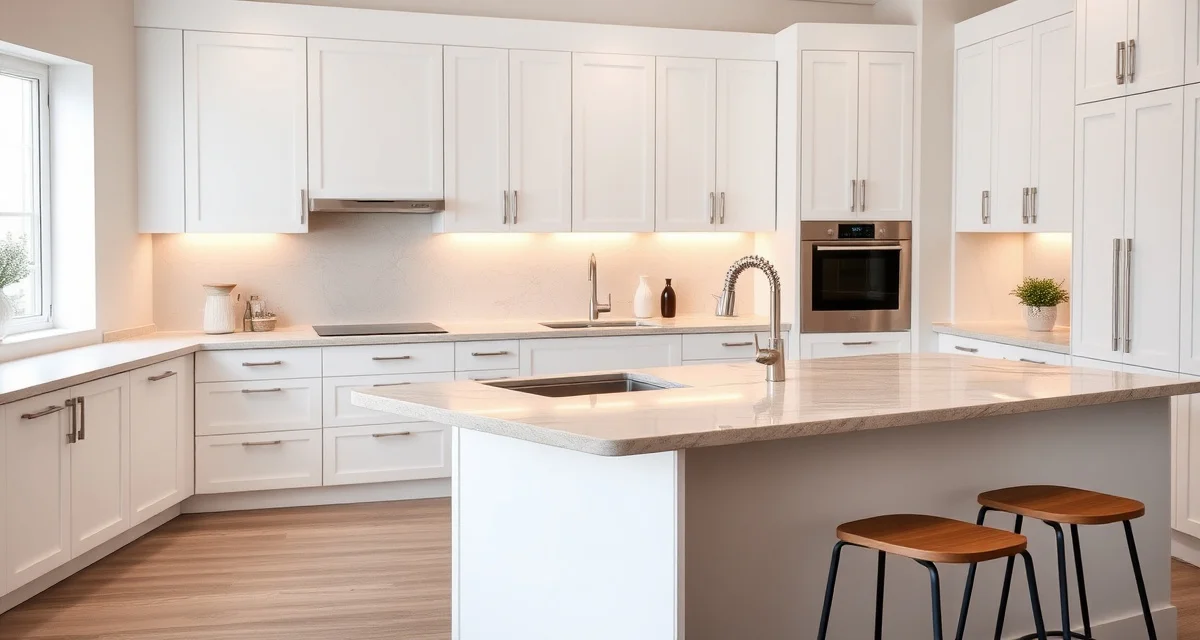
What Is a Peninsula? Definition & Guide for Countertop Fabricators
A peninsula in kitchen design is a countertop section that extends outward from a wall or existing cabinet run, connected on one end while the other end is open. Think of it as a kitchen island that is attached to the perimeter layout instead of standing free. For countertop fabricators, peninsulas present unique challenges around seaming, support, and material layout.
TL;DR
- A peninsula is a countertop extension connected to the main cabinet run on one end, open on the other
- Typically 24-48 inches wide and 36-72 inches long
- Requires support on the open end if the overhang exceeds 10-12 inches
- Creates a natural transition between kitchen and adjacent rooms
- Seam placement is a key fabrication decision, especially at the junction point
- Peninsulas often include seating overhangs on one or both sides
- Proper templating of the wall junction point prevents misfit issues
Peninsula vs. Island: What Is the Difference?
The terms get mixed up constantly, but the distinction matters for fabrication:
Calculate your material waste savings
See exactly how much slab material and money you could save with optimized cutting layouts.
Try the free Waste Calculator| Feature | Peninsula | Island |
|---|---|---|
| Attached to wall/cabinets | Yes, on one end | No, freestanding |
| Accessible sides | 2-3 sides | All 4 sides |
| Typical dimensions | 24-48" wide, 36-72" long | 36-72" wide, 48-120" long |
| Support complexity | Moderate | High |
| Seam considerations | Junction with perimeter | Standalone or multi-piece |
| Cost vs. island | Generally lower | Generally higher |
For the fabricator, the critical difference is that peninsula countertops must connect precisely to the perimeter countertop at the wall junction. This junction creates a seam, a potential mismatch point, and a template-sensitive area that demands accuracy.
Why Peninsulas Matter in Fabrication
Seam Placement at the Junction
The point where the peninsula meets the perimeter countertop is one of the most visible seams in any kitchen. The color, pattern, and vein direction must align across the joint. For natural stone with pronounced veining - like Calacatta marble or heavily veined quartzite - this junction requires careful slab layout during nesting.
AI nesting software can help by positioning the peninsula and perimeter pieces on the same slab in a way that maintains visual continuity across the seam.
Wall Junction Accuracy
Where the peninsula meets the wall (or the end of the existing cabinet run), the fit must be exact. Walls are rarely perfectly straight or square, so the template must capture the actual wall profile - not an assumed 90-degree angle. Digital templating systems using laser measurement capture this profile precisely.
Overhang Support
Most peninsulas include a seating overhang on the open side, typically 12-15 inches. This overhang needs brackets or corbels, just like an island. The support requirements depend on the material and overhang depth:
- 3cm granite/quartz: Support needed beyond 10-12 inches
- 3cm marble: Support needed beyond 6-8 inches
- 2cm any material: Support needed beyond 6 inches
Common Peninsula Configurations
Straight Peninsula
Extends perpendicular from a wall or cabinet run. The simplest configuration with one seam at the junction. This is the most common type in U-shaped and galley-to-peninsula kitchen conversions.
Angled Peninsula
Extends at a 45-degree or other non-perpendicular angle from the perimeter. More complex to template and fabricate because the junction seam is at an angle, requiring precise miter work or carefully matched angled cuts.
Curved Peninsula
Features a radius on the open end, often for a curved eating bar. The curve adds fabrication complexity - CNC routing is typically required for consistent radius work. Material waste can be higher due to the curved cuts.
Waterfall Peninsula
The countertop material wraps down one or both open ends of the peninsula, creating a vertical surface. This requires additional material and precise alignment of patterns across the horizontal-to-vertical transition.
Peninsula Fabrication Best Practices
Template the Junction First
When measuring a peninsula kitchen, template the junction point with extra care. Capture the wall angle, the cabinet alignment on both sides, and any out-of-level conditions. Even a 1/8" error at the junction becomes a visible gap or mismatch.
Plan Seam Direction
For veined materials, decide the vein direction during the quoting/layout phase - not on the saw. The vein should ideally run in a consistent direction across the junction, or the seam will stand out to anyone sitting at the peninsula.
Check Support Before Final Measure
The templater should verify that adequate support exists (or is planned) for the open end before the final measure is recorded. Documenting bracket type and locations prevents installation-day problems.
Account for Uneven Walls
Peninsula-to-wall junctions almost always involve scribing. The template should capture the wall profile so the shop can cut a scribe edge that fits tightly. A 1/4" gap against an uneven wall looks poor even with caulk.
Peninsula Dimensions and Pricing Impact
| Peninsula Element | Typical Range | Impact on Quote |
|---|---|---|
| Length | 36-72 inches | Direct sq ft cost |
| Width | 24-36 inches | Direct sq ft cost |
| Seating overhang | 12-15 inches | Adds support cost |
| Waterfall end | 25-36" height | 1.5-2x material cost |
| Curved end radius | 12-24" radius | CNC time + waste |
| Edge profile | Standard to premium | $5-$30/lin ft |
For a typical 36" x 60" peninsula in 3cm quartz at $70/sq ft installed, the base cost runs roughly $1,050-$1,400. Add a seating overhang with brackets ($200-$400), edge profiling ($100-$250), and the junction seam work, and the complete peninsula section can run $1,500-$2,200+.
How Peninsulas Affect Slab Yield
Peninsulas are generally good for material yield because they are narrower than islands. A 25.5" deep perimeter section plus a 36" wide peninsula section can often be nested efficiently from a single slab, especially when the peninsula is oriented parallel to the slab's long dimension.
Fabrication software that uses AI-driven nesting can automatically position peninsula pieces alongside perimeter pieces for maximum yield, reducing waste on stone that costs $40-$120+ per square foot.
FAQ
What is the standard size of a kitchen peninsula?
Most kitchen peninsulas are 24-36 inches wide and 36-72 inches long. The depth matches the standard countertop depth of 25.5 inches on the cabinet side, with an additional 12-15 inches for seating overhangs.
Does a peninsula need support brackets?
Yes, if the seating overhang exceeds 10-12 inches for 3cm granite or quartz, or 6-8 inches for marble. The open end should also be checked for adequate cabinet support beneath the stone.
How do you seam a peninsula to the perimeter countertop?
The seam is typically placed at the exact junction point where the peninsula leaves the perimeter cabinet run. Color-matched epoxy and careful alignment of any veining patterns create the best result.
Is a peninsula cheaper than an island?
Generally yes. Peninsulas use less material (one fewer exposed side), need less support infrastructure, and involve simpler installation since one end is attached to existing cabinetry.
Can I add a peninsula to an existing kitchen?
Yes. A base cabinet is added to the existing run, extending outward. The fabricator then templates and installs the new peninsula section with a seam at the junction to the existing perimeter top - or replaces the full run for a continuous look.
What edge profiles work best for peninsulas?
Any standard edge profile works. For seating overhangs, an eased or bullnose edge is most comfortable for forearms. Ornate profiles like ogee are less common on the seating side.
How do you handle vein matching at a peninsula junction?
During slab layout, the fabricator positions the peninsula piece adjacent to the perimeter piece so that vein direction and pattern match across the seam. AI nesting tools can optimize this placement automatically.
What is the minimum width for a peninsula?
24 inches is the practical minimum for a peninsula to function as useful counter space. Anything narrower feels cramped and limits functionality.
Do peninsulas affect kitchen resale value?
Peninsulas are viewed favorably in real estate because they add counter space and casual seating without the footprint requirements of a full island. They work well in kitchens where an island would be too tight.
How long does it take to fabricate and install a peninsula countertop?
A peninsula section is typically fabricated as part of the overall kitchen project. The additional time for peninsula-specific work (junction seam, support verification) adds roughly 1-2 hours to the install.
Keep Peninsula Details Straight Across Your Jobs
Junction seams, support specs, vein matching - peninsula fabrication has a lot of details that can slip through the cracks across a busy schedule. SlabWise tracks every measurement from template to install and flags potential issues before they become remakes. Start your 14-day free trial today.
Try These Free Tools
- Nesting Optimizer -- AI-powered slab layout that maximizes yield considering vein direction and defects.
- Defect Mapping -- Upload a slab photo and AI maps every fissure, pit, and color issue.
- Value Engineering -- Find dollar-quantified suggestions to save material without cutting margin.