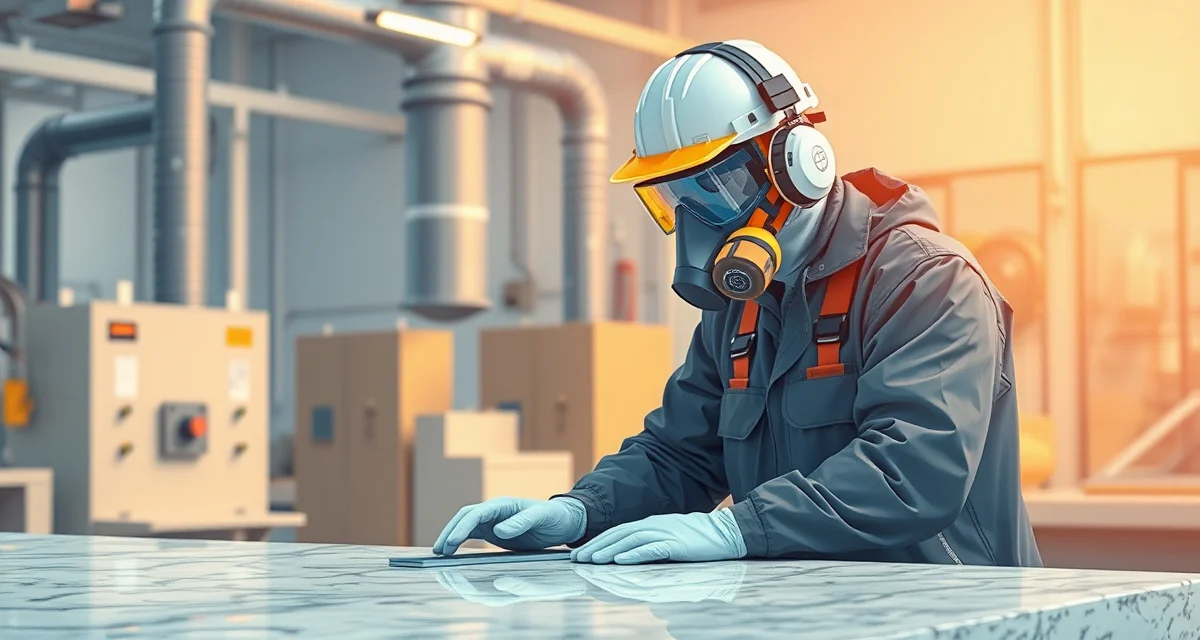
Silicosis Safety FAQ
Quick Definition
This silicosis safety FAQ answers the most common questions from fabricators and homeowners.
Silicosis is a serious, irreversible lung disease caused by inhaling fine particles of crystalline silica dust. Countertop fabrication workers face significant silicosis risk because stone cutting, grinding, and polishing generate respirable silica dust - particularly when working with engineered quartz (93% silica) and natural granite (25-60% silica). OSHA's respirable crystalline silica standard (29 CFR 1926.1153) sets enforceable limits for workplace exposure, and compliance is both a legal obligation and a moral one for every shop owner.
TL;DR
- Silicosis is irreversible - once lung damage occurs, it cannot be undone
- Engineered quartz generates the most silica dust (93% crystalline silica content)
- OSHA's permissible exposure limit (PEL) is 50 micrograms per cubic meter over an 8-hour shift
- Wet cutting reduces airborne silica by 90%+ and is the primary control method
- Every fabrication shop must have a written exposure control plan
- Workers need medical surveillance if exposed above the action level (25 μg/m³)
- Penalties for OSHA silica violations can reach $16,000+ per violation (willful violations: $160,000+)
- Young workers (under 40) have developed accelerated silicosis from quartz fabrication in as little as 5-10 years
- Proper controls make fabrication safe - the risk comes from inadequate protection
Understanding Silicosis
What is silicosis?
Silicosis is a fibrotic lung disease. When very fine silica particles (smaller than 10 microns - invisible to the naked eye) are inhaled, they penetrate deep into the lungs. The body's immune system responds to these particles by creating scar tissue (fibrosis) around them. Over time, this scarring stiffens the lungs, reduces oxygen transfer, and progressively impairs breathing.
Calculate your material waste savings
See exactly how much slab material and money you could save with optimized cutting layouts.
Try the free Waste CalculatorThree forms of silicosis:
| Type | Exposure Duration | Onset | Silica Level |
|---|---|---|---|
| Chronic silicosis | 10-30 years | Gradual, progressive | Lower exposure over long periods |
| Accelerated silicosis | 5-10 years | Faster progression | Moderate to high exposure |
| Acute silicosis | Months to 2 years | Rapid, often fatal | Very high exposure (uncontrolled) |
Accelerated silicosis has been increasingly documented among countertop fabrication workers, particularly those cutting engineered quartz without adequate dust controls. Cases in workers as young as their 20s and 30s have been reported in the US, Australia, Spain, and Israel.
Why is countertop fabrication a high-risk occupation for silicosis?
Several factors combine to create elevated silicosis risk in fabrication shops:
- High silica content materials - Engineered quartz is 93% crystalline silica. Even granite contains 25-60% silica.
- Dust-generating processes - Cutting, grinding, polishing, and edge work all break stone into respirable particles.
- Enclosed work environments - Shop spaces can concentrate airborne dust if ventilation is inadequate.
- Daily exposure - Fabricators work with stone every day, accumulating exposure over years.
- Dry processes - Any dry cutting, grinding, or polishing generates significantly more airborne dust than wet processes.
Which materials produce the most silica dust?
Silica content by countertop material:
| Material | Crystalline Silica Content | Relative Risk |
|---|---|---|
| Engineered quartz | 90-93% | Highest |
| Quartzite | 80-95% | Very high |
| Granite | 25-60% (varies by type) | High |
| Sandstone | 70-90% | Very high |
| Porcelain slab | 10-30% | Moderate |
| Marble | Less than 5% | Lower |
| Limestone | Less than 5% | Lower |
| Soapstone | Negligible | Lowest |
| Solid surface (Corian) | 0% (no silica) | No silica risk |
The key point: Engineered quartz, the most popular countertop material in the US market, generates the most dangerous dust. As quartz has grown from a niche material to nearly 40% market share, silicosis risk across the industry has increased correspondingly.
OSHA Requirements
What does OSHA require for silica exposure in fabrication shops?
OSHA's Respirable Crystalline Silica Standard (29 CFR 1926.1153) applies to all stone fabrication operations. Key requirements:
Exposure limits:
- Permissible Exposure Limit (PEL): 50 μg/m³ (8-hour time-weighted average)
- Action Level: 25 μg/m³ - triggers medical surveillance and monitoring requirements
Required elements of compliance:
| Requirement | Details |
|---|---|
| Written exposure control plan | Document controls, procedures, and responsibilities |
| Exposure assessment | Initial monitoring, and periodic monitoring if above action level |
| Engineering controls | Wet methods, local exhaust ventilation, enclosed processes |
| Respiratory protection | When engineering controls alone don't reduce exposure below PEL |
| Housekeeping | No dry sweeping; use wet methods or HEPA vacuums |
| Medical surveillance | For workers exposed above action level (25 μg/m³) - initial and every 3 years |
| Training | Hazards of silica, controls, proper use of PPE |
| Recordkeeping | Exposure monitoring results, medical surveillance records |
What are the penalties for OSHA silica violations?
OSHA penalties for silica standard violations (2025-2026 rates):
| Violation Type | Maximum Penalty per Violation |
|---|---|
| Serious | $16,131 |
| Willful or repeated | $161,323 |
| Failure to abate | $16,131 per day |
| Posting requirements | $16,131 |
Multiple violations on a single inspection are common. An OSHA inspection that finds no written control plan, no exposure monitoring, no medical surveillance, and no respiratory program could result in four separate serious violations - potentially $64,000+ in fines.
Beyond penalties, shop owners face personal liability, workers' compensation claims, and potential lawsuits from affected workers.
Does OSHA require air monitoring in fabrication shops?
Yes, unless you can demonstrate that exposures are consistently below the action level (25 μg/m³). In practice, most fabrication shops should conduct initial monitoring when:
- Starting operations
- Changing materials (adding quartz, for example)
- Changing processes or equipment
- Modifying ventilation or dust controls
Monitoring involves collecting air samples near workers' breathing zones during normal operations. A qualified industrial hygienist or safety consultant can conduct monitoring. Cost: $500-$2,000 per monitoring event depending on the number of samples.
Dust Control Methods
What are the most effective dust controls for fabrication shops?
The hierarchy of controls, from most effective to least:
1. Elimination/Substitution
- Avoid dry cutting entirely
- Use materials with lower silica content when appropriate
- Choose pre-finished products that reduce fabrication steps
2. Engineering Controls (most critical)
- Wet cutting - Water suppresses 90%+ of airborne dust during CNC and manual cutting
- Local exhaust ventilation (LEV) - Capture dust at the source during grinding and polishing
- Enclosed CNC machines - Full enclosures around CNC saws and routers contain dust
- Water walls - Wet curtains or walls that capture airborne particles
- General ventilation - Dilution ventilation for the overall shop space
3. Administrative Controls
- Rotate workers to limit individual exposure duration
- Schedule high-dust tasks when fewer workers are present
- Enforce housekeeping protocols (no dry sweeping)
- Post warning signs in high-exposure areas
4. Personal Protective Equipment (last resort)
- N95 or P100 respirators (minimum) during any dry stone work
- Half-face or full-face respirators with P100 filters for higher exposures
- Powered air-purifying respirators (PAPRs) for sustained work in dusty conditions
How effective is wet cutting at controlling silica dust?
Wet cutting is the single most effective dust control in stone fabrication. When properly implemented:
- Reduces airborne respirable silica by 90-95%
- Keeps particles in the water/slurry instead of becoming airborne
- Cools blades and tooling, extending their life
- Required for all CNC cutting operations
Critical requirements for effective wet cutting:
- Adequate water flow to the blade (not just a trickle)
- Water recycling system to manage slurry
- Supplemental dust controls for any dry processes (edge touch-ups, hand grinding)
- Regular maintenance of water delivery systems (nozzles clog)
Wet cutting alone may not reduce exposure below the PEL in all cases - particularly during dry hand polishing or when working with high-silica materials in enclosed spaces. Supplemental controls (LEV, respirators) are often needed.
What respiratory protection should fabrication workers use?
Respirator selection depends on the exposure level and task:
| Task | Recommended Respirator | Protection Factor |
|---|---|---|
| CNC wet cutting (enclosed) | May not need respirator if engineering controls are sufficient | N/A |
| CNC wet cutting (open) | N95 or P100 half-face | 10x PEL |
| Dry hand grinding/polishing | P100 half-face minimum | 10x PEL |
| Heavy dry cutting (if ever necessary) | Full-face P100 or PAPR | 50x-1000x PEL |
| Shop general area (wet operations running) | N95 may be adequate | 10x PEL |
Important: Respirators require a formal respiratory protection program under OSHA (29 CFR 1910.134), including:
- Medical evaluation before first use
- Fit testing (annual)
- Training on proper use and maintenance
- Written program documenting all elements
N95 masks grabbed from a box without fit testing do not meet OSHA requirements for a respiratory protection program.
Medical Surveillance
What medical monitoring do fabrication workers need?
Workers exposed above the action level (25 μg/m³) must receive:
Initial medical exam (within 30 days of first exposure above action level):
- Complete medical history focusing on respiratory health
- Chest X-ray or CT scan
- Pulmonary function test (spirometry)
- Tuberculosis screening
Periodic exams (every 3 years):
- Same components as initial exam
- Comparison with baseline results to detect changes
Cost: $200-$500 per exam depending on location and provider. For a shop with 5 exposed workers, annual medical surveillance costs approximately $300-$800 per year (exams every 3 years).
What are the early symptoms of silicosis?
Early silicosis symptoms are often subtle and easily attributed to other causes:
- Persistent cough (especially dry cough)
- Shortness of breath during physical activity
- Fatigue
- Chest tightness
- Decreased exercise tolerance
By the time symptoms become noticeable, significant lung damage has usually occurred. This is why medical surveillance is critical - X-rays and pulmonary function tests can detect changes before symptoms appear.
If any fabrication worker develops respiratory symptoms, immediate medical evaluation and workplace exposure assessment should follow.
Shop Implementation
How do I create a silica exposure control plan?
A written exposure control plan must include:
- Description of tasks that involve silica exposure
- Engineering controls in use (wet cutting, ventilation, enclosures)
- Work practices (housekeeping, wet methods, no dry sweeping)
- Respiratory protection program details
- Medical surveillance program
- Training program (frequency, content, documentation)
- Exposure monitoring schedule and results
- Designated competent person responsible for the program
- Recordkeeping procedures
Templates are available from OSHA's website and from industry associations like the Natural Stone Institute and ISFA. Many safety consultants specialize in fabrication shop compliance and can develop a plan for $1,000-$3,000.
How much does silica compliance cost for a small shop?
Estimated annual compliance costs for a 5-person fabrication shop:
| Compliance Element | Annual Cost |
|---|---|
| Water management system (amortized) | $1,000-$3,000 |
| Local exhaust ventilation (amortized) | $500-$2,000 |
| Respirators and fit testing | $500-$1,500 |
| Exposure monitoring (initial + periodic) | $500-$2,000 |
| Medical surveillance | $300-$800 |
| Training materials and time | $300-$600 |
| Housekeeping supplies (HEPA vacuum, wet methods) | $300-$800 |
| Competent person time | $500-$1,000 |
| Total annual | $3,900-$11,700 |
This is a meaningful cost for a small shop, but it's a fraction of the cost of a single OSHA citation - let alone the human cost of a worker developing silicosis.
Can silicosis be cured?
No. Silicosis is irreversible. Once scar tissue forms in the lungs, it cannot be removed or repaired. Treatment focuses on managing symptoms and slowing progression - supplemental oxygen, bronchodilators, pulmonary rehabilitation. In severe cases, lung transplantation may be considered. Prevention is the only effective strategy.
Is dry cutting ever acceptable in a fabrication shop?
OSHA doesn't explicitly ban dry cutting, but the exposure levels generated by dry cutting on high-silica materials make it nearly impossible to comply with the PEL without extraordinary controls. Practically speaking, all primary cutting (CNC operations) should be wet. Some dry hand polishing may be acceptable with proper respiratory protection and ventilation, but wet methods are preferred whenever possible.
Are granite workers at risk, or just quartz workers?
Both are at risk, though quartz workers face higher risk due to the material's 93% silica content. Granite varies widely - some granites contain 25% silica while others contain 60%. All stone fabrication workers who cut, grind, or polish natural or engineered stone should be included in the shop's silica control program regardless of material.
How often should I train workers on silica safety?
OSHA requires training at initial assignment and whenever there are changes to processes, materials, or controls. Best practice: conduct formal training annually with brief refresher sessions quarterly. Training should cover the health effects of silica exposure, the shop's specific controls, proper use of PPE, and what to do if controls fail or exposures seem elevated.
Do I need a silica program if I only do wet cutting?
Yes. Even with wet cutting, some processes may generate respirable dust (dry hand polishing, edge touch-ups, cleanup activities). A written control plan documents your wet cutting practices, identifies any residual exposure risks, and demonstrates compliance during an OSHA inspection. The plan doesn't have to be complex if your controls are strong, but it must exist in writing.
Can customers or visitors be affected by silica dust in a fabrication shop?
Visitors in an active fabrication shop can be exposed to airborne silica, though their brief exposure is much less risky than daily worker exposure. Still, keep customers and visitors out of active production areas. If clients visit for slab selection, maintain that area separate from cutting and grinding operations. Post warning signage at production area entrances.
What is the difference between N95 and P100 respirators?
N95 masks filter 95% of airborne particles. P100 respirators filter 99.97% of particles - essentially stopping everything. For silica dust in fabrication, P100 is the recommended minimum. N95 may be adequate in well-controlled environments (wet cutting with good ventilation) but P100 provides a significantly better margin of safety for the modest additional cost.
Are there safer alternatives to engineered quartz?
From a silica perspective, materials with lower crystalline silica content are inherently less hazardous: marble, limestone, soapstone, and solid surface (Corian) generate less silica dust. Porcelain slabs have moderate silica content. However, market demand drives material choice - quartz is what customers want. The answer isn't to avoid quartz but to control dust properly when fabricating it.
How long does it take for silicosis to develop?
Chronic silicosis typically develops after 10-30 years of exposure. But accelerated silicosis can develop in 5-10 years of higher exposure, and acute silicosis can develop in months with very high uncontrolled exposure. Cases of accelerated silicosis in young countertop workers (20s and 30s) have been increasingly documented globally since 2015, particularly linked to engineered quartz fabrication without adequate controls.
Who is the "competent person" for silica compliance?
OSHA requires a designated competent person who can identify silica hazards, has authority to take corrective actions, and is capable of implementing the written exposure control plan. This can be the shop owner, a supervisor, or a designated safety coordinator. The competent person doesn't need formal certification, but they must have adequate training and knowledge of silica hazards and control methods.
Protect Your Workers and Your Business
Silicosis prevention isn't optional - it's a legal requirement and a moral responsibility. Every fabrication shop needs proper dust controls, monitoring, and documentation.
While SlabWise focuses on fabrication management rather than safety compliance, our platform helps shops run more efficiently - which means more budget and attention available for safety programs. Reducing remakes through AI template verification, cutting waste through AI slab nesting, and freeing up administrative time through the customer portal all contribute to a shop that has the resources to invest in worker protection.
Start your 14-day free trial - run a more efficient, more profitable shop that can afford to do safety right.
Try These Free Tools
- Nesting Optimizer -- AI-powered slab layout that maximizes yield considering vein direction and defects.
- Defect Mapping -- Upload a slab photo and AI maps every fissure, pit, and color issue.
- Value Engineering -- Find dollar-quantified suggestions to save material without cutting margin.
Sources & Further Reading
- Natural Stone Institute - Natural Stone Care and Maintenance Guide
- National Kitchen & Bath Association - Countertop Selection Guidelines
- ASTM International - Standards for Stone and Countertop Materials
- International Surface Fabricators Association - Countertop Material Properties
Internal Links
- Silicosis Guide - Full guide to silicosis prevention in fabrication
- Dust Control Guide - Engineering controls for silica dust
- Shop Safety Guide - Complete fabrication shop safety program
- Equipment FAQ - Dust control equipment for fabrication shops
- Safety Audit Checklist - Quarterly safety review template
- Silicosis Rates Statistics - Industry exposure and illness data