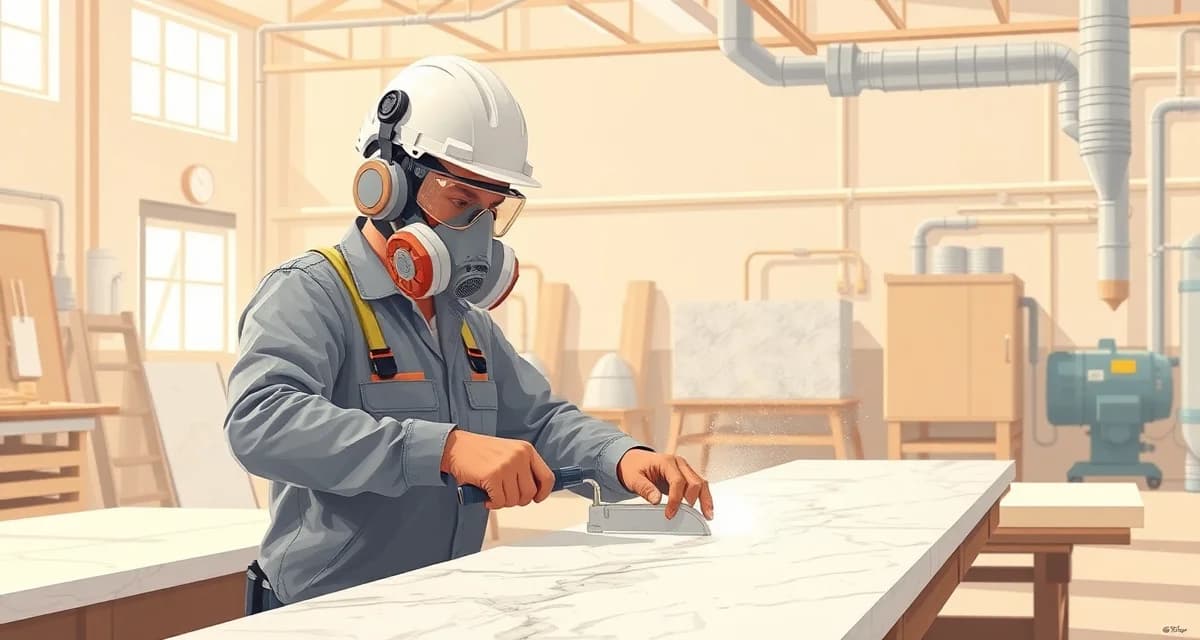
Silicosis Rates in Countertop Fabrication: 2026 Statistics
Current silicosis rates are a critical safety concern for every stone fabrication shop.
Silicosis is a serious, irreversible lung disease caused by inhaling crystalline silica dust during stone cutting, grinding, and polishing. In 2026, countertop fabrication remains one of the highest-risk occupations, with an estimated 12-18% of workers in unprotected environments showing early signs of silicosis within 5-10 years of exposure. Updated OSHA regulations and increased wet-cutting adoption are slowly improving outcomes, but thousands of fabrication workers remain at risk.
TL;DR
- An estimated 12-18% of countertop fabrication workers in poorly ventilated shops develop early silicosis within 5-10 years
- Engineered quartz produces the highest silica dust concentration (up to 93% crystalline silica content)
- OSHA's permissible exposure limit (PEL) for silica is 50 micrograms per cubic meter over an 8-hour shift
- Wet cutting reduces airborne silica by 80-95% compared to dry cutting
- The average silicosis-related workers' comp claim costs $150,000-$500,000
- Only 62% of fabrication shops were fully compliant with OSHA silica standards as of late 2025
- New cases of accelerated silicosis among fabricators under age 35 have increased 300% since 2017
What Is Silicosis and Why Are Fabricators at Risk?
Silicosis occurs when tiny particles of crystalline silica become embedded in lung tissue, causing inflammation and scarring (fibrosis). Over time, the scarring reduces lung capacity and can lead to respiratory failure. There is no cure --- once lung tissue is scarred, it doesn't heal.
Calculate your material waste savings
See exactly how much slab material and money you could save with optimized cutting layouts.
Try the free Waste CalculatorCountertop fabrication workers face high silicosis risk because most stone materials contain significant amounts of crystalline silica:
| Material | Crystalline Silica Content | Relative Risk |
|---|---|---|
| Engineered quartz | 85-93% | Very High |
| Quartzite | 70-90% | Very High |
| Granite | 25-50% | High |
| Sandstone | 60-80% | Very High |
| Marble | <5% | Low |
| Porcelain | 15-30% | Moderate |
| Soapstone | <5% | Low |
Engineered quartz is particularly dangerous because it's manufactured with a very high concentration of crystalline silica bonded with resin. When cut, ground, or polished dry, it produces extremely fine dust particles that penetrate deep into the lungs.
2026 Silicosis Statistics for Fabrication Workers
| Metric | 2026 Data |
|---|---|
| Estimated US fabrication workers exposed to silica | 65,000-80,000 |
| Workers in non-compliant shops | ~28,000-30,000 (38%) |
| New silicosis diagnoses (fabrication-related) | 350-500/year (estimated) |
| Accelerated silicosis cases (under age 40) | 120-180/year |
| Average age at diagnosis | 38 years |
| Average years of exposure before diagnosis | 8-12 years |
| Silicosis-related deaths (fabrication) | 15-25/year (estimated) |
| States with enhanced silica regulations | 14 |
These numbers likely undercount the true burden. Many fabrication workers are uninsured or undocumented, and silicosis is often misdiagnosed as asthma or COPD, especially in early stages. Researchers estimate actual case numbers could be 2-3x the reported figures.
The Rise of Accelerated Silicosis
Traditional silicosis develops slowly over 15-30 years of exposure. But a concerning trend has emerged since 2015: accelerated silicosis, which develops in 5-10 years and affects younger workers.
| Period | Accelerated Silicosis Cases (Under 40) | Primary Material |
|---|---|---|
| 2010-2014 | 25-35 total | Mixed stone types |
| 2015-2017 | 45-60 total | Mostly engineered quartz |
| 2018-2020 | 80-120 total | Engineered quartz dominant |
| 2021-2023 | 150-200 total | Engineered quartz dominant |
| 2024-2026 | 200-280 total (projected) | Engineered quartz dominant |
The growth in accelerated silicosis cases correlates directly with the rise of engineered quartz as the most popular countertop material. Quartz's market share grew from about 15% in 2010 to over 35% in 2026, and its high silica content (85-93%) means even relatively short exposure periods can cause disease.
Several countries have responded aggressively. Australia banned engineered stone countertops entirely in July 2024. The EU has proposed stricter exposure limits. In the US, OSHA updated its silica standard in 2016 and has increased enforcement, but a complete material ban has not been enacted.
OSHA Compliance in Countertop Fabrication
OSHA's Table 1 requirements for silica exposure in construction and general industry specify dust control measures for common tasks:
| Task | Required Control Measures | OSHA Compliance Rate (2025) |
|---|---|---|
| Cutting with stationary saw | Wet cutting + ventilation | 72% |
| Cutting with handheld saw | Wet cutting or vacuum + dust collection | 58% |
| Grinding/polishing | Water suppression + ventilation | 65% |
| CNC operations | Enclosed system + water + exhaust | 78% |
| Edge profiling | Wet processing + LEV | 61% |
| Dry sweeping shop floor | Prohibited (must use HEPA vacuum or wet methods) | 45% |
Overall, only about 62% of fabrication shops were fully compliant with all OSHA silica standards as of late 2025. Small shops (under 5 employees) had the lowest compliance rates at approximately 48%.
The Cost of Non-Compliance
The financial consequences of ignoring silica safety are severe:
| Cost Category | Typical Amount |
|---|---|
| OSHA silica citation (serious) | $16,131 per violation |
| OSHA willful violation | $161,323 per violation |
| Workers' compensation claim (silicosis) | $150,000-$500,000 |
| Civil lawsuit settlement | $500,000-$2,000,000+ |
| Medical monitoring program (per worker/year) | $500-$1,200 |
| Lost productivity (sick worker) | $40,000-$80,000/year |
| Replacement hiring and training | $8,000-$15,000 per worker |
A single serious silicosis case can cost a fabrication shop $200,000-$600,000 in direct expenses, not counting the human cost. Several multi-million dollar lawsuits have been filed against fabrication shops and material manufacturers, with settlements reaching $10M+ in class-action cases.
Compare those costs to prevention: a proper wet-cutting system costs $5,000-$15,000 to install, dust collection costs $3,000-$10,000, and personal protective equipment runs $200-$500 per worker per year.
Effective Dust Control Methods
| Method | Silica Reduction | Initial Cost | Annual Operating Cost |
|---|---|---|---|
| Wet cutting (integrated) | 80-95% | $5,000-$15,000 | $1,500-$3,000 |
| Local exhaust ventilation (LEV) | 60-85% | $8,000-$25,000 | $2,000-$5,000 |
| Enclosed CNC with water | 90-98% | Included in CNC cost | $1,000-$2,500 |
| HEPA dust collection | 70-90% | $3,000-$12,000 | $1,500-$4,000 |
| Water walls/curtains | 50-70% | $2,000-$6,000 | $500-$1,500 |
| Respiratory PPE (N95+) | 90-99% (personal) | $200-$500/worker | $200-$500/worker |
The most effective approach combines multiple methods: wet cutting at the source, local exhaust ventilation in the work area, and respiratory protection as a backup. No single method is sufficient on its own.
Medical Surveillance Requirements
OSHA requires medical surveillance for workers exposed to silica above the action level (25 micrograms/cubic meter) for 30 or more days per year:
| Requirement | Frequency | What It Includes |
|---|---|---|
| Initial medical exam | Within 30 days of first exposure | Chest X-ray, lung function test, history |
| Periodic exam | Every 3 years | Chest X-ray, lung function test, review |
| Enhanced monitoring | Annual (if findings) | CT scan, specialist referral |
| TB screening | Per physician recommendation | Skin test or blood test |
Fabrication shop owners are responsible for covering these costs. For a shop with 8 exposed workers, medical surveillance runs approximately $4,000-$9,600 per year --- a fraction of the cost of even one silicosis claim.
State-Level Regulation Trends
As of early 2026, 14 states have enacted silica regulations that go beyond federal OSHA requirements:
| State | Additional Requirement | Effective |
|---|---|---|
| California | Lower PEL (25 mcg/m3), mandatory reporting | 2020 |
| Washington | Enhanced employer training requirements | 2021 |
| Minnesota | Annual workplace monitoring | 2022 |
| New Jersey | Mandatory silicosis registry | 2023 |
| Virginia | Extended medical surveillance | 2023 |
| Colorado | Fabrication-specific dust controls | 2024 |
| Oregon | Mandatory wet cutting for quartz | 2024 |
| New York | Enhanced worker notification requirements | 2025 |
| Maryland | Quarterly exposure monitoring | 2025 |
| Illinois | Fabricator licensing requirement | 2025 |
| Massachusetts | Mandatory engineering controls for quartz | 2025 |
| Connecticut | Annual compliance audits | 2025 |
| Nevada | Enhanced PPE requirements | 2026 |
| Texas | Voluntary compliance program (incentive-based) | 2026 |
The trend is clearly toward stricter regulation. Fabrication shops that invest in proper dust controls now are ahead of requirements that are likely coming in the next 2-3 years across most states.
How Technology Reduces Silica Exposure
Modern fabrication technology significantly reduces worker exposure:
CNC machines enclose the cutting process and use continuous water flow, reducing airborne silica by 90-98%. Shops that process most of their cutting through CNC have dramatically lower exposure levels than shops relying heavily on hand tools.
AI template verification reduces remakes. Every remake means another round of cutting, grinding, and polishing --- doubling the silica exposure for that job. Tools like SlabWise's 3-layer template check prevent measurement errors that lead to remakes, which means less total cutting and less dust generated.
AI slab nesting optimizes cuts to reduce total cutting time and material waste. Fewer cuts mean less dust generated per job. A 10-15% yield improvement also means fewer slabs processed overall for the same output, proportionally reducing exposure.
Digital templating reduces on-site cutting. When templates are more accurate, fabricators do less adjustment cutting at the installation site, where dust controls are hardest to implement.
Industry Response and Outlook
The countertop fabrication industry is slowly improving its approach to silica safety:
| Year | Wet Cutting Adoption | Full OSHA Compliance | Industry Silicosis Awareness |
|---|---|---|---|
| 2018 | 52% | 38% | Low |
| 2020 | 60% | 45% | Growing |
| 2022 | 68% | 52% | Moderate |
| 2024 | 74% | 58% | High |
| 2026 | 80% | 62% | High |
While progress is real, 38% non-compliance is still far too high. Industry associations, equipment manufacturers, and software providers are working to make safe practices the default rather than the exception.
FAQ
What is the OSHA permissible exposure limit for silica?
The PEL is 50 micrograms of respirable crystalline silica per cubic meter of air, averaged over an 8-hour shift. The action level (triggering medical surveillance) is 25 micrograms per cubic meter.
How quickly can silicosis develop from countertop fabrication work?
Accelerated silicosis can develop in as few as 5-10 years of exposure to high-silica materials like engineered quartz, especially in shops without proper dust controls. Traditional silicosis typically takes 15-30 years.
Is engineered quartz more dangerous than granite for fabricators?
Yes, significantly. Engineered quartz contains 85-93% crystalline silica versus 25-50% for granite. Quartz dust exposure at the same level produces roughly 2-3x the silica dose of granite dust.
What is the minimum PPE for countertop fabrication?
At minimum, workers should wear an N95 respirator when cutting, grinding, or polishing stone. OSHA may require half-face or full-face respirators with P100 filters depending on exposure levels. PPE should be the last line of defense, not the primary control.
How much does it cost to make a shop OSHA-compliant for silica?
For a typical shop, full compliance costs $15,000-$40,000 in initial investment for wet cutting systems, dust collection, and ventilation, plus $5,000-$15,000 annually for PPE, monitoring, and medical surveillance. This is far less than a single silicosis claim.
Can silicosis be reversed?
No. Silicosis causes permanent scarring of lung tissue that cannot be reversed. Treatment focuses on managing symptoms, preventing progression, and avoiding further exposure. In severe cases, lung transplant is the only option.
Are fabrication shop owners liable for worker silicosis?
Yes. Employers have a legal duty to provide a workplace free from recognized hazards. Failure to implement proper silica controls can result in OSHA citations, workers' compensation claims, and civil lawsuits. Several recent cases have resulted in multi-million dollar judgments.
Does wet cutting completely eliminate silicosis risk?
Wet cutting reduces airborne silica by 80-95%, but doesn't eliminate it entirely. Residual dust, drying slurry, and tasks that can't use water (like some edge detailing) still produce some exposure. A combination of wet methods, ventilation, and respiratory protection provides the best protection.
How often should I test air quality in my shop?
OSHA requires exposure monitoring when there's reason to believe workers may be exposed above the action level. Best practice is to conduct air sampling at least annually, and after any changes to equipment, processes, or materials. Many states require more frequent testing.
Will engineered quartz be banned in the US?
As of early 2026, there is no federal ban on engineered quartz fabrication in the US, unlike Australia's 2024 ban. However, stricter regulations are likely. Several states have already enacted fabrication-specific controls, and federal agencies are reviewing whether additional restrictions are needed.
Protect Your Team and Your Business
Reducing unnecessary cutting is one of the simplest ways to lower silica exposure. SlabWise's AI Template Verification catches measurement errors before they become remakes --- fewer cuts, less dust, less risk. AI Slab Nesting reduces total cutting time by optimizing material usage. Start your 14-day free trial at slabwise.com.
Try These Free Tools
- Nesting Optimizer -- AI-powered slab layout that maximizes yield considering vein direction and defects.
- Defect Mapping -- Upload a slab photo and AI maps every fissure, pit, and color issue.
- Value Engineering -- Find dollar-quantified suggestions to save material without cutting margin.
Sources & Further Reading
-
Natural Stone Institute - Fabrication Efficiency Standards and Metrics
-
International Surface Fabricators Association - Industry Performance Benchmarks Report
-
National Kitchen & Bath Association - Countertop Installation Cycle Time Study
-
Marble Institute of America - Stone Fabrication Production Standards