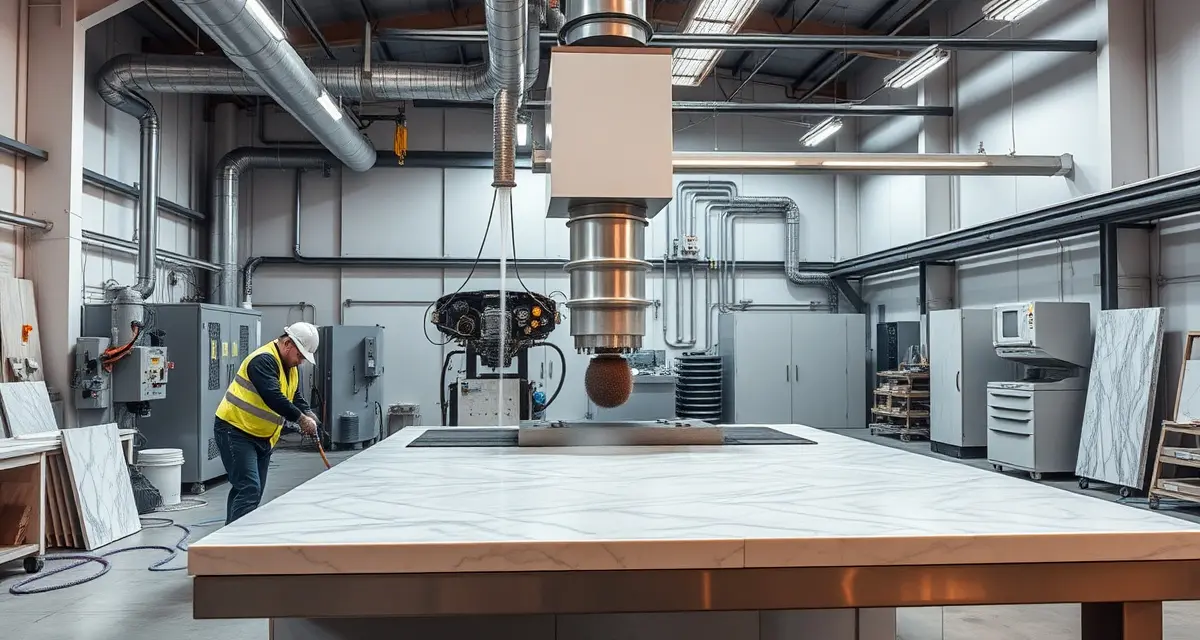
Dust Control Systems for Countertop Fabrication Shops
Silica dust from stone cutting is the single biggest health threat in a fabrication shop. The right dust control system doesn't just keep you OSHA-compliant - it keeps your workers alive. This guide covers the three main control approaches, their costs, and how to choose the right combination for your operation.
TL;DR
- Wet cutting alone reduces airborne silica by 80-95% - it's the foundation of any dust control plan
- Local exhaust ventilation (LEV) captures residual dust that water misses, especially during dry finishing
- HEPA filtration (99.97% efficiency at 0.3 microns) is required for vacuum systems and recommended for ambient air
- A complete dust control system for a 5,000 sq ft shop costs $15,000-$50,000 installed
- Annual maintenance runs $3,000-$8,000 including filter replacements and water treatment
- Shops using multi-layer controls (wet + LEV + filtration) consistently test below OSHA's action level of 25 ug/m3
- Water recycling reduces consumption by 70-85% and cuts monthly water costs from $800+ to $150-$300
The Three Layers of Dust Control
Effective dust management in a fabrication shop uses three complementary approaches. No single method eliminates silica exposure on its own.
Calculate your material waste savings
See exactly how much slab material and money you could save with optimized cutting layouts.
Try the free Waste CalculatorLayer 1: Wet Suppression
Water applied at the cutting point traps silica particles before they become airborne. This is the most effective single control method.
How it works: Water floods the cutting zone, mixing with generated dust to form slurry. The slurry is heavy enough to fall rather than float into the air. Continuous water flow also cools the blade or bit, extending tool life by 30-50%.
Effectiveness by operation:
| Operation | Dry Dust Level | Wet Dust Level | Reduction |
|---|---|---|---|
| Bridge saw cutting | 500-2,000 ug/m3 | 25-100 ug/m3 | 90-95% |
| CNC routing | 300-1,500 ug/m3 | 20-75 ug/m3 | 85-95% |
| Edge polishing | 200-800 ug/m3 | 15-50 ug/m3 | 85-94% |
| Hand grinding | 1,000-5,000 ug/m3 | 50-200 ug/m3 | 80-96% |
| Core drilling | 400-1,500 ug/m3 | 30-100 ug/m3 | 85-93% |
Water flow requirements:
| Equipment | Minimum Flow | Recommended Flow | Delivery Method |
|---|---|---|---|
| Bridge saw | 2 GPM | 3-5 GPM | Blade flood system |
| CNC router | 1 GPM per spindle | 2-3 GPM per spindle | Through-spindle + flood |
| Hand grinder | 0.3 GPM | 0.5-1 GPM | Pressurized center-feed |
| Edge polisher | 0.5 GPM per head | 1-2 GPM per head | Directed nozzles |
| Core drill | 0.5 GPM | 1 GPM | Center-feed through bit |
The catch: Wet cutting creates contaminated slurry that must be managed. Slurry that dries on floors, equipment, or clothing becomes airborne dust again, defeating the purpose. You need a water management system to close the loop.
Layer 2: Local Exhaust Ventilation (LEV)
LEV systems capture dust-laden air near the source and route it through filters before exhausting clean air. They address dust that escapes wet suppression - particularly during dry finishing tasks, hand work, and material handling.
Types of LEV systems:
Downdraft tables: A work surface with a perforated top and exhaust plenum underneath. Air is pulled downward through the workpiece, capturing dust before it reaches the operator's breathing zone. Best for hand finishing, edge work, and small-piece fabrication.
- Capture velocity: 100-200 FPM at the work surface
- Typical size: 4' x 8' or 5' x 10' work area
- Airflow requirement: 1,000-2,500 CFM
- Cost: $3,000-$12,000 installed
Machine enclosures with exhaust: CNC machines and bridge saws enclosed in partial or full cabinets with integrated exhaust. The enclosure contains the dust while the exhaust system filters it.
- Capture velocity: 100-150 FPM at any opening
- Airflow: varies by enclosure size (2,000-6,000 CFM typical)
- Cost: $5,000-$20,000 per machine
Portable dust collectors: Movable units with flexible arms that position near the dust source. Used for grinding, polishing, and other mobile operations.
- Capture distance: within 12" of dust source
- Airflow: 500-1,500 CFM
- Cost: $2,000-$6,000 per unit
Ambient air filtration: Ceiling-mounted units that continuously filter the general shop air. These don't replace source capture but reduce background dust levels.
- Coverage: 1 unit per 2,500-5,000 sq ft
- Airflow: 1,500-3,000 CFM per unit
- Cost: $1,500-$4,000 per unit
Layer 3: HEPA Filtration
HEPA filters capture 99.97% of particles at 0.3 microns - the most dangerous size for lung penetration. They're the final barrier in your dust control system.
Where HEPA is required:
- Shop vacuums used for silica dust cleanup
- Final filter stage in LEV systems
- Portable dust collectors used near workers
Where HEPA is recommended but not strictly required:
- Ambient air filtration units
- Return air in HVAC systems serving the fabrication area
- Vehicle cab filtration for forklifts used in dusty areas
HEPA filter costs:
| Application | Filter Size | Replacement Cost | Replacement Interval |
|---|---|---|---|
| Shop vacuum | Small cartridge | $40-$80 | 3-6 months |
| Downdraft table | Large panel/bag | $150-$400 | 6-12 months |
| Machine enclosure | Large cartridge | $200-$600 | 6-12 months |
| Ambient unit | Panel filters | $100-$300 | 6-12 months |
Always use a pre-filter upstream of the HEPA element to extend its life. A $20 pre-filter replaced monthly can double the HEPA filter's service interval.
Water Management Systems
Wet cutting is only effective if you manage the water properly. A complete water system includes supply, recovery, treatment, and recycling.
System Components
Settlement tank: The first stage of water treatment. Contaminated water flows into a tank where heavy particles settle to the bottom. Settling removes 60-80% of solids. Tanks should be sized for at least 15 minutes of retention time.
Clarifier: Chemical flocculants or mechanical agitation causes fine particles to clump together and settle faster. Clarifiers bring water clarity to the point where it can be reused for cutting.
Filter press: Compresses settled sludge into dry cakes for disposal. Reduces waste volume by 70-80% and produces water clean enough for discharge or reuse.
Recirculation pump and plumbing: Returns treated water to cutting equipment. Include a bypass for fresh water makeup (you'll lose 15-30% to evaporation and carryout).
System Sizing
| Shop Size | Daily Water Use | Settlement Tank | Clarifier | Estimated Cost |
|---|---|---|---|---|
| Small (1-2 saws) | 500-1,000 gal | 250-500 gal | Optional | $3,000-$8,000 |
| Medium (3-5 machines) | 1,000-3,000 gal | 500-1,500 gal | Recommended | $8,000-$20,000 |
| Large (6+ machines) | 3,000-8,000 gal | 1,500-4,000 gal | Required | $20,000-$50,000 |
Water Recycling ROI
A medium shop using 2,000 gallons/day at $0.01/gallon:
- Without recycling: $20/day x 260 working days = $5,200/year in water + $2,000-$4,000/year in sewer fees
- With recycling (85% recovery): $3/day water + $1,200/year maintenance = $1,980/year
- Annual savings: $5,000-$7,000
The recycling system pays for itself in 1.5-3 years, plus you reduce your environmental footprint and simplify wastewater compliance.
System Design for Different Shop Sizes
Small Shop (Under 3,000 sq ft, 1-3 employees)
Recommended setup:
- Wet cutting on all machines (non-negotiable)
- 1 portable dust collector for hand work
- 1 HEPA shop vacuum for cleanup
- Simple settlement tank with manual sludge removal
- N95 or half-face P100 respirators for all workers
Estimated cost: $5,000-$12,000 Monthly operating cost: $200-$400
Medium Shop (3,000-8,000 sq ft, 4-12 employees)
Recommended setup:
- Wet cutting on all machines
- Downdraft table for finishing work
- Enclosed cutting area with dedicated exhaust
- 2-3 HEPA shop vacuums
- Water recycling with clarifier
- Ambient air filtration (1-2 ceiling units)
- Half-face P100 respirators for cutting/grinding
Estimated cost: $20,000-$45,000 Monthly operating cost: $400-$800
Large Shop (8,000+ sq ft, 12+ employees)
Recommended setup:
- Wet cutting on all machines with through-spindle delivery
- Full machine enclosures with integrated exhaust
- Multiple downdraft tables for finishing stations
- Central dust collection system with HEPA final stage
- Comprehensive water recycling with filter press
- Ambient air filtration throughout
- Air quality monitoring stations
- Half-face or full-face P100 for cutting; N95 for general fabrication areas
Estimated cost: $50,000-$120,000 Monthly operating cost: $800-$1,500
Maintenance Schedule
| Task | Frequency | Time Required | Who |
|---|---|---|---|
| Pre-filter inspection | Weekly | 10 min | Any trained worker |
| Pre-filter replacement | Monthly | 15-30 min | Maintenance |
| HEPA filter inspection | Monthly | 15 min | Maintenance |
| HEPA filter replacement | 6-12 months | 30-60 min | Maintenance |
| Settlement tank cleanout | Weekly-monthly | 1-2 hours | Maintenance |
| Ductwork inspection | Quarterly | 30-60 min | Maintenance |
| Airflow velocity check | Quarterly | 1-2 hours | Safety coordinator |
| Water quality testing | Monthly | 15 min | Any trained worker |
| System performance audit | Annually | 4-8 hours | Safety consultant |
Skipping maintenance is the fastest way to turn an effective system into an expensive decoration. Filter clogging reduces airflow, which reduces capture efficiency, which increases worker exposure.
Measuring System Effectiveness
You can't manage what you don't measure. Use these methods to verify your dust controls are working:
Air Quality Monitoring
Personal air sampling: Workers wear small pump-driven sampling badges that collect airborne dust over an 8-hour shift. Samples are analyzed for crystalline silica content. Cost: $150-$300 per sample.
Area monitoring: Stationary samplers placed at key locations (near saws, at finishing stations, in break areas) measure ambient dust levels. Useful for identifying problem areas.
Real-time dust monitors: Electronic instruments that display dust concentration in real time. Useful for immediate feedback when adjusting controls. Cost: $2,000-$8,000 per unit.
Performance Benchmarks
| Measurement Point | Target Level | Action If Exceeded |
|---|---|---|
| Worker breathing zone | <25 ug/m3 (action level) | Investigate and improve controls |
| Near cutting equipment | <50 ug/m3 | Check water flow and enclosure integrity |
| Finishing station | <30 ug/m3 | Verify downdraft function and filter condition |
| Office/break area | <10 ug/m3 | Check separation barriers and HVAC |
| Ambient shop air | <25 ug/m3 | Review overall ventilation and housekeeping |
Can I use a regular shop vac for silica dust?
No. Standard shop vacuums do not have adequate filtration and will blow fine silica particles right through the exhaust. You need a HEPA-rated vacuum (99.97% efficiency at 0.3 microns) specifically listed for silica-containing dust.
How often should I test air quality in my shop?
OSHA requires initial monitoring when you start working with silica-containing materials. If results are below the action level (25 ug/m3), you can stop periodic monitoring unless conditions change (new materials, new equipment, process changes). Most safety consultants recommend annual retesting regardless.
Does wet cutting eliminate the need for respirators?
Not necessarily. While wet cutting reduces silica exposure by 80-95%, residual dust from drying slurry, material handling, and finishing work can still contribute to exposure. OSHA requires you to document that controls bring exposure below the PEL before you can discontinue respiratory protection.
What do I do with the silica-contaminated sludge?
Silica sludge from stone cutting is generally classified as non-hazardous solid waste. Let it dry in a contained area (not in the shop where it can become airborne), then dispose of it in lined dumpsters for landfill. Check local regulations - some jurisdictions have specific requirements.
How do I control dust during installation at job sites?
Use wet cutting tools whenever possible. For dry cuts (which are sometimes unavoidable on-site), use tools with integrated dust collection shrouds connected to a HEPA vacuum. Keep cuts to the minimum necessary and position fans to direct dust away from the operator and building occupants.
Is there a tax credit for dust control equipment?
Section 179 deduction allows you to deduct the full cost of qualifying equipment in the year purchased, up to $1,220,000 (2026 limit). Dust control equipment qualifies as business equipment. Consult your tax professional for specifics.
How much noise do dust collection systems add?
Central dust collection systems typically add 75-85 dB at the unit. Locate the main collector outside the work area or in an enclosed mechanical room. Ductwork transmits minimal noise. Portable collectors run 70-80 dB - lower than most cutting equipment.
Can I build my own dust collection system?
You can, but it must meet OSHA requirements for capture velocity, filtration efficiency, and airflow. Poorly designed DIY systems often lack adequate airflow, use incorrect filter media, or have leaky ductwork that makes the problem worse. Professional system design costs $1,000-$3,000 and ensures compliance.
Protect Your Team, Protect Your Business
Clean air in your shop is non-negotiable. While you're upgrading your dust controls, make sure the rest of your operation is running just as tight. SlabWise helps fabrication shops reduce waste, speed up quotes, and cut down on the administrative work that pulls your attention away from safety and production.
Start Your 14-Day Free Trial →
Try These Free Tools
- Cost Calculator -- Get instant countertop cost estimates by material and square footage.
- Kitchen Visualizer -- Upload a kitchen photo and preview different materials in place.
- Template Compare -- Upload two templates and see every dimension change highlighted.
Sources & Further Reading
- National Kitchen & Bath Association - Kitchen Lighting Design Guidelines
- Natural Stone Institute - Countertop Care and Maintenance Guide
- International Surface Fabricators Association - Best Practices for Stone Installation
- Remodeling Magazine - Kitchen Lighting Trends and Techniques