Quartz FAQ
Quick Definition
This quartz FAQ answers the most common questions from fabricators and homeowners.
Quartz countertops (also called engineered quartz or engineered stone) are manufactured surfaces made of approximately 93% ground natural quartz crystals bound with 7% polymer resin, pigments, and additives. Major brands include Caesarstone, Cambria, Silestone, MSI, and Cosentino. Quartz is the most popular countertop material in the US, valued for its consistency, durability, and low maintenance.
TL;DR
- Quartz holds ~35% of the US countertop market - the single largest material category
- Price range: $50-$120 per square foot installed
- Non-porous - never needs sealing, highly stain-resistant
- Not heat-proof - hot pans can damage the resin (always use trivets)
- Not UV-resistant - will fade in direct sunlight (not recommended for outdoor use)
- Available in hundreds of colors and patterns, including convincing marble and concrete looks
- Fabrication is predictable and efficient - ideal for slab nesting optimization
- Major brands offer 10-15 year warranties on the material
Material Properties
What is quartz made of?
Engineered quartz is approximately:
Calculate your material waste savings
See exactly how much slab material and money you could save with optimized cutting layouts.
Try the free Waste Calculator- 93% ground natural quartz - One of the hardest minerals on Earth (7 on the Mohs scale)
- 7% polymer resin binder - Typically polyester or epoxy-based, holds the ground quartz together
- Pigments and additives - Provide color, pattern, and functional properties
The manufacturing process compresses this mixture under high heat and pressure into slabs, typically 120" x 55" or 126" x 63", in thicknesses of 1.2cm, 2cm, or 3cm.
How hard is quartz?
Quartz ranks 7 on the Mohs hardness scale - harder than granite (6-6.5) and significantly harder than marble (3-4). In practical terms:
- Kitchen knives won't scratch it (though cutting directly on quartz will dull your knives)
- Normal daily use won't damage the surface
- Heavy impacts (dropping a cast-iron pan) can chip edges
Is quartz heat resistant?
Partially. The quartz mineral itself handles heat well, but the resin binder does not. Temperatures above 300F (150C) can discolor or crack the resin, leaving permanent marks.
Always use trivets or hot pads when placing hot cookware on quartz. This is the single most common source of damage claims on quartz countertops.
Is quartz stain-resistant?
Yes - highly. Because quartz is non-porous, liquids don't penetrate the surface. Wine, coffee, oil, and juice can be wiped away without staining. However:
- Strong chemicals (permanent markers, nail polish remover, oven cleaner) can damage the resin
- Leaving highly pigmented substances on the surface for extended periods (turmeric, beet juice) can cause surface discoloration if not wiped up
Does quartz need to be sealed?
No. This is one of its main advantages over natural stone. Quartz is non-porous and never requires sealing - not at installation and not ever. This reduces long-term maintenance to basically zero.
Can quartz go outdoors?
No. UV exposure breaks down the resin binder over time, causing:
- Color fading (especially in darker colors)
- Surface yellowing (in lighter colors)
- Structural weakening of the resin
For outdoor kitchens, use granite, porcelain, or quartzite instead.
For Fabricators
How does quartz fabricate compared to natural stone?
Quartz is the most predictable material to fabricate:
| Aspect | Quartz | Granite | Marble |
|---|---|---|---|
| Cut consistency | Very uniform | Varies by type | Varies significantly |
| Edge finishing | Clean, predictable | Good | Can chip |
| Blade wear | Moderate (resin gums blades) | Low-moderate | Low |
| Breakage risk | Low | Low | Moderate |
| Vein matching | Minimal concern | Often needed | Critical |
| Dust hazard (silica) | High (up to 93% silica) | Moderate (25-60%) | Low (<1%) |
The uniformity makes quartz ideal for high-volume production. You can reliably predict fabrication time, blade consumption, and yield.
What are the best practices for cutting quartz?
- Use adequate water - Wet cutting is mandatory for dust control (OSHA silica compliance) and prevents resin from overheating and gumming the blade
- Moderate feed rate - Pushing too fast overheats the resin; too slow wears the blade unnecessarily
- Diamond blades designed for quartz - Standard granite blades work but wear faster; quartz-specific blades last 20-30% longer
- Clean blade regularly - Resin buildup on the blade reduces cutting efficiency
- Proper PPE - N95 or P100 respirator, safety glasses, hearing protection. Quartz dust is extremely high in respirable crystalline silica.
How does quartz perform in slab nesting?
Quartz is the best material for nesting optimization because:
- No vein direction - Most quartz patterns are uniform, allowing pieces to be rotated freely
- Consistent quality - Fewer defect zones to work around
- Standard slab sizes - Most brands produce consistent dimensions
- No color matching concerns - Pieces from the same lot/batch match perfectly
SlabWise's nesting algorithm typically achieves the lowest waste rates on quartz - often 5-8% compared to 10-15% on vein-directional natural stone.
What's the silicosis risk with quartz fabrication?
High. Quartz slabs contain up to 93% crystalline silica - the highest of any common countertop material. Cutting, grinding, and polishing quartz generates respirable silica dust that causes silicosis, a serious and irreversible lung disease.
OSHA's permissible exposure limit (PEL) is 50 micrograms per cubic meter of air over an 8-hour shift. Fabricating quartz without proper controls can exceed this limit by 10-100x.
Mandatory safety measures:
- Wet cutting at all times (no dry cutting, ever)
- Engineered dust collection systems
- HEPA-filtered vacuums for cleanup
- N95 or P100 respirators
- Regular air quality monitoring
- Worker health surveillance (lung function testing)
See our Silicosis Safety FAQ for detailed safety guidance.
Customer Questions (for Fabricators to Reference)
Which quartz brand is best?
All major brands produce quality products. The differences are mainly in:
- Pattern library - Cambria and Caesarstone tend to lead in design variety
- Warranty terms - Most offer 10-15 years; Cambria offers a limited lifetime warranty
- Price tier - MSI and some Silestone lines are more budget-friendly; Cambria and premium Caesarstone are higher
- Availability - Local distributor inventory varies by region
For fabricators, brand choice affects your cost, inventory strategy, and supplier relationships more than the actual fabrication process.
What are the most popular quartz colors in 2026?
The marble-look trend continues to dominate:
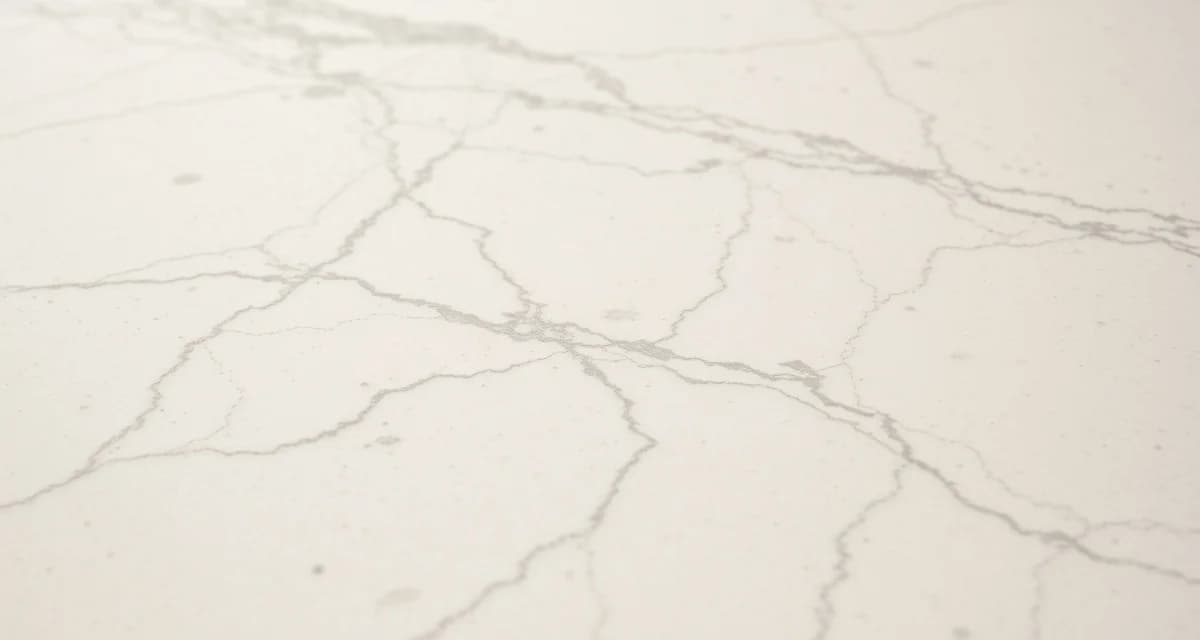
- Calacatta patterns - White background with bold gray/gold veining (mimics Calacatta marble)
- Carrara patterns - White/gray with subtle veining (mimics Carrara marble)
- Concrete/industrial gray - Flat gray tones for modern kitchens
- Warm white - Creamy whites with subtle patterns
- Dark dramatics - Charcoal and black with white veining
As a fabricator, stocking 3-5 colors in the white/gray marble-look category covers the majority of customer preferences. Special-order everything else.
How long do quartz countertops last?
With normal residential use, quartz countertops last 15-25+ years without significant degradation. The resin binder is the limiting factor - it eventually shows wear from UV exposure, chemical contact, and thermal cycling. But in a typical indoor kitchen, that's measured in decades, not years.
Can quartz be repaired if chipped?
Small chips (dime-sized or smaller) can be repaired with color-matched epoxy. The repair is usually visible upon close inspection but not noticeable from a normal viewing distance. Larger chips or cracks may require section replacement.
Does quartz support undermount sinks?
Yes. 3cm quartz provides excellent structural support for undermount sinks. The cutout edge should be polished and properly sealed with silicone. No additional reinforcement is needed for standard residential sinks.
2cm quartz over plywood subtops also supports undermount sinks, though 3cm is preferred for its superior structural integrity.
Pricing and Inventory
How much does quartz cost fabricators?
Fabricator material costs for common quartz brands (per sqft, slab only):
| Brand/Tier | Cost Per Sqft | Typical Slab Size |
|---|---|---|
| Budget (MSI Q-brand, etc.) | $8-$15 | 120" x 55" |
| Mid-range (Silestone, Caesarstone standard) | $15-$30 | 126" x 63" |
| Premium (Cambria, Caesarstone premium) | $25-$45 | 130" x 65" |
| Ultra-premium (Cambria specialty) | $40-$60+ | 130" x 65" |
These are material-only costs before fabrication, installation, and your markup.
How should I manage quartz inventory?
Quartz is easier to inventory than natural stone because:
- Consistent color across production lots (less concern about batch matching)
- Standardized slab sizes
- No unique vein patterns to photograph (though photos are still recommended for customer selection)
- Longer shelf stability (no weathering concerns)
Stock your top 3-5 colors in depth. Special-order everything else with 5-7 business day lead time from your distributor.
SlabWise tracks quartz inventory the same way it tracks natural stone - individual slab profiles with photos, dimensions, cost, and status. The nesting algorithm optimizes quartz cuts with unrestricted rotation for maximum yield.
Is quartz better than granite?
Neither is universally "better." Quartz requires less maintenance (no sealing) and offers more consistent aesthetics. Granite handles heat better and comes in unique natural patterns. Quartz is more expensive on average. Choose based on priorities: low maintenance → quartz; natural uniqueness → granite.
Can you put hot pans on quartz?
Not directly. Always use a trivet or hot pad. The resin in quartz can scorch or crack at high temperatures. This is the most common damage complaint.
Does quartz yellow over time?
Indoor quartz rarely yellows. Outdoor or window-adjacent quartz can yellow from UV exposure. Lighter colors are more susceptible.
Is Cambria the same as other quartz brands?
Cambria is the only major quartz brand manufactured in the US (Le Sueur, Minnesota). Other brands manufacture overseas. Quality is comparable across major brands; the difference is mainly in pattern variety and pricing.
How thick should quartz countertops be?
3cm (1.25") is standard for residential kitchen countertops. 2cm is sometimes used with plywood subtops (adds labor but uses less material). 1.2cm is available for wall cladding and some commercial applications.
Can quartz be used for shower walls?
Yes. Quartz works well for shower wall panels because it's non-porous and easy to clean. However, UV exposure from bathroom windows and steam effects on resin longevity should be considered.
Does quartz emit radon?
No. Unlike some natural stones, engineered quartz does not contain radioactive minerals and does not emit radon gas.
Can quartz countertops crack?
Rarely under normal use. Cracks can occur from thermal shock (placing a very hot item on a cold surface), improper support (overhanging too far without brackets), or structural settling of the house.
Manage Your Quartz Inventory and Fabrication with SlabWise
Quartz is your highest-volume material - SlabWise helps you quote it faster, cut it more efficiently, and track every slab from yard to kitchen.
Start your 14-day free trial → No credit card required.
Try These Free Tools
- Nesting Optimizer -- AI-powered slab layout that maximizes yield considering vein direction and defects.
- Defect Mapping -- Upload a slab photo and AI maps every fissure, pit, and color issue.
- Value Engineering -- Find dollar-quantified suggestions to save material without cutting margin.
Sources & Further Reading
- Natural Stone Institute - Natural Stone Care and Maintenance Guide
- National Kitchen & Bath Association - Countertop Selection Guidelines
- ASTM International - Standards for Stone and Countertop Materials
- International Surface Fabricators Association - Countertop Material Properties
Internal Links
- Granite FAQ - How granite compares
- Marble FAQ - How marble compares
- Countertop Materials FAQ - All materials compared
- Silicosis Safety FAQ - Critical safety info for quartz fabrication
- Slab Nesting FAQ - Nesting optimization for quartz