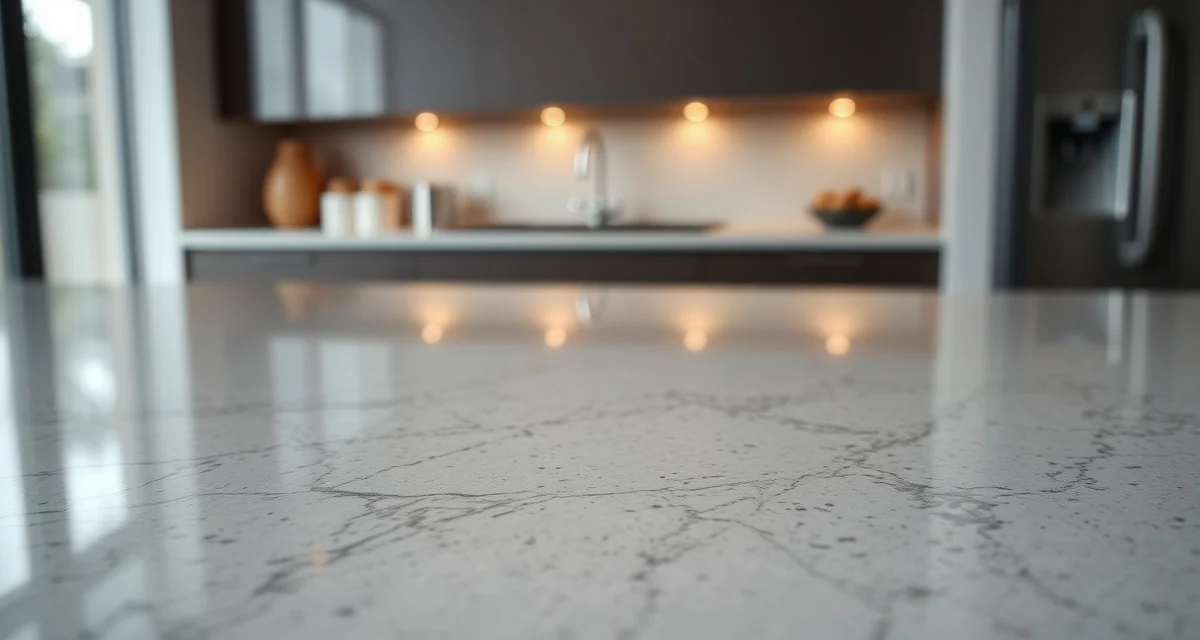
Quartz is the most popular countertop material in America, and it earned that spot honestly. It does not need sealing. It shrugs off coffee, wine, and lemon juice. It comes in everything from plain white to convincing fake marble. And it costs about the same as granite.
It is also misunderstood. Quartz is not stone cut from a mountain. It can scorch. It cannot live outside. And the price difference between a $50 slab and a $150 slab is real, not branding.
This guide covers all of it: what quartz actually is, what it costs in 2026, which brands deserve your money, which rooms it belongs in, and the failure modes nobody mentions in the showroom. By the end you should know whether quartz is right for your project and roughly what a fair quote looks like.
What is quartz, actually?
Quartz countertops are engineered slabs made from roughly 90 to 94% ground natural quartz crystals bound with 6 to 10% polymer resin and pigments. The quartz part is real stone. The slab is not. It is manufactured in a factory, usually on equipment built by an Italian company called Breton, which patented the process in the 1960s.
That manufacturing is the whole point. Natural stone has pores, fissures, and surprises. Engineered quartz is pressed and cured into a dense, uniform, non-porous sheet. Nothing soaks in. That is why it never needs sealing and why it resists stains that would soak into granite or destroy marble.
Two clarifications that save people money and embarrassment:
Quartz and quartzite are different materials. Quartzite is natural stone, quarried in slabs, harder than granite, and priced higher ($80 to $200 per square foot installed). Quartz is the engineered product. Salespeople mix these up constantly, sometimes on purpose. If it came out of the ground, it is quartzite. Our quartzite guide covers the natural stone.
The resin matters as much as the quartz. The resin is what fails. Heat scorches it. UV light yellows it. Harsh chemicals dull it. Almost every quartz limitation in this guide traces back to that 6 to 10% of the slab. The manufacturing process explains why, and the Breton method is worth understanding if you want to know what you're paying for.
What do quartz countertops cost in 2026?
Installed quartz runs $50 to $150 per square foot in 2026, with most kitchens landing between $60 and $100. A typical 40 square foot kitchen comes out between $2,400 and $6,000 including fabrication and installation. Brand, color complexity, and your local labor market drive the spread.
Here is how the major brands price out installed:
| Brand | Installed cost/sq ft | Position |
|---|---|---|
| MSI Q Quartz | $50-$70 | Budget workhorse |
| Polarstone | $50-$65 | Basic solid colors |
| LG Viatera | $55-$75 | Mid-range value |
| Vicostone | $55-$80 | Marble looks for less |
| HanStone | $60-$80 | Quiet mid-range pick |
| Silestone | $65-$95 | Biggest color library |
| Caesarstone | $70-$100 | Design-forward |
| Cambria | $85-$150 | Premium, American-made |
A few things about that table worth saying plainly:
The slab itself is often only a third of your bill. Fabrication (cutting, edges, cutouts, seams) and installation make up the rest, which is why the same MSI slab can be quoted at $55 per square foot by one shop and $75 by another. Quote variance is usually a labor and overhead story, not a material story.
Veined, marble-look patterns cost more than solid colors within every brand. The manufacturing is harder. A plain white Silestone might be $65 installed while a heavily veined pattern from the same brand hits $90.
Sticker shock works in both directions. Big box stores sometimes advertise $39 per square foot quartz. That number rarely survives contact with edge upgrades, sink cutouts, tear-out, and seam charges. Our full cost breakdown walks through every line item, and the brand-specific pages cover Cambria, Caesarstone, and Silestone pricing in detail.
Edges are the upsell to watch. An eased edge is standard and free. Ogee adds $15 to $25 per linear foot, a mitered edge $25 to $50, and a waterfall island side $40 to $80 per linear foot. On a kitchen with 30 linear feet of edge, profile choice alone can move the quote by $750 or more.
Which rooms does quartz belong in?
Quartz belongs in kitchens, bathrooms, and laundry rooms. It does not belong outdoors, and it needs care near serious heat sources. Room by room:
Calculate your material waste savings
See exactly how much slab material and money you could save with optimized cutting layouts.
Try the free Waste CalculatorKitchens: yes, with one habit change. This is where quartz is best. Spills, acids, and daily abuse bounce off. The one adjustment: use trivets. The resin can scorch from hot cookware, and scorch marks are permanent. If your household sets pans straight from the burner onto the counter and won't stop, granite tolerates that abuse better. We cover the specifics in can you put hot pots on quartz and quartz near a stove.
Bathrooms: ideal. Non-porous means makeup, toothpaste, hair dye, and standing water do nothing. No sealing, ever. For vanities, the cheaper end of the brand table works fine because bathroom counters take less abuse. Vanity-specific pricing is covered in our bathroom vanity cost guide.
Laundry and mudrooms: great, and a place to save. Remnants from a fabricator's previous quartz jobs are often sold at steep discounts and are perfect for a 6 to 10 square foot laundry counter. Ask any shop what remnants they have before paying full slab price.
Outdoor kitchens: no. UV light degrades the resin. Most quartz yellows, fades, or gets blotchy outside, and almost every manufacturer warranty is void the moment the slab lives outdoors. Caesarstone makes a small outdoor-rated collection, but it's the exception. For outdoor projects, granite, quartzite, or porcelain are the right call. The full explanation is in can quartz go outside.
Fireplace surrounds: check the clearance. Quartz handles ambient warmth fine but not sustained direct heat. Manufacturers generally want at least 6 inches of clearance from a firebox. For tight surrounds, porcelain or granite are safer.
Who is quartz right for?
Quartz fits busy households that want the counter to be a non-issue for fifteen years. It is the right answer for most families, most landlords, and most people renovating to sell. It is the wrong answer for outdoor cooks and for purists who want real stone.
Busy families: the strongest case for quartz. Juice, markers, ketchup, homework chaos. Nothing soaks in, and cleanup is dish soap and water. There's a reason it dominates family kitchen renovations.
Rental owners: quartz on the cheaper tiers (MSI, Polarstone) is close to indestructible by tenant standards, and you'll never schedule a sealing visit. Our rental property countertop guide runs the cost math against laminate and granite.
Selling soon: "quartz countertops" is a listing keyword that buyers search for by name. A mid-tier white or light-veined quartz reads as new and clean in photos and offends nobody. Skip the premium brands for a flip; buyers can't tell Cambria from MSI in a showing.
Serious cooks: mixed verdict. The work surface itself is excellent, but if your cooking style involves moving hot cast iron and sheet pans around without thinking, the trivet rule will annoy you. Granite or quartzite forgive heat carelessness.
Forever homes: quartz works, and this is where the premium brands earn their price. Cambria's lifetime transferable warranty and US manufacturing justify the spend when you'll live with the counters for decades.
Which quartz brand should you pick?
For most kitchens, the honest answer is the cheapest brand whose color you love, because slab quality across major brands is closer than the prices suggest. Pay for premium brands when you want a specific pattern, a stronger warranty, or American manufacturing, not because budget quartz will fail.
That said, the brands do differ, and we've reviewed them individually:
MSI Q Quartz is the volume player. Quality control had rough patches years ago, but current production is solid, and at $50 to $70 installed it's what most budget renovations should buy. Stick to their popular colors, which turn over fast and come from recent production runs.
LG Viatera and HanStone are the quiet value picks. Both are made by big Korean manufacturers (LX Hausys and Hyundai), both run $55 to $80 installed, and neither spends much on marketing, which is exactly why they're priced under Silestone.
Silestone has the deepest color library in the industry and strong distribution, so your fabricator can actually get the slab you picked. Their HybriQ line cut the resin content and added recycled material. $65 to $95 installed.
Caesarstone leads on design. Their concrete looks and muted modern palettes show up in design magazines for a reason. $70 to $100 installed, plus that small outdoor-rated collection nobody else offers.
Cambria is the premium pick: family-owned, made entirely in Minnesota, 200+ patterns, and a lifetime transferable warranty that's the best paper in the business. $85 to $150 installed. Worth it for forever homes, hard to justify for flips.
Budget brands like Allen + Roth (Lowe's) and Pompeii fill out the low end. They're fine surfaces, but compare the all-in installed quote against MSI through a local fabricator before assuming the big box price wins. It often doesn't.
For a deeper side-by-side, see our quartz brands ranked and the full brand comparison. The head-to-heads people actually search for are covered too: MSI vs Cambria and MSI vs Silestone.
How durable is quartz, really?
Quartz is one of the most durable kitchen surfaces you can buy, with two specific exceptions: sustained heat and UV light. On the standard hazards it outperforms almost everything.
Scratches: quartz is harder than steel knives. You'll dull your blades before you mark the counter. Cutting boards are for your knives, not the quartz.
Stains: non-porous means wine, coffee, turmeric, and oil sit on the surface until you wipe them. The qualifier: pigmented liquids left for days can discolor the resin on lighter slabs, so don't let the red wine puddle over a long weekend. Details in does quartz stain.
Chips: edges can chip if you hit them with something heavy, especially square-edged profiles at the sink. Chips are repairable with color-matched epoxy, and a fabricator charges $150 to $300 for a visit. The DIY route is covered in quartz chip repair.
Cracks: rare, and almost always caused by installation stress, an unsupported overhang, or thermal shock rather than daily use. A properly supported quartz top does not crack from normal life. What causes the exceptions is covered in can quartz crack.
Heat: the real limit. The resin starts suffering around 300°F, which a pan straight off the burner exceeds easily. Brief contact usually survives; a hot pan parked for minutes leaves a permanent scorch ring. This is the number one quartz damage claim fabricators see, and warranties exclude it.
Sunlight: the other real limit. Even through a big south-facing window, years of direct sun can subtly yellow some quartz. By a normal window it's a non-issue. In a sunroom, ask the brand about UV stability before you buy, and read quartz discoloration for what fading looks like.
What maintenance does quartz need?
Almost none, which is the main reason to buy it. Daily care is dish soap, water, and a soft cloth. No sealing, no polishing, no annual anything. What you actually need to know is the short list of things that damage it:
- Bleach and high-pH cleaners dull and discolor the resin over time. The occasional disinfecting wipe won't ruin anything, but bleach as a routine cleaner will. Safe products are listed in what cleaner to use on quartz and the bleach question specifically in bleach on quartz.
- Hot cookware, covered above. Buy two trivets.
- Abrasive pads can dull polished finishes. The melamine sponge is fine; steel wool is not.
- Solvents like paint thinner, nail polish remover, and oven cleaner spot-damage resin. Wipe spills fast.
That's the entire ownership manual. Compare that to marble (seal it, baby it, accept the etching) or butcher block (oil it monthly) and the popularity makes sense.
Where does quartz fall short?
Beyond heat and UV, quartz has a few honest weaknesses worth knowing before you sign a quote:
It isn't natural stone, and reads that way up close. Solid colors and subtle patterns look manufactured because they are. The premium marble-look patterns have gotten convincing, but a stone purist will always clock the difference. If authenticity matters to you, granite and quartzite cost about the same.
Pattern repetition on budget lines. Cheap veined quartz repeats its pattern across the slab, and on a big island the repeat can be visible. Premium brands print more varied patterns. Always view the full slab, not a 4-inch sample.
Seams show on light slabs. Any counter longer than about 10 feet will have a seam. Good fabricators make them tight and color-matched, but on bright white quartz a seam is never invisible. Seam placement is a fabrication skill issue, which is one more reason the cheapest quote isn't automatically the best one.
Repairs are harder than granite. A granite chip can often be polished out. Quartz repairs are epoxy fills that a careful eye can spot. Less of an issue than it sounds, since quartz needs repair far less often, but worth knowing.
Weight is real. A 3cm quartz counter runs about 14 to 15 pounds per square foot, which is a structural consideration for big islands and older cabinets, and the reason this is not a DIY install.
How does quartz compare to the alternatives?
Quartz beats most alternatives on maintenance and predictability, and loses on heat, outdoor use, and natural character. The quick view:
| Material | Installed/sq ft | Maintenance | Where it beats quartz |
|---|---|---|---|
| Laminate | $15-$40 | Low | Price, nothing else |
| Butcher block | $30-$60 | High | Warmth, price, repairability |
| Solid surface | $40-$75 | Low | Invisible seams, repairs |
| Granite | $50-$150 | Medium | Heat, outdoor use, natural look |
| Quartz | $50-$150 | Very low | The baseline |
| Marble | $75-$200 | High | Luxury looks, nothing practical |
| Quartzite | $80-$200 | Medium | Heat plus the marble look |
| Porcelain/sintered | $60-$120 | Very low | Heat, UV, outdoor use |
The matchups people actually agonize over each have a dedicated comparison: quartz vs granite (the big one), the quartzite alternative, quartz vs marble, quartz vs porcelain, quartz vs Dekton, quartz vs Corian, quartz vs laminate, and quartz vs soapstone.
If you're starting from zero and not sure quartz is even the right direction, the best countertop materials overview ranks everything by use case.
What should be on your quartz quote?
A complete quartz quote lists the material brand and color, square footage, edge profile, cutouts, tear-out, and seam locations as separate line items. If a quote is one number on a text message, you can't compare it to anything, and that's usually the point.
The line items and fair 2026 ranges:
- Material, quoted per square foot with the brand and color named. Verify the brand. "White quartz" that turns out to be an off-brand import is the oldest trick in the book.
- Fabrication and installation, sometimes bundled into the per-foot price, sometimes separate. Either is fine as long as it's stated.
- Edge profile: eased free, bullnose $8 to $20 per linear foot, ogee $15 to $25, mitered $25 to $50.
- Cutouts: sink, cooktop, and faucet holes typically $100 to $250 each. More than that needs a reason.
- Tear-out and disposal of old counters: $300 to $600 for a typical kitchen. Confirm it's included or excluded.
- Seam count and placement. Fewer and better-placed seams cost more material. Ask where they'll fall before fabrication, not after.
Get two or three quotes with this breakdown and the comparison becomes arithmetic instead of guesswork. The edge upgrade cost guide and our fabricator directory help with the legwork, and how much your kitchen actually measures keeps the square footage honest.
How do you actually buy quartz? The short version
- Measure roughly. Length times depth of each counter run, in feet. Most kitchens are 30 to 60 square feet.
- Pick two or three candidate colors online, then ignore everything until you see full slabs.
- Visit a stone yard or fabricator showroom and view the actual slab, not the sample chip. Patterns, repeats, and veining only read at full scale. Note the lot number of a slab you love; the next lot can look different.
- Get three itemized quotes from local fabricators, not just the big box counter desk. Independent shops frequently beat the chains on the same brand. The directory lists shops by city.
- Ask each shop two questions: who does the install (employees or subs), and where will the seams fall. The answers tell you most of what you need to know about quality.
- Schedule for fall or winter if you can. Fabricators are slammed in spring and summer; the slow season gets you better pricing and more attention.
- Buy the trivets before the install date. Seriously.
Common questions about quartz countertops
Can you put hot pans on quartz?
Briefly, usually yes; parked, no. The resin scorches around 300°F and a pan off the burner is well past that. Use a trivet and the problem never exists. Scorch marks are permanent and excluded from every warranty.
Does quartz need to be sealed?
No, never. Quartz is non-porous, so there's nothing for a sealer to soak into. If someone quotes you a quartz sealing service, walk away. That's a granite and marble expense.
Can quartz countertops go outside?
No. UV light yellows and degrades the resin, and outdoor use voids nearly every manufacturer warranty. Caesarstone's small outdoor collection is the one exception. For outdoor kitchens, use granite, quartzite, or porcelain.
Is quartz cheaper than granite?
They overlap almost exactly: $50 to $150 per square foot installed for both. Entry granite can undercut entry quartz by a little. The decision should ride on maintenance (quartz wins) and heat tolerance (granite wins), not price.
What is the difference between 2cm and 3cm quartz?
Thickness. 3cm (about 1.25 inches) is the standard for kitchens: stronger overhangs, no plywood buildup, a chunkier edge. 2cm is lighter and cheaper, common for vanities and walls. Some looks use 2cm with a mitered edge to fake a thick slab.
Does quartz stain?
Almost never with normal cleanup. Pigmented liquids left sitting for days can discolor lighter slabs, and rust or dye transfer can mark the resin. Wipe spills inside a day and staining is a non-issue.
How long do quartz countertops last?
Twenty to thirty years or more with basic care, which is to say: the counters will outlast your taste for them. Warranties run 10 or 15 years to lifetime depending on brand, with Cambria's lifetime transferable warranty the strongest.
Is quartz worth the money?
For most kitchens, yes. It's the lowest-maintenance surface in its price range and the resale market likes it. Where it stops being worth it: outdoor projects, heat-careless cooks, and buyers who really want natural stone, who should price granite and quartzite instead.