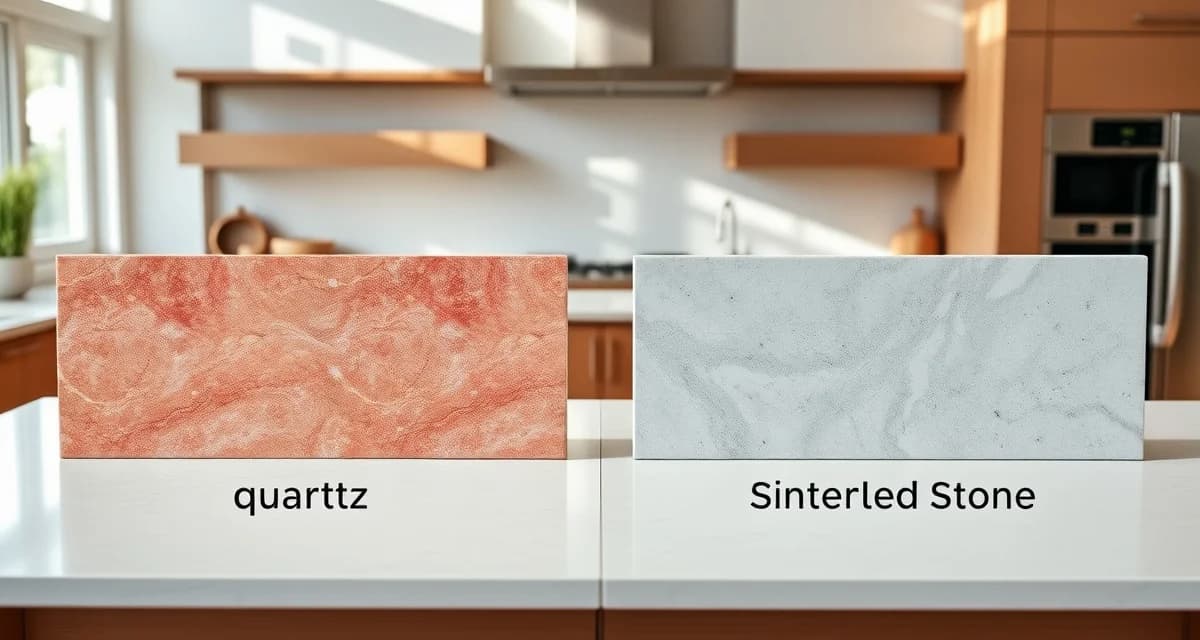
Quartz vs Sintered Stone Countertops: 2026 Comparison
Sintered stone is the category name for ultra-compact surfaces like Dekton, Neolith, Lapitec, and Laminam. These products are made by fusing raw minerals under extreme heat and pressure, creating surfaces that outperform quartz in heat resistance, UV stability, and outdoor durability. Quartz fights back with more color choices, wider availability, and a longer market track record.
TL;DR
- Sintered stone handles heat (500F+), UV, and outdoor exposure --- quartz fails at all three
- Quartz has far more color and pattern options from dozens of brands
- Both are non-porous and never need sealing
- Sintered stone comes in ultra-thin profiles (8mm-12mm); quartz is typically 2cm-3cm
- Quartz has wider fabricator availability and a more established supply chain
- Pricing overlaps: quartz $50-$150/sq ft, sintered stone $65-$150/sq ft
- Sintered stone edges are more chip-prone than quartz due to rigidity
Side-by-Side Comparison
| Feature | Quartz | Sintered Stone |
|---|---|---|
| Composition | Ground quartz + polymer resin | Minerals fused at 2,000F+ |
| Brands | Cambria, Silestone, Caesarstone, MSI, etc. | Dekton, Neolith, Lapitec, Laminam |
| Installed Cost (per sq ft) | $50-$150 | $65-$150 |
| Sealing | Never | Never |
| Heat Resistance | Low (300F limit) | Excellent (500F+) |
| UV Resistance | No | Yes |
| Outdoor Use | No | Yes |
| Scratch Resistance | High | Very High |
| Stain Resistance | Very High | Very High |
| Edge Chip Risk | Low-Moderate | Moderate |
| Thickness Options | 2cm, 3cm | 8mm-30mm |
| Color Options | Hundreds | Growing (50-100+) |
| Fabricator Availability | Very Wide | Growing |
Performance Advantages of Sintered Stone
Sintered stone's manufacturing process --- particles of natural minerals compressed under 25,000+ tons of pressure and fired at 2,000F+ --- produces a surface with no organic binders. This gives sintered stone three major performance advantages:
Calculate your material waste savings
See exactly how much slab material and money you could save with optimized cutting layouts.
Try the free Waste Calculator- Heat immunity: No resin means no scorching. Hot pans, curling irons, and other heated objects cause zero damage.
- UV stability: No polymers means no yellowing or degradation from sunlight. Safe for outdoor use.
- Chemical resistance: Sintered stone resists virtually all household chemicals, solvents, and acids.
Quartz's 6-10% resin content is the source of its weaknesses in all three areas.
Why Quartz Still Leads the Market
Despite sintered stone's performance advantages, quartz dominates market share for several reasons:
- Selection: dozens of brands and hundreds of color options vs. a few brands with smaller collections
- Familiarity: homeowners, designers, and contractors know quartz well
- Fabricator base: nearly every shop works with quartz; sintered stone requires special training
- Price accessibility: budget quartz starts at $50/sq ft; sintered stone's floor is higher
- Edge profiles: quartz's thickness supports every edge treatment; thin sintered stone has limitations
Fabrication Considerations
Sintered stone fabrication requires specific training, tooling, and handling procedures. The material is harder than quartz and behaves differently during cutting and polishing. Key differences:
- Different blade types and cutting speeds
- More careful handling (thin slabs are fragile before installation)
- Specialized adhesives and seaming products
- Limited edge profile options at thinner profiles
Shops expanding into sintered stone should invest in proper training and equipment. The upside: sintered stone projects typically carry premium margins, and the growing demand means early adopters capture market share.
SlabWise helps fabrication shops manage quoting and nesting across quartz, sintered stone, and natural stone --- keeping workflows efficient as material variety grows.
Best Uses
Choose Quartz When:
- Wide design selection and brand variety matter most
- Indoor-only installation in kitchen or bathroom
- Budget sensitivity requires options below $65/sq ft
- Fabricator expertise with sintered stone is not available locally
Choose Sintered Stone When:
- Heat resistance is non-negotiable
- Outdoor or UV-exposed installation areas
- Ultra-thin profiles (8mm-12mm) fit the design
- Maximum durability across all performance categories is the goal
What exactly is sintered stone?
Sintered stone is an engineered surface made by fusing natural mineral particles (silica, porcelain, glass, and stone) under extreme heat (2,000F+) and pressure (25,000+ tons). The result is an ultra-dense, non-porous material with no organic binders.
Is sintered stone better than quartz?
Sintered stone outperforms quartz in heat resistance, UV stability, scratch hardness, and chemical resistance. Quartz offers more design options, wider availability, and lower starting prices. The best choice depends on your specific priorities.
How expensive is sintered stone?
Sintered stone typically costs $65-$150 per square foot installed, depending on brand, pattern, and thickness. This overlaps significantly with mid-range and premium quartz pricing.
Can sintered stone chip?
Yes. Sintered stone's extreme hardness comes with rigidity --- heavy point impacts on edges can cause chipping. The surface is very resistant to damage, but edges are the vulnerable area, particularly at thinner profiles.
Do I need a special fabricator for sintered stone?
Yes. Sintered stone requires specific training and tooling. Not all countertop fabrication shops have experience with it. Verify your fabricator's sintered stone credentials before committing.
Is sintered stone the same as porcelain?
They are similar but not identical. Both are fired at extreme temperatures and share many properties. The term "sintered stone" typically refers to ultra-compact surfaces like Dekton that use specific mineral compositions and manufacturing processes. Porcelain slabs like Neolith and Laminam are in the same general category.
Which is better for a kitchen, quartz or sintered stone?
For indoor kitchens, both work well. If you frequently cook with high heat and hate using trivets, sintered stone's heat immunity is a compelling advantage. If design variety and finding the perfect pattern matter more, quartz has more options.
Can quartz be used near a fireplace?
Quartz is not recommended near fireplaces or other sustained heat sources. The resin can discolor from prolonged heat exposure. Sintered stone is a better choice for fireplace surrounds and hearths.
Get Started
Both quartz and sintered stone are premium engineered surfaces with different strengths. Your choice depends on performance priorities, design preferences, and available fabrication expertise.
Estimate your project cost using our countertop cost calculator. Fabricators can try SlabWise free for 14 days to manage all material types in one platform.
Try These Free Tools
- Cost Calculator -- Compare material costs instantly across different countertop options.
- Compare Materials -- Side-by-side material comparison with pricing, durability, and maintenance.
- Kitchen Visualizer -- Let customers preview countertop materials in their actual kitchen.
Sources & Further Reading
-
Natural Stone Institute - Technology and Software Solutions for Stone Fabricators
-
International Surface Fabricators Association - Fabrication Software and Digital Tools
-
National Kitchen & Bath Association - Technology Integration in Countertop Design
-
Marble Institute of America - Digital Fabrication and Software Standards