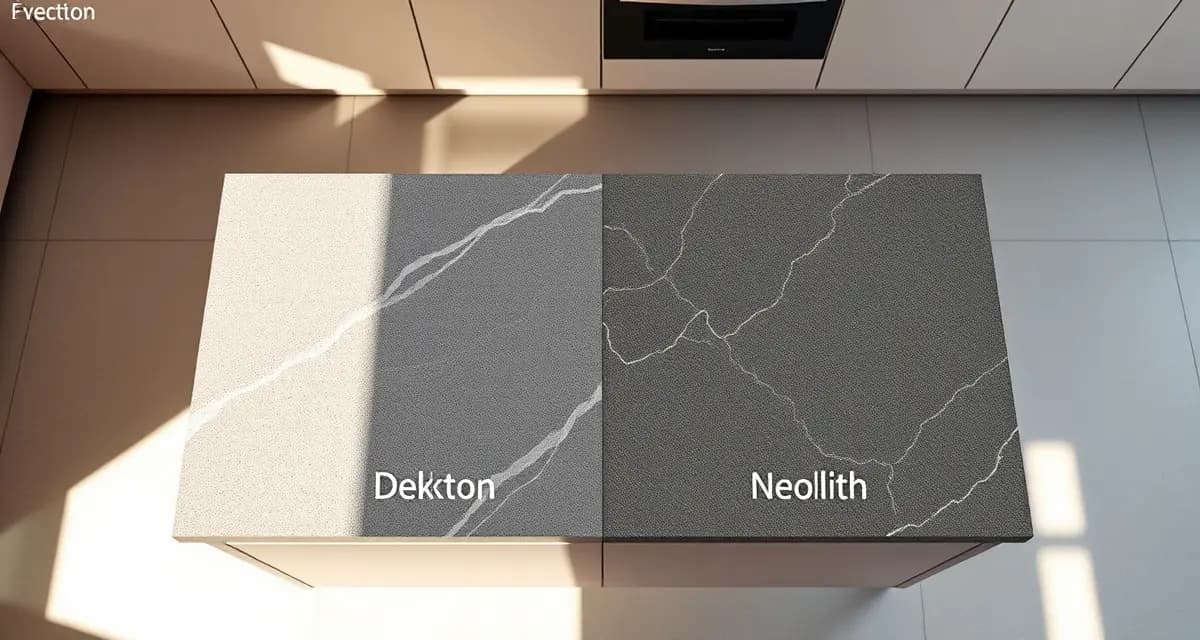
Dekton vs Neolith Countertops: 2026 Comparison
Dekton and Neolith are the two most prominent sintered stone brands competing for the ultra-compact countertop market. Both are non-porous, heat-resistant, UV-stable, and built for indoor and outdoor use. The differences come down to manufacturing details, pattern selection, availability, and brand support.
TL;DR
- Both are sintered stone --- non-porous, heat-resistant, UV-stable, and scratch-resistant
- Dekton (by Cosentino) has a larger U.S. distribution network and broader fabricator support
- Neolith (by TheSize) is known for realistic stone and wood finishes and larger slab sizes
- Performance specs are nearly identical --- the practical differences are aesthetic and logistical
- Pricing is similar: both range from $65-$150/sq ft installed
- Both require specialized fabrication training --- verify your fabricator has experience with whichever brand you choose
- Pattern selection differs: Dekton has ~60+ designs; Neolith has ~70+ designs with focus on natural looks
Side-by-Side Comparison
| Feature | Dekton | Neolith |
|---|---|---|
| Manufacturer | Cosentino (Spain) | TheSize (Spain) |
| Manufacturing Process | TSP (Technology of Sintered Particles) | Sinterized Particle Technology |
| Installed Cost (per sq ft) | $65-$150 | $65-$150 |
| Sealing | Never | Never |
| Heat Resistance | Excellent (500F+) | Excellent (500F+) |
| Scratch Resistance | Very High | Very High |
| UV Resistance | Yes | Yes |
| Outdoor Use | Yes | Yes |
| Stain Resistance | Very High | Very High |
| Slab Sizes | Up to 126" x 56" | Up to 126" x 60" (some larger) |
| Thickness Options | 8mm, 12mm, 20mm, 30mm | 6mm, 12mm, 20mm |
| Pattern Count | 60+ designs | 70+ designs |
| U.S. Distribution | Extensive (Cosentino Centers nationwide) | Growing (distributed through multiple channels) |
| Warranty | 25 years (residential) | 25 years (residential) |
Manufacturing: Similar but Distinct
Both Dekton and Neolith are sintered surfaces made by compressing mineral particles under extreme heat and pressure. The core process is similar, but each brand uses proprietary formulations and techniques:
Calculate your material waste savings
See exactly how much slab material and money you could save with optimized cutting layouts.
Try the free Waste CalculatorDekton uses what Cosentino calls TSP (Technology of Sintered Particles). Raw materials include porcelain, glass, and quartz, compressed at 25,000+ tons and fired at 2,192F. Cosentino is also the parent company of Silestone (quartz) and markets natural stone, giving them a wide portfolio.
Neolith is manufactured by TheSize, a company focused exclusively on sintered stone. Their slabs are made from natural raw materials (clite, feldspar, silica, and natural oxides) fired at 2,192F under extreme pressure. TheSize concentrates all resources on this single product category.
Pattern and Design Selection
This is where the brands differentiate most visibly.
Dekton Patterns
Dekton organizes its collection into several design families:
- Natural Collection --- marble, stone, and mineral looks
- Industrial Collection --- concrete, metal, and urban aesthetics
- Solid Collection --- uniform solid colors
- XGloss --- high-gloss finishes with mirror-like reflectivity
- Stonika --- ultra-realistic natural stone reproductions
Dekton's Stonika line is particularly noteworthy for marble and quartzite looks that are among the most realistic in any sintered stone brand.
Neolith Patterns
Neolith's collection tends to emphasize:
- Stone looks --- highly realistic marble, granite, and quartzite reproductions
- Wood looks --- unique to sintered stone; wood patterns for countertop applications
- Concrete and urban looks --- industrial aesthetics
- Solid colors --- clean, uniform surfaces
- Textile-inspired --- unique patterns inspired by fabric
Neolith is often praised for its natural stone reproductions, which use advanced digital printing and texture technology to create convincing depth.
Both brands regularly release new patterns. The best approach is to visit showrooms and see actual slabs in person --- digital images do not capture the full character of either product.
Distribution and Availability
Dekton benefits from Cosentino's extensive U.S. distribution infrastructure. Cosentino operates "Cosentino Centers" in major metro areas across the country, providing fabricators and homeowners with local slab showrooms, logistics support, and technical training. If you are in a major U.S. market, accessing Dekton is straightforward.
Neolith is distributed through a network of dealers and distributors across the U.S. While growing, their physical presence is less extensive than Cosentino's. In some regions, finding a Neolith-certified fabricator may require more research.
For fabricators: both brands offer training and certification programs. Cosentino's program is more established in the U.S. market, which can matter for shops new to sintered stone.
Performance: Nearly Identical
In practical performance, Dekton and Neolith are so similar that the differences do not affect daily use:
- Both resist heat above 500F
- Both are completely non-porous
- Both never need sealing
- Both resist scratches, stains, and UV
- Both work indoors and outdoors
- Both carry 25-year residential warranties
The choice between them comes down to:
- Which patterns you prefer
- Which brand is more available in your area
- Which fabricator your shop (or your chosen shop) has experience with
Slab Sizes and Thickness
Neolith offers slightly larger maximum slab sizes in some product lines, which can matter for large-format applications (kitchen islands, wall cladding, large countertops) where fewer seams are desirable.
Dekton offers a 30mm thickness option that Neolith does not currently match, providing more options for thick-profile edge treatments.
Both offer 12mm and 20mm as their primary countertop thicknesses.
Fabrication Notes
For fabrication shops, adding either brand requires similar investments:
- Specialized cutting equipment and diamond tooling
- Brand-specific training and certification
- Different adhesive and seaming products than stone or quartz
- Careful handling procedures for thinner slabs
- Updated quoting processes to account for different material costs and waste rates
SlabWise supports nesting and quoting for both Dekton and Neolith, helping shops maximize material usage on these premium-priced slabs where waste is especially costly.
Best Uses
Choose Dekton When:
- Cosentino distribution is strong in your area
- The Stonika or XGloss collections match your design vision
- You want a 30mm thickness option
- Your fabricator is already Cosentino-certified
Choose Neolith When:
- Their pattern collection better matches your aesthetic
- Larger slab sizes matter for your project
- Wood-look or textile-inspired surfaces interest you
- Your fabricator has Neolith experience and access
Is Dekton or Neolith better?
Neither is objectively better. Performance specifications are nearly identical. The choice comes down to pattern preferences, local availability, and fabricator experience. Visit showrooms to compare designs in person.
Are Dekton and Neolith the same thing?
They are the same category of product (sintered stone) but different brands with different proprietary formulations, patterns, and distribution networks. Think of them as competitors in the same market segment, similar to how Caesarstone and Silestone are both quartz but differ in specifics.
How much do Dekton and Neolith cost?
Both range from $65-$150 per square foot installed, depending on pattern, thickness, and local market pricing. Premium patterns and larger formats cost more. The pricing is comparable between the two brands.
Can you repair chipped Dekton or Neolith?
Small chips can be filled with color-matched epoxy, but repairs are usually visible. Both brands are very hard, which makes them chip-resistant on surfaces but rigid --- edge impacts are the main risk.
Which has more color options?
Both offer 60-70+ patterns and regularly release new designs. Neolith has a slight edge in total pattern count and is known for wood-look options. Dekton's Stonika line is known for ultra-realistic stone reproductions. Selection is a matter of personal preference.
Do I need a special fabricator for these materials?
Yes. Both Dekton and Neolith require fabricators trained in sintered stone cutting, polishing, and installation. Using an untrained shop risks material damage and poor results. Both brands offer certification programs.
Can I use Dekton or Neolith outdoors?
Yes, both are explicitly designed for outdoor use. They are UV-stable, weather-resistant, frost-resistant, and non-porous. No sealing is needed for outdoor installations.
How do I choose between Dekton and Neolith?
Visit local showrooms to see actual slabs. Compare the specific patterns you like, check which brand has better fabricator support in your area, and get quotes from experienced shops for both. The material that matches your design vision and logistical reality is the right choice.
Get Expert Help
Dekton and Neolith are both excellent sintered stone products. The best material for your project depends on design preferences and local availability.
Compare costs for either material with our countertop cost calculator. Fabricators expanding into sintered stone can try SlabWise free for 14 days to manage quoting and nesting across all material types.
Try These Free Tools
- Cost Calculator -- Compare material costs instantly across different countertop options.
- Compare Materials -- Side-by-side material comparison with pricing, durability, and maintenance.
- Kitchen Visualizer -- Let customers preview countertop materials in their actual kitchen.
Sources & Further Reading
-
Natural Stone Institute - Technology and Software Solutions for Stone Fabricators
-
International Surface Fabricators Association - Fabrication Software and Digital Tools
-
National Kitchen & Bath Association - Technology Integration in Countertop Design
-
Marble Institute of America - Digital Fabrication and Software Standards