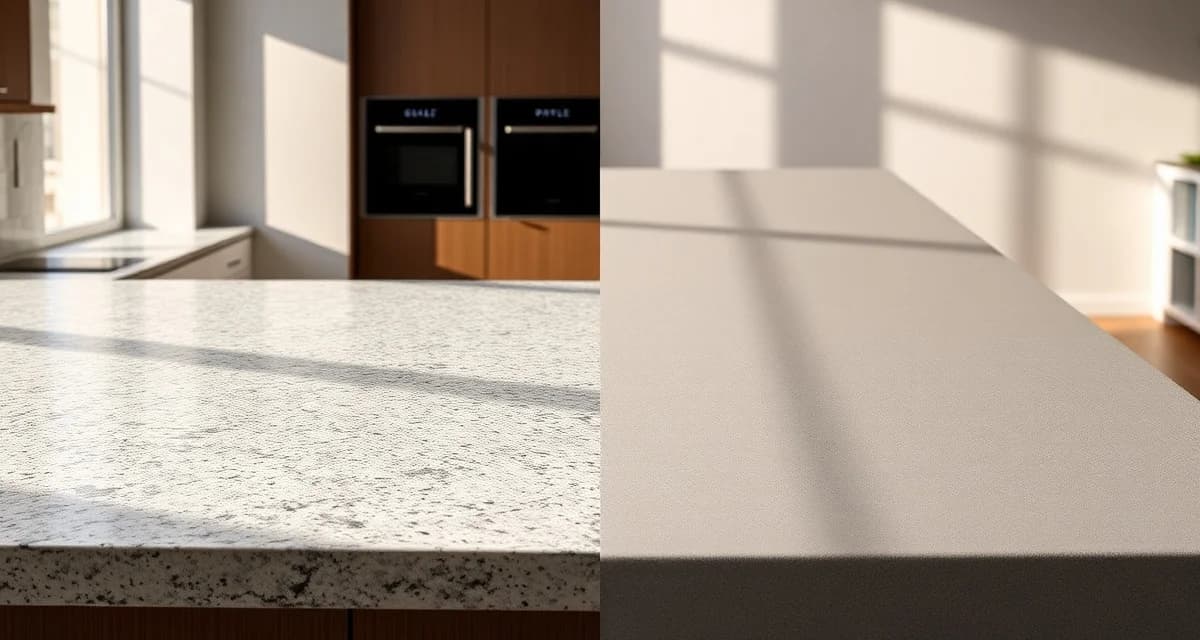
Granite vs Sintered Stone Countertops: 2026 Comparison
Granite is the natural stone standard that has proven itself over decades. Sintered stone (Dekton, Neolith, Lapitec) is the high-tech alternative that eliminates many of granite's maintenance requirements while adding capabilities like outdoor durability. Here is how they compare across every factor that matters.
TL;DR
- Granite is natural and unique; sintered stone is manufactured with printed patterns
- Sintered stone is non-porous and never needs sealing; granite requires sealing every 1-3 years
- Both handle heat extremely well --- granite from its geological origins, sintered stone from its manufacturing process
- Both work outdoors and are UV-stable
- Granite offers wider color variety and one-of-a-kind slab patterns
- Sintered stone comes in thinner profiles (8mm-20mm) for modern designs
- Granite is generally cheaper: $40-$100/sq ft vs. $65-$150/sq ft for sintered stone
- Granite has much wider fabricator availability
Side-by-Side Comparison
| Feature | Granite | Sintered Stone |
|---|---|---|
| Type | Natural igneous stone | Manufactured ultra-compact surface |
| Installed Cost (per sq ft) | $40-$100 | $65-$150 |
| Sealing | Every 1-3 years | Never |
| Heat Resistance | Excellent | Excellent |
| Scratch Resistance | High (6-7 Mohs) | Very High |
| Stain Resistance | Moderate (sealed) | Very High |
| UV Resistance | Yes | Yes |
| Outdoor Use | Yes | Yes |
| Porosity | Porous (needs sealant) | Non-porous |
| Pattern | Unique natural patterns | Printed patterns |
| Edge Profiles | Full range | Limited at thin profiles |
| Fabricator Availability | Very wide | Growing |
Where Granite Wins
Price: Budget granite starts at $40/sq ft --- well below sintered stone's floor of $65/sq ft. For cost-conscious projects, granite offers premium natural stone at accessible prices.
Calculate your material waste savings
See exactly how much slab material and money you could save with optimized cutting layouts.
Try the free Waste CalculatorPattern uniqueness: Every granite slab is a one-of-a-kind piece of earth's geology. Sintered stone patterns, while attractive, are manufactured and can repeat.
Edge profiles: At standard 3cm thickness, granite supports every common edge treatment. Thin sintered stone is limited in edge options.
Fabricator access: Nearly every countertop shop in the U.S. works with granite. Sintered stone requires specialized training that not all shops have completed.
Track record: Granite installations from the 1990s still look excellent. Sintered stone has a shorter history in countertop applications.
Where Sintered Stone Wins
Zero maintenance: No sealing, ever. Granite needs sealing every 1-3 years. Over a 20-year period, this adds convenience and saves $200-$500 in sealing products.
Stain resistance: Sintered stone is completely non-porous. Even without sealant, nothing absorbs. Granite can stain if its sealant is compromised.
Scratch hardness: Sintered stone is harder than granite and resists scratches even better.
Design versatility: Sintered stone can mimic marble, concrete, wood, metal, and other materials. It comes in ultra-thin profiles (8mm) for modern designs and can be used as wall cladding, flooring, and exterior facades in addition to countertops.
Outdoor performance: While both work outdoors, sintered stone's zero-sealing requirement makes it easier to maintain in exterior applications.
Fabrication Perspective
Granite fabrication is straightforward --- every shop knows the material, has the right tooling, and can produce consistent results. It is the bread-and-butter material of the countertop industry.
Sintered stone requires investment in training and new tooling. The cutting, polishing, and seaming processes differ from natural stone. However, shops that add sintered stone to their capabilities access a growing market segment with strong margins.
For shops working across both materials, SlabWise's nesting and quoting tools handle granite and sintered stone projects in a single workflow --- keeping operations efficient as your material range expands.
Best Uses
Choose Granite When:
- Budget is a primary factor
- Natural stone authenticity matters
- Wide edge profile options are needed
- You want maximum fabricator choice and competition on pricing
Choose Sintered Stone When:
- Zero maintenance is the top priority
- Modern, thin profiles are desired
- The project spans indoor and outdoor surfaces
- Mimicking marble, concrete, or wood looks is the goal
Is sintered stone more durable than granite?
Sintered stone is harder and non-porous, giving it advantages in scratch and stain resistance. Granite is proven over decades and extremely durable in its own right. Both are excellent for long-term kitchen use.
Does granite look better than sintered stone?
Granite's natural uniqueness gives it a character that manufactured surfaces cannot fully replicate. Sintered stone offers design versatility that granite cannot match (concrete looks, wood finishes, etc.). Beauty is subjective --- both have strong aesthetics.
Can I use sintered stone outdoors?
Yes. Sintered stone is UV-stable, weather-resistant, and non-porous --- ideal for outdoor kitchens. No sealing is needed even in exposed applications.
Is granite outdated?
No. Granite remains one of the most installed countertop materials in the U.S. and continues to perform well in kitchens across all style categories. It is a classic material with enduring appeal.
How often does granite need sealing?
Most granites need sealing every 1-3 years. Light-colored varieties may need it annually. Dark, dense granites can go 2-3 years between applications. The water drop test tells you when it is time.
Can sintered stone chip?
Yes. Heavy impacts on edges can cause chipping, especially at thinner profiles. The surface itself is very resistant to damage. Granite's natural composition gives it slightly better edge chip resistance.
Which is heavier?
Granite at standard 3cm thickness is heavier per square foot. Sintered stone at 12mm or 20mm is notably lighter, which can be an advantage in some installations.
What brands make sintered stone?
Major brands include Dekton (Cosentino), Neolith (TheSize), Lapitec, and Laminam. Each offers different pattern ranges and thickness options.
Choose Your Material
Granite and sintered stone both deliver premium countertop performance. Granite wins on price, natural beauty, and proven track record. Sintered stone wins on maintenance, stain resistance, and design versatility.
Get a cost estimate with our countertop cost calculator. Fabricators can try SlabWise free for 14 days to manage quoting and nesting across all material types.
Try These Free Tools
- Cost Calculator -- Compare material costs instantly across different countertop options.
- Compare Materials -- Side-by-side material comparison with pricing, durability, and maintenance.
- Kitchen Visualizer -- Let customers preview countertop materials in their actual kitchen.
Sources & Further Reading
-
Natural Stone Institute - Technology and Software Solutions for Stone Fabricators
-
International Surface Fabricators Association - Fabrication Software and Digital Tools
-
National Kitchen & Bath Association - Technology Integration in Countertop Design
-
Marble Institute of America - Digital Fabrication and Software Standards