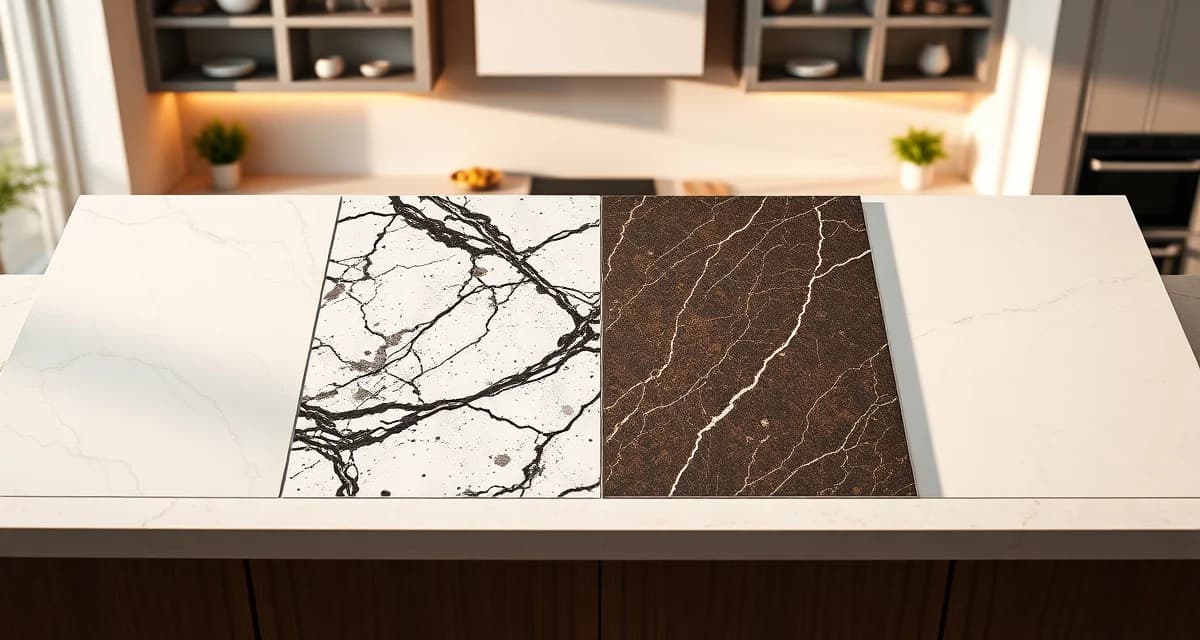
Best Most Durable Countertops in 2026
Durable countertops resist scratching, heat, staining, and chipping through decades of daily use. The toughest options -- quartzite, granite, porcelain slabs, and engineered quartz -- combine mineral hardness with practical toughness that keeps them looking good for 20-50+ years with minimal upkeep.
TL;DR: Most Durable Countertops Ranked
- Quartzite (Mohs 7-8) is the hardest natural stone countertop, resisting scratches, heat, and acids
- Granite (Mohs 6-7) has a 50+ year track record as the durability benchmark for kitchen counters
- Porcelain slabs resist virtually everything -- heat, scratches, UV, stains, and chemicals
- Engineered quartz (Mohs 7) excels at scratch and stain resistance but fails at heat tolerance
- Stainless steel is indestructible from a functional standpoint but scratches visually
- Concrete is structurally tough but requires ongoing maintenance to prevent staining
- Soapstone resists chemicals and heat but is the softest stone on this list (Mohs 1-2)
How We Measured Durability
| Criteria | Weight | What We Tested |
|---|---|---|
| Scratch resistance (Mohs hardness) | 25% | Resistance to knife marks, abrasion, and daily wear |
| Heat resistance | 20% | Maximum safe temperature without damage |
| Stain resistance | 20% | How well it repels wine, oil, coffee, and acids |
| Chip and crack resistance | 20% | Toughness against impacts and edge damage |
| Longevity | 15% | Expected lifespan before replacement is needed |
1. Quartzite -- Most Durable Natural Stone Countertop
Quartzite is metamorphosed sandstone, pressure-cooked deep in the earth until its quartz grains fuse into one of the hardest natural stones available. With a Mohs hardness of 7-8, it outranks granite and approaches the hardness of topaz. It scratches less, chips less, and handles heat better than almost any alternative.
Calculate your material waste savings
See exactly how much slab material and money you could save with optimized cutting layouts.
Try the free Waste CalculatorDurability scorecard:
| Test | Performance |
|---|---|
| Scratch resistance | Excellent -- kitchen knives will not mark it |
| Heat resistance | Excellent -- 1,200°F+ without damage |
| Stain resistance | Very good when sealed; will not etch from acids |
| Chip resistance | Very good -- harder than granite, less brittle |
| Expected lifespan | 50+ years |
Why it tops the durability list:
- Kitchen knives cannot scratch it (steel is Mohs 5.5; quartzite is 7-8)
- Acids like lemon juice and vinegar do not etch the surface (unlike marble)
- Heat from pots and pans is no issue at any kitchen temperature
- Dense structure resists staining when properly sealed
Where quartzite falls short:
- Not all "quartzite" sold is genuine -- mislabeled marble and dolomite are common
- Some varieties are more porous than others, requiring more frequent sealing
- Harder on fabrication tooling, leading to higher installation costs
- Premium pricing ($100-$250/sq ft installed)
For fabricators: Quartzite's hardness means faster blade wear and slower cutting speeds. A single quartzite kitchen can burn through diamond blades 20-40% faster than the same layout in granite. Tracking tool costs per material type in your shop management system -- something platforms like SlabWise handle automatically -- keeps your quotes profitable on these harder materials.
2. Granite -- Most Proven Durable Countertop
Granite has been the gold standard for durable kitchen countertops for over three decades in the US market. It is an igneous rock formed from cooled magma, composed primarily of quartz, feldspar, and mica -- minerals that give it hardness, density, and resistance to almost everything a kitchen throws at it.
Durability scorecard:
| Test | Performance |
|---|---|
| Scratch resistance | Very good -- Mohs 6-7, resists most kitchen abrasion |
| Heat resistance | Excellent -- formed at 1,200°F+, handles any kitchen heat |
| Stain resistance | Good when sealed; porous if unsealed |
| Chip resistance | Good -- occasional edge chips from impacts are the main risk |
| Expected lifespan | 50+ years (essentially permanent) |
Why granite remains the durability benchmark:
- Millions of granite counters installed over 30+ years prove its track record
- Every fabricator knows how to work with it
- Available in thousands of colors and patterns at every price point
- The original "upgrade" material still holds its resale value
Where granite can be vulnerable:
- Edge chips from dropped heavy objects (pots, cast iron pans)
- Staining if sealant is neglected -- wine, oil, and dark liquids can penetrate unsealed granite
- Some varieties (particularly lighter colors) are more porous and stain-prone than others
- Annual sealing is recommended for kitchen use
| Spec | Detail |
|---|---|
| Cost Range | $40-$200/sq ft installed |
| Mohs Hardness | 6-7 |
| Sealing | Annually |
| Lifespan | 50+ years |
| Best For | Any kitchen -- the all-around durability performer |
3. Porcelain Slabs -- Most Resistant to Everything
Porcelain slab countertops are fired at temperatures exceeding 2,200°F, creating a surface that is practically impervious to heat, scratches, stains, UV light, and chemicals. No other countertop material offers resistance across so many categories simultaneously.
Durability scorecard:
| Test | Performance |
|---|---|
| Scratch resistance | Excellent -- Mohs 7+, resists steel knives |
| Heat resistance | Excellent -- 2,200°F+, the highest of any countertop |
| Stain resistance | Excellent -- completely non-porous, zero absorption |
| Chip resistance | Good -- edges can chip from hard impacts, but the surface is very tough |
| Expected lifespan | 25+ years |
Where porcelain excels:
- Zero porosity means it literally cannot stain -- wine, turmeric, oil, and ink wipe right off
- Heat proof to temperatures no kitchen appliance can reach
- UV stable -- one of the few countertop materials rated for full outdoor sun exposure
- No sealing, no oiling, no special cleaners -- ever
Where porcelain has limits:
- Edge chipping is the primary vulnerability, especially with thinner (12mm) slabs
- Impact resistance is lower than granite and quartzite
- Requires specialized fabrication tools and skills
- Large slab format makes transportation and handling more challenging
| Spec | Detail |
|---|---|
| Cost Range | $50-$200/sq ft installed |
| Mohs Hardness | 7+ |
| Sealing | Never |
| Lifespan | 25+ years |
| Best For | Low-maintenance kitchens, outdoor kitchens, commercial spaces |
4. Engineered Quartz -- Most Stain-Resistant Countertop
Engineered quartz (Caesarstone, Cambria, Silestone, MSI) is manufactured by binding crushed natural quartz with polymer resins under heat and pressure. The resulting surface is non-porous, uniform in appearance, and resists staining better than any natural stone.
Durability scorecard:
| Test | Performance |
|---|---|
| Scratch resistance | Very good -- Mohs 7, hard to scratch in normal use |
| Heat resistance | Poor -- resin binder degrades at ~300°F |
| Stain resistance | Excellent -- non-porous, resists virtually all household stains |
| Chip resistance | Good -- less likely to chip than natural stone |
| Expected lifespan | 15-25 years |
The big trade-off: Engineered quartz tops the list for stain resistance and low maintenance, but its heat weakness is a serious durability gap. A single hot pan can cause permanent damage that cannot be repaired. This makes it the most durable choice for bathrooms and prep areas but a risky choice near stoves and ovens if trivets are not used consistently.
Where quartz excels:
- Never needs sealing
- Wine, coffee, turmeric, and oil do not stain it
- Consistent appearance -- no natural variation to worry about
- 10-25 year manufacturer warranties
Where quartz fails:
- Hot pans above 300°F cause permanent white marks
- Not UV stable -- yellows in direct sunlight
- Cannot be refinished or resurfaced if damaged
- Shorter expected lifespan than natural stone
| Spec | Detail |
|---|---|
| Cost Range | $50-$150/sq ft installed |
| Mohs Hardness | 7 |
| Heat Resistance | Poor (~300°F max) |
| Sealing | Never |
| Lifespan | 15-25 years |
| Best For | Bathrooms, bar areas, kitchens where trivets are always used |
5. Stainless Steel -- Most Functionally Indestructible
Stainless steel countertops cannot be burned, stained, or cracked by anything in a residential kitchen. They are standard in commercial kitchens for exactly this reason. However, they scratch easily -- which is a cosmetic issue, not a structural one.
Durability scorecard:
| Test | Performance |
|---|---|
| Scratch resistance | Fair -- visible scratches from regular use (cosmetic only) |
| Heat resistance | Excellent -- no temperature limit for kitchen use |
| Stain resistance | Excellent -- non-porous, hygienic |
| Chip/crack resistance | Excellent -- metal does not chip or crack |
| Expected lifespan | 30+ years |
The scratch trade-off: Every stainless steel countertop will develop a patina of fine scratches within months. Many homeowners and chefs consider this a normal part of the material's character. If visible scratching is unacceptable to a client, stainless steel is the wrong choice.
| Spec | Detail |
|---|---|
| Cost Range | $80-$200/sq ft installed |
| Heat Resistance | Unlimited for kitchen use |
| Sealing | Never |
| Lifespan | 30+ years |
| Best For | Commercial kitchens, modern residential, performance-focused cooks |
6. Concrete -- Most Structurally Tough
Concrete countertops are hard to break. The material's compressive strength exceeds 3,000 PSI in most countertop mixes, and fiber reinforcement adds tensile strength that prevents cracking under load. But concrete's porous nature means its durability depends heavily on maintenance.
Durability scorecard:
| Test | Performance |
|---|---|
| Scratch resistance | Good -- hard surface resists light scratches |
| Heat resistance | Good -- handles hot pots without burning |
| Stain resistance | Fair -- porous without sealing; good with proper sealing |
| Chip/crack resistance | Good structurally; hairline cracks can develop over time |
| Expected lifespan | 20+ years with maintenance |
| Spec | Detail |
|---|---|
| Cost Range | $65-$150/sq ft installed |
| Compressive Strength | 3,000+ PSI |
| Sealing | Regular (every 1-3 months for heavy use) |
| Lifespan | 20+ years |
| Best For | Custom shapes, industrial kitchens, integrated features |
7. Soapstone -- Most Chemically Resistant
Soapstone's primary claim to durability fame is its chemical resistance. Acids, bases, and solvents that would etch marble or stain granite have zero effect on soapstone. Science labs have used soapstone work surfaces for over a century for exactly this reason.
Durability scorecard:
| Test | Performance |
|---|---|
| Scratch resistance | Poor -- Mohs 1-2, scratches easily (but scratches sand out) |
| Heat resistance | Excellent -- handles extreme heat without cracking |
| Stain resistance | Excellent -- non-porous, chemically inert |
| Chip/crack resistance | Fair -- soft stone can chip on edges |
| Expected lifespan | 50+ years |
The scratch paradox: Soapstone is the softest stone on this list and the most scratch-prone. But scratches on soapstone are easy to remove with sandpaper and mineral oil, and many owners let scratches accumulate as part of the stone's evolving character. If you value chemical and heat resistance over scratch resistance, soapstone is remarkably durable.
| Spec | Detail |
|---|---|
| Cost Range | $70-$150/sq ft installed |
| Mohs Hardness | 1-2 (soft, but repairable) |
| Sealing | Oil periodically (no chemical sealant needed) |
| Lifespan | 50+ years |
| Best For | Chemistry-focused kitchens, bakers, canners, and preservers |
Master Durability Comparison Table
| Material | Scratch | Heat | Stain | Chip | Lifespan | Overall Score |
|---|---|---|---|---|---|---|
| Quartzite | 9/10 | 9/10 | 8/10 | 8/10 | 50+ yrs | 9/10 |
| Granite | 8/10 | 9/10 | 7/10 | 7/10 | 50+ yrs | 8/10 |
| Porcelain | 9/10 | 10/10 | 10/10 | 7/10 | 25+ yrs | 8.5/10 |
| Eng. Quartz | 8/10 | 3/10 | 10/10 | 8/10 | 15-25 yrs | 7/10 |
| Stainless | 4/10 | 10/10 | 10/10 | 10/10 | 30+ yrs | 8/10 |
| Concrete | 7/10 | 7/10 | 5/10 | 7/10 | 20+ yrs | 6.5/10 |
| Soapstone | 2/10 | 9/10 | 9/10 | 5/10 | 50+ yrs | 6.5/10 |
What Destroys Countertops: The Real Damage Sources
Understanding what actually damages countertops helps both homeowners and fabricators set realistic expectations:
Impact Damage (Chips and Cracks)
The number-one cause of countertop damage is impact -- dropping a heavy pot, a child's toy, or a cast iron pan onto the edge or surface. Natural stone is particularly vulnerable at inside corners and near cutouts where the material is thinnest.
Thermal Shock
Placing something extremely hot on a very cold surface (or vice versa) creates thermal stress. This rarely affects granite or quartzite in normal use, but can crack engineered quartz and some marbles.
Chemical Etching
Acidic substances (lemon juice, vinegar, tomato sauce, wine) etch calcium-based stones like marble and some limestone. Quartzite and granite are resistant. Engineered quartz is immune.
Staining from Absorption
Porous materials absorb liquids if left standing. Oil, wine, and dark-colored foods can leave permanent marks in unsealed granite or marble. Non-porous materials (quartz, porcelain, stainless) do not absorb.
UV Degradation
Sunlight causes engineered quartz to yellow over time. Natural stone and porcelain are UV stable. This matters for kitchens with large windows and for outdoor installations.
How Fabricators Prevent Durability-Related Callbacks
Durability issues lead to some of the most expensive callbacks in the fabrication business. Remakes cost $1,500-$4,000 on average. Here is how shops minimize these:
-
Accurate templating -- A template that is off by 1/8" forces the installer to make field adjustments that weaken the countertop at stress points. Digital templating with verification catches these before cutting.
-
Proper support around cutouts -- Undermount sink cutouts are the most common failure point. Adequate support and properly rounded inside corners prevent stress fractures.
-
Material-appropriate seam placement -- Seams near high-stress areas (sink corners, cooktop edges) are more likely to fail. Planning seam locations during nesting -- which software like SlabWise handles during layout optimization -- reduces long-term failure risk.
-
Customer education at delivery -- Explaining care requirements (trivets for quartz, sealing schedule for granite) in writing at the time of installation reduces warranty claims from preventable damage.
FAQ
What is the most durable countertop material overall?
Quartzite offers the best all-around durability: Mohs 7-8 hardness, 1,200°F+ heat resistance, acid resistance, and a 50+ year lifespan. It matches or exceeds granite in every durability category.
How long do granite countertops last?
Granite countertops last 50+ years -- essentially the lifetime of the home. The stone itself does not degrade. The only maintenance requirement is periodic resealing to maintain stain resistance.
Is quartz more durable than granite?
Quartz is more stain resistant (non-porous vs. granite's porosity), but granite is far more heat resistant (1,200°F vs. 300°F). For overall kitchen durability, granite has the edge because heat damage to quartz is irreversible and unfixable.
Can you cut directly on quartzite?
You physically can, and the stone won't show marks -- quartzite is harder than steel knife blades. However, cutting on any stone surface will dull your knives rapidly. Use a cutting board to protect your knives, not the stone.
Do porcelain countertops chip easily?
Not easily, but they can chip. Edge chipping from impacts is porcelain's main vulnerability. Thicker (20mm) slabs resist chipping better than thinner (12mm) versions. The surface itself is extremely scratch resistant.
What countertop resists stains the best?
Porcelain slabs and engineered quartz are tied for best stain resistance. Both are completely non-porous, meaning spills sit on the surface rather than absorbing. Even turmeric, red wine, and permanent marker wipe off.
How often does granite need to be sealed?
Most granite kitchen countertops benefit from sealing once a year. Darker, denser granites like Absolute Black may need sealing only every 2-3 years. Lighter, more porous granites may benefit from sealing every 6-12 months.
Which countertop is best for a family with kids?
Granite or quartzite. Both handle the abuse of a busy family kitchen -- dropped toys, spilled juice, hot pizza boxes, crayon marks -- without lasting damage. They're also hard to chip under normal household impacts.
Can damaged countertops be repaired?
It depends on the material. Soapstone scratches sand out with mineral oil. Granite chips can be filled with color-matched epoxy. Engineered quartz heat marks and deep scratches are permanent. Porcelain chips can sometimes be filled but may remain visible.
What is the best durable countertop for outdoor kitchens?
Porcelain slabs are the best outdoor choice due to their combined heat, UV, stain, and freeze-thaw resistance. Granite is a good runner-up. Engineered quartz should never be used outdoors.
Keep Your Countertop Projects on Track
Durable materials deserve precise fabrication. SlabWise's Template Verification catches measurement errors before you cut expensive quartzite or exotic granite, and our nesting optimization makes the most of every slab. Stop losing money to remakes and wasted material. Start your 14-day free trial at slabwise.com.
Try These Free Tools
- Nesting Optimizer -- AI-powered slab layout that maximizes yield considering vein direction and defects.
- Defect Mapping -- Upload a slab photo and AI maps every fissure, pit, and color issue.
- Value Engineering -- Find dollar-quantified suggestions to save material without cutting margin.
Sources & Further Reading
- Natural Stone Institute - Digital Tools for Stone Fabricators
- International Surface Fabricators Association - Technology Solutions for Countertop Businesses
- National Kitchen & Bath Association - Business Management Software Guide
- Remodeling Magazine - CRM Systems for Custom Fabricators