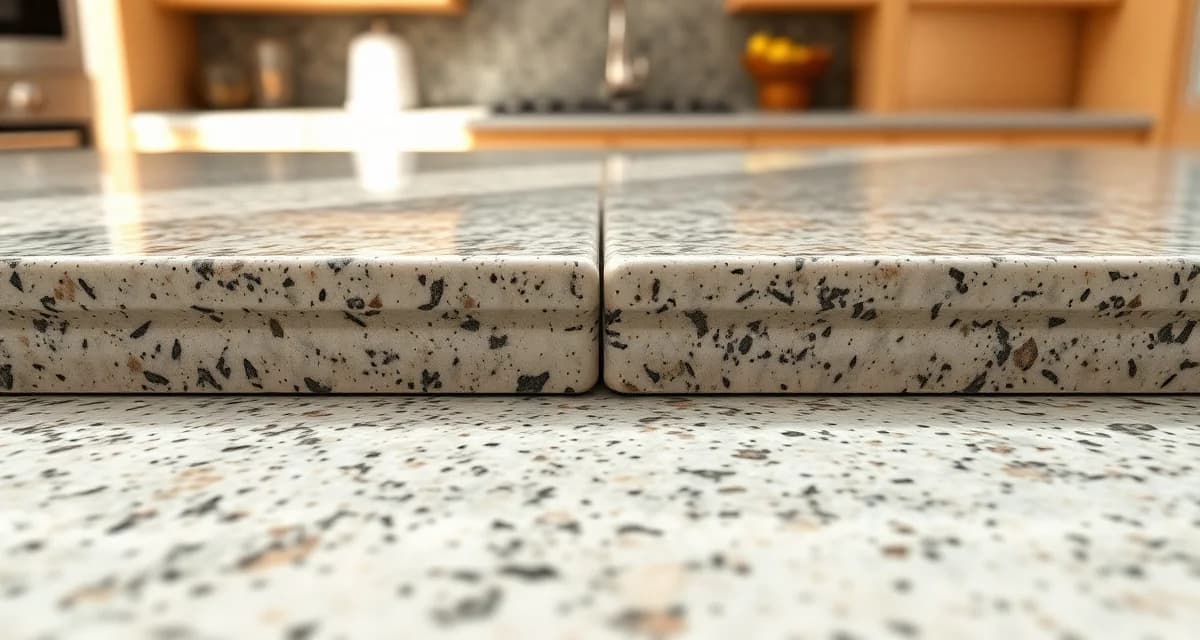
Countertop Seam Separating: Causes, Repair Options, and Costs
A separating countertop seam is more than a cosmetic annoyance - it's a sign that something has shifted, failed, or was never properly bonded in the first place. Left unaddressed, an open seam allows water infiltration, bacteria growth, and can worsen into a structural problem. The fix ranges from a $30 DIY repair to a $2,000+ professional intervention, depending on how far the seam has opened and why.
TL;DR
- Countertop seams separate due to thermal expansion, settling cabinets, adhesive failure, or poor initial bonding
- Hairline separations (under 1/32 inch) are often normal thermal movement and can be monitored
- Gaps between 1/32 and 1/16 inch can typically be repaired with color-matched epoxy without professional help
- Gaps over 1/16 inch usually require professional repair, which may involve disassembling and re-bonding the joint
- Repair costs range from $30 for a DIY epoxy fill to $500-$2,000 for professional re-bonding
- Seam placement matters enormously - fabricators who verify template data and nesting layouts catch bad seam locations before cutting
- Prevention starts at the template stage with proper seam planning and structural support
What a Separating Seam Looks Like
Seam separation shows up in a few ways, and the type of separation tells you a lot about the cause.
Calculate your material waste savings
See exactly how much slab material and money you could save with optimized cutting layouts.
Try the free Waste CalculatorTypes of Seam Separation
| Type | Description | Severity |
|---|---|---|
| Hairline gap | Thin visible line, can't fit a fingernail in | Low - monitor it |
| Lippage | One side sits higher than the other | Moderate - needs attention |
| Open gap | Visible separation you can feel with a finger | High - repair needed |
| Shifting | Pieces have moved laterally at the seam | High - structural concern |
| Crumbling edge | Epoxy filler is breaking apart at the seam line | Moderate - re-fill needed |
Where Seams Most Commonly Fail
- L-shaped corners (miter joints): The most failure-prone seam location. Miter joints carry stress from two directions and are the first to show movement.
- Near sinks: The weight of a full sink, plus vibration from the garbage disposal, puts constant stress on nearby seams.
- Long runs over 10 feet: Any countertop run exceeding a standard slab width requires a seam, and longer spans are subject to more thermal expansion.
- Island seams: Islands lack the wall backing that perimeter counters have, making their seams more vulnerable to lateral movement.
5 Reasons Countertop Seams Separate
1. Thermal Expansion and Contraction
Stone and quartz expand and contract with temperature changes. Dark-colored countertops near windows can experience surface temperature swings of 30-40°F over a single day. That thermal cycling pushes and pulls on the seam adhesive.
Typical expansion rates:
- Granite: 4.7 x 10⁻⁶ per °F
- Quartz: 6.0 x 10⁻⁶ per °F
- Marble: 5.5 x 10⁻⁶ per °F
Over a 10-foot run with a 30°F temperature change, that translates to roughly 0.02 inches of movement - not much individually, but over hundreds of cycles, it fatigues the epoxy bond.
2. Cabinet Settling or Movement
The same settling that causes uneven countertops can pull seams apart. If one cabinet section drops even 1/16 inch, the seam above it absorbs that differential movement.
This is especially common in:
- New construction (first 6-12 months)
- Homes with crawl spaces or pier-and-beam foundations
- Kitchens where appliances were replaced with heavier models
3. Poor Adhesive Application
Seam bonding requires the right epoxy, applied at the right thickness, with the right cure time. Common mistakes include:
- Not enough adhesive: The epoxy layer was too thin to absorb any movement
- Wrong adhesive type: Using silicone where structural epoxy is required, or vice versa
- Contaminated surfaces: Dust, moisture, or fabrication residue on the seam edges preventing a proper bond
- Insufficient cure time: Moving or stressing the seam before the epoxy fully cures (typically 24 hours for full strength)
4. Inadequate Seam Support
Every seam needs support underneath - either from the cabinet structure or from supplemental support like a plywood subtop or steel brace. A seam that spans an unsupported gap is relying entirely on the adhesive bond to hold two heavy pieces of stone together. That's a losing proposition long-term.
Industry standard calls for solid support within 3 inches of either side of every seam. Some fabricators use seam clips or rodding underneath for additional reinforcement.
5. Bad Seam Placement in the Design Phase
Sometimes the root cause isn't installation at all - it's where the seam was located in the first place. A seam placed at a stress point (over an unsupported span, near a cooktop cutout, or at a sharp angle) is inherently more likely to fail.
Experienced fabricators plan seam locations during the templating and nesting phase, balancing structural integrity, visual appearance, and material yield.
How to Repair a Separating Seam
DIY Repair: Hairline to 1/16 Inch Gaps
Materials needed:
- Color-matched countertop epoxy or seam filler ($15-$40)
- Acetone or denatured alcohol for cleaning
- Blue painter's tape
- Razor blade or plastic scraper
- Paper towels
Steps:
-
Clean the seam: Remove any old, loose filler material. Clean both edges with acetone to remove grease and residue. Let it dry completely.
-
Tape the edges: Apply painter's tape along both sides of the seam, leaving about 1/16 inch on each side exposed. This protects the countertop surface from excess filler.
-
Apply the filler: Using a syringe or small applicator, push the color-matched epoxy into the gap. Slightly overfill - the epoxy will shrink slightly as it cures.
-
Scrape flush: After the epoxy begins to gel (check your product's working time - usually 15-30 minutes), carefully scrape the excess flush with a razor blade.
-
Remove tape and clean: Pull the tape at a 45-degree angle while the epoxy is still workable. Clean any residue with acetone.
-
Cure: Allow 24 hours before putting weight or water on the seam.
Cost: $30-$60 total
Professional Repair: Gaps Over 1/16 Inch
For wider separations, a professional needs to evaluate whether the seam can be re-bonded in place or needs to be disassembled.
In-place re-bonding (gap under 1/8 inch):
- The fabricator cleans out the old epoxy, checks the alignment, and re-fills with structural-grade seam adhesive
- Cost: $150-$400
Disassembly and re-bonding (gap over 1/8 inch or with lippage):
- The countertop sections are separated at the seam
- Seam edges are re-cut or re-polished if damaged
- Cabinet support is corrected
- Pieces are re-bonded with fresh adhesive and clamped
- Cost: $500-$2,000
Full seam replacement (if the stone edges are damaged beyond repair):
- One or both sections may need to be re-fabricated
- This is effectively a partial countertop replacement
- Cost: $1,000-$3,500+
Seam Repair Cost Summary
| Repair Type | DIY Cost | Professional Cost |
|---|---|---|
| Epoxy fill (hairline gap) | $30-$60 | $150-$250 |
| Re-bond in place (moderate gap) | Not recommended | $250-$500 |
| Disassembly and re-bond | Not possible DIY | $500-$2,000 |
| Section re-fabrication | Not possible DIY | $1,000-$3,500+ |
How to Prevent Seam Separation
For Homeowners
- Don't lean or sit on seam areas: Concentrated weight stresses the bond
- Address plumbing leaks immediately: Water under the countertop weakens adhesive and warps cabinet supports
- Maintain consistent kitchen temperature: Extreme temperature swings accelerate thermal cycling
- Don't place hot pots directly on or near seams: Sudden thermal shock is especially hard on seam bonds
For Fabricators
- Plan seam locations during nesting: Place seams over solid support, away from cutouts, and where visual impact is minimized
- Use structural epoxy for seams: Not silicone, not general-purpose adhesive - use seam-specific products rated for stone
- Verify template data before cutting: A seam location that looks fine on screen may fall over an unsupported span in the actual kitchen
- Install seam support: Plywood subtops, seam clips, or steel braces underneath every seam joint
SlabWise's nesting optimization places seams at structurally sound locations while maximizing yield from available slab inventory. Combined with Template Verification, seam placement decisions are checked against actual jobsite conditions before any cutting begins.
When Is a Separating Seam a Warranty Issue?
Most fabricators warranty seam work for 1-2 years. A seam that separates within that period due to adhesive failure or improper bonding is generally covered.
Typically covered:
- Adhesive failure within warranty period
- Seam placed in an improper location by the fabricator
- Lippage that was present from day one
Typically NOT covered:
- Separation caused by settling or structural movement
- Damage from placing hot items on the seam
- Normal thermal expansion in particularly exposed locations
- Modifications made to cabinets after installation
Document and report early. Take dated photos showing the gap width (use a coin or ruler for scale) and email your fabricator. Verbal complaints are hard to prove later.
Is it normal for a countertop seam to be visible?
Yes. Even the best seam work produces a visible line. The goal is a tight, flush, color-matched seam - not an invisible one. If someone promises invisible seams, be skeptical.
Can I use caulk to fill a separating seam?
Caulk is not a structural repair. It can temporarily mask a hairline gap but will peel and discolor within months. Use color-matched countertop epoxy designed for stone seams.
How long should a countertop seam last?
A properly bonded seam should last the life of the countertop - 15-25 years or more. If a seam fails within the first few years, something went wrong during installation.
Will a separating seam get worse over time?
Usually, yes. A small gap allows water infiltration, which weakens the adhesive further. Thermal cycling continues to stress the joint. Address it before it widens.
Can separating seams cause water damage?
Absolutely. Water that enters through a seam gap can damage the plywood subtop, warp cabinets, and promote mold growth. Seams near sinks are especially vulnerable.
How do fabricators decide where to place seams?
Seam placement considers slab dimensions, structural support locations, visual impact, and distance from stress points like sinks and cooktops. Software-assisted nesting helps optimize all these factors simultaneously.
Can you re-polish a seam after repair?
For natural stone, yes - a professional can re-hone and re-polish the seam area to blend the repair. For quartz, re-polishing is more difficult and not always possible.
Should I choose a material with fewer seams?
Larger slab formats (jumbo slabs up to 130 x 65 inches) can eliminate some seams in standard kitchens. Discuss slab availability with your fabricator during the planning phase.
Is epoxy or polyester better for seam repair?
Epoxy is generally stronger and more durable for structural seam bonds. Polyester-based fillers are sometimes used for cosmetic touch-ups but aren't ideal for structural repairs.
How can I find a qualified seam repair specialist?
Contact your original fabricator first. If they can't help, look for stone restoration companies in your area that specialize in natural and engineered stone repair.
Fix Seams Right the First Time
For fabrication shops: seam failures are one of the top callback drivers, and most trace back to placement decisions made during nesting and templating. SlabWise optimizes seam locations for structural integrity and yield, catching bad placements before they become jobsite problems.
Start your 14-day free trial - see how smarter nesting reduces seam callbacks.
Try These Free Tools
- Cost Calculator -- Get instant countertop cost estimates by material, edge profile, and square footage.
- Compare Materials -- Side-by-side material comparison with pricing, durability, and maintenance ratings.
- Edge Profile Selector -- Browse edge profiles with cost impact and visual previews.
Sources & Further Reading
-
Natural Stone Institute - Stone Installation Guidelines and Best Practices
-
National Kitchen & Bath Association - Countertop Installation Standards
-
International Surface Fabricators Association - Fabrication and Installation Technical Guide
-
Marble Institute of America - Stone Care and Installation Manual