Most Modern Edge Profile?
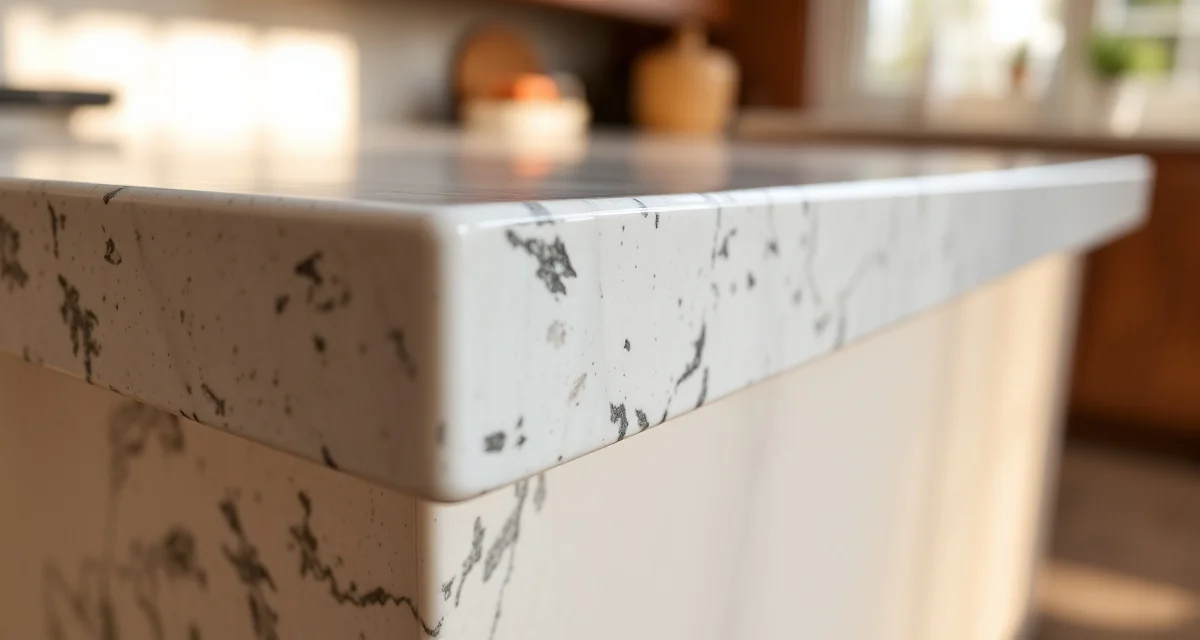
The eased (flat polished) edge is the most modern countertop edge profile in 2025-2026. It features a clean, squared-off look with just the slightest rounding at the corners to remove sharpness. Mitered edges rank as the second most modern option, especially for waterfall island designs where the countertop material continues down the side.
TL;DR
- The eased (flat polished) edge is the #1 choice for modern and contemporary kitchen designs
- Mitered edges are the go-to for waterfall islands and thick-slab looks without the actual thickness
- Razor/knife edge is the most minimal option - a perfectly sharp 90-degree profile with no softening
- Modern kitchens avoid ornate profiles like ogee, dupont, and heavily rounded bullnose
- Cost ranges from $0 (eased, often standard) to $30-$50 per linear foot (mitered)
- The trend is moving toward thinner visual profiles - 2cm slabs or mitered 3cm edges that look like 6cm
- Material choice matters: porcelain and ultra-compact surfaces pair naturally with minimal edge styles
Why the Eased Edge Dominates Modern Design
The eased edge (also called "flat polished" or "straight edge") is a squared-off profile with microscopic rounding at the top and bottom corners. That tiny rounding - usually less than 1mm - exists purely to prevent the edge from chipping during handling and installation. From a visual standpoint, the edge looks perfectly flat and square.
Calculate your material waste savings
See exactly how much slab material and money you could save with optimized cutting layouts.
Try the free Waste CalculatorThis profile works for modern kitchens because it follows the core design principle: lines, not curves. Modern kitchen design emphasizes:
- Horizontal slab-door cabinets with no raised panels
- Flat, handleless drawer fronts
- Integrated appliances with flush panels
- Minimal ornamentation
An eased countertop edge continues that flat, linear language. Adding a rounded bullnose or decorative ogee to a modern flat-panel kitchen creates a visual mismatch - the countertop "disagrees" with everything around it.
Ranking the Most Modern to Least Modern Edges
| Rank | Edge Profile | Modern Score | Cost/LF | Best Application |
|---|---|---|---|---|
| 1 | Eased (flat polished) | 10/10 | $0-$3 | Any modern kitchen |
| 2 | Mitered | 9/10 | $30-$50 | Waterfall islands, thick-look slabs |
| 3 | Knife/Razor | 9/10 | $5-$10 | Ultra-minimal designs, commercial |
| 4 | Thin bevel | 7/10 | $5-$10 | Transitional-to-modern kitchens |
| 5 | Half bullnose | 4/10 | $0-$5 | Traditional-to-transitional |
| 6 | Full bullnose | 3/10 | $5-$10 | Traditional, family-friendly |
| 7 | Bevel | 3/10 | $5-$10 | Transitional |
| 8 | Ogee | 1/10 | $15-$25 | Traditional, formal |
| 9 | Dupont | 1/10 | $20-$30 | Traditional, ornate |
The Mitered Edge: Modern and Dramatic
A mitered edge joins two pieces of stone at a 45-degree angle to create the illusion of a much thicker slab. A standard 3cm slab with a mitered edge can look like it's 6cm or even 12cm thick.
This technique is essential for waterfall islands - where the countertop surface continues vertically down the sides of the island to the floor. The miter allows that continuous flow of material without requiring a single massive block of stone.
Mitered Edge Cost Breakdown
Mitered edges are the most expensive standard edge option because they require:
- Extra material (the drop-down piece)
- Precision 45-degree cutting
- Color-matched epoxy bonding
- Additional polishing of the bonded joint
Expect $30-$50 per linear foot for a mitered edge, compared to $0-$3 for a standard eased edge. For a 10-foot island with a mitered apron on one side, that's an added $300-$500 just for the edge treatment.
Emerging Trends in Modern Edge Profiles
Ultra-Thin Slabs (12mm and 8mm)
Porcelain and ultra-compact surfaces like Dekton and Neolith are available in 12mm (about 1/2 inch) thickness. These thin slabs create an extremely minimal profile that doesn't need any edge profiling at all - the edge is simply polished flat. The result is a countertop that almost appears to float.
Integrated Drip Edges
Some modern fabricators are milling a small groove (3-5mm) along the underside of the countertop edge. This "drip channel" prevents water from running down cabinets below. It's invisible from the front but adds a functional detail that appeals to detail-oriented homeowners.
Recessed or Shadow-Line Edges
In high-end modern projects, the countertop edge is set back slightly from the cabinet face, creating a shadow line between the counter and cabinet. This technique makes the countertop appear to float and requires precise eased-edge fabrication.
Material and Edge Pairing Guide
Not every material works equally well with every modern edge:
Best Materials for Eased Edges
- Quartz: Machines to a perfect flat edge with minimal effort. Uniform color means the edge matches the surface exactly.
- Porcelain slabs: Available in ultra-thin profiles that look naturally modern with a simple polished edge.
- Ultra-compact surfaces (Dekton, Neolith): Designed for minimal edge treatments.
Best Materials for Mitered Edges
- Quartz: Consistent material makes for invisible miter joints. The color and pattern match perfectly at the seam.
- Solid-color granite: Blacks (Absolute Black) and consistent whites work well because the miter seam disappears.
- Porcelain slabs: Thin porcelain mitered to look thicker is a growing trend in European-influenced designs.
Materials to Avoid for Sharp Eased Edges
- Highly veined marble: A sharp eased edge exposes the marble to chipping along natural fracture lines in the veins. A very slight bevel (1-2mm) helps.
- Granite with large crystals: Coarse-grained granites can show small chip-outs at perfectly sharp edges. Again, a minimal ease of 1mm solves this.
What About Pencil Round vs. Eased?
This causes confusion. A pencil round softens the top edge into a small curve (roughly 3mm radius). An eased edge has a much smaller rounding (less than 1mm) - barely perceptible.
For maximum modern impact, request the eased edge, not the pencil round. The pencil round introduces a visible curve that softens the look slightly - fine for transitional kitchens but not as sharp for a fully modern design.
Matching Your Edge to Your Kitchen Style
| Kitchen Style | Best Edge | Why |
|---|---|---|
| Modern/Contemporary | Eased or mitered | Clean lines, no curves |
| Transitional | Eased or thin bevel | Bridges modern and traditional |
| Farmhouse | Half bullnose or eased | Simple, unfussy profile |
| Traditional | Bullnose, ogee, or bevel | Decorative detail matches cabinetry |
| Industrial | Eased or raw/unpolished | Matches raw material aesthetic |
| Mid-Century Modern | Eased with thin profile (2cm) | Period-accurate minimal look |
FAQ
What is the most popular countertop edge for modern kitchens?
The eased (flat polished) edge is the most popular choice for modern kitchens. It provides a clean, squared-off appearance that matches flat-panel cabinetry and minimalist design language.
Are mitered edges worth the extra cost?
For waterfall islands and visual statement pieces, yes. A mitered edge can make a standard 3cm slab look 6cm thick, creating a substantial design impact. For standard perimeter countertops, the eased edge delivers the same modern look at a fraction of the cost.
Is bullnose edge considered modern?
Not really. Bullnose is a classic profile that reads as traditional or transitional. If your kitchen has flat-panel cabinets and a minimalist aesthetic, a bullnose edge will look out of place. Stick with eased or mitered for a modern vibe.
What edge profile hides seams best?
Eased edges can actually make seams slightly more visible because there's no visual distraction at the edge. If hiding seams is a priority, a small bevel or pencil round at the top edge draws the eye along the edge detail rather than the seam line.
Can you get a modern edge on granite?
Absolutely. Granite looks sharp with an eased edge, especially darker varieties like Absolute Black, Steel Grey, or Black Pearl. The flat edge shows off the stone's polished depth.
What edge is best for a quartz waterfall island?
A mitered edge is the standard for waterfall islands. It creates the seamless look where the countertop and side panel appear to be one continuous piece of stone flowing from horizontal to vertical.
Does edge profile affect countertop durability?
Yes. Sharper edges (eased, knife) are slightly more susceptible to chipping from impact than rounded edges (bullnose). However, with normal kitchen use, the difference is minimal. Quartz and granite are hard enough that eased edges perform well in daily life.
What is a knife edge on a countertop?
A knife edge (or razor edge) is a perfectly sharp 90-degree angle with zero rounding. It's the most minimal edge possible but is also the most prone to chipping. It's mainly used in commercial settings and high-end residential projects where appearance trumps practicality.
How do I tell my fabricator which edge I want?
Ask to see edge profile samples - most shops have a sample board with 6-10 profiles cut into stone. Point to the one you want, and confirm the name they use (terminology can vary by shop). Take a photo of the sample for your records.
What edge profile adds the most value to a home?
For resale, eased and half bullnose are the safest choices because they appeal to the broadest range of buyers. Highly decorative edges (ogee, dupont) can actually date a kitchen and reduce appeal to modern-minded buyers.
Get an Instant Countertop Estimate
Deciding between edge profiles for your modern kitchen? SlabWise's Quick Quote tool lets you compare edge options and see the cost impact in about 3 minutes. Start your 14-day free trial and generate accurate estimates that include edge profile pricing.
Try These Free Tools
- Cost Calculator -- Get instant countertop cost estimates by material, edge profile, and square footage.
- Compare Materials -- Side-by-side material comparison with pricing, durability, and maintenance ratings.
- Edge Profile Selector -- Browse edge profiles with cost impact and visual previews.