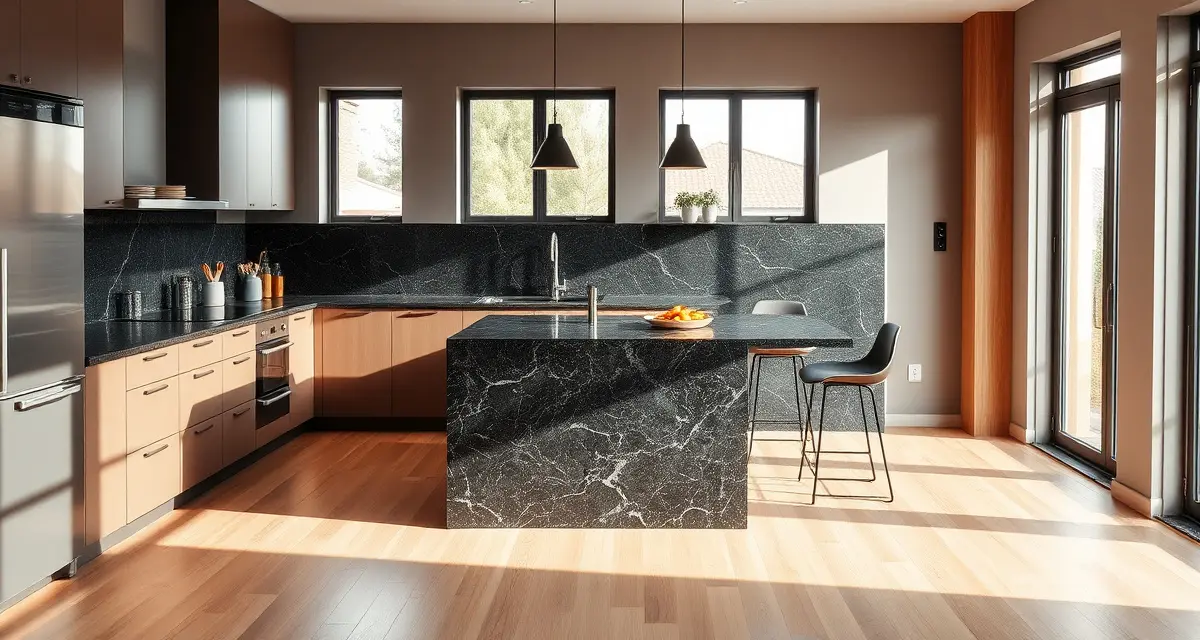
Should Countertops Match Floor?
No - countertops should not match the floor exactly. Instead, they should coordinate. A perfect match between countertop and flooring creates a flat, monotone look that lacks depth. The design rule followed by most kitchen professionals: pick surfaces that share a color family or undertone but differ in shade, pattern, or texture.
TL;DR
- Countertops and floors should coordinate, not match exactly - aim for complementary tones rather than identical colors
- The "60-30-10" color rule applies: 60% dominant (cabinets), 30% secondary (countertops), 10% accent (backsplash)
- Light floors + darker countertops is the most popular and safest combination
- Matching the undertone (warm vs. cool) matters more than matching the color itself
- Avoid matching pattern intensity - if your floor is busy, keep countertops calmer (and vice versa)
- Natural stone countertops often contain flecks of color that can pull from your flooring to create visual connection
- When in doubt, bring a flooring sample to the countertop showroom or slab yard
The 60-30-10 Rule for Kitchen Surfaces
Professional kitchen designers use this formula to balance visual weight across a kitchen:
Calculate your material waste savings
See exactly how much slab material and money you could save with optimized cutting layouts.
Try the free Waste Calculator| Percentage | Surface | Role |
|---|---|---|
| 60% | Cabinets | Dominant color - sets the overall tone |
| 30% | Countertops + flooring | Secondary color - provides contrast and depth |
| 10% | Backsplash + accents | Accent - adds personality and visual interest |
Within that 30% secondary zone, your countertops and flooring work together but don't need to be identical. They share the same visual tier, which means they should feel cohesive without competing for attention.
What "Coordinating" Actually Means
Coordination comes down to three things: undertone, value (light vs. dark), and pattern scale.
Undertone Matching
Every surface has an undertone - warm (yellow, gold, red, orange) or cool (blue, gray, green). This is the single most important factor in making countertops and flooring look good together.
Examples that work:
- Cool gray quartz countertop + cool gray-toned wood flooring
- Warm beige granite + warm honey oak floors
- White marble with gold veining + warm wood-look tile
Examples that clash:
- Cool blue-gray quartz + warm orange-toned red oak
- Warm cream granite + stark blue-gray tile flooring
- Yellow-undertone marble + ash-gray laminate flooring
Value Contrast
Value refers to how light or dark a surface is. The strongest kitchen designs have noticeable value contrast between the countertop and floor - not a perfect match.
| Combination | Effect | Popularity |
|---|---|---|
| Light floor + dark countertop | Grounded, classic, most forgiving | Very high |
| Dark floor + light countertop | Dramatic, high-contrast, shows more dirt | Moderate |
| Medium floor + medium countertop | Can look muddy if tones are too similar | Low |
| Light floor + light countertop | Airy, open, needs accent contrast | Moderate |
The most popular combination in US kitchens (based on Houzz and NKBA surveys) is light-to-medium flooring with medium-to-dark countertops.
Pattern Scale
If your flooring has a bold pattern (wide-plank herringbone, geometric tile, heavily veined marble-look tile), your countertop should have a calmer pattern. If your flooring is simple and uniform, your countertop can carry more visual drama.
Rule of thumb: Only one surface in the kitchen should be the "star." If your countertop is a dramatic veined marble, keep the floor simple. If the floor is a showpiece herringbone pattern, choose a quieter solid or lightly speckled countertop.
Popular Countertop + Floor Combinations That Work
White Quartz + Medium Oak Hardwood
This is the most popular kitchen combination in the US right now. The white quartz reads clean and bright, while the medium oak adds warmth. The undertones align - both lean slightly warm - and the value contrast is strong without being jarring.
Dark Granite + Light Gray Tile
Absolute Black or Steel Grey granite over a light gray porcelain tile creates a high-contrast, modern look. Both surfaces share cool undertones, and the dramatic value difference gives the kitchen a sense of depth.
Marble-Look Quartz + Light Hardwood
Quartz that mimics Calacatta or Carrara marble pairs beautifully with light natural wood floors (white oak, maple, birch). The soft gray veining in the quartz connects visually to the cool-neutral tone of light hardwood.
Warm Brown Granite + Dark Walnut Floor
This combination leans traditional but works well in craftsman and rustic kitchens. Both surfaces are warm-toned and rich, but the granite's movement and mineral flecks differentiate it from the floor's wood grain.
Combinations to Avoid
Exact Color Match
A gray granite countertop on a gray tile floor of the same shade creates a washed-out, one-dimensional kitchen. The eye needs contrast to perceive depth and define where one surface ends and another begins.
Competing Patterns
A heavily veined marble countertop above a busy mosaic tile floor overloads the visual field. Both surfaces fight for attention, and neither wins.
Clashing Undertones
Mixing warm and cool without intention - warm golden oak floors under a cool blue-gray quartz - creates tension that feels "off" even if you can't immediately identify why.
Matchy-Matchy Stone
Using the same exact stone on both countertops and floors (for example, travertine everywhere) can make a kitchen feel monotone. If you want stone on both surfaces, use different finishes (polished countertop, honed floor) or different cuts/colors from the same stone family.
How to Test Your Combination Before Committing
- Get physical samples. Online photos lie about color. Get 4x4-inch samples of your flooring and hold them next to countertop slabs in person.
- Check samples in your kitchen's lighting. LED vs. fluorescent vs. natural light all shift how colors read. Bring samples home and view them at different times of day.
- Look at samples vertically and horizontally. Your countertop is horizontal and your eye hits it from above. Your floor is horizontal too, but viewed at an angle. The same material can look lighter or darker depending on viewing angle.
- Use the squint test. Hold your samples together, squint until the details blur, and look at the overall tones. If they feel harmonious as blurred shapes, they'll work together as installed surfaces.
- Photograph with your phone on neutral settings. Take a photo of your samples together, then view it in black and white. This strips out color and shows you the value contrast. If the surfaces disappear into each other in B&W, you need more contrast.
Does the Cabinets' Color Change the Equation?
Absolutely. Cabinets occupy the most visual real estate in a kitchen (that 60% from the rule above), so they anchor the whole palette.
| Cabinet Color | Floor Suggestion | Countertop Suggestion |
|---|---|---|
| White | Medium warm wood or light gray tile | Medium to dark (gray, black, marble-look) |
| Gray | Light warm wood or white tile | White, light marble-look, or dark contrast |
| Navy/Dark blue | Medium warm wood | White or light marble-look |
| Natural wood | Complementary (not matching) wood or neutral tile | White, gray, or dark contrast |
| Black | Light wood or light tile | White, marble-look, or light stone |
The key principle: if cabinets are light, you have more freedom with both floor and countertop darkness. If cabinets are dark, keep at least one surface (floor or countertop) light to prevent the kitchen from feeling like a cave.
FAQ
Should countertops be lighter or darker than the floor?
Either works, but dark countertops over lighter floors is the most popular combination. It grounds the kitchen visually and is more forgiving with crumbs and spills on both surfaces.
Do white countertops go with any floor?
White countertops are among the most versatile, but they don't go with every floor automatically. The undertone still matters - a warm white countertop coordinates better with warm-toned floors, and a cool white pairs better with gray or cool-toned flooring.
Can I use the same stone on floors and countertops?
You can, but vary the finish. A polished granite countertop with a honed or leathered version of the same stone on the floor creates visual difference through texture rather than color. Just be aware that some stones (like marble) are too soft for heavy-traffic floor use.
Should countertops match the backsplash or the floor?
The countertop should relate to both, but it doesn't need to match either. A stronger design connection is usually between the countertop and backsplash (since they're adjacent) than between the countertop and floor.
What if my floors are already installed?
Bring a sample or large photo of your existing floor to the slab yard or showroom. Most countertop decisions are made around existing flooring, not the other way around. Hold your floor sample directly against potential slabs to check compatibility.
Do countertops and floor need to be the same material?
No. Mixing materials (stone countertop + wood floor, quartz countertop + tile floor) is standard practice and often creates a more interesting kitchen than using the same material on every surface.
What undertone is my floor?
Place a pure white piece of paper on your floor. The floor's undertone will become more apparent by contrast. If the floor looks warm/yellow/gold next to the white paper, it's warm. If it looks gray/blue/cool, it's cool.
How do I match countertops if my home has open-concept flooring?
In open-concept homes, the floor runs continuously from room to room, so the countertop needs to work with a floor that may have been chosen for the living room aesthetic. Focus on undertone matching and value contrast - those two principles work regardless of the floor's original design intent.
Get an Instant Countertop Estimate
Ready to pick your countertop material? SlabWise's Quick Quote tool generates a detailed estimate in about 3 minutes, so you can compare options and find the right look to coordinate with your existing floor. Start your 14-day free trial today.
Try These Free Tools
- Cost Calculator -- Get instant countertop cost estimates by material and square footage.
- Kitchen Visualizer -- Upload a kitchen photo and preview different materials in place.
- Template Compare -- Upload two templates and see every dimension change highlighted.
Sources & Further Reading
-
Natural Stone Institute - Countertop Installation Best Practices Guide
-
National Kitchen & Bath Association - Kitchen Renovation Sequencing Guidelines
-
International Surface Fabricators Association - Professional Installation Standards
-
Remodeling Magazine - Kitchen Remodel Installation Order Best Practices