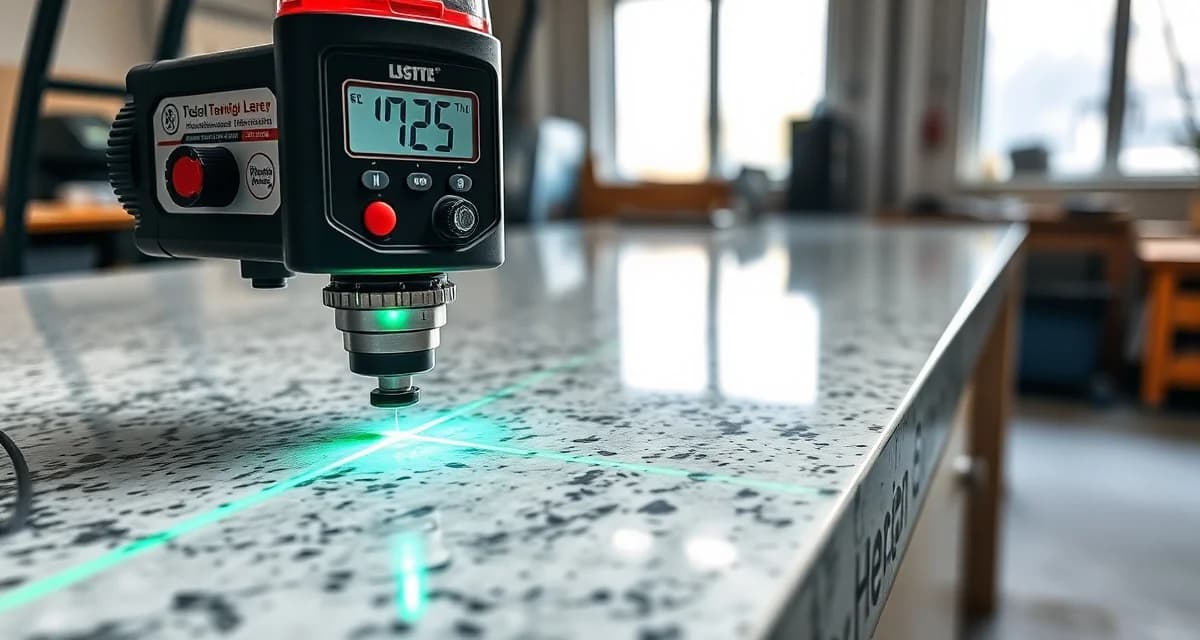
How Accurate Is Laser Templating?
Laser templating is accurate to within ±1/64 of an inch (approximately 0.4mm) under typical job-site conditions. That's roughly 4 to 8 times more precise than traditional strip templating, which typically achieves ±1/8 to ±1/4 inch accuracy. For countertop fabrication, this level of precision translates directly into better-fitting countertops and fewer costly remakes.
TL;DR
- Laser templating accuracy: ±1/64 inch (0.4mm) in standard conditions
- Traditional strip templates: ±1/8 to ±1/4 inch accuracy
- Laser templating reduces remake rates by 50-80% at most shops
- A full kitchen template takes 20-40 minutes with laser vs. 60-90 minutes manual
- Equipment cost: $15,000-$30,000 for a quality laser templating system
- Digital output integrates directly with CAD/CAM and CNC machines
- The technology has been adopted by an estimated 30-40% of US fabrication shops
How Laser Templating Works
Laser templating uses a precision laser measuring device mounted on a stable base. The operator positions the unit in the room, then shoots the laser at specific points along the countertop layout - every corner, edge, curve, and cutout gets captured as a digital coordinate.
Calculate your material waste savings
See exactly how much slab material and money you could save with optimized cutting layouts.
Try the free Waste CalculatorThe system builds a 2D or 3D digital map of the entire countertop area. Here's the basic process:
- Set up the device - The laser templater is placed on a tripod or stand with a clear view of the countertop area
- Establish reference points - The system calibrates using known distances or built-in reference geometry
- Capture measurement points - The operator aims the laser at each critical point and records its position
- Build the digital template - Software assembles all points into a complete countertop outline
- Add details - Sink cutouts, faucet holes, edge profiles, and seam locations are marked in the digital file
- Export the file - The completed template exports as a DXF, DWG, or proprietary format for CNC programming
Popular Laser Templating Systems
| System | Accuracy | Price Range | Key Features |
|---|---|---|---|
| LT-2D3D | ±0.5mm | $18,000-$25,000 | 2D and 3D capability, widely adopted |
| Proliner | ±0.4mm | $20,000-$35,000 | Touch-probe and laser combo |
| Flexijet | ±0.5mm | $22,000-$30,000 | 3D measurement, AutoCAD integration |
| Laser Products LT-55 | ±1mm | $8,000-$15,000 | Budget-friendly entry point |
Laser Templating vs. Manual Templating: Accuracy Comparison
The difference in accuracy between laser and manual methods is significant, but the real impact shows up in practical outcomes.
| Metric | Laser Templating | Manual Strip Templating |
|---|---|---|
| Linear accuracy | ±1/64 inch | ±1/8 to ±1/4 inch |
| Angular accuracy | ±0.1 degrees | ±0.5 to 1.0 degrees |
| Curve capture | Hundreds of points | Limited by strip flexibility |
| Template time (avg kitchen) | 20-40 minutes | 60-90 minutes |
| Data transfer to CNC | Direct digital file | Manual tracing required |
| Remake rate (industry avg) | 1-2% | 3-5% |
| Template transport issues | None (digital file) | Can shift or warp in transit |
Where Accuracy Gains Matter Most
Not every measurement needs ±1/64 inch precision. But several areas of countertop fabrication benefit enormously from it:
Seam alignment - When two pieces of stone meet at a seam, even 1/16 inch of misalignment is visible and noticeable to the touch. Laser accuracy keeps seams tight.
Undermount sink cutouts - The cutout needs to match the sink bowl precisely. Too big, and the clips won't hold. Too small, and the sink won't drop in. Laser measurements get this right consistently.
Wall scribing - Where the countertop or backsplash meets a wall, the stone needs to follow the wall's contour. Laser systems capture wall irregularities that manual methods miss.
Complex shapes - Curved islands, radius corners, and angled peninsula layouts are much easier to capture accurately with a laser than with rigid strip templates.
The Financial Impact of Better Accuracy
For fabrication shops, the accuracy argument comes down to money. Here's a straightforward cost analysis:
Remake Cost Comparison
Assume a shop installs 80 kitchens per month:
| Scenario | Manual Templates | Laser Templates |
|---|---|---|
| Remake rate | 4% (industry average) | 1.5% |
| Remakes per month | 3.2 | 1.2 |
| Average remake cost | $2,500 | $2,500 |
| Monthly remake expense | $8,000 | $3,000 |
| Annual remake expense | $96,000 | $36,000 |
| Annual savings | - | $60,000 |
Against an equipment cost of $20,000-$25,000, laser templating pays for itself within the first year at most shops.
Time Savings
Time is money in fabrication. A templater who visits 4-5 homes per day with strip templates might complete 3 jobs per day. With laser, the same person can do 5-7 jobs per day.
| Factor | Manual | Laser |
|---|---|---|
| Average template time | 75 minutes | 30 minutes |
| Drive + setup time | 30 minutes | 30 minutes |
| Jobs per 8-hour day | 3-4 | 5-7 |
| Monthly capacity (22 days) | 66-88 jobs | 110-154 jobs |
Factors That Affect Laser Templating Accuracy
While laser templating is highly precise under controlled conditions, real-world factors can reduce accuracy:
Environmental Factors
- Temperature extremes - Very hot or cold conditions can affect laser calibration slightly
- Vibration - If the floor is unstable or there's nearby construction, readings can shift
- Direct sunlight - Bright sunlight can make the laser point harder to see, leading to targeting errors
- Dust and debris - Heavy dust in the air can scatter the laser beam
Operator Factors
- Training level - An experienced operator gets better results than a beginner
- Point density - Taking more measurement points produces a more accurate template
- Device positioning - The laser needs a clear line of sight to all measurement points
- Calibration maintenance - Regular calibration checks keep the system at peak accuracy
Job-Site Factors
- Cabinet stability - If cabinets shift between templating and installation, even perfect measurements won't help
- Multiple reference stations - Large kitchens may require repositioning the laser, which introduces small alignment errors between stations (good systems handle this well)
How Fabrication Software Uses Laser Template Data
The accuracy of a laser template is only valuable if the data flows cleanly into the fabrication process. Modern fabrication workflows look like this:
- Laser template captured on-site → Digital file created
- File imported into CAD software → Layout reviewed, edited, finalized
- CAD file sent to nesting software → Pieces arranged on available slabs for minimal waste
- Nested layout exported to CNC → Machine cuts the stone automatically
- Pieces fabricated, polished, and installed
At each step, digital data reduces the chance of human error. There's no physical template to warp, no tracing step where someone might slip, and no handwritten measurements to misread.
Platforms like SlabWise integrate template verification into this workflow. Their AI Template Verification system runs a 3-layer check on incoming template data, flagging dimensional inconsistencies before fabrication starts. Combined with AI Slab Nesting that achieves 10-15% better material yield than manual layout, the technology turns accurate template data into less waste and fewer mistakes.
Is Laser Templating Worth It for Smaller Shops?
This is a common question from fabrication shops doing 20-40 jobs per month. The math works differently at smaller volume:
| Monthly Jobs | Annual Remake Savings | Years to ROI (on $22,000 system) |
|---|---|---|
| 20 | $15,000 | 1.5 years |
| 40 | $30,000 | 0.7 years |
| 60 | $45,000 | 0.5 years |
| 80+ | $60,000+ | 0.4 years |
Even at 20 jobs per month, laser templating pays for itself well within two years. And the time savings - allowing your templater to handle more jobs per day - adds additional value that's harder to quantify but very real.
FAQ
How accurate is laser templating compared to a tape measure?
A tape measure is accurate to about ±1/16 inch at best, with significant human error potential. Laser templating achieves ±1/64 inch - about 4 times more precise.
Can laser templates be used with any CNC machine?
Most laser templating systems export in standard formats (DXF, DWG) that work with any modern CNC machine. Check compatibility with your specific equipment before purchasing.
How long does training take for laser templating?
Most operators become proficient in 1-2 weeks of daily use. Basic operation can be learned in a few hours, but developing speed and handling complex layouts takes practice.
Does laser templating work for curved countertops?
Yes - this is actually one of its biggest advantages. Laser systems can capture curves by taking hundreds of closely-spaced points, producing much more accurate curve templates than manual methods.
What if the laser battery dies during a template?
Modern systems save data continuously. If the battery dies, you typically lose only the last few unsaved points. Most batteries last 6-8 hours of continuous use.
Do you still need a person on-site, or is it automated?
A trained operator must be on-site to position the laser, identify measurement points, and make decisions about seam placement and cutout locations. The laser doesn't replace the person - it makes them more accurate and faster.
Can laser templating measure vertical surfaces like backsplashes?
Yes. Systems with 3D capability (like the LT-2D3D) can measure vertical surfaces, overhangs, and even ceiling-to-counter distances.
Is laser templating accurate enough for mitered edges?
Absolutely. Mitered edges require precise angle measurements, and laser systems handle this with ease. The ±0.1-degree angular accuracy is more than sufficient for mitered work.
What's the maintenance cost for a laser templating system?
Annual maintenance typically runs $500-$1,500, including calibration checks and software updates. Major repairs are rare if the equipment is handled properly.
Can one laser templating system work for multiple templaters?
Yes, if your schedule allows it. However, most shops that send multiple templaters into the field daily purchase one system per operator.
Does weather affect laser templating accuracy?
Extreme cold can slightly affect battery performance, and rain or snow makes outdoor measurements difficult. For typical indoor kitchen and bath work, weather is rarely a factor.
How does laser templating handle overhangs and waterfall edges?
3D-capable systems measure overhang depth, waterfall panel dimensions, and the angles where surfaces meet. This is significantly more reliable than manual methods for these complex geometries.
Improve Your Template-to-Fabrication Accuracy
SlabWise adds an AI verification layer on top of your templating process - catching measurement errors before they become expensive remakes. Pair that with AI slab nesting for 10-15% better material yield. Start your 14-day free trial at slabwise.com.
Try These Free Tools
- Nesting Optimizer -- AI-powered slab layout that maximizes yield considering vein direction and defects.
- Defect Mapping -- Upload a slab photo and AI maps every fissure, pit, and color issue.
- Value Engineering -- Find dollar-quantified suggestions to save material without cutting margin.