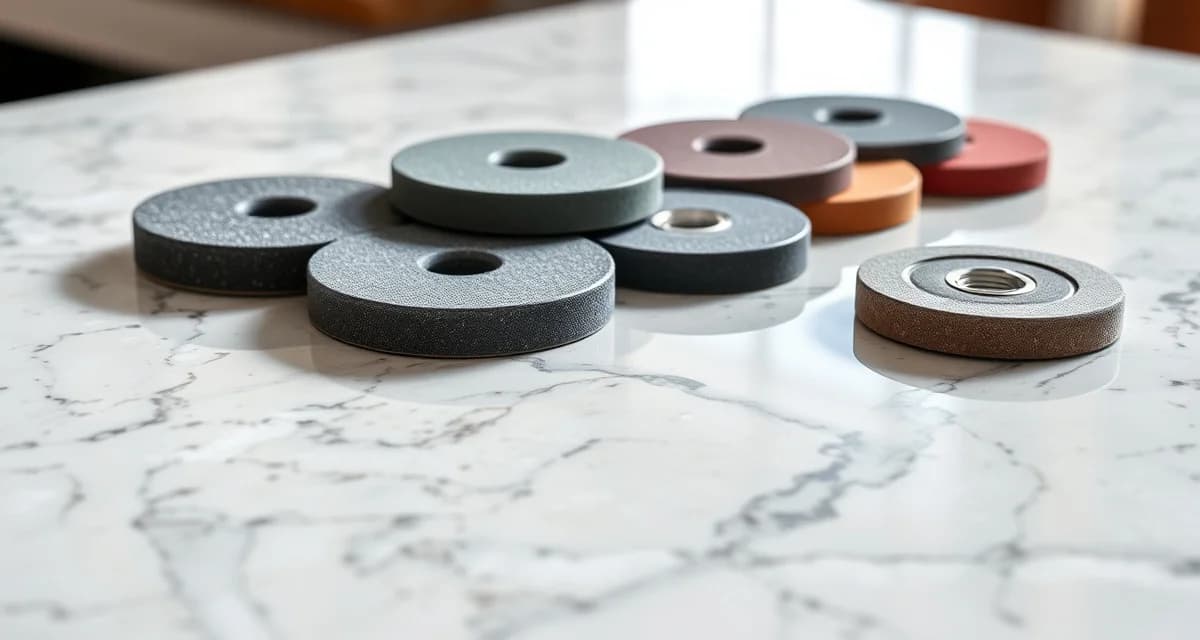
How Are Countertops Polished?
Stone countertops are polished through a multi-step abrasive process that progressively smooths the surface from rough to mirror-like. The process starts with coarse diamond pads (50-100 grit) and works through increasingly fine grits (200, 400, 800, 1500, 3000+) until the stone reaches the desired finish. Most slabs arrive at the fabrication shop already polished on the top face, so fabricators primarily polish cut edges, sink cutout edges, and any areas that need refinishing.
TL;DR
- Polishing uses progressive diamond abrasive pads from coarse (50 grit) to fine (3000+ grit)
- Most slab surfaces come pre-polished from the quarry or distributor
- Fabricators polish cut edges, sink cutouts, and edge profiles
- A polished finish requires 6-8 grit steps and takes 10-20 minutes per linear foot
- Honed (matte) finishes stop at 200-400 grit
- Leathered finishes add texture after the honing step
- Engineered quartz is polished at the factory and rarely needs additional polishing
The Polishing Process: Step by Step
Step 1: Shaping (Before Polishing)
Before any polishing begins, the stone edge or surface must be shaped to its final profile. For edge profiles (bullnose, ogee, bevel, etc.), this is done with a CNC router or hand-held profile wheel. The shaped surface is rough after this step - typically equivalent to 30-50 grit.
Calculate your material waste savings
See exactly how much slab material and money you could save with optimized cutting layouts.
Try the free Waste CalculatorStep 2: Coarse Grinding (50-100 Grit)
The first polishing step removes the marks left by cutting and shaping tools. Coarse diamond pads grind down high spots and create a uniformly scratched surface. The stone looks dull and scratchy at this stage.
Step 3: Medium Grinding (200 Grit)
Finer abrasives begin removing the scratches left by the coarse pads. The surface starts to feel smoother but still has a matte appearance.
Step 4: Fine Grinding (400 Grit)
At this point, the surface is smooth to the touch. A slight sheen begins to appear on some stones, particularly darker granites and marbles.
Step 5: Pre-Polish (800 Grit)
The scratch pattern becomes so fine it's barely visible. The stone starts showing noticeable shine. Many honed finishes stop around this grit or slightly below.
Step 6: Polish (1500 Grit)
True polish begins. The surface reflects light and shows the full color depth of the stone. Most commercial polishing stops here for standard polished finishes.
Step 7: High Polish (3000+ Grit)
For a mirror-like finish, additional steps with 3000 grit and sometimes higher (up to 8000+ for some marbles) produce maximum reflectivity. This level of polish is common on high-end marble installations.
Full Grit Progression Table
| Grit Level | Surface Appearance | Typical Use |
|---|---|---|
| 50 | Rough, heavy scratches | Initial shaping |
| 100 | Coarse scratches, flat | First grinding step |
| 200 | Fine scratches, matte | Honed finish (low end) |
| 400 | Smooth, slight sheen | Honed finish (standard) |
| 800 | Very smooth, partial shine | Semi-polished or pre-polish |
| 1500 | Reflective, full color | Standard polished finish |
| 3000 | Mirror-like, deep color | High polish |
| 8000+ | Maximum reflectivity | Premium marble finish |
Polishing Methods
CNC Polishing
Modern CNC machines with polishing attachments can polish edges automatically. The machine cycles through pad grits while moving along the edge at a controlled speed. This produces consistent results and is faster than hand polishing.
Speed: 3-8 linear feet per minute per grit step Consistency: Very high - machine maintains constant pressure and speed Limitation: Limited to profiles the machine can reach
Hand Polishing
A fabricator uses a variable-speed angle grinder or polisher fitted with diamond polishing pads. Each grit pad is used in sequence, with the fabricator checking progress between steps.
Speed: 1-3 linear feet per minute per grit step Consistency: Depends on operator skill Advantage: Can reach areas CNC machines can't - tight corners, sink cutout interiors, field repairs
Wet vs. Dry Polishing
| Method | Advantages | Disadvantages |
|---|---|---|
| Wet polishing | Less dust, cooler grinding, longer pad life | Water management needed, messier |
| Dry polishing | Portable, less cleanup, faster setup | More dust (requires respirator), pads wear faster, risk of overheating |
Most shop work is done wet. On-site touch-ups may use dry polishing with proper dust control.
Different Finish Types
Not every countertop is polished to a shine. Here are the main finish options:
Polished
The most popular finish. Smooth, reflective surface that brings out the full color and pattern of the stone. Achieved through the complete grit progression up to 1500-3000+ grit.
Best for: Granite, marble, quartz, quartzite Maintenance: Shows water spots and fingerprints more easily Durability: The smooth surface resists staining because pores are partially closed during polishing
Honed
A matte, smooth finish with no shine. Achieved by stopping the polishing process at 200-400 grit. Very popular in contemporary and farmhouse-style kitchens.
Best for: Marble, limestone, granite Maintenance: Hides water spots and fingerprints better than polished Note: More porous than polished, so it may need more frequent sealing (natural stones only)
Leathered
A textured, matte finish created by running a special texturing tool over a honed surface. The result has a soft, slightly bumpy feel - like leather.
Best for: Granite, quartzite Maintenance: Very good at hiding fingerprints and water marks Note: The texture can make cleaning slightly more effort
Brushed
Similar to leathered but with a slightly softer texture. Created with softer brushing wheels that roughen the surface without deep texturing.
Flamed
A rough, anti-slip finish created by applying extreme heat (for natural stone) or mechanical texturing. Rarely used on indoor countertops but common for outdoor kitchen surfaces.
What Fabricators Actually Polish
Since slabs arrive with their top face already polished (or honed, per order), the fabrication shop's polishing work focuses on:
Edge Profiles
Every exposed edge needs polishing. This is the most time-consuming polishing task. A standard eased edge on a kitchen might have 20-30 linear feet of edge to polish. More complex profiles (ogee, bullnose) require more polishing time because of the curved surfaces.
Sink Cutout Edges
For undermount sinks, the inner edge of the cutout is visible and needs to be polished. This is a relatively small area (typically 6-10 linear feet) but requires careful work due to the confined space and corner radii.
Seam Preparation
Where two pieces meet at a seam, the mating edges need to be flat and smooth. While not polished to a shine (they'll be hidden by epoxy), they need to be ground flat to ensure a tight joint.
Backsplash Edges
If a stone backsplash is included, its top edge and any exposed side edges need polishing.
The Cost of Polishing
Polishing adds time and cost to fabrication:
| Polish Type | Time per Linear Foot | Additional Cost per Linear Foot |
|---|---|---|
| Eased edge (simple) | 3-5 minutes | $0-$5 (often included) |
| Beveled edge | 5-8 minutes | $5-$10 |
| Bullnose | 8-12 minutes | $10-$20 |
| Ogee | 12-18 minutes | $15-$30 |
| Dupont | 15-20 minutes | $20-$35 |
| Mitered edge | 10-15 minutes | $30-$50 |
For a standard kitchen with 25 linear feet of edge, choosing a simple eased edge vs. an ogee profile could mean a price difference of $375-$625.
FAQ
Are countertop slabs polished before or after cutting?
The slab face is polished at the quarry or processing facility before it reaches the fabrication shop. The fabricator polishes cut edges, sink cutouts, and edge profiles after cutting.
How long does edge polishing take?
A simple eased edge takes 3-5 minutes per linear foot. Complex profiles like ogee or dupont take 12-20 minutes per foot. A full kitchen edge typically takes 1-3 hours.
Can I change my countertop from polished to honed after installation?
Technically yes, but it's a significant project. The entire surface would need to be sanded down on-site - messy, time-consuming, and expensive ($15-$30 per square foot).
Why does my polished granite have dull spots?
Dull spots usually indicate etching (acid damage), wear, or improper sealing. On granite, this is less common than on marble. A stone restoration professional can re-polish affected areas.
How are quartz countertops polished?
Engineered quartz is polished at the factory during manufacturing. The resin binder in quartz makes it respond differently to polishing than natural stone. Fabricators don't typically need to polish the face - only cut edges.
Do polished countertops need sealing?
Engineered quartz does not need sealing. Natural stone countertops with a polished finish are less porous than honed, but most granite and marble still benefit from periodic sealing (every 1-2 years for granite, more frequently for marble).
What's the difference between polished and glossy?
In the countertop world, these terms are essentially interchangeable. "Polished" refers to the specific abrasive process, while "glossy" describes the visual result.
Can scratches in polished stone be fixed?
Minor surface scratches can often be buffed out using fine-grit polishing pads. Deeper scratches may require starting at a coarser grit and working back up through the polishing sequence.
Is a honed finish more expensive than polished?
Sometimes. Honed slabs from the distributor cost the same, but honed edges at the fabrication level can cost slightly more because the matte finish requires more careful workmanship to look uniform.
How do fabricators polish inside sink cutouts?
Using small hand-held polishers or flexible pad holders that fit inside the cutout radius. CNC machines with articulating heads can also reach inside cutouts on some systems.
Precision Fabrication Starts with Accurate Data
SlabWise helps fabrication shops catch errors before they reach the polishing stage - because re-polishing a remade piece doubles the time and cost. AI Template Verification and Smart Nesting reduce remakes and waste. Try it free for 14 days at slabwise.com.
Try These Free Tools
- Nesting Optimizer -- AI-powered slab layout that maximizes yield considering vein direction and defects.
- Defect Mapping -- Upload a slab photo and AI maps every fissure, pit, and color issue.
- Value Engineering -- Find dollar-quantified suggestions to save material without cutting margin.