Can You Install a New Countertop Over an Existing One?
Quick Answer
In some cases, yes - but it depends on the existing countertop material, its condition, and what you want to install on top. Thin porcelain slabs, solid surface overlays, and some engineered stone systems are specifically designed for over-existing installation. However, you cannot place standard 3cm granite or quartz slabs over existing countertops without removing the old surface first. The added weight, height, and structural concerns make full overlay impractical for most traditional stone installations.
TL;DR
- Thin overlay products (6mm-12mm) can go over existing countertops in many cases
- Standard 3cm granite/quartz slabs require removing the old countertop first
- The existing surface must be level, structurally sound, and firmly attached to cabinets
- Overlay installation saves on demolition costs ($300-$800 savings) and is faster
- Total countertop height increases by the overlay thickness - this affects sink, faucet, and appliance fit
- Not all cabinets can handle the extra weight of a second layer
- Full removal and replacement is the better option for most kitchen renovations
When Overlay Installation Works
Thin Porcelain Slabs
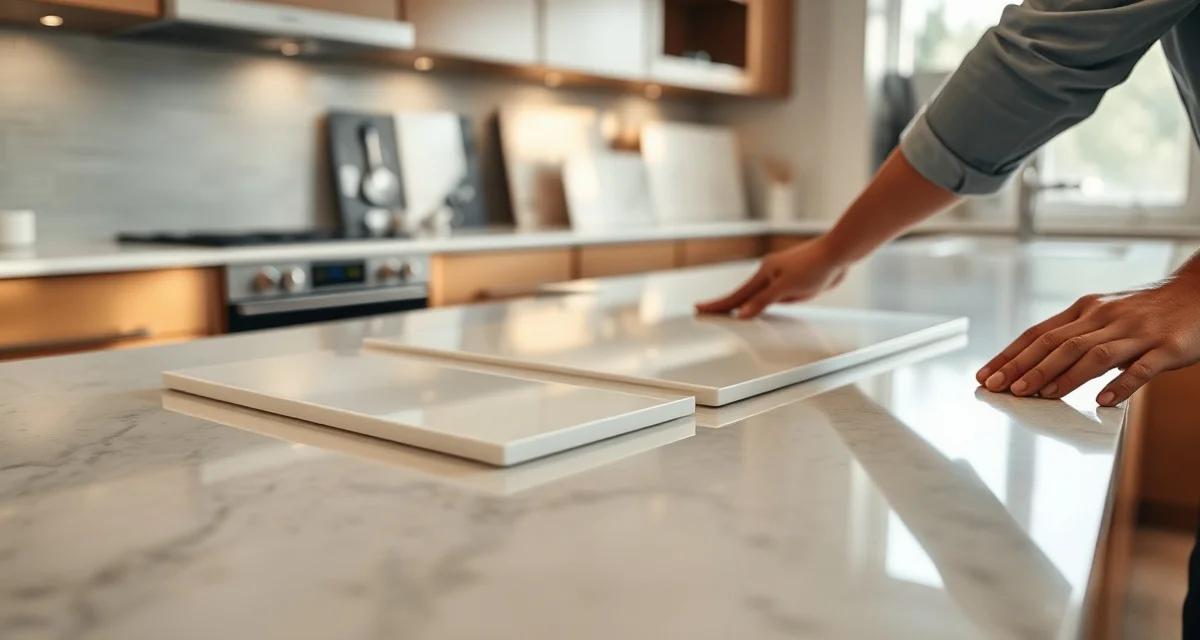
Porcelain slabs in 6mm (1/4 inch) or 12mm (1/2 inch) thickness are the most common overlay material. They're specifically engineered for over-existing applications. At 6mm, a porcelain overlay adds minimal height and weight.
Calculate your material waste savings
See exactly how much slab material and money you could save with optimized cutting layouts.
Try the free Waste CalculatorWorks well over: Laminate, solid surface, tile, and existing stone (if level and in good condition).
Solid Surface Overlays
Some solid surface manufacturers offer thin overlay sheets (6mm-12mm) that bond directly to existing countertops. These are more common in commercial applications like hotel renovations where speed matters.
Engineered Overlay Systems
A few manufacturers produce engineered stone systems designed as overlays, typically 10mm-15mm thick. These include a substrate layer that bonds to the existing countertop.
When Overlay Installation Doesn't Work
Standard 3cm Stone Slabs
You cannot install a standard 3cm (1.2 inch) granite or quartz slab over an existing countertop. Here's why:
| Problem | Details |
|---|---|
| Weight | A 3cm slab adds 18-25 lbs per square foot. Cabinets designed for a single countertop layer may not handle double the weight. |
| Height | Adding 1.2 inches raises the countertop well above standard 36-inch counter height. Sink, faucet, and cooktop alignment is thrown off. |
| Undermount sinks | Impossible with a double layer - the sink would need to mount to the bottom layer while the top layer sits above it |
| Structural gaps | Any void, dip, or unevenness in the existing countertop transfers to the new slab, causing stress cracks |
Damaged or Uneven Existing Surfaces
If the existing countertop is warped, delaminating, water-damaged, or loose on the cabinets, an overlay will inherit all those problems. The existing surface must be:
- Firmly attached to the cabinets
- Level within 1/8 inch over any 10-foot span
- Free of soft spots, water damage, or rot
- Structurally capable of supporting additional weight
Tile Countertops (With Caveats)
Tile countertops can sometimes receive an overlay, but the grout lines create an uneven surface. If the tile is not perfectly flat, those ridges and dips will telegraph through thin overlay material. The tile must be leveled with a skim coat before the overlay is applied.
Cost Comparison: Overlay vs. Full Replacement
For a typical 40 sq ft kitchen:
| Cost Category | Overlay (Porcelain 6mm) | Full Replacement (3cm Quartz) |
|---|---|---|
| Demolition/removal | $0 (old stays) | $300-$800 |
| Material | $1,600-$3,200 | $2,000-$4,800 |
| Fabrication | $800-$1,600 | $1,200-$2,400 |
| Installation | $600-$1,200 | $800-$1,600 |
| Plumbing adjustments | $100-$300 | $200-$400 |
| Total | $3,100-$6,300 | $4,500-$10,000 |
Overlay saves roughly 25-40% compared to full replacement. But the material options are more limited, and the final result may not match the feel and appearance of a full-thickness stone countertop.
The Overlay Installation Process
Step 1: Assessment
The fabricator evaluates the existing countertop for:
- Level and flatness
- Structural integrity
- Cabinet condition underneath
- Sink and appliance clearances
- Edge conditions
Step 2: Surface Preparation
The existing surface is cleaned thoroughly. For tile, a leveling compound fills grout lines. For laminate, the surface is lightly sanded to improve adhesive bonding. Any loose areas are secured.
Step 3: Templating
Just like a standard countertop installation, the fabricator templates the kitchen. The template accounts for the existing countertop dimensions and any edge buildup that will be applied.
Step 4: Fabrication
The overlay material is cut to the template specifications. Sink and cooktop cutouts are made. Edge treatments are applied - though options may be limited with thin material.
Step 5: Installation
The overlay is bonded to the existing countertop using construction adhesive or thin-set mortar (for porcelain). Seams are treated with color-matched adhesive. Edges may receive a buildup strip to create a thicker appearance.
Step 6: Finishing
Plumbing connections are adjusted for the new height. Sink is remounted. Backsplash gap is addressed (the overlay may leave a gap between the new surface and the backsplash).
Height and Clearance Concerns
Adding any overlay increases your countertop height. Here's how that affects your kitchen:
Standard counter height: 36 inches (from floor to top of countertop)
| Overlay Thickness | New Counter Height | Impact |
|---|---|---|
| 6mm (1/4") | 36.25 inches | Minimal - usually no issues |
| 12mm (1/2") | 36.5 inches | May need faucet adjustment; sink mounting depth decreases |
| 15mm (5/8") | 36.6 inches | Noticeable height increase; appliance fit should be checked |
| 20mm (3/4") | 36.75 inches | Significant - may conflict with window sills, appliances |
Even 1/4 inch matters for:
- Dishwasher clearance - if the dishwasher was already a tight fit, adding height could prevent it from sliding out
- Slide-in range fit - range tops are designed for 36-inch counter height
- ADA compliance - if the kitchen must meet ADA standards, height increases may be a problem
Pros and Cons of Overlay Installation
Advantages
- No demolition - saves $300-$800 and avoids the mess of removal
- Faster timeline - install day is quicker without demo
- Less disruption - kitchen is out of service for a shorter period
- Cost savings - 25-40% less than full replacement
- Less waste - old countertop stays in place instead of going to the landfill
Disadvantages
- Limited material options - you're restricted to thin overlay products
- Height increase - even small increases can cause problems with appliances and sinks
- Edge profile limitations - thin materials can't accommodate many edge profiles
- Hides problems - covering a damaged countertop or rotten substrate without fixing it leads to bigger problems later
- Resale perception - some buyers see overlay as a shortcut rather than a quality renovation
- Undermount sink limitations - existing undermount sinks may need to be converted to drop-in
When to Just Replace
Full removal and replacement is the better choice when:
- You want standard 3cm granite, quartz, or marble
- The existing countertop is damaged, warped, or water-logged
- You're changing the kitchen layout (adding an island, extending a peninsula)
- The cabinets need repair or replacement
- You want undermount sinks on a new countertop
- You're doing a full kitchen remodel
In most whole-kitchen renovations, full replacement is worth the extra cost. The result is cleaner, more durable, and gives you full freedom in material, edge profile, and sink style.
Can I put granite over laminate countertops?
Not standard 3cm granite. The weight (18-22 lbs/sq ft) is too much for most laminate substrates and cabinets. Thin granite overlay products (10-12mm) exist but are less common than porcelain overlays.
Can I put quartz over existing granite?
Technically possible with thin engineered quartz overlay products, but rarely done. The cost of a thin quartz overlay approaches the cost of just removing the granite and installing new quartz, with a better result.
Will my sink still work with an overlay?
Drop-in sinks usually work fine - the overlay is cut around the existing sink opening. Undermount sinks are trickier. The overlay adds depth between the sink rim and the new countertop surface, which may require sink replacement or modified mounting.
How long does overlay installation take?
Typically one day for templating and one day for installation - similar to standard countertop replacement but without the demolition day. Total project time from templating to completion is usually 5-10 business days.
Does overlay void my existing countertop warranty?
Often yes. Applying adhesive and material over the existing surface typically voids the manufacturer's warranty on the original countertop. Check your warranty terms before proceeding.
Is a countertop overlay as durable as full-thickness stone?
Thin overlay materials are durable surfaces, but they're not as impact-resistant as 3cm stone. A heavy pot dropped on a 6mm porcelain overlay is more likely to crack it than the same impact on 3cm quartz. For normal daily kitchen use, overlay durability is adequate.
Can I do a countertop overlay myself?
Porcelain overlays require professional cutting and bonding equipment. Solid surface overlays require specialized adhesives and clamping. This is not a typical DIY project - professional fabrication and installation are recommended.
How much does overlay installation cost?
For a typical 40 sq ft kitchen, expect $3,100-$6,300 for porcelain overlay including fabrication and installation. That's 25-40% less than full replacement with 3cm stone.
Get an Accurate Quote Faster
Whether you're quoting an overlay job or a full replacement, SlabWise's Quick Quote tool lets fabricators generate accurate estimates in about 3 minutes instead of 20. Faster quotes mean more bids sent and more jobs won.
Start your 14-day free trial to simplify your quoting process.
Try These Free Tools
- Cost Calculator -- Get instant countertop cost estimates by material, edge profile, and square footage.
- Compare Materials -- Side-by-side material comparison with pricing, durability, and maintenance ratings.
- Edge Profile Selector -- Browse edge profiles with cost impact and visual previews.
Sources & Further Reading
- Natural Stone Institute - Stone Thickness Guidelines
- International Surface Fabricators Association - Countertop Specifications
- National Kitchen & Bath Association - Countertop Installation Standards
- ASTM International - Standard Test Methods for Stone Thickness