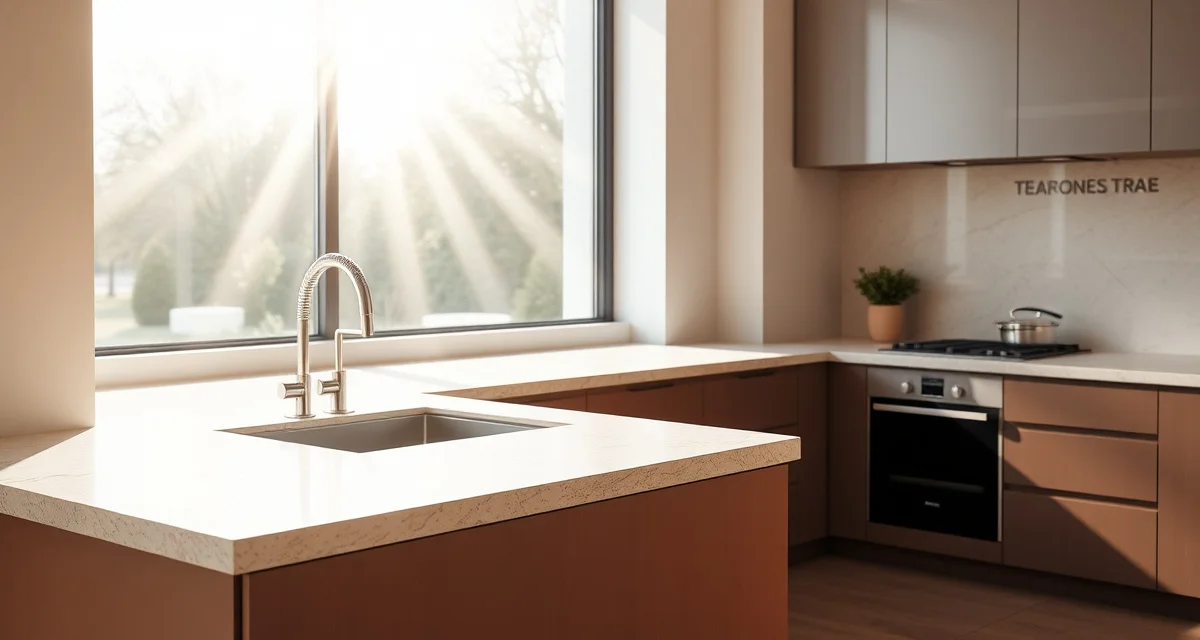
Countertop Near Window: Will UV Damage Your Countertop?
Quick Answer
Placing a countertop near window requires understanding material limitations.
It depends entirely on the material. Quartz is the most vulnerable - the polymer resin binder can yellow, warp, or discolor with prolonged direct sunlight exposure. Granite, marble, and quartzite are essentially UV-proof - natural stone doesn't degrade from sunlight. Porcelain is also UV-stable. If your countertop sits directly in front of a south-facing or west-facing window that gets hours of direct sun daily, material choice matters significantly.
TL;DR
- Quartz is the material most affected by UV - it can yellow, fade, or warp
- Natural stone (granite, marble, quartzite) handles direct sunlight with no issues
- Porcelain/sintered stone is UV-stable and won't change color
- Solid surface (Corian) can also discolor with extended sun exposure
- South-facing and west-facing windows deliver the most UV exposure
- UV-protective window film can reduce damage for about $8-$15 per square foot
- Lighter quartz colors show UV yellowing more than darker colors
UV Vulnerability by Material
| Material | UV Resistance | What Happens With Extended Sun Exposure |
|---|---|---|
| Granite | Excellent | No change - mineral composition is UV-stable |
| Marble | Excellent | No change - natural calcium carbonate is UV-stable |
| Quartzite | Excellent | No change - metamorphic structure handles UV |
| Soapstone | Excellent | No change - natural darkening (patina) continues regardless of sun |
| Porcelain / sintered stone | Excellent | No change - color is fired in at 2,200°F+ |
| Quartz (engineered) | Poor | Yellowing, fading, potential warping with prolonged exposure |
| Solid surface (Corian) | Moderate | Can fade or yellow, though less than quartz |
| Butcher block | Moderate | Lightens or darkens depending on species; drying and cracking possible |
| Laminate | Moderate | Color fading over years of direct exposure |
| Concrete | Good | Minimal color change; sealant may degrade faster in sun |
Why Quartz Is Vulnerable to UV
Quartz countertops are 90-95% ground natural quartz - which is UV-stable on its own. The problem is the 5-10% polymer resin binder that holds the quartz particles together. This resin:
Calculate your material waste savings
See exactly how much slab material and money you could save with optimized cutting layouts.
Try the free Waste Calculator- Yellows when exposed to UV radiation over time
- Can warp under prolonged heat from direct sunlight (especially darker colors that absorb more heat)
- May change texture slightly in sun-exposed areas vs. shaded areas
The damage isn't immediate. It typically takes 6-12 months of daily direct sunlight (4+ hours per day) before yellowing becomes noticeable. The severity depends on:
- Quartz brand and resin quality - higher-quality resins resist UV better
- Color - white and light-colored quartz shows yellowing most obviously
- Exposure duration - intermittent sunlight is less damaging than constant
- UV intensity - Southern US states and high-altitude locations have stronger UV
How the Damage Appears
- Yellowing: White and cream quartz develops a yellowish tint in sun-exposed areas
- Uneven color: The sun-exposed section looks different from shaded sections
- Fading: Darker quartz colors may lighten in areas of prolonged exposure
- Texture change: The surface may feel slightly different (rougher or stickier) in damaged areas
Once UV damage occurs in quartz, it's not reversible. The resin has chemically changed. The only fix is replacing the affected section or the entire countertop.
Which Window Orientations Are Risky?
Not all windows deliver equal UV exposure.
| Window Orientation | UV Risk Level | Daily Direct Sun (Summer) | Notes |
|---|---|---|---|
| South-facing | High | 6-10 hours | Maximum year-round sun exposure |
| West-facing | High | 4-6 hours | Intense afternoon sun; hottest UV |
| East-facing | Moderate | 3-5 hours | Morning sun - less intense but still significant |
| North-facing | Low | 0-2 hours | Minimal direct sun; mostly ambient light |
Skylights above a countertop area are also high-risk, as they deliver direct overhead sun that's harder to block with window treatments.
Geographic Factors
UV intensity varies by location:
- Southern US (Florida, Texas, Arizona): Higher UV index year-round
- High altitude (Denver, Salt Lake City): UV increases roughly 10% per 1,000 feet of elevation
- Northern US: Lower UV intensity, but summer sun through south-facing windows can still cause damage over years
Protection Options
Window Film
UV-blocking window film is the most cost-effective protection. Modern window films block 99% of UV radiation while still allowing visible light through.
| Film Type | UV Blocked | Visible Light Transmission | Cost |
|---|---|---|---|
| Clear UV film | 99% | 70-80% | $8-$12/sq ft installed |
| Tinted film | 99% | 40-60% | $10-$15/sq ft installed |
| Low-E film | 99% | 50-70% | $12-$18/sq ft installed |
For a standard 3x5 foot window, professional installation runs $120-$270.
Window Treatments
- UV-blocking shades or blinds: Close them during peak sun hours
- Sheer curtains: Reduce UV significantly without eliminating natural light
- Plantation shutters: Adjustable slats let you control sun angle
Countertop Covers
Not practical for daily use, but some homeowners cover the sun-exposed portion of the countertop with a decorative runner or mat during peak sun hours.
Material Selection
The simplest protection is choosing a UV-resistant material for countertops near windows:
- Granite or quartzite for natural stone lovers
- Porcelain for a modern look with zero UV concern
- Marble if the aesthetic calls for it
What Quartz Manufacturers Say
Most quartz manufacturers include UV disclaimers in their warranties. Common language:
- "Not recommended for outdoor use or areas of prolonged direct sunlight"
- "UV damage is not covered under warranty"
- "Interior use only - avoid extended exposure to direct sunlight"
If a quartz countertop yellows or warps from sun exposure, the manufacturer's warranty will not cover the damage in most cases. This is a known limitation of the material, and it's documented in the warranty terms.
Brands With Better UV Performance
Some quartz brands have improved their resin formulations for better UV resistance. However, no quartz manufacturer currently claims full UV stability. If sun exposure is a concern, quartz remains a riskier choice than natural stone or porcelain regardless of brand.
Real-World Scenarios
Scenario 1: Kitchen Counter Under a South-Facing Window
A white quartz countertop directly below a large south-facing window in Phoenix, AZ. After 8 months, the 2-foot section closest to the window has yellowed noticeably. The rest of the countertop is still bright white. Replacement cost for the affected section: $800-$1,500.
Better choice: White granite or porcelain - same bright aesthetic, no UV risk.
Scenario 2: Bathroom Vanity Near a Skylight
Quartz vanity in a bathroom with a skylight. The vanity receives 3-4 hours of direct overhead sun daily. After 14 months, the surface has developed an uneven yellow tone. The warranty claim was denied - UV damage exclusion.
Better choice: Marble (natural for a bathroom setting) or porcelain.
Scenario 3: Kitchen Island With Intermittent Sun
Quartz kitchen island that gets dappled sunlight through a nearby east-facing window for about 2 hours in the morning. After 3 years, no visible damage. The exposure is brief and the sun intensity is lower in the morning.
Verdict: Low-risk scenario - quartz is fine for brief, indirect exposure.
Can UV Damage Be Repaired?
For quartz: No. The resin has undergone a chemical change. The yellowed or discolored area cannot be polished, buffed, or treated back to its original color. The only solution is section replacement or full countertop replacement.
For solid surface (Corian): Sometimes. Light UV discoloration can sometimes be sanded and buffed out, since solid surface material is consistent throughout its thickness.
For butcher block: Yes. Sun-lightened or darkened wood can be sanded back and refinished. The new surface will be the wood's natural color.
Will my quartz countertop yellow near a window?
It depends on exposure. Brief, indirect sunlight (1-2 hours of morning sun through an east window) is usually fine. Extended direct sunlight (4+ hours through south or west windows) can cause yellowing within 6-18 months, especially on white or light-colored quartz.
Does granite fade in the sun?
No. Granite's mineral composition is naturally UV-stable. The color won't fade, yellow, or change from sun exposure. This is one reason granite remains popular for outdoor kitchens and sunlit kitchen areas.
Is UV window film worth installing?
If you have quartz countertops near a south or west window with significant sun exposure, yes. At $120-$270 per window, it's far cheaper than replacing a UV-damaged countertop ($800-$4,000+).
Will low-E windows protect my countertop?
Low-E glass blocks a significant portion of UV and infrared radiation. Homes with modern low-E windows have lower UV risk, but they don't block 100% of UV. For high-exposure situations with quartz, adding UV window film provides an extra layer of protection.
Can I use quartz in a sunroom?
It's not recommended. Sunrooms typically have extensive glass and high UV exposure. Natural stone, porcelain, or solid surface with UV-blocking window treatments are better choices for sunroom countertops.
Does laminate fade in the sun?
Over several years, yes. Direct sunlight can fade laminate countertop colors, especially darker tones. The fading is gradual and usually takes 3-5+ years to become noticeable.
How quickly does quartz yellow from sunlight?
Noticeable yellowing typically appears after 6-18 months of daily direct exposure (4+ hours). The timeline depends on UV intensity, quartz brand, and color. White and cream colors show changes first.
Will a window treatment fully protect my quartz?
If you consistently close blinds or shades during peak sun hours, you can prevent most UV damage. The key word is "consistently" - intermittent protection still allows cumulative UV exposure over time.
Help Homeowners Choose the Right Material
For fabricators, educating customers about UV sensitivity during the quoting process prevents unhappy callbacks later. SlabWise's Customer Portal lets you share material guidance, quotes, and project updates with homeowners - reducing the back-and-forth phone calls that eat into your day.
Start your 14-day free trial to give your customers a better experience.
Try These Free Tools
- Cost Calculator -- Get instant countertop cost estimates by material, edge profile, and square footage.
- Compare Materials -- Side-by-side material comparison with pricing, durability, and maintenance ratings.
- Edge Profile Selector -- Browse edge profiles with cost impact and visual previews.
Sources & Further Reading
- Natural Stone Institute - Stone Thickness Guidelines
- International Surface Fabricators Association - Countertop Specifications
- National Kitchen & Bath Association - Countertop Installation Standards
- ASTM International - Standard Test Methods for Stone Thickness