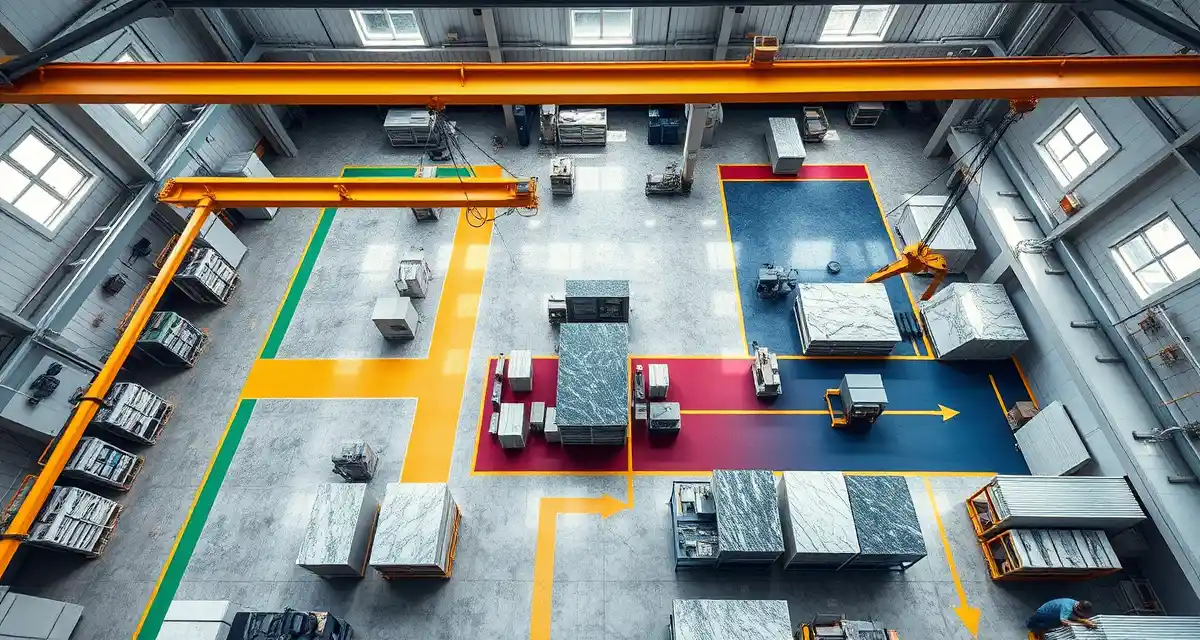
Shop Layout Design for Countertop Fabrication
A poorly designed shop layout costs you 15-25% of your production capacity without you realizing it. Every extra slab move, every bottleneck at the saw, every time a fabricator walks 50 feet to grab a tool - that's money and time evaporating. This guide covers how to design a workflow-driven layout that gets the most out of your square footage.
TL;DR
- Organize your shop into 5 zones: receiving/storage, cutting, fabrication/finishing, staging/QC, and loading
- Material should flow in one direction through the shop - no backtracking
- Allow 800-1,200 sq ft per major piece of equipment for proper clearance and workflow
- Slab storage needs 30-40% of your total floor space
- Overhead crane coverage should reach every work station
- Safety clearances are non-negotiable: 36" around electrical panels, 48" walking paths, 28" minimum between A-frames
- A well-planned 5,000 sq ft shop can outproduce a disorganized 8,000 sq ft shop
The Five Production Zones
Every fabrication shop needs five distinct zones, arranged so material flows from receiving to shipping without doubling back.
Calculate your material waste savings
See exactly how much slab material and money you could save with optimized cutting layouts.
Try the free Waste CalculatorZone 1: Receiving and Slab Storage
Purpose: Offload incoming slabs, store inventory, and stage material for production.
Space allocation: 30-40% of total shop area. This seems like a lot, but slab storage is space-intensive. Each A-frame rack holds 15-20 slabs and has a footprint of approximately 10' x 4' (plus access space on both sides).
Layout requirements:
- Direct access to loading dock or drive-in bay
- Overhead crane coverage for the entire storage area
- Minimum 48" aisles between A-frame rows for safe slab access
- Floor must support concentrated loads (15,000-20,000 lbs per loaded A-frame)
- Slab photography station near the entry (if you photograph slabs for customer selection)
- A-frames angled at 5-10 degrees from vertical, bolted or weighted against tipping
Storage capacity planning:
| Shop Size | A-Frame Racks | Slab Capacity | Storage Area |
|---|---|---|---|
| Small (3,000 sq ft) | 5-8 | 75-160 slabs | 1,000-1,200 sq ft |
| Medium (5,000-8,000 sq ft) | 10-20 | 150-400 slabs | 2,000-3,200 sq ft |
| Large (10,000+ sq ft) | 20-40 | 300-800 slabs | 4,000-6,000 sq ft |
Zone 2: Cutting
Purpose: Primary slab cutting on bridge saw and/or CNC.
Space allocation: 20-25% of total area.
Equipment placement:
| Equipment | Footprint | Clearance Needed | Total Floor Space |
|---|---|---|---|
| Bridge saw | 15' x 12' | 5' each side | 25' x 22' (550 sq ft) |
| CNC router | 20' x 10' | 4' each side + loading | 28' x 18' (504 sq ft) |
| Waterjet (if applicable) | 12' x 8' | 4' each side | 20' x 16' (320 sq ft) |
Key considerations:
- Position the bridge saw so the overhead crane can load slabs directly onto the saw table
- CNC machines need unobstructed access on the loading side for slab feed
- Water drainage is critical - slope the floor 1/8" per foot toward drains
- Locate the water recycling system adjacent to cutting equipment
- Electrical panels for saws and CNC should be within 25 feet of the machines
Zone 3: Fabrication and Finishing
Purpose: Edge polishing, sink cutout finishing, seam prep, and hand work.
Space allocation: 20-25% of total area.
Work station layout:
| Station | Floor Space | Notes |
|---|---|---|
| Edge polishing (inline) | 25' x 8' | Linear workflow; allow 5' on each side |
| Edge polishing (hand) | 8' x 6' per station | Downdraft table recommended |
| Sink cutout finishing | 8' x 6' | Near polishing supplies |
| Seam prep table | 10' x 5' | Flat, level surface required |
| Dry-fit/assembly table | 12' x 8' | For checking piece alignment before install |
Layout rules:
- Finishing stations should flow from the cutting zone - pieces move one direction
- Downdraft ventilation on all hand-polishing stations for dust control
- Tool storage walls or carts within arm's reach of each station
- Good overhead lighting (50-75 foot-candles minimum for detail finishing work)
- Water supply at each wet-polishing station
Zone 4: Quality Check and Staging
Purpose: Final inspection, packaging, and staging for delivery.
Space allocation: 10-15% of total area.
Requirements:
- Flat inspection table large enough for a full countertop set (10' x 5' minimum)
- Good lighting for inspecting edges, surfaces, and sink cutouts
- Packaging materials (foam, blankets, A-frame carts) stored nearby
- Space for 2-3 days of completed jobs awaiting installation
- Clear labeling system linking pieces to job numbers
Zone 5: Loading and Dispatch
Purpose: Load completed pieces onto installation trucks.
Space allocation: 5-10% of total area.
Requirements:
- Direct access to exterior (truck parking)
- Overhead crane or forklift access to loading area
- Space for A-frame transport carts
- Weather protection (covered loading dock or interior bay preferred)
- Clear of obstructions for truck maneuvering
Workflow Flow Patterns
Linear Flow (Recommended)
Material enters one end of the shop and exits the other, passing through each zone in sequence:
Receiving → Storage → Cutting → Finishing → QC/Staging → Loading
This is the most efficient pattern because:
- No backtracking or cross-traffic
- Clear visual management (you can see where each job is in the process)
- Minimizes crane and forklift travel distance
- Easiest to supervise
Works best in rectangular buildings with docks on opposite ends.
U-Flow
Material enters and exits from the same end of the building:
Receiving/Loading → Storage → Cutting → Finishing → QC/Staging → back to Loading
Advantages:
- Only one loading dock needed
- Keeps receiving and shipping staff in one area
- Works in buildings with limited dock access
Disadvantages:
- Cross-traffic between incoming and outgoing material
- Requires wider aisles to handle two-way movement
L-Flow
Material enters one side and exits an adjacent side:
Receiving (side A) → Storage → Cutting → Finishing → QC/Staging → Loading (side B)
Works in L-shaped buildings or when dock access is on perpendicular walls.
Overhead Crane Planning
The overhead crane is the spine of your shop. Its coverage area determines how efficiently you can move slabs between zones.
Crane Specifications
| Shop Width | Crane Span | Capacity | Estimated Cost |
|---|---|---|---|
| 30-40 ft | 28-38 ft | 2-3 ton | $12,000-$25,000 |
| 40-60 ft | 38-58 ft | 3-5 ton | $20,000-$40,000 |
| 60-80 ft | 58-78 ft | 5-10 ton | $35,000-$70,000 |
Crane Coverage Rules
- The crane should reach every A-frame rack, every saw table, and the loading area
- If your building is too wide for a single crane span, consider two parallel cranes or a gantry system
- Minimum hook height: 14 feet above floor for slab clearance over A-frames
- Crane rail height: typically 2-3 feet below ceiling
- Leave at least 3" clearance between the crane hoist and the building ceiling
When One Crane Isn't Enough
If your shop handles more than 15-20 jobs per week, a single crane becomes a bottleneck. Options:
- Second bridge crane on the same rails (requires anti-collision system)
- Jib cranes at individual work stations for local material movement
- Forklift for moving slabs between A-frames in the storage area (frees the overhead crane for production)
Utility Planning
Electrical
| Circuit | Amperage | Phase | Location |
|---|---|---|---|
| Bridge saw | 30-60A | 3-phase | Zone 2 |
| CNC router | 40-80A | 3-phase | Zone 2 |
| Inline polisher | 20-40A | 3-phase | Zone 3 |
| Overhead crane | 20-30A | 3-phase | Shop-wide |
| Dust collection | 15-30A | Single/3-phase | Zones 2-3 |
| Compressor | 20-40A | 3-phase | Mechanical room |
| Lighting | 20A per circuit | Single phase | Shop-wide |
| Office/break room | 20A per circuit | Single phase | Office area |
Total service: 200-400 amps, 3-phase. Budget $10,000-$50,000 for electrical upgrades if the existing service is inadequate.
Plumbing and Water
- Main supply: 1" or larger water line to support 3-8 GPM continuous flow
- Individual feeds to each cutting machine through PVC or flexible hose
- Floor drains at each wet cutting station, connected to the water treatment system
- Settlement tank and recycling system located near cutting equipment
- Compressed air: 5-10 HP compressor, 3/4" main line, drops at each work station
Drainage
- Floor slope: 1/8" per foot toward drains in all wet areas
- Trench drains preferred along the length of cutting zones
- Never connect stone slurry drainage to the sanitary sewer without treatment
- Water recycling system should be accessible for daily/weekly maintenance
Safety Clearances
These are non-negotiable - they're required by OSHA and building codes:
| Area | Minimum Clearance | Standard |
|---|---|---|
| Walking aisles | 28" (44" recommended) | OSHA 1910.22 |
| Main traffic aisles | 48" minimum | OSHA 1910.176 |
| Electrical panels | 36" front clearance | NEC 110.26 |
| Emergency exits | 28" minimum, unobstructed | OSHA 1910.37 |
| Between A-frame racks | 28" minimum, 48" recommended | OSHA 1910.176 |
| Fire extinguishers | 36" clearance, visible | NFPA 10 |
| Eye wash stations | Unobstructed path, within 10 seconds | ANSI Z358.1 |
| Machine operating areas | Per manufacturer specification | OSHA 1910.212 |
Sample Floor Plans
3,000 sq ft Shop (Startup)
| Zone | Area | Equipment |
|---|---|---|
| Receiving/Storage | 1,200 sq ft | 5 A-frames, photo station |
| Cutting | 800 sq ft | 1 bridge saw |
| Finishing | 500 sq ft | 2 hand-finishing stations |
| QC/Staging | 300 sq ft | 1 inspection table |
| Loading | 200 sq ft | Direct exterior access |
6,000 sq ft Shop (Established)
| Zone | Area | Equipment |
|---|---|---|
| Receiving/Storage | 2,200 sq ft | 12 A-frames, photo station |
| Cutting | 1,500 sq ft | Bridge saw + CNC |
| Finishing | 1,200 sq ft | Inline polisher + 3 hand stations |
| QC/Staging | 600 sq ft | Inspection table + cart storage |
| Loading | 500 sq ft | Covered loading bay |
10,000+ sq ft Shop (High Volume)
| Zone | Area | Equipment |
|---|---|---|
| Receiving/Storage | 4,000 sq ft | 25+ A-frames, forklift access |
| Cutting | 2,500 sq ft | 2 bridge saws + CNC |
| Finishing | 2,000 sq ft | Inline polisher + 4-6 hand stations |
| QC/Staging | 1,000 sq ft | Multiple inspection stations |
| Loading | 500 sq ft | 2 loading bays |
Common Layout Mistakes
Mistake 1: Slab storage too far from the saw. Every extra 20 feet of crane travel adds 1-2 minutes per slab load. Over 20 jobs per day, that's 20-40 minutes of lost production.
Mistake 2: Finishing stations far from cutting. Cut pieces need to move directly to finishing without being set down, picked back up, and moved again. Minimize the distance and the number of handling steps.
Mistake 3: No room for growth. If your layout uses 100% of available space on day one, you have zero room to add equipment, expand storage, or hire more staff. Plan for 70-80% utilization initially.
Mistake 4: Ignoring the office. Your estimating, scheduling, and customer communication happen in the office. Place it where the office manager can see the shop floor and hear the phone. A small showroom area near the entrance helps close retail customers.
Mistake 5: Poor lighting. Fabrication is detail work. Insufficient lighting (below 30 foot-candles) leads to missed defects and quality callbacks. Budget for 50-75 foot-candles in finishing areas and 30-50 in cutting zones.
How much space do I need per employee?
Budget 500-800 sq ft per production employee. A 6-person production team needs 3,000-4,800 sq ft of production space plus storage and office area.
Should I build or lease my shop space?
Lease initially - you need to prove the business before committing to construction. Purpose-built fabrication facilities are ideal but cost $150-$250/sq ft to build. An existing industrial building with adequate power and ceiling height is usually the best starting option.
Can I operate a fab shop in a multi-tenant building?
Yes, but check lease restrictions on noise, water discharge, truck traffic, and operating hours. Some industrial parks restrict wet operations or require specific waste handling. Neighbors may complain about noise from cutting operations (90-100 dB).
How do I handle workflow when the shop is full?
Overflow A-frame racks outside (covered) help when slab inventory exceeds indoor capacity. For production overflow, consider a second shift rather than cramming more equipment into an undersized space.
What's the ROI on a good shop layout vs a poor one?
Shops that redesign from a disorganized layout to a workflow-optimized layout typically report 15-25% increases in production capacity without adding equipment or staff. On $1M annual revenue, that's $150,000-$250,000 in additional capacity.
Should I hire a professional to design my layout?
For shops over 5,000 sq ft, yes. Industrial layout consultants who specialize in stone fabrication charge $3,000-$10,000 for a detailed floor plan. Equipment dealers (Park Industries, Breton) often provide layout assistance as part of a major equipment purchase.
How do I plan for a CNC machine I'll add later?
Reserve 500-600 sq ft in the cutting zone with appropriate electrical conduit roughed in (40-80A, 3-phase). Run compressed air and water lines to the reserved area during initial buildout - retrofitting these utilities later costs 3-5x more.
What flooring is best for a fabrication shop?
Sealed concrete is standard. The floor must be rated for concentrated loads (3,000+ PSI), sloped for drainage in wet areas, and sealed to prevent stone slurry from staining or degrading the surface. Epoxy coatings ($3-$8/sq ft) improve durability and cleanup.
Design Your Shop for Production, Not Just Equipment
The best layout in the world doesn't help if your quoting takes 20 minutes per job and customer calls eat up half your day. SlabWise simplifies the operational side so your production floor can run at the efficiency your layout was designed for.
Start Your 14-Day Free Trial →
Try These Free Tools
- Kitchen Visualizer -- Upload a kitchen photo and preview different countertop materials in place.
- AR Overlay -- See the actual stone pattern on your customer's cabinets using AR.
- Sink Finder -- Search compatible sink models by countertop dimensions and cutout specs.
Sources & Further Reading
- Natural Stone Institute - Bathroom Design Guidelines
- National Kitchen & Bath Association - Countertop Selection Guide
- Marble Institute of America - Bathroom Stone Applications
- International Surface Fabricators Association - Residential Bathroom Standards