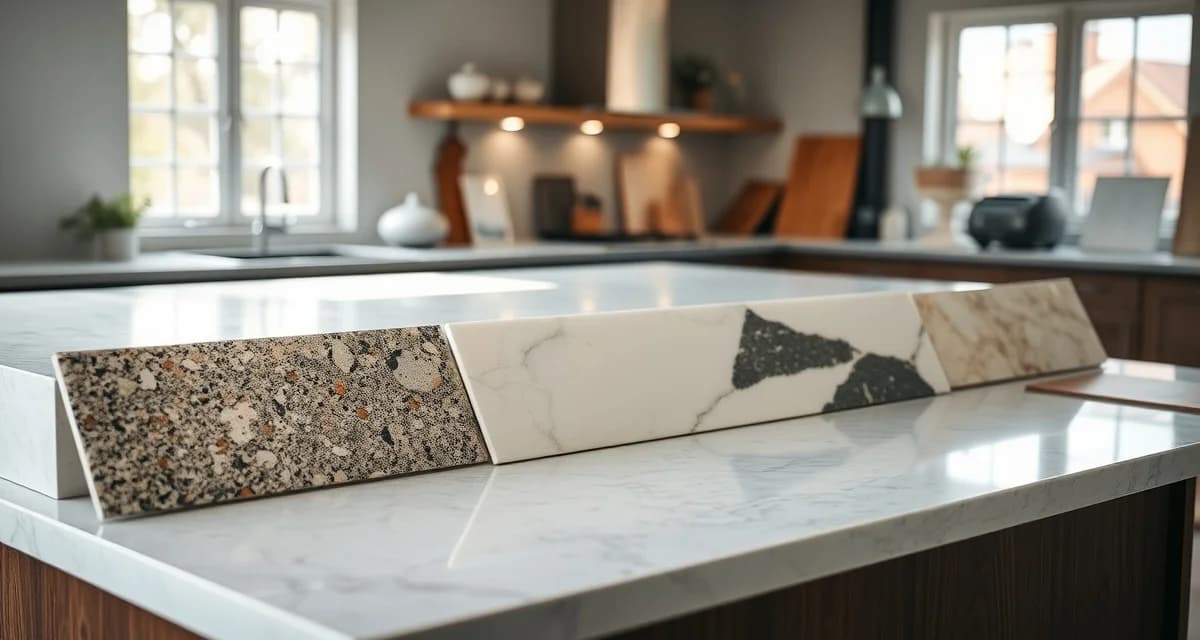
Kitchen Countertop Buying Guide
What Should You Know Before Buying Kitchen Countertops?
Buying new kitchen countertops is one of the biggest decisions in a kitchen renovation - it affects how the room looks, how it functions daily, and how much value it adds to your home. This guide walks you through every step: choosing the right material for your lifestyle, understanding costs, finding a reputable fabricator, and knowing what to expect during the installation process.
TL;DR
- Start with your budget and daily use - these two factors narrow your material choices quickly
- The 5 most popular materials are quartz, granite, marble, quartzite, and solid surface - each with distinct trade-offs
- Visit a showroom to see and touch materials in person before deciding
- Get 3 quotes from local fabricators and compare what is included, not just the bottom line number
- The fabrication process takes 1-3 weeks from template to installation for most projects
- Ask about warranty, sealing, and edge options before signing a contract
- Plan for 10-15% above your estimate for unexpected adjustments and add-ons
Step 1: Define Your Priorities
Before looking at materials, answer these questions about your kitchen:
Calculate your material waste savings
See exactly how much slab material and money you could save with optimized cutting layouts.
Try the free Waste CalculatorHow Do You Use Your Kitchen?
| Usage Level | Best Materials | Materials to Avoid |
|---|---|---|
| Heavy daily cooking, kids, entertaining | Quartz, granite, quartzite | Marble, butcher block (high maintenance) |
| Moderate cooking, careful use | Any material works | - |
| Light use, mostly aesthetic | Marble, concrete, butcher block | - (choose what you love) |
| Baking and pastry making | Marble (cool surface) or quartz | - |
What Is Your Budget?
| Budget Range | Best Material Options | Typical Project (35 sq ft) |
|---|---|---|
| Under $2,000 | Laminate, basic solid surface | Basic kitchen refresh |
| $2,000-$4,000 | Granite (Level 1-2), mid-range quartz | Most common budget range |
| $4,000-$7,000 | Premium quartz, mid-range marble, quartzite | Popular upgrade range |
| $7,000-$12,000 | Exotic granite, premium quartzite, Calacatta marble | High-end renovation |
| $12,000+ | Exotic natural stone, bookmatched slabs, waterfall islands | Luxury projects |
What Look Do You Want?
- Clean and modern: White or gray quartz with a simple edge
- Warm and traditional: Brown or gold granite with an ogee edge
- Dramatic and bold: Veined marble or quartzite with a waterfall edge
- Organic and natural: Soapstone, concrete, or butcher block
- Uniform and consistent: Solid-color quartz or solid surface
Step 2: Understand Your Material Options
Quartz (Engineered Stone)
Quartz countertops are manufactured from roughly 90-95% ground natural quartz mixed with resins and pigments. They are the most popular countertop material in the US for good reason.
Pros: Non-porous (no sealing needed), consistent appearance, wide color range, stain resistant, very durable
Cons: Not heat-proof (can discolor from hot pans), cannot be repaired if chipped, visible seams on some colors, higher cost than basic granite
Price range: $50-$120/sq ft installed
Top brands: Cambria, Silestone, Caesarstone, MSI, Viatera
Granite
Granite is a natural stone quarried from the earth, cut into slabs, and fabricated to fit your kitchen. Every slab is unique.
Pros: Extremely durable, heat resistant, natural beauty with unique patterns, good resale value, wide price range
Cons: Requires periodic sealing (annual for most), some colors are porous, can chip if hit hard, patterns vary slab to slab
Price range: $40-$100/sq ft installed (basic to mid-range); $100-$200+ for exotic
Marble
Marble is a natural stone prized for its distinctive veining and timeless appearance. It is the classic choice for both traditional and contemporary kitchens.
Pros: Unmatched natural beauty, cool surface (great for baking), high-end look, increases home value
Cons: Porous (stains from wine, citrus, oils), scratches easily, requires regular sealing, etches from acidic foods, high maintenance
Price range: $60-$150/sq ft installed (Carrara to Calacatta)
Quartzite
Quartzite is a natural stone formed when sandstone is subjected to heat and pressure. It offers the veined look of marble with much better durability.
Pros: Extremely hard (harder than granite), heat resistant, beautiful veining, better durability than marble
Cons: Expensive, limited color range (mostly whites and grays), still requires sealing, fewer pattern options than quartz
Price range: $70-$150/sq ft installed
Solid Surface (Corian, etc.)
Solid surface is a manufactured material that can be molded into shapes, including integrated sinks and backsplashes.
Pros: No visible seams, can be repaired (scratches sand out), non-porous, integrated sink options, affordable
Cons: Scratches easily, not heat resistant, can look "plastic" compared to stone, limited resale value
Price range: $40-$80/sq ft installed
Laminate
Modern laminate has improved dramatically, with realistic stone and pattern options at the lowest price point.
Pros: Most affordable option, huge variety of patterns, easy to clean, no sealing
Cons: Cannot be repaired if damaged, visible seams, lower resale value, not heat resistant, edges can chip or peel
Price range: $15-$40/sq ft installed
Step 3: Choose Your Edge Profile
The edge profile is the shape of the front edge of your countertop. It significantly affects the look and feel of your kitchen.
| Edge | Style | Cost Impact | Best For |
|---|---|---|---|
| Eased (flat with slight round) | Modern, clean | Included | Contemporary kitchens |
| Beveled | Slightly angled | $5-$10/lin ft | Modern/transitional |
| Half bullnose | Rounded top | $8-$15/lin ft | Versatile, any style |
| Full bullnose | Fully rounded | $10-$20/lin ft | Traditional, soft look |
| Ogee | S-curve profile | $15-$25/lin ft | Traditional, ornate |
| Mitered | Creates thick appearance | $20-$40/lin ft | Modern, dramatic |
| Waterfall | Stone flows down sides | $500-$2,000/side | Statement islands |
Tip: Ask your fabricator to show edge profile samples on actual stone. Photos do not capture how an edge looks and feels in person.
Step 4: Find the Right Fabricator
Your fabricator choice matters as much as your material choice. A great fabricator on a budget material delivers better results than a poor fabricator on premium stone.
What to Look For
- CNC fabrication equipment - Produces tighter seams and more consistent results than manual cutting
- Portfolio of completed work - Ask to see photos of projects similar to yours
- Reviews - 4.5+ stars on Google with 50+ reviews is a good benchmark
- Showroom - A physical location where you can see materials and meet the team
- Clear communication - Do they respond promptly? Explain things clearly?
- Warranty - What do they cover, for how long?
Red Flags
- No physical location or showroom
- Unwilling to provide references
- Asking for 100% payment upfront
- No written contract or scope of work
- Significantly cheaper than all other quotes (may be cutting corners)
- Poor or few online reviews
- Cannot show photos of past work
Questions to Ask Every Fabricator
- What is included in your quote? (Template, fabrication, installation, sink cutout, edge, sealing)
- What edge profiles are available and what do they cost?
- How long from signing the contract to installation?
- Who does the installation - your team or subcontractors?
- What is your warranty?
- How do you handle issues if something goes wrong?
- Can I visit your shop and see the slab before fabrication?
- What is your payment schedule?
Step 5: Understand the Process
The Countertop Installation Timeline
| Step | Timeframe | What Happens |
|---|---|---|
| 1. Consultation/Quote | Day 1-3 | Visit showroom, choose material, get estimate |
| 2. Contract Signing | Day 3-7 | Sign agreement, pay deposit |
| 3. Material Selection | Day 7-14 | Choose your specific slab (for natural stone) |
| 4. Templating | Day 14-21 | Fabricator measures your kitchen precisely |
| 5. Fabrication | 5-10 business days after template | Slab is cut, edged, and polished |
| 6. Installation | 1 day | Countertops are installed and sealed |
| 7. Final Inspection | Same day or next day | Verify everything is correct |
Total timeline: Typically 2-4 weeks from contract to installation. Larger or more complex projects may take longer.
Preparing for Installation Day
- Cabinets must be installed and level before the template visit
- Remove everything from existing countertops and cabinets below
- Disconnect plumbing (sink, dishwasher, garbage disposal) - your plumber or the fabricator handles this
- Clear a path from your front door to the kitchen for the crew and material
- Expect dust and noise - fabricators may do minor cutting on-site for final adjustments
- Plan to be home - someone needs to be present during installation
Step 6: Maintenance Planning
Different materials require different levels of ongoing care:
| Material | Sealing | Daily Cleaning | Special Care |
|---|---|---|---|
| Quartz | None needed | Soap and water | Avoid direct heat |
| Granite | Annual | Soap and water or stone cleaner | Reseal yearly |
| Marble | Every 6-12 months | pH-neutral cleaner only | Avoid acids (lemon, vinegar) |
| Quartzite | Annual | Soap and water or stone cleaner | Reseal yearly |
| Solid Surface | None | Soap and water | Sand out scratches |
| Laminate | None | Any household cleaner | Avoid standing water at seams |
Common Buying Mistakes to Avoid
| Mistake | Why It Matters |
|---|---|
| Choosing material from a small sample | Colors and patterns look different in full-slab size - visit the slab yard |
| Picking based on price alone | The cheapest quote often means lowest quality material or poor installation |
| Not checking the actual slab | For natural stone, every slab is different - approve your specific slab before fabrication |
| Ignoring maintenance requirements | Marble looks beautiful but needs regular care - make sure you are willing |
| Skipping the fabricator research | Your fabricator's skill directly affects how your countertops look and last |
| Not measuring before quoting | Accurate measurements lead to accurate quotes - avoid surprises |
| Forgetting about plumbing | Budget $150-$400 for a plumber to disconnect and reconnect |
FAQ
How long do countertops last?
Granite and quartzite last a lifetime with proper care. Quartz typically lasts 15-25+ years. Marble lasts decades but may need professional refinishing over time. Laminate typically lasts 10-15 years before showing wear.
Can I install countertops myself?
Technically possible for laminate, but not recommended for stone. Stone slabs weigh 400-1,000+ pounds and require specialized equipment, precise fitting, and professional seaming. DIY installation risks cracking the slab and voiding any warranty.
How thick should kitchen countertops be?
Standard thickness is 3cm (approximately 1.25 inches) for most stone countertops. This thickness is structural enough to span standard cabinet widths without support. Some modern designs use 2cm stone with a built-up edge for a thicker appearance.
Should I match my countertop to my cabinets or flooring?
Countertops should complement - not match - your cabinets and flooring. Contrasting tones (light countertops on dark cabinets, or vice versa) create visual interest. Matching everything to the same tone can look flat. Bring cabinet door samples to the showroom when selecting materials.
What is the best countertop material for resale value?
Quartz and granite are the safest choices for resale. Both are universally appealing and expected by buyers in the mid-to-upper price ranges. Marble adds value for luxury homes but may be a concern for buyers worried about maintenance.
Can I put my new countertops on top of existing ones?
Some materials (particularly laminate) can be installed over existing countertops, but this is generally not recommended. It adds height, may not be level, and limits the fabricator's ability to create a proper fit.
How do I choose between quartz and granite?
Choose quartz if you want low maintenance, consistent patterns, and a wide color selection. Choose granite if you want natural stone character, heat resistance, and unique one-of-a-kind patterns. Both are excellent choices with similar durability.
When is the best time of year to buy countertops?
Late fall and winter (November through February) are typically slower periods for fabricators, meaning potentially shorter lead times and more flexibility on scheduling. Spring and summer are peak renovation season with longer waits.
How many square feet of countertop is typical for a kitchen?
A standard U-shaped kitchen has 35-50 square feet of countertop. An L-shaped kitchen with an island has 40-60 square feet. Measure your existing countertops for the most accurate estimate.
What is templating and why does it matter?
Templating is the precise measurement of your countertops using laser or digital tools. It captures exact dimensions, angles, and cutout locations. Accurate templating is the foundation of a perfect fit - it is the most important technical step in the process.
Ready to Start Your Kitchen Countertop Project?
The right countertop transforms your kitchen from functional to stunning. Take your time choosing the material, find a fabricator you trust, and enjoy the process.
Start your 14-day free trial of SlabWise - the platform that helps fabrication shops deliver a smooth, transparent experience from Quick Quote to installation, so homeowners know exactly what to expect at every step.
Try These Free Tools
- Kitchen Visualizer -- Upload a kitchen photo and preview different countertop materials in place.
- AR Overlay -- See the actual stone pattern on your customer's cabinets using AR.
- Sink Finder -- Search compatible sink models by countertop dimensions and cutout specs.
Sources & Further Reading
- Natural Stone Institute - Bathroom Design Guidelines
- National Kitchen & Bath Association - Countertop Selection Guide
- Marble Institute of America - Bathroom Stone Applications
- International Surface Fabricators Association - Residential Bathroom Standards