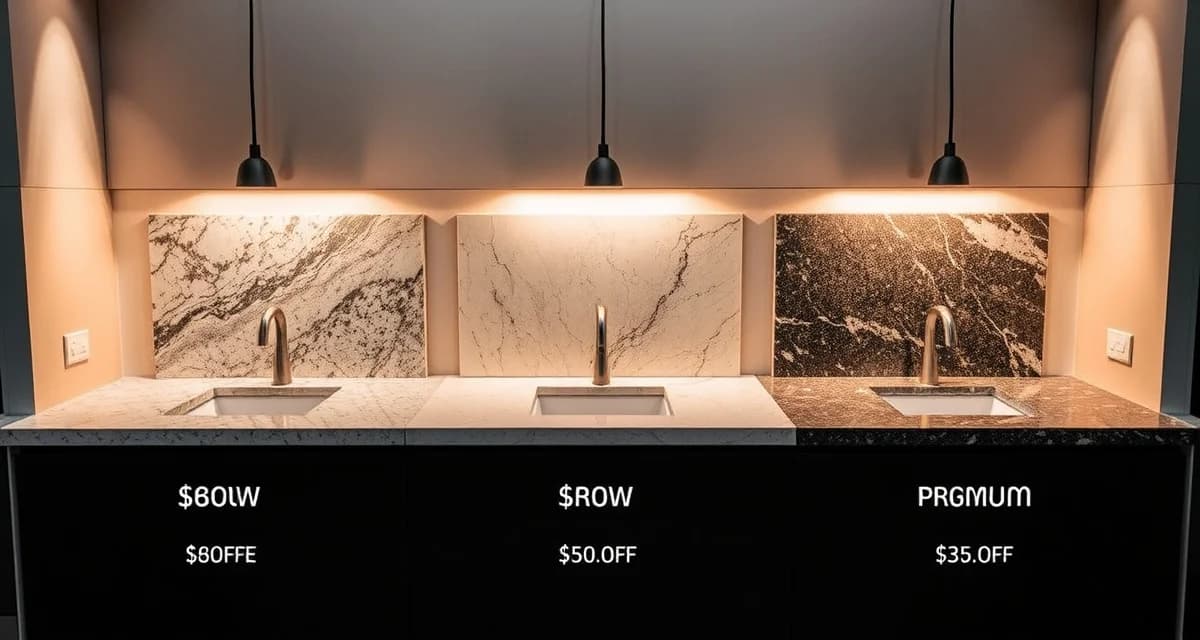
What Is Good Better Best? Definition & Guide
Quick Definition
Good-better-best (GBB) is a pricing strategy where a countertop fabrication shop presents every customer with three pricing tiers for their project - a budget option ("Good"), a mid-range option ("Better"), and a premium option ("Best"). Rather than quoting a single price that the customer either accepts or rejects, GBB gives homeowners a reason to say yes at whatever budget level they're comfortable with. Shops using tiered pricing consistently report 10-20% higher average order values and 10-15% higher close rates compared to single-price quotes.
TL;DR
- Good-better-best presents customers with three pricing tiers on every countertop quote
- Increases average order value by 10-20% because customers tend to pick the middle option
- Improves close rates by 10-15% because price-sensitive buyers have a budget option instead of walking away
- Typically varies by material grade, edge profile, and included features across tiers
- The "Better" (middle) option is where most customers land - design it as your target offering
- Works for both retail homeowner quotes and trade contractor proposals
- SlabWise Quick Quote automatically generates three-tier pricing on every estimate
Why Good-Better-Best Works
The Psychology of Three Options
When you present one price, the customer's decision is binary: yes or no. When you present three prices, the decision shifts to "which one" - a fundamentally different mental framework.
Calculate your material waste savings
See exactly how much slab material and money you could save with optimized cutting layouts.
Try the free Waste CalculatorResearch in behavioral economics consistently shows:
- Most people choose the middle option (50-60% of buyers)
- Budget-conscious buyers choose the lowest tier instead of walking away (20-30%)
- A meaningful segment trades up to the premium tier (15-25%)
Without tiered pricing, the budget-conscious buyer who can't afford your single-price quote disappears. The premium buyer who would have spent more never gets the opportunity. You lose revenue at both ends.
The Anchoring Effect
The "Best" tier sets a price ceiling that makes the "Better" option feel reasonable by comparison. If the premium option is $8,500, the mid-range at $6,200 feels like a sensible decision - even if the customer would have balked at $6,200 presented alone.
How to Build Your Three Tiers
Tier 1: Good (Budget)
This is the entry-level option. It should be genuinely attractive - not a stripped-down version designed to push customers up.
Typical "Good" tier includes:
- Level 1 or basic material (popular granite colors, entry-level quartz)
- Standard eased or small bevel edge
- Standard undermount sink cutout
- Basic 4" backsplash or no backsplash
- Standard installation
Purpose: Capture price-sensitive buyers who would otherwise shop elsewhere. Convert leads who say "I just need something basic."
Tier 2: Better (Mid-Range)
This is your target option - the one you want most customers to choose. Price it to deliver your ideal margin.
Typical "Better" tier includes:
- Level 2 material or mid-grade quartz
- Upgraded edge profile (half bullnose, small ogee)
- Undermount sink cutout with polished finish
- 4" backsplash included
- Standard installation with seam placement planning
Purpose: Deliver the best value perception. Most customers choose this tier because it feels like a meaningful upgrade from "Good" without the premium price.
Tier 3: Best (Premium)
The aspirational option. Some customers will choose it. Its primary job is making the "Better" tier look sensible.
Typical "Best" tier includes:
- Premium material (exotic granite, high-end quartz, marble, quartzite)
- Premium edge profile (full bullnose, ogee, dupont, laminated edge)
- Multiple cutouts with polished finish
- Full-height backsplash
- Premium installation with enhanced seam matching
Purpose: Anchor the price ceiling, capture customers who want the best, and increase average order value when premium buyers would have been offered only the mid-range.
Example: Three-Tier Countertop Quote
Customer: Kitchen with 42 sqft of countertop, L-shaped layout, one undermount sink
| Feature | Good | Better | Best |
|---|---|---|---|
| Material | Luna Pearl Granite | Cambria Brittanicca Quartz | Calacatta Gold Marble |
| Edge | Eased | Half Bullnose | Full Ogee |
| Sink Cutout | Standard | Polished finish | Polished + drainboard grooves |
| Backsplash | None | 4" height | Full height (18") |
| Seam | Standard | Planned placement | Color-matched, minimal visibility |
| Price | $3,400 | $5,200 | $8,800 |
Most customers presented with these options choose "Better" at $5,200. Without tiered pricing, the shop might have quoted only the $5,200 option - losing the customer who'd happily pay $3,400 for granite, and missing the customer who'd spend $8,800 on marble.
Pricing the Tiers Correctly
The 60-40 Rule
The gap between tiers shouldn't be equal. The jump from Good to Better should feel smaller than the jump from Better to Best.
- Good to Better: 30-50% price increase
- Better to Best: 50-80% price increase
This makes the Better tier feel like a modest upgrade from Good, while Best feels like a significant leap. Most customers will comfortably step up from Good to Better, which is exactly what you want.
Margin by Tier
| Tier | Target Gross Margin |
|---|---|
| Good | 25-35% |
| Better | 35-45% |
| Best | 40-55% |
Your Good tier can operate on thinner margins because it captures customers who would otherwise leave. Your Best tier should carry premium margins because customers choosing it are less price-sensitive.
Where Fabricators Go Wrong With GBB
Making the "Good" Tier Too Bad
If the budget option is clearly inferior - ugly material, no edge profile, no backsplash - customers feel manipulated rather than given a genuine choice. The Good tier should be something you'd be proud to install.
Tiers That Are Too Close in Price
If Good is $4,800, Better is $5,100, and Best is $5,500, the price differences aren't meaningful enough to drive a decision. Customers need to feel a real difference between tiers.
Only Varying Material
Some shops present the same edge, same features, and same installation - just different stone. That's material selection, not tiered pricing. True GBB varies multiple features across tiers to create distinct value propositions.
Not Explaining the Differences
A price table without explanation leaves customers guessing why they should pay more. Each tier needs a brief description of what the customer gets and why it matters: durability, appearance, maintenance requirements, resale value.
Implementing GBB in Your Shop
Step 1: Define Your Material Tiers
Organize your available materials into three groups. Don't overthink it - budget stones in Good, popular mid-range in Better, premium and exotic in Best.
Step 2: Map Features to Tiers
Decide which edge profiles, backsplash options, cutout finishes, and installation details belong at each level. Write it down so every salesperson quotes consistently.
Step 3: Calculate Pricing for Each Tier
Build each tier's pricing from actual costs and target margins. Don't set prices arbitrarily - make sure each tier is profitable.
Step 4: Create a Visual Quote Template
The presentation matters. Use a side-by-side comparison format with material photos, feature lists, and clear pricing. Homeowners decide with their eyes as much as their wallets.
Step 5: Train Your Sales Team
Your salespeople need to present all three options without steering. Let the customer choose. The middle option sells itself when the tiers are designed correctly.
What is good-better-best pricing in countertop fabrication?
Good-better-best is a tiered pricing strategy where every countertop quote presents three options - a budget tier, a mid-range tier, and a premium tier - giving customers a choice instead of a take-it-or-leave-it price.
How much does tiered pricing increase average order value?
Shops using good-better-best pricing typically see a 10-20% increase in average order value, primarily because customers who would have chosen the baseline are drawn to the mid-range option.
Which tier do most customers choose?
The "Better" (middle) tier. Approximately 50-60% of customers choose the middle option, 20-30% choose Good, and 15-25% choose Best.
Does good-better-best pricing improve close rates?
Yes. Close rates typically improve 10-15% because budget-conscious customers who would have walked away from a single mid-range price can still say yes to the Good tier.
What should change between the tiers?
Material grade, edge profile, backsplash inclusion or height, cutout finish quality, and installation features. The best GBB quotes vary multiple elements, not just the stone.
How big should the price gap be between tiers?
The Good-to-Better gap should be 30-50%. The Better-to-Best gap should be 50-80%. Unequal spacing makes the Better tier feel like the obvious value choice.
Can I use good-better-best for trade/contractor quotes?
Absolutely. Present GCs with three material-and-feature packages at different price points. Contractors appreciate options because their homeowner clients have different budgets.
How do I avoid making the budget tier look bad?
Choose genuinely attractive budget materials. Luna Pearl granite, basic white quartz, and other popular entry-level stones look great and install well. The Good tier should be something any homeowner would be happy with.
Should every quote include three tiers?
Yes. Even simple bathroom vanity quotes benefit from three options. The practice becomes automatic once your tier structure is defined.
Can quoting software automate good-better-best?
Yes. SlabWise Quick Quote automatically generates three-tier pricing on every estimate, pulling from your defined material tiers and feature packages.
What if a customer wants to mix tiers?
Great - that often means a higher total. A customer who wants Good-tier material with the Better-tier edge and Best-tier backsplash is customizing their project, which usually increases the total price above the straight Better tier.
Does GBB work for commercial projects?
Yes, though the tier definitions may differ. For commercial work, tiers might vary by material durability, edge complexity, and warranty length rather than aesthetic choices.
Sell More on Every Quote With Three Smart Options
Single-price quotes leave money on the table and push budget buyers out the door. SlabWise Quick Quote automatically generates good-better-best pricing on every estimate - presenting three clear options that increase close rates and average order values without extra work from your sales team.
Start your 14-day free trial →
Try These Free Tools
- Cost Calculator -- Get instant countertop cost estimates by material, edge profile, and square footage.
- Compare Materials -- Side-by-side material comparison with pricing, durability, and maintenance ratings.
- Edge Profile Selector -- Browse edge profiles with cost impact and visual previews.
Sources & Further Reading
- National Kitchen & Bath Association - Cabinet Frame Construction Standards
- International Surface Fabricators Association - Support Frame Requirements for Stone Installation
- Natural Stone Institute - Structural Framing Guidelines for Natural Stone Applications
- ASTM International - ASTM C1242 Standard Guide for Selection, Design, and Installation of Dimension Stone Attachment Systems