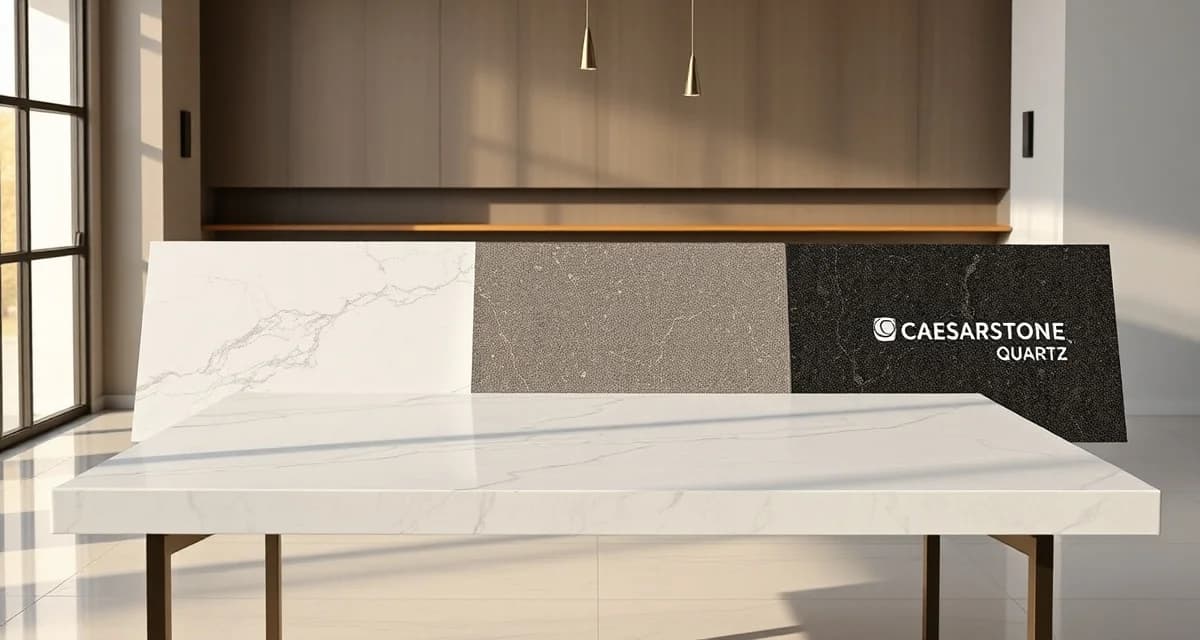
What Is Caesarstone Brand? Definition & Guide
Caesarstone is a publicly traded engineered quartz surface manufacturer headquartered in Sdot Yam, Israel. Founded in 1987, Caesarstone was one of the first companies to commercialize quartz countertops and remains a major player in the US fabrication market. For countertop shops, Caesarstone is a mid-to-premium quartz brand that appears regularly in residential kitchen and bathroom projects.
TL;DR
- Caesarstone is an Israeli-based quartz surface manufacturer, publicly traded on NASDAQ (CSTE)
- Founded in 1987, making it one of the original engineered quartz brands
- Manufactures slabs at facilities in Israel and in Richmond Hill, Georgia (US)
- Offers 80+ designs across multiple collections and price tiers
- Standard slab size is 56.5" x 120" in 2cm and 3cm thicknesses
- Retail pricing typically runs $50-$110 per square foot installed
- Uses open distribution, making it accessible through most stone distributors
Company Background
Origins and Market Position
Caesarstone pioneered the engineered quartz countertop category. The company began producing quartz surfaces in the late 1980s at its kibbutz-based facility in Israel, entering the US market in the mid-1990s. Caesarstone went public on the NASDAQ exchange in 2012 under the ticker CSTE.
Calculate your material waste savings
See exactly how much slab material and money you could save with optimized cutting layouts.
Try the free Waste CalculatorAs a publicly traded company, Caesarstone regularly reports financial performance. The company has faced increased competition from lower-priced quartz imports and from premium domestic brands like Cambria. Still, Caesarstone maintains strong brand recognition among homeowners and fabricators alike.
Manufacturing and Distribution
Caesarstone operates manufacturing facilities in:
- Sdot Yam, Israel - Primary production facility
- Richmond Hill, Georgia (US) - North American production
- Bar Lev, Israel - Additional production capacity
Unlike Cosentino, which distributes through its own Centers, Caesarstone uses open distribution. Fabricators can purchase slabs through major distributors like MSI, Arizona Tile, Daltile, and regional stone yards. This makes Caesarstone one of the more accessible premium quartz brands for smaller shops.
Product Specifications
Physical Properties
| Property | Specification |
|---|---|
| Quartz content | ~90-93% |
| Hardness (Mohs) | 7 |
| Flexural strength | >30 MPa |
| Water absorption | <0.02% |
| Standard slab size | 56.5" x 120" |
| Thickness options | 1.3cm, 2cm, 3cm |
| Heat resistance | ~300°F for brief exposure |
| Warranty | Lifetime limited (residential) |
Slab Size Consideration
Caesarstone's standard slab of 56.5" x 120" is smaller than Cambria's 65.5" x 132" or Silestone's 63" x 128". This affects fabrication layout on larger kitchen islands or L-shaped countertops where a bigger slab could eliminate a seam. Fabricators should factor this into quoting and nesting.
Caesarstone Collections
- Pebbles - Uniform, fine-grained patterns with subtle variation
- Supernatural - Designs inspired by natural marble and stone
- Metropolitan - Concrete and industrial-inspired looks
- Classico - Traditional solid and semi-solid colors
- Outdoor - UV-stable formulations for exterior applications
Pricing Tiers
| Tier | Retail Price (per sq ft, installed) | Typical Designs |
|---|---|---|
| Standard | $50-$65 | Solid colors, simple patterns |
| Premium | $65-$85 | Moderate veining, popular collections |
| Supernatural | $85-$110 | Marble-look, complex veining |
Fabrication Considerations
Cutting and Processing
Caesarstone fabricates similarly to other engineered quartz:
- Standard diamond bridge saw blades handle the material well
- CNC routers with diamond tooling produce clean edges
- Water cooling is mandatory during all cutting and grinding
- Edge polishing follows standard quartz pad sequences (50 through 3000+ grit)
Specific Fabrication Notes
- Corner radius: Minimum 3/8" radius on all internal cutout corners to prevent stress cracks
- Seam adhesive: Use color-matched epoxy; Caesarstone provides color-matching guides
- Support requirements: Overhangs exceeding 12" require additional support
- Outdoor products: The outdoor line has different fabrication guidelines around adhesive selection and joint spacing
Template Accuracy Matters
A standard Caesarstone kitchen job uses material costing $50-$110 per square foot. On a 45-square-foot kitchen, that's $2,250-$4,950 in material value. A remake due to template error wipes out the profit margin on that job and likely the next two or three jobs.
Shops using AI-powered template verification report catching 2-4 errors per month that would have reached the CNC. At average remake costs of $1,500-$4,000, that's $3,000-$16,000 in avoided losses monthly.
Caesarstone vs. Other Quartz Brands
| Feature | Caesarstone | Silestone | Cambria | MSI Q Quartz |
|---|---|---|---|---|
| Origin | Israel | Spain | USA | Various (imported) |
| Slab size | 56.5" x 120" | 63" x 128" | 65.5" x 132" | Varies |
| Distribution | Open | Cosentino Centers | Authorized dealers only | Open |
| Colors | 80+ | 80+ | 200+ | 150+ |
| Warranty | Lifetime (limited) | 25 years | Lifetime (transferable) | Limited |
| Outdoor line | Yes | No (Dekton instead) | No | Limited |
| Price range (retail/sq ft) | $50-$110 | $50-$120 | $75-$150+ | $35-$80 |
Caesarstone's Competitive Position
Caesarstone occupies the middle ground in the premium quartz market - less expensive than Cambria, priced similarly to Silestone, positioned above budget imports. For fabricators:
- Consistent demand: Homeowners frequently encounter Caesarstone at showrooms and retailers
- Reasonable margins: Fabricators can mark up material while staying competitive on total project costs
- Accessible supply: Open distribution means no special authorization needed
Managing Caesarstone in Your Shop
Quoting Efficiency
Caesarstone's multi-tier pricing means accurate quoting requires knowing the specific design. A quote using generic "quartz" pricing might be off by $15-$30 per square foot. Quick quoting tools that pull material-specific pricing help shops deliver accurate estimates in minutes.
Slab Nesting Optimization
Caesarstone's slightly smaller slab size makes efficient nesting especially important. On a large kitchen with 55+ square feet, poor nesting could mean two slabs instead of one - adding $2,000-$5,000 in material cost. AI-powered nesting optimizes piece placement while accounting for vein direction, delivering 10-15% better yield than manual layout.
Remnant Tracking
Caesarstone remnants from popular designs are valuable for small projects. Digital remnant inventory lets shops match incoming vanity or bar-top jobs to existing stock instead of ordering new material.
FAQ
Who makes Caesarstone?
Caesarstone Ltd. is a publicly traded company (NASDAQ: CSTE) headquartered in Sdot Yam, Israel, with manufacturing in Israel and the United States.
How much does Caesarstone cost?
Caesarstone retails from approximately $50 to $110 per square foot installed, depending on design tier and regional pricing.
Is Caesarstone better than granite?
Caesarstone is nonporous, never needs sealing, and offers consistent color. Granite offers unique natural patterns and may be less expensive. The best choice depends on the homeowner's priorities.
Where can I buy Caesarstone?
Caesarstone is available through most major stone distributors including MSI, Arizona Tile, and Daltile. No special authorization is needed.
Does Caesarstone need sealing?
No. Caesarstone is nonporous and never requires sealing.
Can Caesarstone be used outdoors?
Caesarstone offers a specific outdoor product line for exterior use. Standard interior products should not be used outdoors due to UV sensitivity.
What size are Caesarstone slabs?
Standard slabs measure 56.5" x 120" in 1.3cm, 2cm, and 3cm thicknesses.
What is Caesarstone's warranty?
Caesarstone offers a limited lifetime warranty for residential installations covering manufacturing defects. Installation must meet Caesarstone's guidelines.
Is Caesarstone made in the USA?
Caesarstone operates a manufacturing facility in Richmond Hill, Georgia, but also produces slabs in Israel. Slab origin may vary.
How does Caesarstone compare to Silestone?
Both are premium quartz brands with similar properties. Key differences: slab size (Silestone is larger), distribution (Silestone through Cosentino Centers), and formulation (Silestone HybriQ+ is crystalline silica-free).
Quote Caesarstone Jobs Faster, Cut Them Smarter
SlabWise helps fabrication shops handle Caesarstone projects with AI-powered template verification, optimized slab nesting, and automated customer updates. Reduce remake risk, improve material yield, and spend less time on the phone. Start your 14-day free trial today.
Try These Free Tools
- Nesting Optimizer -- AI-powered slab layout that maximizes yield considering vein direction and defects.
- Defect Mapping -- Upload a slab photo and AI maps every fissure, pit, and color issue.
- Value Engineering -- Find dollar-quantified suggestions to save material without cutting margin.