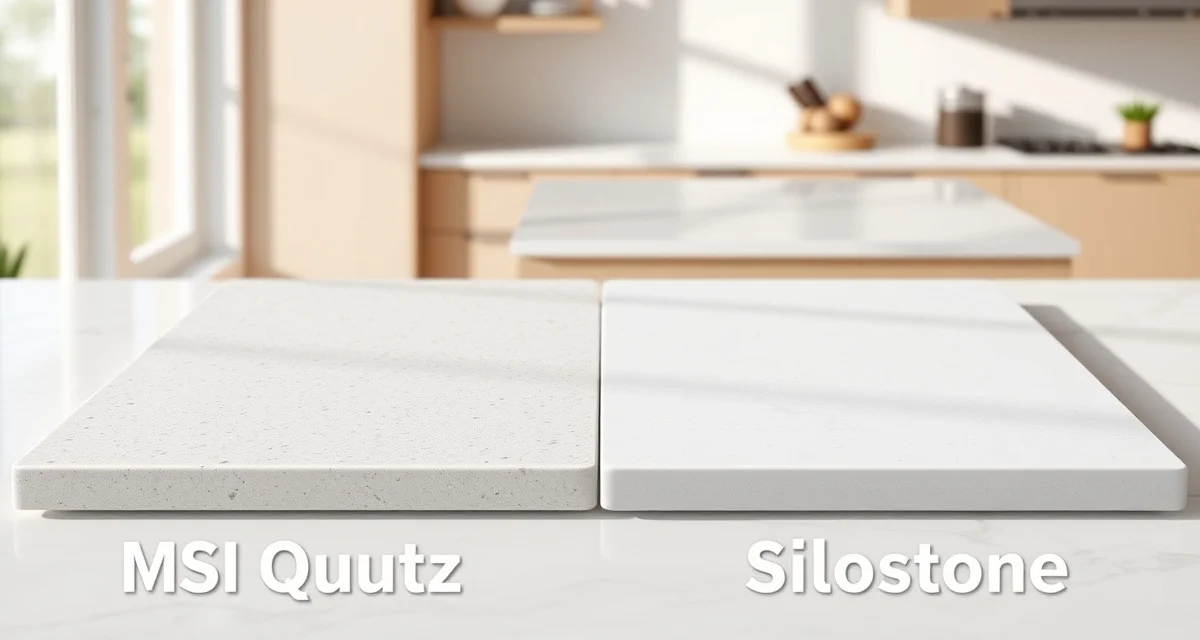
MSI Quartz vs Silestone Countertops: 2026 Comparison
MSI Quartz and Silestone represent different tiers of the quartz market. MSI (M S International) offers competitive pricing and wide availability, including big-box retail. Silestone positions itself as a premium brand with proprietary HybriQ+ technology. This comparison helps you decide if the premium is worth paying.
TL;DR
- MSI Quartz costs significantly less: $50-$85/sq ft vs. $70-$130/sq ft for Silestone
- Silestone's HybriQ+ technology reduces crystalline silica content and uses recycled materials
- MSI has wide big-box availability (Home Depot, etc.); Silestone sells through Cosentino Centers and dealers
- Both are non-porous and never need sealing
- Silestone has better pattern realism overall, especially in marble-look designs
- MSI offers solid value for budget-conscious kitchens and investment properties
- Performance is similar for daily kitchen use; the difference is primarily aesthetic and brand prestige
Side-by-Side Comparison
| Feature | MSI Quartz | Silestone |
|---|---|---|
| Manufacturer | M S International (USA-based, global mfg) | Cosentino (Spain) |
| Installed Cost (per sq ft) | $50-$85 | $70-$130 |
| Color Options | 100+ | 80+ |
| Sealing | Never | Never |
| Heat Resistance | Low (resin-based) | Low (resin-based) |
| Stain Resistance | High | Very High |
| Warranty | Limited lifetime | 25 years |
| Big-Box Availability | Yes (Home Depot, etc.) | Limited |
| Composition | Traditional quartz + resin | HybriQ+ (mineral hybrid) |
| Pattern Realism | Good | Very Good |
The Price Gap
This is the key differentiator. For a 40-square-foot kitchen:
Calculate your material waste savings
See exactly how much slab material and money you could save with optimized cutting layouts.
Try the free Waste Calculator- MSI Quartz: $2,000-$3,400
- Silestone: $2,800-$5,200
That $800-$1,800 savings from MSI is meaningful for many homeowners. The question is whether Silestone's advantages justify the premium.
Where Silestone Justifies Its Premium
Pattern quality: Silestone's marble and stone reproductions tend to be more realistic. The veining has more depth, the color transitions are subtler, and the overall appearance is closer to natural stone. MSI's patterns have improved significantly but still look more manufactured side-by-side with Silestone.
HybriQ+ composition: Silestone's reduced crystalline silica content matters for fabricator health and aligns with tightening industry regulations. MSI uses traditional quartz-resin formulations.
Brand consistency: Every Silestone slab undergoes Cosentino's quality control. MSI sources from multiple global manufacturers, so quality consistency can vary slightly between production runs.
Where MSI Wins
Price: 30-40% less than Silestone for comparable basic patterns. For budget kitchens, rentals, and investment properties, MSI delivers solid quartz performance at a fraction of premium brand pricing.
Accessibility: MSI is available at Home Depot and through a massive network of distributors. For homeowners who want to see and touch samples easily, MSI is often the most convenient brand to shop.
Selection: MSI's 100+ color range offers plenty of choices across price points, including some excellent value options that look convincing from a normal distance.
Real Cost Breakdown
The price difference between MSI and Silestone is the biggest differentiator. Here's what that looks like on actual kitchen projects:
| Kitchen Size | MSI Q Installed | Silestone Installed | Savings with MSI |
|---|---|---|---|
| Small (25 sq ft) | $1,000-$1,875 | $1,750-$3,250 | $750-$1,375 |
| Medium (40 sq ft) | $1,600-$3,000 | $2,800-$5,200 | $1,200-$2,200 |
| Large (60 sq ft) | $2,400-$4,500 | $4,200-$7,800 | $1,800-$3,300 |
For builders and developers doing multiple units, the savings with MSI are substantial. A 10-kitchen apartment renovation saves $12,000-$22,000 by going with MSI over Silestone.
Long-Term Value
Both materials last 25-30+ years with normal use. Neither needs sealing. The day-to-day durability is comparable, which means the long-term cost per year actually favors MSI since there's no meaningful difference in lifespan or maintenance.
Daily Kitchen Performance
Both MSI and Silestone handle normal kitchen conditions without issues. They're both non-porous, stain-resistant, and durable enough for busy households.
Where they differ in practice:
Slab consistency between pieces: Silestone comes from Cosentino's quality-controlled factories. MSI sources from multiple manufacturers globally, which means two MSI slabs of the "same" color can show subtle differences in tone or pattern. For kitchens with multiple slabs (islands + perimeters), Silestone offers more reliable matching.
Surface finish quality: Silestone's polished finishes tend to have a slightly deeper, more refined sheen. MSI's finishes are good but occasionally show minor inconsistencies on close inspection. From normal kitchen viewing distance, most people won't notice.
Heat and scratch resistance: Identical for practical purposes. Both scorch above 300F. Both resist scratching from normal use. Both require trivets and cutting boards for best results.
Fabrication Differences
For countertop shops, MSI and Silestone process with the same equipment. But there are a few shop-level differences worth noting:
- MSI slab flatness can be less consistent than Silestone, sometimes requiring more shimming during installation
- Silestone's HybriQ+ formula produces less crystalline silica dust, which matters for shop air quality and OSHA compliance
- MSI's distribution network (35+ US warehouses) means fast slab availability in most markets
- Silestone's Cosentino network provides fabricator training, sample programs, and lead referrals that MSI doesn't offer at the same level
Margins tend to be tighter on MSI work since customers buying on budget resist premium fabrication pricing. Silestone's higher material cost supports higher overall project pricing.
Resale Value
Both MSI and Silestone qualify as "quartz countertops" in real estate listings, which is what most buyers care about. The brand name on the underside of the slab rarely matters at resale unless the buyer specifically asks.
That said, in luxury markets where buyers look at every detail, a Silestone invoice carries more brand recognition than MSI. For most mid-range home sales, the material quality is what matters, and both brands deliver.
Best Uses
Choose MSI Quartz When:
- Budget is the primary driver
- The project is a rental, flip, or investment property
- Big-box retail convenience matters (Home Depot carries MSI)
- You find a pattern you love in MSI's collection
- Doing multi-unit projects where savings add up fast
Choose Silestone When:
- Pattern realism and design quality matter most
- HybriQ+ composition is important (fabricator health, sustainability)
- You're investing in a primary home with long-term plans
- Budget accommodates premium pricing
- Consistent slab matching across a large kitchen is important
FAQ
Is MSI quartz as good as Silestone?
For basic non-porosity, stain resistance, and daily function, MSI performs comparably to Silestone. Where Silestone pulls ahead is pattern realism, composition technology, and brand prestige. Whether that difference is worth 30-40% more depends on your priorities.
Is MSI quartz good quality?
Yes. MSI quartz is a solid mid-range product used in millions of kitchen installations. It is non-porous, stain-resistant, and durable. It may not match Silestone's pattern realism at the high end, but it delivers reliable performance.
Does MSI quartz stain?
MSI quartz is non-porous and resists stains from normal kitchen use. Like all quartz, it can be damaged by harsh chemicals (oven cleaners, paint strippers) but handles coffee, wine, oil, and other common substances without issue.
Which has better marble looks?
Silestone's marble-look patterns are generally more realistic than MSI's. Silestone's Ethereal collection specifically targets marble aesthetics with convincing depth and veining. MSI's Calacatta options are good but more obviously manufactured in direct comparison.
Can I save money with MSI without sacrificing much?
Yes. If you choose a solid color or simple pattern where manufacturing sophistication matters less, MSI offers excellent value. The quality gap narrows considerably for solid whites, grays, and simple patterns.
Where can I see MSI quartz samples?
Home Depot is the easiest option for most people. MSI also has showrooms in major markets and distributes through thousands of countertop fabrication shops.
Are MSI and Silestone both safe for food prep?
Yes. Both are non-porous surfaces that do not harbor bacteria when properly cleaned. Both are safe for food contact.
Which brand do fabricators recommend more?
This varies by shop. Many fabricators stock MSI for budget-conscious customers and Silestone for premium clients. Some shops prefer working with Cosentino's support network; others appreciate MSI's broader distribution and lower material costs.
Make Your Choice
MSI Quartz and Silestone both get the job done. MSI saves you money. Silestone gives you better aesthetics and advanced composition technology. Choose based on budget, design standards, and how long you plan to enjoy the kitchen.
Estimate your project using our countertop cost calculator. Fabricators can try SlabWise free for 14 days to quote all quartz brands faster.
Try These Free Tools
- Cost Calculator -- Compare material costs instantly across different countertop options.
- Compare Materials -- Side-by-side material comparison with pricing, durability, and maintenance.
- Kitchen Visualizer -- Let customers preview countertop materials in their actual kitchen.
Sources & Further Reading
-
Natural Stone Institute - Technology and Software Solutions for Stone Fabricators
-
International Surface Fabricators Association - Fabrication Software and Digital Tools
-
National Kitchen & Bath Association - Technology Integration in Countertop Design
-
Marble Institute of America - Digital Fabrication and Software Standards