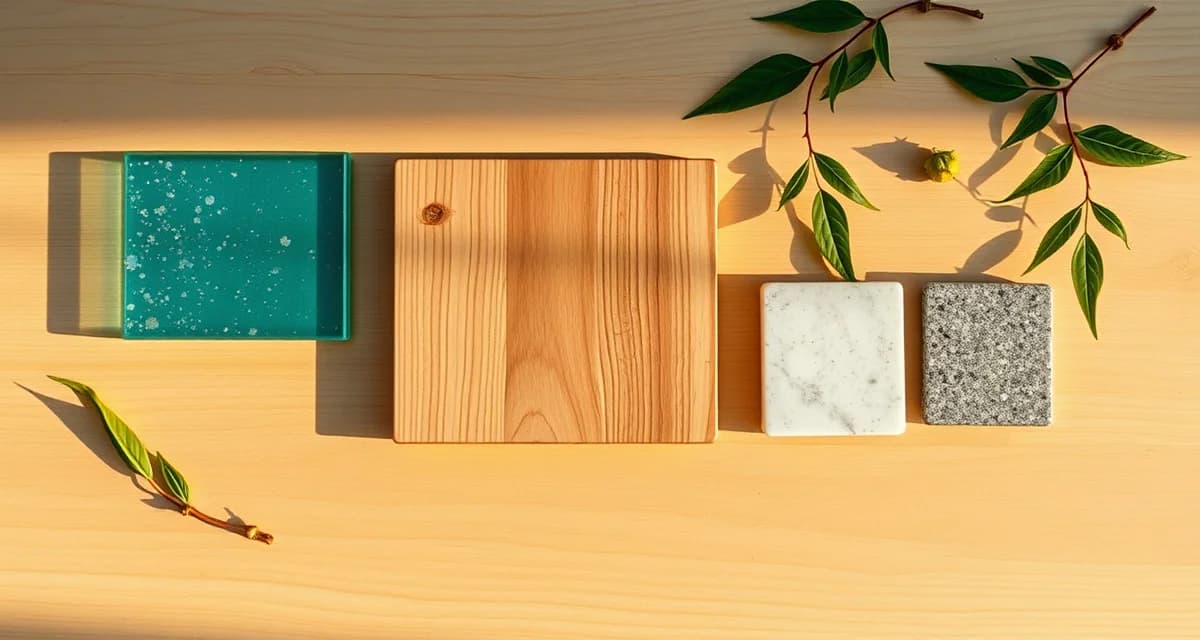
Best Eco-Friendly Countertops in 2026
Eco-friendly countertops are made from recycled content, sustainably sourced materials, or natural resources with minimal environmental processing. The best options in 2026 -- recycled glass, reclaimed wood, bamboo, recycled paper composite, and locally quarried stone -- reduce your kitchen's environmental footprint without sacrificing durability or aesthetics.
TL;DR: Best Eco-Friendly Countertops
- Recycled glass countertops ($50-$120/sq ft) use 75-100% post-consumer glass in a cement or resin binder
- Reclaimed wood ($50-$100/sq ft) repurposes salvaged timber from old buildings and structures
- Bamboo ($40-$80/sq ft) grows back in 3-5 years versus 25-80 years for hardwood trees
- Paper composite ($30-$80/sq ft) uses recycled paper saturated with petroleum-free resins
- Recycled porcelain ($50-$120/sq ft) incorporates up to 40% recycled ceramic content
- Locally quarried natural stone reduces transport emissions while providing lifetime durability
- Concrete with recycled aggregate ($65-$150/sq ft) uses crushed glass, fly ash, or reclaimed aggregate
How We Evaluated Eco-Friendliness
| Criteria | Weight | What We Measured |
|---|---|---|
| Recycled/renewable content | 30% | Percentage of recycled or rapidly renewable material |
| Manufacturing impact | 25% | Energy use, emissions, and waste during production |
| Lifespan | 20% | How long it lasts (longer = less replacement waste) |
| End-of-life recyclability | 15% | Whether it can be recycled or composted after removal |
| Transportation footprint | 10% | Distance from source to typical US installation |
1. Recycled Glass Countertops -- Best Overall Eco-Friendly Option
Recycled glass countertops embed fragments of crushed post-consumer glass (wine bottles, beer bottles, window panes, jars) into a cement or resin matrix. The glass content typically ranges from 75% to 100%, diverting thousands of pounds of glass from landfills per countertop.
Calculate your material waste savings
See exactly how much slab material and money you could save with optimized cutting layouts.
Try the free Waste CalculatorLeading brands:
- Vetrazzo -- 85% recycled glass in a cement binder, made in the US
- IceStone -- 75% recycled glass with cement, manufactured in Brooklyn, NY using 100% renewable energy
- Durat -- Finnish brand using recycled plastics as the binder with glass aggregate
Environmental credentials:
- Diverts post-consumer glass from landfill
- IceStone operates on 100% wind power
- No VOC emissions during manufacturing
- Cement-based versions are fully recyclable at end of life
Performance:
- Heat resistant (better than engineered quartz)
- Hard and durable for daily kitchen use
- Non-porous when properly sealed
- Available in dozens of color blends depending on the source glass
Limitations:
- Cement-based versions need periodic sealing
- Resin-based versions are less eco-friendly due to the binder
- Higher cost than standard laminate or tile
- Limited availability in some regions
| Spec | Detail |
|---|---|
| Cost Range | $50-$120/sq ft installed |
| Recycled Content | 75-100% |
| Durability | 20+ years |
| Maintenance | Seal every 1-2 years (cement-based) |
| Best For | Eco-conscious kitchens, colorful designs |
2. Reclaimed Wood -- Best for Character and Sustainability
Reclaimed wood countertops use timber salvaged from demolished buildings, old barns, retired ships, and other structures. The wood has already served one life, and giving it a second one as a countertop keeps it out of the waste stream while avoiding the need to harvest new trees.
Common sources:
- Barn wood (100+ year old oak, chestnut, pine)
- Factory and warehouse beams (old-growth fir, maple, elm)
- Wine and whiskey barrel staves (oak)
- Ship and dock wood (teak, mahogany)
- Railroad ties (note: check for chemical treatment before food contact)
Environmental credentials:
- Zero new trees harvested
- Diverts demolition waste from landfill
- Minimal processing energy compared to stone or engineered surfaces
- Carbon already sequestered in the wood stays locked in
Performance:
- Old-growth reclaimed wood is often denser and harder than new-growth equivalents
- Naturally antibacterial (hardwoods like oak and maple)
- Can be sanded and refinished multiple times
- Develops warm patina with age
Limitations:
- Requires regular oiling and maintenance
- Not suitable for wet areas without careful sealing
- May contain hidden nails, staples, or old paint that need removal
- Availability depends on local demolition activity
- Must verify wood is free of lead paint or harmful chemical treatments
| Spec | Detail |
|---|---|
| Cost Range | $50-$100/sq ft installed |
| Recycled Content | 100% |
| Durability | 25+ years with maintenance |
| Maintenance | Regular oiling |
| Best For | Farmhouse kitchens, island tops, spaces wanting character |
3. Bamboo -- Best Rapidly Renewable Countertop
Bamboo is technically a grass, not a wood, and it reaches harvest maturity in just 3-5 years compared to 25-80 years for hardwood trees. This rapid growth cycle makes bamboo one of the most renewable solid surface materials available for countertops.
Environmental credentials:
- Reaches maturity in 3-5 years (versus 25-80 for hardwoods)
- Does not require replanting -- bamboo regenerates from its root system after harvest
- Absorbs more CO2 per acre than most hardwood forests
- Requires no pesticides or fertilizers in most growing conditions
Performance:
- Harder than most hardwoods (1,180-1,380 Janka hardness for strand-woven varieties)
- Naturally moisture resistant when properly finished
- Available in natural (blonde), carbonized (amber), and stained finishes
- Can be sanded and refinished
Limitations:
- Most bamboo is grown in China, adding transportation emissions
- Adhesives used in lamination can contain formaldehyde (look for NAUF or NAF certifications)
- Can scratch and dent from heavy impacts
- Requires periodic oiling and sealing
- Quality varies significantly between manufacturers
| Spec | Detail |
|---|---|
| Cost Range | $40-$80/sq ft installed |
| Renewable Cycle | 3-5 years |
| Durability | 15-25 years |
| Maintenance | Oil every 3-6 months |
| Best For | Modern kitchens, Asian-inspired design, eco-budgets |
4. Paper Composite -- Best Hidden Eco-Performer
Paper composite countertops sound fragile, but they are anything but. Brands like Richlite and PaperStone saturate layers of recycled paper (sometimes FSC-certified virgin paper) with phenolic resin or petroleum-free cashew shell-based resins, then compress them under heat and pressure. The result is a dense, durable solid surface that looks and feels like soapstone.
Leading brands:
- Richlite -- used by major knife-handle and skateboard ramp manufacturers; extremely tough
- PaperStone -- uses a cashew shell-based resin instead of petroleum-based phenolic
- Kliptech EcoTop -- combines bamboo fiber and recycled paper
Environmental credentials:
- Made from recycled or sustainably sourced paper
- PaperStone uses a petroleum-free resin system
- Manufactured in the US (both Richlite and PaperStone)
- Fully recyclable and biodegradable at end of life
Performance:
- Dense and heavy -- feels like soapstone
- Heat resistant (outperforms engineered quartz)
- Will not chip or crack like stone
- Food-safe and non-porous
- NSF-rated for food preparation
Limitations:
- Limited color range (primarily dark browns, blacks, and charcoals)
- Can be scratched by knives (but scratches sand out easily)
- Needs periodic oiling to maintain appearance
- Not widely available -- may need to order and wait
| Spec | Detail |
|---|---|
| Cost Range | $30-$80/sq ft installed |
| Recycled Content | 80-100% |
| Durability | 20+ years |
| Maintenance | Oil periodically, sand scratches as needed |
| Best For | Modern or industrial kitchens, food prep surfaces |
5. Recycled Porcelain Slabs -- Best Eco-Friendly for Zero Maintenance
Several porcelain slab manufacturers have begun incorporating recycled ceramic and glass content into their slabs. Brands like Laminam and select Dekton lines include up to 40% recycled content while maintaining the material's signature durability.
Environmental credentials:
- Up to 40% recycled content in some product lines
- Manufacturing waste from the production process is recycled back into new slabs
- Extremely long lifespan reduces replacement frequency
- No quarrying of natural stone resources
Performance:
- Heat resistant to 2,200°F+
- Completely non-porous -- zero sealing needed
- UV stable for indoor and outdoor use
- Scratch resistant
Limitations:
- Recycled content percentage varies by product line -- always check specs
- Manufacturing still requires high energy input for firing
- Most production is in Europe, adding transportation emissions for US buyers
- Requires specialized fabrication equipment and training
| Spec | Detail |
|---|---|
| Cost Range | $50-$120/sq ft installed |
| Recycled Content | Up to 40% |
| Durability | 25+ years |
| Maintenance | Almost none |
| Best For | Modern zero-maintenance eco kitchens |
6. Locally Quarried Natural Stone -- Best for Reducing Transport Emissions
Choosing natural stone from a quarry within your region dramatically reduces transportation-related carbon emissions. A granite slab quarried 200 miles away has a far smaller carbon footprint than one shipped 5,000 miles from Brazil or India, even though the material itself is identical in type.
US quarrying regions:
- Vermont -- granite, marble, slate
- Georgia -- granite (Elberton is the "Granite Capital of the World")
- Minnesota/Wisconsin -- granite, dolomite
- Indiana -- limestone
- Montana/Idaho -- quartzite, granite
- Texas -- limestone, granite
Environmental credentials:
- Minimal transport emissions (quarry to fabricator in the same region)
- No synthetic materials or chemical binders
- Extremely long lifespan (50+ years or essentially permanent)
- Can be repurposed or recycled at end of life
Limitations:
- Color and pattern options limited to what is available locally
- Local stone may not match trending design aesthetics
- Not all regions have active quarries
| Spec | Detail |
|---|---|
| Cost Range | $50-$150/sq ft installed (varies by region) |
| Sustainability Factor | Low transport emissions, no synthetic content |
| Durability | 50+ years |
| Best For | Regionally authentic kitchens, LEED projects |
7. Concrete with Recycled Aggregate -- Best Customizable Eco Option
Concrete countertops become eco-friendly when you substitute standard aggregate with recycled materials: crushed recycled glass, fly ash (a byproduct of coal power plants), recycled stone dust, or reclaimed aggregate from demolished structures.
Eco-concrete mix options:
- Fly ash replacement -- substitute up to 50% of Portland cement with fly ash
- Recycled glass aggregate -- crushed bottles and jars replace standard gravel
- GFRC (Glass Fiber Reinforced Concrete) -- thinner, lighter, uses less material overall
- Reclaimed aggregate -- crushed concrete from demolition sites
Environmental credentials:
- Reduces Portland cement usage (the highest-emission concrete component)
- Diverts glass, fly ash, and demolition waste from landfills
- Can be made locally with local materials
- Fully recyclable as aggregate at end of life
Limitations:
- Quality depends heavily on the fabricator's skill
- Porous -- needs regular sealing
- Heavier than most alternatives
- May develop hairline cracks over time
| Spec | Detail |
|---|---|
| Cost Range | $65-$150/sq ft installed |
| Recycled Content | 20-60% depending on mix design |
| Durability | 20+ years |
| Maintenance | Regular sealing |
| Best For | Custom shapes, integrated sinks, eco-industrial style |
Eco-Friendly Countertop Comparison Table
| Material | Cost/sq ft | Recycled % | Durability | Maintenance | DIY? |
|---|---|---|---|---|---|
| Recycled Glass | $50-$120 | 75-100% | 20+ yrs | Moderate | No |
| Reclaimed Wood | $50-$100 | 100% | 25+ yrs | Regular | Possible |
| Bamboo | $40-$80 | Renewable | 15-25 yrs | Regular | Yes |
| Paper Composite | $30-$80 | 80-100% | 20+ yrs | Light | No |
| Recycled Porcelain | $50-$120 | Up to 40% | 25+ yrs | Minimal | No |
| Local Stone | $50-$150 | N/A (natural) | 50+ yrs | Annual | No |
| Eco Concrete | $65-$150 | 20-60% | 20+ yrs | Regular | Challenging |
Understanding Green Certifications for Countertops
Several certifications help identify genuinely eco-friendly countertop materials:
LEED Credit Eligibility
Materials with recycled content, regional sourcing (within 500 miles), or low-emission manufacturing can contribute to LEED certification points for green building projects.
Greenguard Certification
Tests for low VOC (volatile organic compound) emissions. Important for indoor air quality. Most stone and porcelain products pass easily; some engineered materials may not.
Cradle to Cradle (C2C)
Evaluates the full lifecycle of the product, from raw material sourcing through end-of-life recyclability. IceStone's recycled glass countertops hold C2C certification.
FSC Certification
For wood-based products (butcher block, bamboo), Forest Stewardship Council certification ensures the source material comes from responsibly managed forests or plantations.
How Fabricators Can Reduce Waste on Every Job
Whether or not a client chooses an eco-friendly material, fabricators can reduce their environmental impact by optimizing slab usage:
- Better nesting -- AI-powered slab nesting software like SlabWise improves yield by 10-15%, meaning less stone ends up as waste
- Remnant management -- Tracking and cataloging remnants for use on future small jobs (vanities, backsplashes, side tables) keeps usable material out of the dumpster
- Cross-job batching -- Combining cuts from multiple jobs on a single slab when materials match reduces total slab consumption
- Water recycling -- Most modern fab shops recycle their cutting water; those that don't should invest in a closed-loop system
- Dust collection -- Proper silica dust management protects workers and can be repurposed in some applications
FAQ
What is the most eco-friendly countertop material?
Recycled glass countertops from manufacturers like IceStone offer the strongest eco credentials: 75-100% recycled content, manufacturing powered by renewable energy, zero VOC emissions, and full recyclability at end of life.
Are granite countertops eco-friendly?
Granite has a mixed eco profile. It is natural, contains no synthetic chemicals, and lasts 50+ years (reducing replacement waste). However, quarrying requires significant energy, and most granite is shipped thousands of miles from Brazil or India to the US. Choosing locally quarried granite dramatically improves its environmental footprint.
Is quartz or granite more environmentally friendly?
Granite is generally more eco-friendly because it requires less processing energy. Engineered quartz involves mining raw quartz, mixing it with petroleum-based resin binders, and firing it in large factories. Neither is ideal from a pure sustainability standpoint, but granite's lower processing energy and potential for local sourcing give it an edge.
How do bamboo countertops compare to butcher block?
Bamboo is more sustainable as a resource (3-5 year regrowth versus 25-80 years for hardwood), but most bamboo is shipped from China, adding significant transport emissions. Reclaimed wood butcher block is arguably more eco-friendly overall because it reuses existing material with minimal processing and transport.
Are paper composite countertops durable?
Yes. Paper composite countertops like Richlite and PaperStone are dense, heat resistant, and used in demanding applications like commercial kitchens and skatepark ramps. They scratch more easily than stone but can be sanded and refinished repeatedly.
Do eco-friendly countertops cost more?
Some do, some don't. Bamboo ($40-$80/sq ft) and paper composite ($30-$80/sq ft) are competitive with standard materials. Recycled glass ($50-$120/sq ft) runs slightly higher than basic granite. The premium for eco-friendly options has narrowed significantly in recent years.
Can I get LEED points for my countertop choice?
Yes. Recycled content materials, regionally sourced stone (within 500 miles of the project), and low-emission products can all contribute to LEED credits under the Materials and Resources category.
What happens to old countertops when they are replaced?
Most removed countertops end up in landfills. Natural stone can be crushed for aggregate or repurposed as landscape stone. Wood can be salvaged or composted. Engineered quartz is not currently recyclable due to its resin content. Recycled glass and paper composite countertops can be recycled.
Are recycled glass countertops sanitary?
Yes. When properly sealed, recycled glass countertops are non-porous and safe for food preparation. The cement or resin matrix seals the glass fragments, creating a solid, cleanable surface.
How do I find locally quarried stone?
Contact your regional stone distributor or search the Natural Stone Institute's member directory for quarries in your state. Many distributors can identify which slabs in their inventory were quarried domestically versus imported.
Reduce Material Waste on Every Job
Eco-friendly fabrication starts with using more of what you buy. SlabWise's AI-powered slab nesting optimizes cut layouts to reduce waste by 10-15%, and our remnant tracking system ensures usable offcuts find their way to future projects instead of the dumpster. Start your 14-day free trial at slabwise.com.
Try These Free Tools
- Nesting Optimizer -- AI-powered slab layout that maximizes yield considering vein direction and defects.
- Defect Mapping -- Upload a slab photo and AI maps every fissure, pit, and color issue.
- Value Engineering -- Find dollar-quantified suggestions to save material without cutting margin.
Sources & Further Reading
- Natural Stone Institute - Digital Tools for Stone Fabricators
- International Surface Fabricators Association - Technology Solutions for Countertop Businesses
- National Kitchen & Bath Association - Business Management Software Guide
- Remodeling Magazine - CRM Systems for Custom Fabricators