Can an Undermount Sink Fall Off?
Quick Answer
Yes, an undermount sink can fall off - but it's rare when the installation is done correctly. A properly mounted undermount sink uses a combination of silicone adhesive, epoxy, and mechanical clips or brackets that can support 200+ pounds of static weight. Failures happen when installers rely on adhesive alone without mechanical support, when cheap silicone is used, or when the sink was installed on a stone surface that wasn't properly cleaned before bonding. About 2-3% of undermount sinks experience some degree of loosening within the first 5 years.
TL;DR
- Properly installed undermount sinks almost never fall - failure rate is around 2-3%
- A good installation uses both adhesive (silicone + epoxy) AND mechanical clips
- Most failures happen because installers used adhesive only, with no mechanical backup
- A full cast iron sink with water can weigh 150+ pounds - mechanical support is essential
- Warning signs include a visible gap between sink rim and stone, water seeping through, or slight wobble
- Repair costs range from $200-$600 depending on the situation
- Stone type matters: polished granite and marble bond better than some quartz surfaces
How Undermount Sinks Are Attached
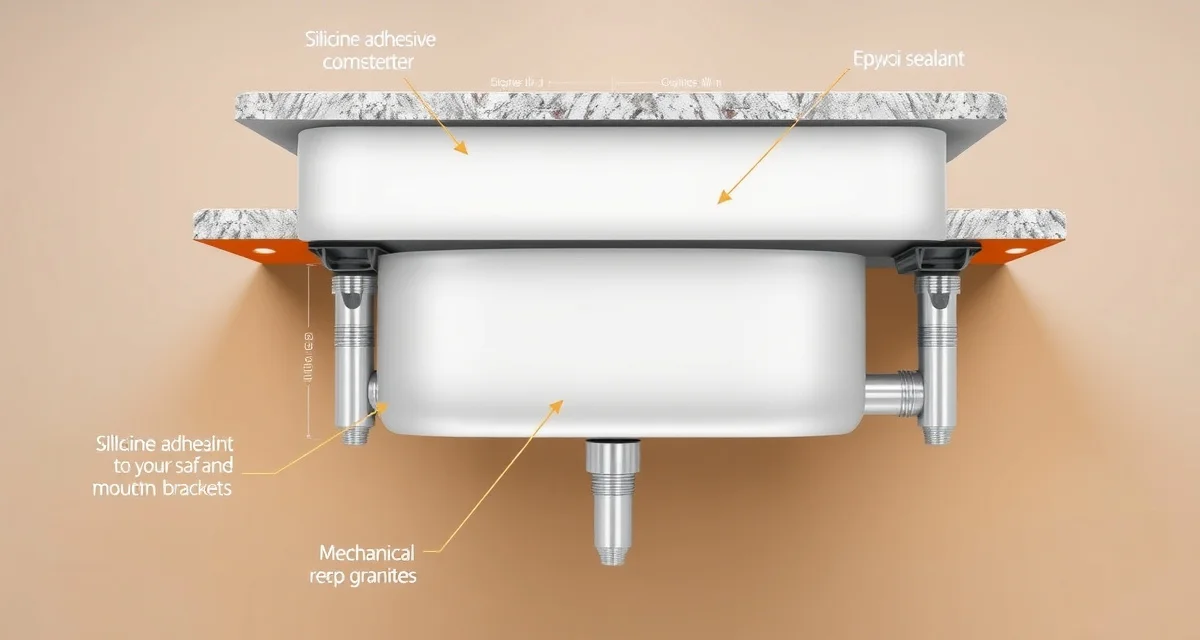
There's no single method. Most professional fabricators use a belt-and-suspenders approach - adhesive for the primary bond and mechanical fasteners as a safety backup.
Calculate your material waste savings
See exactly how much slab material and money you could save with optimized cutting layouts.
Try the free Waste CalculatorThe Three-Part Mounting System
| Component | Function | Holds Without Others? |
|---|---|---|
| Silicone adhesive | Creates a waterproof bond between sink rim and stone underside | Temporarily, but weakens over time |
| Epoxy | Provides a stronger initial bond than silicone alone | Yes, for moderate loads |
| Mechanical clips/brackets | Physical support independent of adhesive | Yes - this is the failsafe |
Best practice: Use all three. The adhesive creates the watertight seal, the epoxy adds bond strength, and the clips ensure the sink stays up even if the adhesive fails over time.
Mechanical Support Options
Sink clips (most common). Metal brackets that screw into the underside of the countertop substrate or directly into mounting channels. These are the standard for stone countertops.
T-bracket supports. Metal bars that span from one side of the cabinet to the other, supporting the sink from below. Commonly used with heavy cast iron sinks.
Channel mounting systems. A metal channel is epoxied to the underside of the stone around the cutout perimeter, and the sink clips into the channel. This distributes weight more evenly.
Support rods. Threaded rods that pass through the sink's mounting holes and anchor to brackets on top of the stone (covered by the sink rim area). Less common but very secure.
Weight Loads: What an Undermount Sink Actually Carries
People underestimate how much weight an undermount sink holds during regular use.
| Scenario | Approximate Weight |
|---|---|
| Empty stainless steel sink | 15-25 lbs |
| Empty cast iron sink | 60-100 lbs |
| Sink full of water (standard 33" kitchen sink) | 80-100 lbs of water |
| Cast iron sink full of water | 140-200 lbs total |
| Sink full of water + dishes + pots stacked | 120-180 lbs (stainless) |
| Someone leaning on the sink rim | Additional 30-80 lbs of force |
A standard undermount mounting system (adhesive + clips) is rated for 200-300 pounds of static load. That's enough for nearly all normal use. Problems occur with dynamic loading - someone putting sudden weight on the sink edge, or children hanging from the sink rim.
Why Undermount Sinks Fall: The Top Causes
1. Adhesive-Only Installation (No Clips)
This is the number-one cause of undermount sink failure. Some installers skip the mechanical clips because they're confident in their adhesive application. It works fine for months or years, then:
- The silicone degrades from constant moisture exposure
- Temperature cycling (hot water, cold water) stresses the bond
- The sink gradually loosens and drops
Fix: Always insist on mechanical clips or brackets in addition to adhesive.
2. Poor Surface Preparation
Adhesive needs a clean, dry surface to bond properly. If the stone underside has:
- Cutting residue or slurry
- Dust or debris
- Moisture from recent cutting
...the adhesive bond will be weak from day one. Professional fabricators clean the bonding area with acetone or denatured alcohol before applying adhesive.
3. Wrong Adhesive Type
Not all silicone is created equal. Using bathroom caulk (acetic acid cure silicone) instead of neutral-cure, 100% silicone rated for stone bonding is a common mistake. Acetic acid silicone can corrode the metal clips and weakens faster under moisture exposure.
4. Heavy Cast Iron Sinks Without Adequate Support
A 90-pound cast iron farmhouse sink full of water approaches 200 pounds. Without T-brackets or a support shelf underneath, the adhesive and clips bear all that weight continuously. Over time, something gives.
5. Dishwasher Vibration
If the dishwasher is directly adjacent to the sink cabinet, years of vibration during wash cycles can gradually loosen adhesive bonds. It's not a sudden failure - it's a slow weakening.
Warning Signs Your Undermount Sink Is Loosening
Catch these early and the repair is simpler:
- Visible gap between the sink rim and the stone underside (even a hairline gap)
- Water seeping between the sink and countertop during use
- Slight wobble when you press on the sink rim
- Mildew or mold forming along the sink-to-stone junction (indicates moisture intrusion)
- Caulk pulling away from the stone surface
- Dripping underneath the countertop near the sink edge
If you notice any of these, address it promptly. A sink that's loosening will only get worse, and a full drop can damage the sink, plumbing, and cabinet below.
How to Prevent Undermount Sink Failure
For Homeowners
- Ask your fabricator about their mounting method. If they say "adhesive only," request clips or brackets.
- Don't hang on the sink. Avoid putting body weight on the front edge of the sink.
- Check the seal annually. Run your finger along the sink-to-stone joint. If you feel a gap or the caulk is pulling away, call your fabricator.
- Support heavy items. If you regularly fill the sink to the brim with water (especially cast iron sinks), make sure the support system is adequate.
For Fabricators
- Always use mechanical clips - even on lightweight stainless sinks. It's cheap insurance.
- Clean the bonding surface with acetone before applying adhesive.
- Use neutral-cure, 100% silicone rated for stone applications.
- Add T-brackets for cast iron sinks over 60 pounds.
- Document the mounting method in the job packet so the install crew follows the plan.
- Let adhesive cure fully before releasing clamps - typically 24 hours for full strength.
Repair Options If a Sink Drops or Loosens
| Issue | Repair Method | Estimated Cost |
|---|---|---|
| Slight gap, no drop | Re-caulk with proper silicone | $100-$200 |
| Sink loosening, still attached | Remove old adhesive, re-bond with epoxy + clips | $200-$400 |
| Sink dropped partially | Re-mount with new clips, brackets, and adhesive | $300-$500 |
| Sink dropped fully, no stone damage | Full re-installation with mechanical support | $400-$600 |
| Sink dropped, stone cracked at cutout | Stone repair or replacement + sink re-install | $800-$3,000+ |
Most repairs can be done without removing the countertop. The fabricator works from below, inside the cabinet.
Does Stone Type Affect Undermount Sink Adhesion?
Yes. Some surfaces bond better than others.
| Material | Bond Quality | Notes |
|---|---|---|
| Polished granite | Excellent | Smooth, clean surface bonds well with silicone and epoxy |
| Honed granite | Very good | Slightly textured surface provides good mechanical grip |
| Polished marble | Good | Similar to granite, but softer stone requires careful handling |
| Quartz | Good to variable | Some quartz surfaces have a resin-rich layer that resists adhesive bonding |
| Quartzite | Very good | Natural stone with good bonding characteristics |
| Porcelain slab | Moderate | Very smooth surface; specialized adhesive may be needed |
Quartz is the one material where bonding can be tricky. Some quartz brands have a smoother, more resin-saturated underside that doesn't grip adhesive as well. Lightly sanding the bonding area with 80-grit sandpaper before applying adhesive helps significantly.
How much weight can an undermount sink hold?
A properly installed undermount sink with adhesive and mechanical clips typically supports 200-300 pounds of static weight. That's more than enough for a full sink of water and dishes.
How often do undermount sinks fall off?
Rarely - about 2-3% of installations experience loosening within the first 5 years. Full detachment is even less common. Most failures involve adhesive-only installations without clips.
Can I reinstall an undermount sink myself?
It's possible for a handy homeowner, but not recommended. The sink is heavy, the adhesive needs proper application, and clip installation requires working in an awkward position inside the cabinet. A professional repair typically costs $200-$500.
Do undermount sinks work with all countertop materials?
They work with granite, quartz, marble, quartzite, and porcelain slab. They do not work well with laminate or tile countertops, which lack the structural integrity to support the sink's weight from above.
How long should undermount sink adhesive last?
Quality neutral-cure silicone should last 10-20 years in normal conditions. The mechanical clips should last indefinitely. The most common reason for early adhesive failure is using the wrong type of silicone.
What's the difference between sink clips and sink brackets?
Clips are small metal pieces that screw into the countertop substrate and grip the sink rim. Brackets are larger support structures (T-brackets or L-brackets) that span the cabinet and support the sink from below. Heavy sinks benefit from both.
Should I worry about my undermount sink if it was installed recently?
If a professional fabricator installed it with clips and adhesive, you're fine. Run a finger along the sink-to-stone joint every year to check for gaps. No gap means no problem.
Does a farmhouse (apron-front) sink have the same falling risk?
No. Farmhouse sinks sit on a support structure built into the cabinet, not hung from the countertop. The stone sits on top of or around the sink. Falling risk is essentially zero.
Plan Smarter Sink Cutouts With Digital Tools
Sink cutout placement, support requirements, and seam locations near sinks are all factors that SlabWise's template verification system checks before fabrication begins. Catching a poorly positioned cutout or undersized support plan before cutting stone prevents expensive remakes.
Start your 14-day free trial to see how digital verification reduces installation callbacks.
Try These Free Tools
- Photo to Template -- Snap a photo of an existing countertop and get an AI-generated DXF template.
- Template Compare -- Upload two templates and see every dimension change highlighted instantly.
- AI Template Verification -- Cross-check your template against manufacturer specs before cutting.
Sources & Further Reading
- Natural Stone Institute - Countertop Support Guidelines
- International Surface Fabricators Association - Structural Support Requirements
- National Kitchen & Bath Association - Countertop Installation Standards
- ASTM International - C1526 Standard Specification for Serpentine Dimension Stone