How Do They Cut Sink Holes in Countertops?
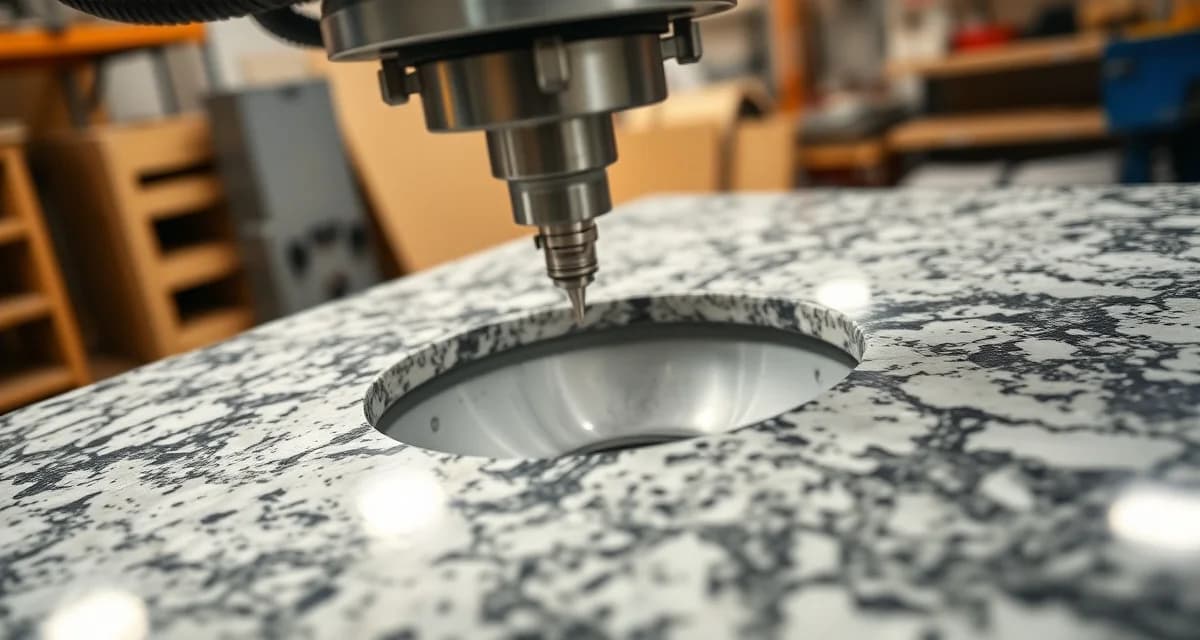
Sink holes in stone countertops are cut at the fabrication shop using CNC machines or specialized hand tools - not in your kitchen. The fabricator uses a template (physical or digital) of both the countertop layout and the exact sink dimensions to program the cutout. CNC machines use diamond-tipped router bits to trace the sink outline with precision down to 1/16 of an inch. The entire process takes about 15-30 minutes per cutout on a CNC, or 30-60 minutes by hand.
TL;DR
- Sink holes are cut at the fabrication shop, not in your home
- CNC machines handle most sink cutouts in modern shops (accuracy: ±1/16 inch)
- Hand cutting is still done by some shops or for on-site adjustments
- The fabricator needs your actual sink on-site during the template visit
- Undermount sinks require precise cutout sizing - too large and clips won't hold
- Drop-in (top-mount) sinks are more forgiving on cutout dimensions
- A wrong-sized cutout costs $500-$2,000 to fix (often requires a new piece)
CNC Sink Cutout Process
Most modern fabrication shops use CNC (Computer Numerical Control) machines to cut sink holes. Here's what happens:
Calculate your material waste savings
See exactly how much slab material and money you could save with optimized cutting layouts.
Try the free Waste CalculatorStep 1: Template Capture
During the field measure at your home, the technician captures the exact position of the sink cutout. If they're using digital templating, the sink outline becomes part of the CAD file. With physical templates, the sink position is traced onto the template material.
Step 2: CAD Programming
Back at the shop, a programmer sets up the CNC file:
- Cutout dimensions from the sink manufacturer's specifications
- Position on the countertop (centered on the cabinet, offset left or right, etc.)
- Corner radius (most undermount cutouts have rounded corners, typically 1/2 to 1 inch radius)
- Reveal amount - how much of the sink rim is visible from above (usually 1/8 to 3/8 inch)
Step 3: CNC Cutting
The stone slab is placed on the CNC bed and secured with vacuum cups or clamps. The machine cuts in stages:
- Rough cut - A diamond router bit cuts the basic outline, leaving about 1/8 inch of extra material
- Finish cut - A finer pass removes the remaining material to final dimensions
- Edge finishing - The inner edge of the cutout is polished or eased (typically a small 1/16 inch round-over to prevent chipping)
Step 4: Quality Check
The fabricator test-fits the sink in the cutout or compares measurements against the spec sheet. For undermount sinks, the cutout needs to be precise - too large by even 1/4 inch can cause installation problems.
Hand-Cut Sink Holes
Some shops still cut sink holes by hand, either by choice or because they don't have CNC equipment. Hand cutting is also used for on-site modifications when something doesn't fit.
Hand-Cutting Tools
| Tool | Purpose | Accuracy |
|---|---|---|
| Angle grinder with diamond blade | Straight cuts and rough shaping | ±1/8 inch |
| Diamond-hole saw | Starting holes at corners | N/A |
| Router with diamond bit | Finish edges and radius corners | ±1/16 inch |
| Circular saw with diamond blade | Long straight cuts | ±1/8 inch |
| Polishing pads | Finishing exposed edges | N/A |
Hand-Cutting Process
- Mark the cutout outline on the stone surface using the sink template
- Drill relief holes at each corner using a diamond core bit
- Connect the corners with straight cuts using an angle grinder or circular saw
- Fine-tune the edges with a router or grinder
- Polish or ease the exposed edges
- Test-fit the sink
Hand cutting takes longer (30-60 minutes vs. 15-30 on CNC) and requires significant skill. The accuracy is lower, which is why CNC has become the standard for shops handling volume.
Undermount vs. Drop-In: Different Cutout Requirements
The type of sink you choose significantly affects how the cutout is made:
Undermount Sink Cutouts
| Specification | Details |
|---|---|
| Tolerance | ±1/16 inch (tight - the stone edge is exposed) |
| Edge finish | Polished or eased (visible from above) |
| Corner radius | Matched to sink bowl radius (1/2 to 1 inch typical) |
| Reveal | Typically 1/8 to 3/8 inch inset from sink rim |
| Support | Requires clips or brackets attached to underside of stone |
| Risk level | High - mistakes are visible and structural |
Undermount sinks are more demanding because the cutout edge is fully visible from above. The stone edge that borders the cutout needs to be polished and smooth since you'll see it (and touch it) every day.
Drop-In (Top-Mount) Sink Cutouts
| Specification | Details |
|---|---|
| Tolerance | ±1/4 inch (sink rim covers the edge) |
| Edge finish | Rough is fine (hidden under sink lip) |
| Corner radius | Approximate - covered by sink frame |
| Reveal | N/A - sink sits on top |
| Support | Sink rim rests on countertop surface |
| Risk level | Lower - the sink rim hides imperfections |
Drop-in sinks are more forgiving because the sink's rim sits on top of the stone and covers the cutout edge. The fabricator still needs the right location, but dimensional precision is less critical.
Farmhouse (Apron-Front) Sink Cutouts
These are the most complex because the front of the sink is exposed through the cabinetry:
- The countertop gets a notch at the front edge, not a complete hole
- The stone must be cut precisely to meet the top edge of the sink
- The cabinet face frame needs modification to accommodate the sink
- Tolerances are very tight (±1/16 inch) because there's no overlap to hide mistakes
Why Your Actual Sink Must Be On-Site for Templating
You'll hear this from every fabricator: "Have your sink at the house when we come to template." Here's why this matters:
- Manufacturer specs can be wrong - Published dimensions sometimes differ from actual sink dimensions by 1/8 to 1/4 inch
- Sink models change - Even the same model number may have slight dimensional changes between production runs
- Custom reveal preferences - The templater can adjust the reveal (visible stone edge around the sink) based on what looks best with your specific sink
- Fitment verification - The templater can physically confirm that the sink fits the cabinet opening, not just the countertop cutout
Shops that cut based on spec sheets alone have higher rates of fit problems. It's always better to work from the actual product.
What Happens When a Sink Cutout Goes Wrong
A bad sink cutout is one of the most common fabrication errors, and it's expensive:
| Problem | Cause | Cost to Fix |
|---|---|---|
| Cutout too large | Measurement error, wrong sink specs | $500-$2,000 (often needs new piece) |
| Cutout too small | Under-cutting, wrong specs | $100-$300 (can be enlarged on-site) |
| Wrong position | Template error, miscommunication | $500-$2,000 (new piece required) |
| Crooked cutout | CNC programming error, jig slip | $500-$2,000 (new piece required) |
| Chipped edges | Tool wear, material defect | $50-$200 (can sometimes be repaired) |
A cutout that's too small can often be corrected by removing more material. A cutout that's too large or in the wrong position usually means fabricating a new piece from another section of slab - which is why this mistake costs $1,500-$4,000 when it requires a complete remake.
How Modern Technology Reduces Cutout Errors
The combination of digital templating and CNC fabrication has dramatically reduced sink cutout errors. When a laser templater captures the exact sink position and sends that data directly to a CNC machine, there's no manual transcription step where errors typically creep in.
Fabrication platforms like SlabWise add another layer of protection with AI Template Verification. This 3-layer checking system reviews incoming template data for inconsistencies - like a sink cutout that doesn't match the specified sink model's dimensions, or a cutout positioned where it would conflict with a seam. Catching these issues before the CNC runs saves material and prevents the expensive remake cycle.
FAQ
Are sink holes cut in my kitchen or at the shop?
At the shop, in almost all cases. The stone is cut and finished at the fabrication facility, then transported to your home as completed pieces.
Can a sink hole be cut after the countertop is installed?
It's possible but risky and messy. Cutting stone on-site creates significant dust, water, and vibration. It's also harder to achieve the same precision as a CNC machine. Some on-site modifications happen, but full cutouts should be done at the shop.
How long does it take to cut a sink hole?
On a CNC machine, 15-30 minutes. By hand, 30-60 minutes. This is just the cutting time - setup and finishing add more time.
What happens if my sink doesn't fit the cutout?
If the cutout is too small, a fabricator can enlarge it (sometimes on-site). If it's too large, you may need a new countertop piece - which costs $500-$2,000 or more.
Why does the fabricator need my actual sink for templating?
Published dimensions aren't always exact. The templater measures the actual sink to ensure the cutout matches perfectly. Even 1/8 inch matters for undermount installations.
Can I change my sink after templating?
It's possible if the new sink has the same or smaller cutout dimensions. If the new sink is larger, the existing piece may work. If it's a completely different shape or much smaller, you might need a new countertop piece.
Do all sinks use the same cutout shape?
No. Single bowls, double bowls, farmhouse sinks, and D-shaped bowls all require different cutouts. Even sinks of the same type vary by manufacturer.
How close can a sink cutout be to the edge of the countertop?
Most fabricators require a minimum of 2-3 inches of stone between the cutout and any edge. Less than that risks cracking during fabrication, transport, or installation.
What's a sink reveal?
The reveal is the small strip of polished stone visible between the cutout edge and the inner rim of an undermount sink. It's typically 1/8 to 3/8 inch wide and is an aesthetic choice.
Can a sink cutout be repaired if it chips?
Small chips along the cutout edge can often be filled with color-matched epoxy. For undermount sinks where the edge is visible, this repair may be noticeable.
Do farmhouse sinks require a special cutout?
Yes. Farmhouse (apron-front) sinks need a notch at the front of the countertop instead of a full hole, and the cabinet must also be modified. This is more complex and costs more to fabricate.
Who is responsible if the sink cutout is wrong - the fabricator or me?
If the fabricator measured incorrectly or cut to wrong dimensions, it's their responsibility. If you changed your sink after templating without notifying the shop, the cost falls on you.
Reduce Cutout Errors Before They Happen
SlabWise's AI Template Verification catches dimensional inconsistencies in sink cutouts and other template data before fabrication begins - saving shops $1,500-$4,000 per avoided remake. Start your 14-day free trial at slabwise.com.
Try These Free Tools
- Photo to Template -- Snap a photo of an existing countertop and get an AI-generated DXF template.
- Template Compare -- Upload two templates and see every dimension change highlighted instantly.
- AI Template Verification -- Cross-check your template against manufacturer specs before cutting.