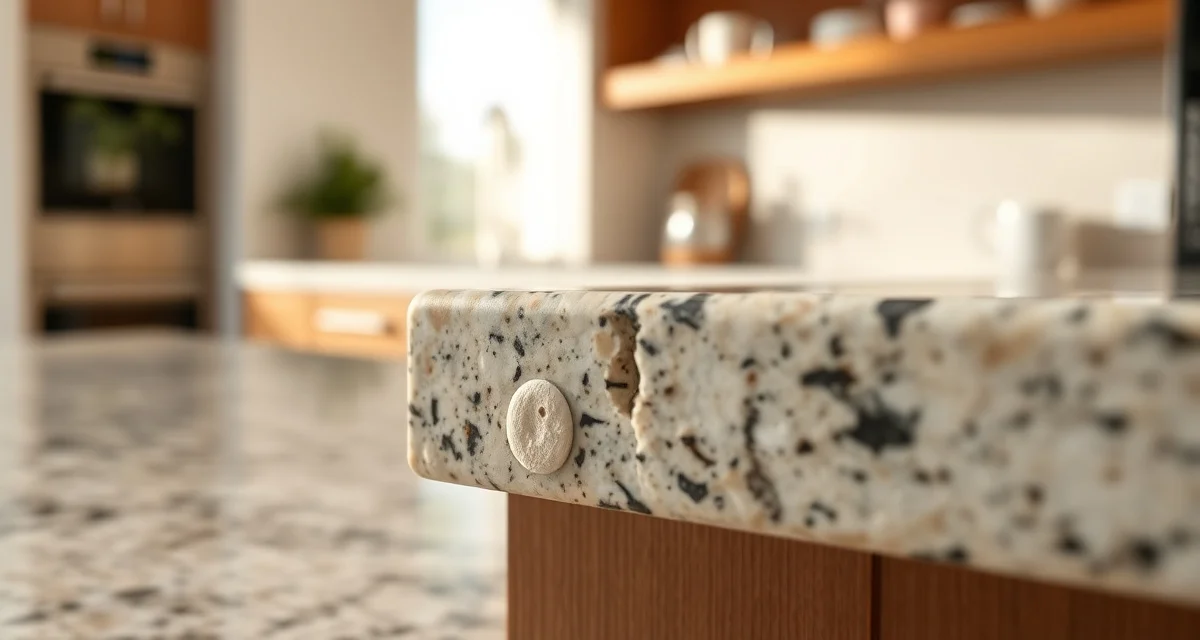
What Causes Countertop Chips?
Countertop chips are most commonly caused by impact from dropped objects, particularly at edges and corners where the stone is thinnest and most vulnerable. Heavy items like cast iron pans, ceramic dishes, and glass bottles are the top culprits. Other common causes include improper installation (insufficient support), fabrication stress points near cutouts, and bumping the counter edge with hard objects. Most chips are small (1/4" or less) and repairable, but large chips near structural areas may indicate a more serious issue.
TL;DR
- Dropped heavy objects (pans, dishes, bottles) cause 60-70% of countertop chips
- Edges and corners are the most vulnerable areas due to minimal stone mass
- Granite, marble, and quartzite chip more easily than quartz (engineered stone)
- Small chips (under 1/4") can be repaired with color-matched epoxy for $10-$50 DIY
- Professional chip repair costs $150-$300 per repair visit
- Fabrication-related chips (around cutouts or seams) may be covered by warranty
- Rounded edge profiles (bullnose, half-bullnose) chip less than sharp-edged profiles (flat polish, mitered)
Most Common Causes of Countertop Chips
Impact Damage (Most Common)
The number one cause of countertop chips is dropping or banging hard objects against the stone surface or edge. The most frequent scenarios:
Calculate your material waste savings
See exactly how much slab material and money you could save with optimized cutting layouts.
Try the free Waste Calculator| Object | Where Chips Happen | Risk Level |
|---|---|---|
| Cast iron pan | Counter edge during cooking | High |
| Ceramic plate or bowl | Edge when loading dishwasher | High |
| Glass bottle or jar | Surface impact | Medium |
| Canned goods | Edge during grocery unpacking | Medium |
| Heavy mixer or appliance | Edge during moving | Medium |
| Kitchen tools (metal) | Edge during stirring/prepping | Low |
Edges and corners take the most damage because the stone is thinnest there. A 3cm countertop provides 1.18" of material at the surface, but the edge has no backing material behind it, making it the natural fracture point.
Poor Support and Installation
Countertops need continuous support from cabinets beneath. When support is inadequate:
- Overhangs exceeding 12" without brackets create cantilever stress that concentrates at the cabinet edge
- Uneven cabinets cause the countertop to flex when weight is applied, potentially chipping at stress points
- Insufficient adhesive between the countertop and cabinets allows subtle movement that weakens the stone over time
- Gaps between cabinets and countertop mean certain areas bear more weight than others
If chips appear without any obvious impact event, check whether the counter has adequate support underneath.
Fabrication Stress Points
The fabrication process creates natural weak points in the stone:
Sink cutouts: The corners of rectangular undermount sink openings are high-stress areas. If the corner radius is too tight (less than 1/2"), the stone concentrates stress at that point and may chip or crack over time.
Cooktop openings: Large rectangular cutouts for cooktops leave thin strips of stone on the sides that can be vulnerable to chips and cracks if support is insufficient.
Edge profiles: Sharp-angle edge profiles (like a flat polish or mitered edge) chip more easily than rounded profiles. The sharp edge presents a thin line of material to any impact force.
Seam edges: The area where two pieces of stone meet at a seam is bonded with epoxy, not natural stone. These areas can chip differently than solid stone sections.
Natural Stone Characteristics
Some chipping relates to the material itself:
Granite: Contains different minerals with different hardness levels. The boundaries between minerals (like where quartz meets feldspar) can be natural chip points. Granites with large crystals are more prone to chipping than fine-grained varieties.
Marble: Softer than granite (3-5 on the Mohs scale vs. 6-7 for granite). Marble edges chip more easily, and the chips tend to be more visible on polished white surfaces.
Quartzite: Very hard but can be brittle. Quartzite chips tend to be sharper and more angular than granite chips.
Quartz (engineered): The resin binder makes quartz slightly more flexible than natural stone, giving it better chip resistance overall. However, quartz edges can still chip from significant impact.
Chip Risk by Edge Profile
Your edge profile choice significantly affects chip vulnerability:
| Edge Profile | Chip Resistance | Why |
|---|---|---|
| Full bullnose | Excellent | Fully rounded; no sharp edges to catch impacts |
| Half bullnose | Very good | Rounded top; flat bottom absorbs less impact |
| Beveled/chamfered | Good | Angled edge distributes force |
| Ogee | Good | Curved profile, but the concave area can chip |
| Eased (slightly rounded) | Moderate | Minor rounding; still relatively sharp |
| Flat polish (square) | Poor | Sharp 90-degree edge is highly chip-prone |
| Mitered | Poor | Thin stone at the miter joint chips easily |
If chip prevention is a priority, choose a bullnose or half-bullnose profile. The rounded edge has more mass at the impact point and distributes force over a larger area.
How to Prevent Countertop Chips
Protect edges from impact:
- Don't slide heavy items along the counter edge
- Be cautious when loading/unloading the dishwasher near the counter edge
- Keep heavy appliances (mixer, blender) away from edges
Support overhangs properly:
- Any overhang over 10-12" should have brackets or corbels
- Follow manufacturer guidelines for overhang limits (typically 12" for 3cm stone, 6" for 2cm)
Use cutting boards:
- Cutting directly on stone won't chip it, but the knife motion can push food items off the edge, and the knife itself can nick the stone
Install bumpers:
- Small rubber bumpers on cabinet drawers and doors near the countertop prevent repeated impact from daily use
Choose a rounded edge profile:
- If you're still in the selection phase, opt for a bullnose, half-bullnose, or beveled edge
How to Repair Countertop Chips
DIY Repair (Chips Under 1/4")
Small chips can be repaired at home with a countertop repair kit:
Materials needed:
- Color-matched epoxy or superglue ($10-$30 for a kit)
- Fine-grit sandpaper (400-600 grit)
- Rubbing alcohol for cleaning
- Razor blade for smoothing
Process:
- Clean the chipped area with rubbing alcohol
- Apply color-matched epoxy to fill the chip, slightly overfilling
- Let cure for 24 hours
- Carefully scrape excess with a razor blade
- Sand lightly with fine-grit sandpaper
- Polish with a stone-safe polishing compound if needed
Color matching tips: Many manufacturers sell repair kits in their exact colors. For granite, you may need to mix colors to match the stone's variation. Clear epoxy works for small chips where color matching is difficult.
Professional Repair ($150-$300 per visit)
For larger chips or chips in prominent locations, a professional stone repair technician offers better results:
- Uses professional-grade epoxy matched to your specific stone
- Can blend the repair into surrounding stone pattern
- Polishes the repair to match the existing finish level
- Repair is typically invisible from normal viewing distance (3+ feet)
Professional repairs for chips are usually completed in 1-2 hours, including cure time.
When Repair Isn't Enough
Replace the affected section if:
- The chip is larger than 1" in diameter
- Multiple chips appear along a crack line (indicating structural failure)
- The chip is at a cutout corner and growing
- The damage is near a seam and the seam is separating
Warranty and Chip Claims
Manufacturer warranties (Caesarstone, Cambria, Silestone, etc.) typically do not cover impact chips. These are classified as "misuse" or "accidental damage."
Fabricator warranties may cover chips caused by fabrication defects, specifically:
- Chips that appear near cutout corners (insufficient corner radius)
- Chips at seams due to poor seam work
- Chips from inadequate support or shimming
Homeowner's insurance may cover chip damage under your home policy's personal property coverage, but you'll need to meet your deductible (typically $500-$1,000), which usually exceeds the repair cost.
FAQ
Are countertop chips common? Small chips happen to most countertops over their 15-25 year lifespan. A well-maintained counter in a busy kitchen might accumulate 2-4 minor chips over 10 years. Proper edge selection and careful use minimize this.
Does granite chip more than quartz? Natural granite chips slightly more than engineered quartz because quartz's resin binder adds flexibility. However, both materials can chip from significant impact. The difference is minor in practice.
Can a chipped countertop crack further? A small chip usually doesn't propagate into a crack. However, chips near cutout corners or along fissures can grow over time if the underlying cause (stress, poor support) isn't addressed.
Should I repair or ignore a small chip? Repair it. Even a small chip creates a rough area that collects dirt and bacteria. On granite, an unrepaired chip also exposes unsealed stone to potential staining. Repairs take 30 minutes and cost under $30 DIY.
Can my fabricator fix a chip? Many fabricators offer repair services or can recommend a stone restoration specialist. This is usually better than DIY for prominent areas. Typical cost: $150-$300 per visit.
Do dark countertops show chips less? Dark countertops can show chips more visibly because the chip exposes lighter material underneath (especially with granite). Light-colored countertops sometimes hide small chips better, though this varies by material.
Will a chip void my warranty? Impact chips are not covered by manufacturer warranties. However, the chip itself won't void coverage for other warranty claims (like material defects or manufacturing inconsistencies).
How do I prevent chips near the dishwasher? The counter edge adjacent to the dishwasher takes frequent abuse from plates and bowls being loaded. Install a rubber edge guard ($10-$20) or develop the habit of loading from the center of the counter rather than scraping items over the edge.
Can chips happen during installation? Yes. Installation chips are the fabricator's responsibility and should be repaired before the job is signed off. Always inspect edges and corners during the installation walkthrough.
Does 3cm stone chip less than 2cm? At the surface, chip resistance is similar since the impact occurs at the edge regardless of thickness. However, 3cm stone has more mass at the edge, which means chips tend to be smaller and the edge is structurally stronger overall.
Get a Countertop Quote
Planning new countertops? Use our free cost calculator to compare materials and edge profiles. Choosing the right combination of material and edge profile can significantly reduce long-term chip risk.
[Try the SlabWise Cost Calculator →]
Try These Free Tools
- Cost Calculator -- Get instant countertop cost estimates by material and square footage.
- Kitchen Visualizer -- Upload a kitchen photo and preview different materials in place.
- Template Compare -- Upload two templates and see every dimension change highlighted.
Sources & Further Reading
-
Natural Stone Institute - Countertop Installation Best Practices Guide
-
National Kitchen & Bath Association - Kitchen Renovation Sequencing Guidelines
-
International Surface Fabricators Association - Professional Installation Standards
-
Remodeling Magazine - Kitchen Remodel Installation Order Best Practices