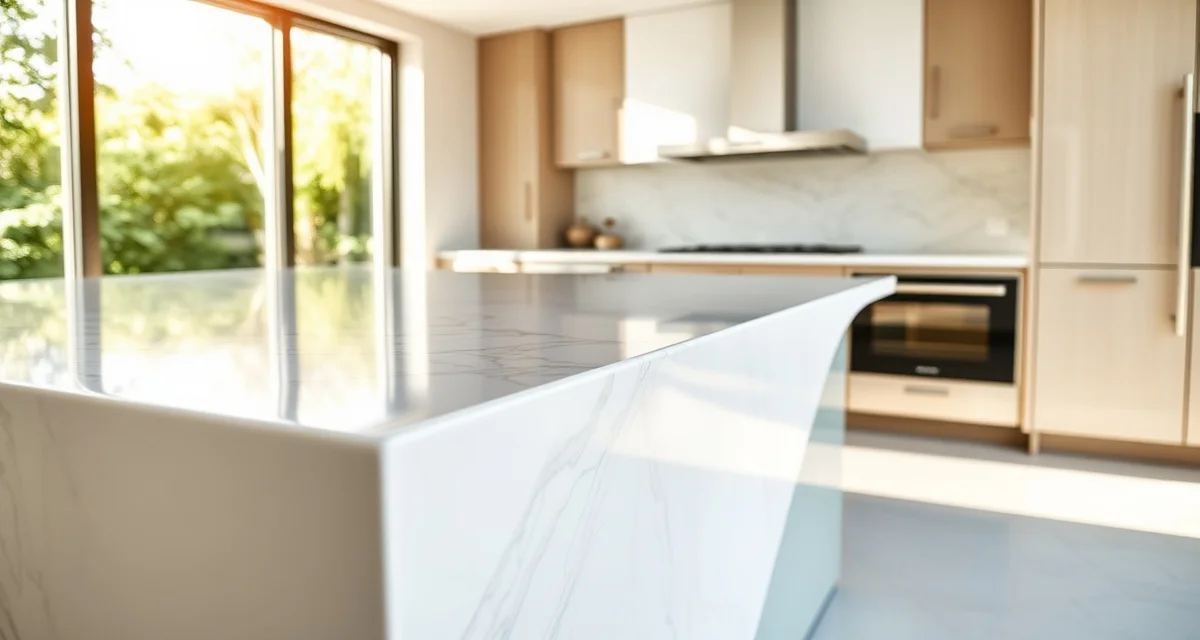
Waterfall Countertops Guide
A waterfall countertop is a design where the countertop material continues vertically down one or both sides of a kitchen island or cabinet, flowing to the floor like a waterfall. For fabricators, waterfall edges are among the most technically demanding - and most profitable - projects in residential countertop work. A single waterfall island typically adds $1,500-$4,000 to a kitchen job. This guide covers miter techniques, vein matching, material selection, structural support, and pricing.
TL;DR
- Waterfall edges use a 45-degree miter joint to wrap material from horizontal to vertical
- Vein-matched (bookmatched) waterfalls command 30-50% premiums over non-matched
- Material waste increases 25-40% due to vein matching requirements and panel sizing
- Miter joints are the #1 failure point - proper technique and adhesive selection are critical
- Most common materials: quartz, marble, quartzite, porcelain (3cm preferred)
- Average waterfall add-on price: $1,500-$4,000 per side
- SlabWise AI Slab Nesting optimizes material use for waterfall projects, reducing waste by 10-15%
Anatomy of a Waterfall Edge
A waterfall countertop consists of three main components:
Calculate your material waste savings
See exactly how much slab material and money you could save with optimized cutting layouts.
Try the free Waste Calculator- Horizontal surface: The standard countertop top
- Miter joint: A 45-degree angled cut where the horizontal meets the vertical
- Waterfall panel: The vertical piece running from the countertop down to the floor (or a specific height)
The miter joint is where the magic happens - and where most problems occur. A perfect miter creates the illusion that the slab simply bends 90 degrees. A bad miter shows a visible line, a color mismatch, or worse, fails structurally.
Single vs. Double Waterfall
- Single waterfall: Material drops on one end of the island. Most common configuration. Adds 8-12 sq ft of material.
- Double waterfall: Material drops on both ends. More dramatic, more expensive, more complex. Adds 16-24 sq ft of material.
- Full waterfall with return: Material drops and then returns under the countertop as a horizontal shelf. Rarely requested but very high-end.
Vein Matching: The Profit Driver
Vein matching (also called bookmatching) is the technique of orienting the horizontal and vertical pieces so the stone's natural veining flows continuously from the top surface down the waterfall panel. When done well, it looks like the stone folds around the corner.
How Vein Matching Works
- Select a slab with strong, directional veining (random speckled patterns don't benefit from matching)
- Cut the horizontal and vertical pieces from adjacent areas of the same slab
- Orient the vertical piece so it mirrors the horizontal - the vein pattern at the miter line should align
Types of Vein Matching
| Method | Description | Difficulty | Price Premium |
|---|---|---|---|
| Continuous flow | Veins flow from top to side as if the stone bends | High | 30-50% |
| Bookmatch | Vertical piece is flipped to mirror the horizontal | Very high | 40-60% |
| Same slab, no match | Both pieces from the same slab but not aligned | Low | 10-15% |
| Different slab | Horizontal and vertical from different slabs | None | Standard price |
Continuous flow vein matching is the most requested and the most profitable. It requires careful slab selection and precise cutting - you may need to buy a larger slab than the project technically requires, specifically to get the right vein alignment.
Material Waste Impact
Vein-matched waterfall projects generate 25-40% more waste than standard countertop work. Why:
- You can't freely rotate pieces to minimize waste - orientation is fixed by vein direction
- The miter cut itself wastes a strip of material along the 45-degree angle
- Matching requirements may leave large unused sections of the slab
- Mistakes at the miter are expensive - you're cutting into the most carefully selected part of the slab
SlabWise AI Slab Nesting factors in vein direction and matching requirements when optimizing layouts, reducing the waste premium from 25-40% down to 15-25%.
Miter Joint Fabrication
The miter joint makes or breaks a waterfall countertop. Here's the step-by-step process.
Cutting the Miter
Equipment needed:
- CNC bridge saw with tilting head (preferred) or a manual bridge saw with 45-degree capability
- Diamond blade appropriate for the material (quartz, natural stone, or porcelain-rated)
- Straight edge or CNC programming for consistent angle
The cut:
- Set the blade to exactly 45 degrees. Check with a precision square - even 0.5 degrees off creates a visible gap.
- Cut the horizontal piece first. The miter is cut on the end that will receive the waterfall panel.
- Cut the vertical piece. The miter is cut on the top edge.
- Dry-fit the two pieces. Check alignment, vein matching, and gap width.
Tolerance: The gap between the two miter faces should be less than 1/32" (0.8mm) along the entire length. Any more and the seam will be visible, even with color-matched adhesive.
Preparing the Joint
- Clean both miter surfaces with denatured alcohol - any dust or residue weakens the bond
- Apply masking tape 1/4" from the miter edge on both the top surface and the vertical face to prevent adhesive overflow
- If using mechanical reinforcement (recommended), install steel biscuits, dowels, or a Lamello system into pre-routed slots along the miter
Gluing the Miter
The adhesive and technique depend on the material:
| Material | Recommended Adhesive | Cure Time | Notes |
|---|---|---|---|
| Quartz | Polyester or epoxy (color-matched) | 30-45 min | Use manufacturer-recommended adhesive |
| Granite | Polyester with hardener | 20-30 min | Knife-grade for vertical hold |
| Marble | Epoxy (slower cure preferred) | 45-60 min | Allows more alignment time |
| Quartzite | Epoxy | 45-60 min | Strongest bond for heavy material |
| Porcelain | Flexible epoxy | 30-45 min | Must accommodate thin-slab flex |
Application process:
- Apply adhesive to both miter faces in a thin, even layer
- Bring pieces together while checking vein alignment
- Apply clamping pressure using miter clamps or ratchet straps
- Support the vertical piece with a brace to prevent it from shifting under its own weight
- Clean excess adhesive before it cures (razor blade + acetone for polyester, scraper for epoxy)
Mechanical Reinforcement
For islands over 6 feet long, mechanical reinforcement of the miter joint is strongly recommended. Options:
- Steel L-brackets (concealed behind the island framing): Simplest, most common
- Stainless steel rods (epoxied into drilled channels): Strongest, best for heavy materials
- Lamello biscuit system: Fastest to install, good for quartz and lighter materials
- Granite grabber clips: Quick installation, moderate strength
A miter joint in 3cm quartzite without mechanical reinforcement will eventually fail under its own weight plus daily use stress. Don't skip reinforcement on heavy materials.
Material Selection for Waterfall Projects
Not all materials are equally suited for waterfall countertops.
Best Choices
Quartz: Consistent patterns make vein matching predictable. Lighter weight than natural stone. Seams blend well with color-matched adhesive. 70%+ of waterfall countertops are quartz.
Marble (Calacatta, Statuario): The dramatic veining is the entire reason customers want waterfall edges. Beautiful results but higher risk - marble is softer and more prone to chipping at the miter.
Quartzite: Natural veining similar to marble but much harder and more durable. Heavier, which increases miter joint stress.
Acceptable Choices
Porcelain slabs: Lightweight, consistent, UV stable. However, porcelain is brittle at 45-degree cuts and requires specialized diamond blades. Edge chipping risk is higher.
Granite: Works well for solid or subtle-pattern granites. Bold vein matching is rare in granite because most patterns are granular rather than linear.
Challenging Choices
Dekton/sintered stone: Very hard, which makes clean miter cuts difficult. Tends to chip along the thin edge of the miter. Requires specialized tooling and slow feed rates.
Ultra-compact (12mm) slabs: Thin material makes the miter edge extremely fragile. Some fabricators laminate two thin pieces to create a thicker miter profile.
Structural Support and Installation
Waterfall panels need proper structural support - they're heavy vertical surfaces held in place primarily by the miter joint and concealed brackets.
Support Framework
The island cabinet or frame must include:
- Plywood or steel backing on the waterfall side for bracket attachment
- Leg levelers to ensure the island is perfectly plumb and level
- Cross-bracing to prevent racking that would stress the miter joint
- A recessed pocket at the floor line if the waterfall panel runs to the floor (allows scribe fitting to uneven floors)
Installation Steps
- Install the horizontal countertop first, shimming level
- Test-fit the vertical panel against the miter
- Apply adhesive to the miter joint
- Lift the vertical panel into position (2-person minimum, 3 for pieces over 4 feet)
- Clamp and brace the panel in position
- Install concealed L-brackets or angle brackets from behind
- Allow adhesive to fully cure before removing braces (minimum 2 hours for polyester, 8 hours for epoxy)
- Apply silicone caulk at the floor joint (not adhesive - the floor joint needs to flex)
Weight Considerations
| Material | 3cm Weight/sq ft | Typical Waterfall Panel (3' x 3') | Support Requirement |
|---|---|---|---|
| Quartz | 13-15 lbs | 120-135 lbs | Standard brackets |
| Granite | 18-20 lbs | 160-180 lbs | Heavy-duty brackets |
| Quartzite | 18-22 lbs | 160-200 lbs | Heavy-duty brackets + rods |
| Marble | 16-18 lbs | 145-160 lbs | Standard-heavy brackets |
| Porcelain (12mm) | 6-8 lbs | 55-70 lbs | Standard brackets |
Pricing Waterfall Countertops
Waterfall edges are a premium add-on. Price them accordingly.
Per-Side Pricing
| Configuration | Standard (No Vein Match) | Continuous Vein Match | Bookmatch |
|---|---|---|---|
| Single waterfall, one side | $1,200-$1,800 | $1,800-$2,800 | $2,500-$4,000 |
| Double waterfall, both sides | $2,200-$3,200 | $3,500-$5,500 | $5,000-$8,000 |
What's Included in the Price
- Additional material for the vertical panel(s)
- Miter cutting (precision 45-degree cuts)
- Vein matching (slab selection and orientation)
- Additional fabrication time (3-5 hours per side)
- Mechanical reinforcement hardware
- Installation labor (additional 1-2 hours per side)
Margin Target
Waterfall edges should hit 50-60% gross margin. The work is skilled, the materials are expensive, and the customer is paying for a specific visual result. Shops that discount waterfall work to win bids are undervaluing their craftsmanship.
Common Waterfall Mistakes and How to Avoid Them
Visible Miter Line
Cause: Blade not at exact 45 degrees, surfaces not flat, improper adhesive color match Fix: Use a CNC saw for consistent angles. Verify with a precision square. Always do a dry fit before gluing.
Vein Mismatch at the Joint
Cause: Pieces cut from different areas of the slab, incorrect orientation during gluing Fix: Mark vein lines on both pieces before cutting. Photograph the planned layout. Verify orientation before applying adhesive.
Miter Joint Failure (Separation)
Cause: Insufficient mechanical reinforcement, adhesive not rated for the material weight, inadequate cure time Fix: Always use mechanical reinforcement on natural stone. Don't rush cure time. Use the right adhesive for the material.
Chipping at the Miter Edge
Cause: Worn blade, feed rate too fast, material not supported during the cut Fix: Use a sharp blade rated for the material. Reduce feed rate by 30% for miter cuts. Support both sides of the cut to prevent breakout.
SlabWise AI Template Verification checks miter joint dimensions, support requirements, and cutout clearances before fabrication starts - catching issues that lead to $2,000-$4,000 remakes.
How much does a waterfall countertop cost?
A single waterfall edge adds $1,200-$4,000 to a kitchen island, depending on material and whether vein matching is requested. Double waterfall islands run $2,200-$8,000.
What material is best for waterfall countertops?
Quartz is the most popular and forgiving material for waterfall edges. Marble (Calacatta, Statuario) produces the most dramatic vein-matched results but is more fragile and expensive.
Can granite be used for waterfall edges?
Yes, though granite's granular patterns don't produce the dramatic vein-matching effect that makes waterfall edges popular. Solid-colored granites (Absolute Black, Bianco Romano) work well for a clean, modern look.
How are waterfall countertop seams hidden?
The miter joint is a 45-degree cut that creates a nearly invisible seam when the two pieces are properly aligned and glued with color-matched adhesive. Vein-matched pieces draw the eye along the pattern rather than the seam line.
Do waterfall countertops need extra support?
Yes. The vertical panel needs concealed L-brackets or angle brackets attached to the island framing. For heavy materials (granite, quartzite), steel rod reinforcement within the miter joint itself is recommended.
Are waterfall countertops a trend or here to stay?
Waterfall edges have been popular since 2015 and show no signs of fading. They're now a standard feature in mid-to-high-end kitchen design, not a passing trend.
How long does waterfall countertop fabrication take?
Expect 3-5 additional hours of fabrication time per waterfall side, plus standard countertop fabrication time. Total project time for a waterfall island is typically 2-3 days from template to installation.
Can porcelain slabs be used for waterfall edges?
Yes, but with care. Porcelain is brittle at 45-degree cuts and prone to edge chipping. Use specialized blades, slow feed rates, and support both sides of the cut. The result is lightweight and UV stable.
What if the miter joint doesn't align perfectly?
Small misalignments (under 1mm) can be corrected with careful sanding and adhesive fill. Larger misalignments require recutting. This is why dry-fitting before gluing is mandatory.
Should waterfall panels go all the way to the floor?
Most do, but some designs stop the waterfall 4-6 inches above the floor with a recessed toe kick. Full-to-floor panels need a scribing allowance at the bottom for uneven floors.
Cut Waterfall Waste and Prevent Remakes
Waterfall projects are your highest-margin countertop work - but also your highest-risk. SlabWise AI Slab Nesting reduces material waste by 10-15% on vein-matched projects, and AI Template Verification catches miter and dimension errors before you cut into expensive slabs.
Start your 14-day free trial →
Plans start at $199/month. No credit card required for the trial.
Try These Free Tools
- Nesting Optimizer -- AI-powered slab layout that maximizes yield considering vein direction and defects.
- Defect Mapping -- Upload a slab photo and AI maps every fissure, pit, and color issue.
- Value Engineering -- Find dollar-quantified suggestions to save material without cutting margin.
Sources & Further Reading
-
International Surface Fabricators Association - Digital Fabrication and CAD/CAM Best Practices
-
Natural Stone Institute - Stone Fabrication Technology and Optimization
-
Marble Institute of America - Template and Layout Efficiency Guidelines
-
National Kitchen & Bath Association - Countertop Installation and Fabrication Standards