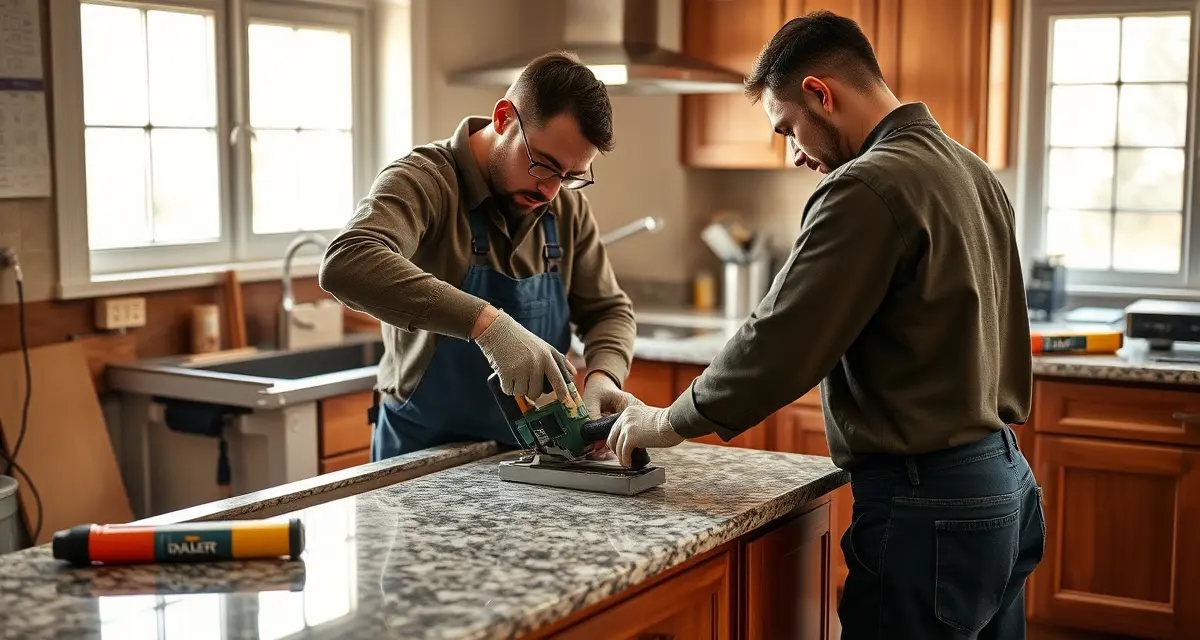
How to Remove Old Countertops
Quick Definition
This how to remove old countertops walks you through the process step by step.
Countertop removal is the process of detaching and disposing of existing kitchen or bathroom countertops before new surfaces are installed. The job typically takes 2-6 hours depending on material type, attachment method, and whether you're preserving the cabinets underneath. Proper removal prevents cabinet damage and keeps installation costs down.
TL;DR
- Most countertop removals take 2-6 hours with basic tools - no specialized equipment needed for laminate or tile
- Granite and quartz slabs weigh 15-25 lbs per square foot, requiring 2-3 people minimum for safe lifting
- Disconnect plumbing and appliances first to avoid water damage and electrical hazards
- Budget $200-$500 for professional removal or $0-$100 in tool rentals for DIY
- Cabinet damage during removal costs $300-$1,200 to repair, so take your time with pry bars
- Disposal fees range from $50-$200 depending on material and local dump rates
- Fabricators prefer clean, level cabinets - poor removal work can add $200+ to your new installation quote
Why Proper Removal Matters More Than You Think
Most homeowners fixate on picking their new countertop material. That's the fun part. But the removal of your existing countertop sets the stage for everything that follows. A rushed tear-out can crack cabinets, damage walls, and create an uneven surface that makes your new fabrication job harder and more expensive.
Calculate your material waste savings
See exactly how much slab material and money you could save with optimized cutting layouts.
Try the free Waste CalculatorFabrication shops see this constantly. A customer orders a beautiful quartz slab, the template goes perfectly, and then the installer shows up to find cabinets that were gouged during a weekend warrior removal. Now the shop has to shim, adjust, and sometimes re-template - all because the old countertop came out rough.
Tools and Materials You'll Need
Essential Tools
| Tool | Purpose | Approximate Cost |
|---|---|---|
| Pry bar (flat) | Separating countertop from cabinets | $10-$20 |
| Utility knife | Cutting caulk and adhesive | $5-$10 |
| Adjustable wrench | Disconnecting plumbing | $12-$25 |
| Bucket and towels | Catching residual water | On hand |
| Safety glasses | Eye protection from debris | $5-$15 |
| Work gloves | Hand protection | $10-$20 |
| Drill/driver | Removing screws from underneath | $30-$80 |
Material-Specific Extras
- Granite/quartz removal: Suction cups ($25-$60), moving blankets, dolly
- Tile countertops: Hammer, cold chisel, reciprocating saw
- Laminate countertops: Putty knife, heat gun (optional for stubborn adhesive)
- Solid surface (Corian): Similar to stone - watch for adhesive bonds to subtop
Step-by-Step Removal Process
Step 1: Disconnect Everything
Before touching the countertop itself, handle the utilities:
- Turn off water supply valves under the sink (both hot and cold)
- Disconnect supply lines from the faucet using your adjustable wrench
- Place a bucket under the P-trap and remove it
- Unplug the garbage disposal if present (or turn off the breaker)
- Disconnect the dishwasher supply line from the hot water valve
- Turn off gas if you have a cooktop integrated into the counter
- Remove the cooktop or range if it sits in a counter cutout
This step takes 30-60 minutes. Don't skip it, and don't rush it. Water damage from a forgotten supply line can cost $2,000+ to remediate.
Step 2: Remove the Sink and Fixtures
For undermount sinks (common with stone countertops):
- Look underneath for mounting clips - usually 8-12 per sink
- Unscrew each clip while someone supports the sink from below
- The sink will drop once all clips are removed
For drop-in sinks:
- Cut the caulk line around the rim with a utility knife
- Lift straight up - these usually weigh 10-20 lbs
For faucets, remove from below using a basin wrench. Set everything aside if you plan to reuse it.
Step 3: Cut the Caulk Lines
Run your utility knife along every seam where the countertop meets:
- The wall or backsplash
- The cabinet frame
- Any adjoining countertop sections
For backsplashes that are part of the countertop (common with laminate), score the paint line where the backsplash meets the wall. This prevents tearing drywall paper when you pull the counter away.
Step 4: Check for Hidden Fasteners
Look under the countertop for:
- Screws driven up through corner brackets into the countertop substrate
- Adhesive spots (silicone or construction adhesive) on the cabinet top rails
- L-brackets or clips connecting sections at seams
- Toggle bolts or clips used for undermount sinks (already removed in Step 2)
Remove every screw you find. For adhesive, you'll break it free with the pry bar in the next step.
Step 5: Lift and Remove
For laminate countertops: Work a flat pry bar between the counter and cabinet at one corner. Apply slow, steady pressure. Move along the length, prying every 12-18 inches. Laminate counters usually weigh 3-5 lbs per square foot, so one person can handle sections up to about 8 feet.
For granite, quartz, or marble:
- Position 2-3 helpers around the slab
- Use suction cups for grip on polished surfaces
- Pry gently to break the silicone bond - stone counters are almost always set with silicone, not screwed down
- Lift straight up, then walk the slab out on edge
- A 30 sq ft granite countertop weighs 450-750 lbs - do not underestimate this
For tile countertops: These are the messiest. The tile is typically set on plywood or cement board:
- If you don't need to save the tile, smash it with a hammer and chisel
- Pry up the substrate (plywood/backer board) from the cabinets
- Expect significant dust - wear a respirator, not just a dust mask
Step 6: Clean Up the Cabinets
After removal, inspect and prep the cabinet tops:
- Remove any remaining silicone with a razor scraper
- Pull out leftover screws or nails
- Check for level - place a 4-foot level across the cabinets in multiple spots
- Note any damage (cracks, splits, water stains) for the fabricator
Removal Costs: DIY vs. Professional
| Approach | Cost Range | Time | Best For |
|---|---|---|---|
| Full DIY | $0-$100 (tools you don't own) | 3-6 hours | Laminate, tile, handy homeowners |
| Hire help for lifting only | $100-$200 | 2-4 hours | Stone counters, physical limitations |
| Professional removal | $200-$500 | 1-3 hours | All materials, time-pressed homeowners |
| Removal included in install | $0-$300 (bundled) | Varies | When your fabricator offers it |
Many fabrication shops include removal in their installation quote, typically adding $150-$300 to the total. Ask your fabricator - it's often the most cost-effective option because they have the equipment and insurance to handle stone safely.
Material-Specific Tips
Granite and Natural Stone
- Never try to slide a granite slab across cabinets - it can snap at the sink cutout
- Support all overhangs during removal; corbels and brackets should be removed last
- Old granite in good condition can be donated or resold - check local salvage yards
Quartz (Engineered Stone)
- Removal process is identical to granite
- Quartz is slightly more flexible than granite but still heavy (15-22 lbs/sq ft)
- Watch for seams that were bonded with color-matched epoxy - these are structural
Laminate
- Easiest material to remove - most common in rental renovations
- The particleboard substrate may crumble if water damaged; have a shop vac ready
- Some laminate tops from the 1970s-80s may contain asbestos in the backing - if you see a gray, fibrous material, stop and get it tested
Solid Surface (Corian, Hi-Macs)
- Usually bonded to a plywood subtop with adhesive
- Requires more prying force than laminate but weighs less than stone
- Can crack if pried unevenly - work from both ends toward the center
Disposal Options
| Method | Cost | Notes |
|---|---|---|
| Municipal dump | $50-$150 per load | Call ahead - some won't accept stone |
| Dumpster rental | $200-$400 (3-day) | Best for full kitchen reno |
| Junk removal service | $150-$300 | They do the lifting |
| Habitat ReStore donation | Free (+ tax deduction) | Must be in good condition |
| Craigslist/Facebook free listing | Free | Granite and marble go fast |
What Fabricators Want to See After Removal
When your fabrication shop arrives to template for new countertops, they're looking at:
- Clean, flat cabinet tops - no old silicone blobs, screws, or shims
- Level surfaces - within 1/8" over 8 feet is ideal
- Stable cabinets - wiggle test each one; loose cabinets need to be secured to the wall
- Clear access - appliances moved, sink and plumbing out of the way
- Exposed walls - old backsplash tile removed if new countertop height will change
Shops that use digital templating (like SlabWise's template verification system) can catch levelness issues during the measurement process, but starting with clean cabinets saves everyone time and reduces the chance of remakes.
Common Mistakes to Avoid
- Forgetting to turn off the water - floods happen more often than you'd think
- Prying too aggressively near corners - this cracks cabinet face frames
- Leaving the dishwasher connected - the drain line pulls and leaks
- Not supporting a stone slab at cutouts - snap risk is highest at the sink opening
- Throwing out old hardware - you may need faucet mounting nuts or clips for the new install
- Skipping the level check - uneven cabinets mean uneven new countertops
FAQ
How long does it take to remove countertops?
Laminate removal takes 1-3 hours for most kitchens. Granite and quartz removal takes 2-4 hours because of the weight and the need for careful lifting. Tile countertops take the longest at 3-6 hours due to demolition and cleanup.
Can I remove granite countertops myself?
You can, but you'll need at least 2 helpers. A typical kitchen granite countertop weighs 400-800 lbs total. The pieces are fragile at cutout points and can snap if lifted unevenly. Rent suction cups and have moving blankets ready.
Will removing countertops damage my cabinets?
It's possible, especially if the countertop was heavily glued down. Using a flat pry bar and working slowly minimizes damage. Budget $100-$300 for minor cabinet repairs (touch-up paint, replacing a cracked rail) just in case.
Do I need to remove the backsplash too?
If the backsplash is a separate tile installation on the wall, you can leave it unless you're replacing it. If the backsplash is attached to the countertop (common with laminate), it comes out as one piece.
How much does professional countertop removal cost?
Expect $200-$500 for most kitchens. Stone removal is on the higher end due to weight and liability. Many fabricators bundle removal with installation for $150-$300 extra.
Can I reuse my old countertops?
Laminate countertops rarely survive removal intact. Granite, marble, and quartz can often be reused, donated, or sold. Solid surface countertops can sometimes be resurfaced and reused.
What's under my countertop?
Laminate countertops sit on particleboard with plywood buildup strips. Stone countertops sit directly on plywood subtops or directly on the cabinet frames. Tile countertops have a substrate layer (plywood, cement board, or both).
Do I need a permit to remove countertops?
In most jurisdictions, no. Countertop removal is considered a cosmetic renovation. However, if you're moving plumbing or electrical during the process, you may need a permit. Check with your local building department.
How do I dispose of old granite countertops?
List them for free on Facebook Marketplace or Craigslist - stone countertops in decent shape get claimed quickly. Alternatively, contact a local stone salvage yard or donate to Habitat for Humanity ReStore.
Should I remove countertops before or after new ones are ordered?
Order first, remove later. Your fabricator needs to template before removal in some cases, or they'll template on the cabinets after removal. Ask your fab shop for their preferred sequence.
Can old laminate countertops contain asbestos?
Countertops manufactured before the mid-1980s may contain asbestos in the backing material or adhesive. If your home was built before 1985, consider getting a sample tested before demolition. Testing costs $25-$50 per sample.
What if my cabinets are damaged after removal?
Minor scratches and screw holes can be patched with wood filler and paint. Cracked face frames may need to be replaced ($50-$150 per section). If cabinets are water-damaged or structurally compromised, replacement is usually more cost-effective than repair.
Get Accurate Measurements for Your New Countertops
Removing your old countertops is just the first step. Getting precise measurements for your new surfaces is what determines whether the job goes smoothly or ends in a costly remake. SlabWise's template verification system uses a 3-layer check to catch measurement errors before they reach the CNC - saving fabricators an average of $1,500-$4,000 per avoided remake.
Try SlabWise free for 14 days and see how digital verification fits into your fabrication workflow.
Try These Free Tools
- Photo to Template -- Snap a photo of an existing countertop and get an AI-generated DXF template.
- Template Compare -- Upload two templates and see every dimension change highlighted instantly.
- AI Template Verification -- Cross-check your template against manufacturer specs before cutting.
Sources & Further Reading
-
Natural Stone Institute - ADA Compliance Guidelines for Natural Stone Installations
-
National Kitchen & Bath Association - Universal Design and ADA Standards for Kitchen Countertops
-
ASTM International - Standard Practice for Accessible Counter and Work Surface Design